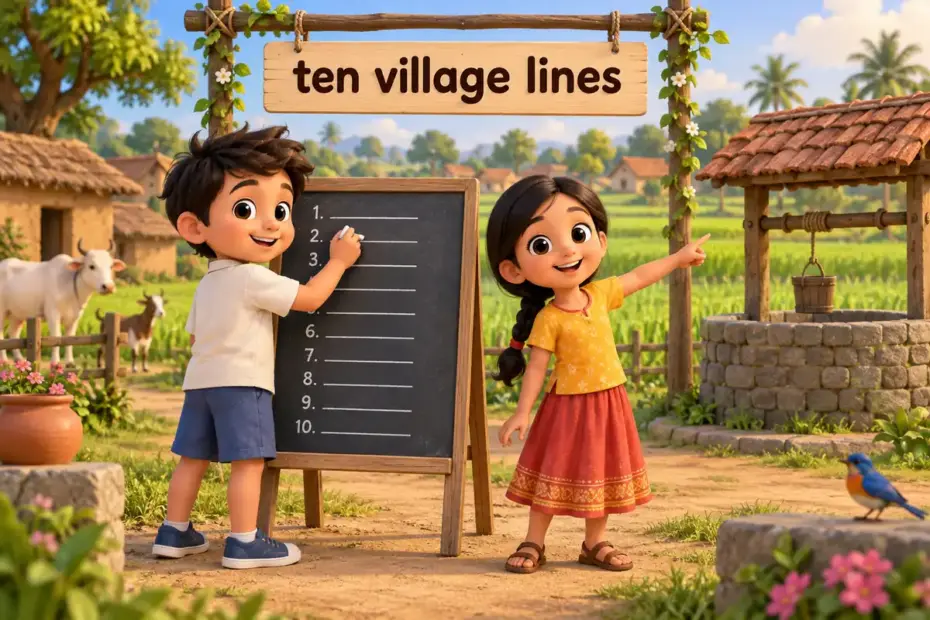
10 lines about a visit to a village are ten short sentences that describe one trip from the first field to the final farewell. Each line names a sight, a sound or a person you meet. A simple opening is “The village wakes slowly as roosters call across the fields.”
10 lines about a visit to a village at a glance
- Ten lines about a village visit are ten short sentences about one trip.
- Each line usually names one detail you can see, hear or do.
- The lines follow the day, from arrival to the ride home.
- Past tense suits a recount; present tense makes the village feel near.
- Most lines open with a subject, not with and, so or because.
What are 10 lines about a visit to a village?
Ten lines about a visit to a village are brief statements that together build one clear picture of a country trip. They are not a full story; they are a tidy set of sentences that a reader can picture in order. Common lines describe a field, a well, a temple, a meal or a friendly neighbour, and each line stands on its own.
| Kind of line | Example | What it does |
|---|---|---|
| Sight | Green fields stretch past the last house of the village. | Sets the country scene. |
| Sound | A cow bells softly near the village pond. | Adds a calm country sound. |
| Smell | The air carries the warm smell of wood smoke. | Makes the scene feel real. |
| Person | A farmer waves to us from the edge of his field. | Puts a friendly face in the scene. |
| Action | We draw water from the old stone well. | Shows the writer doing something. |
| Feeling | The quiet street makes the whole day feel slow. | Shares the mood of the trip. |
How do you write 10 lines about a visit to a village?
Walk through the visit in your mind, from the road at the edge of the village to the last turn home. Write one sentence for each step and keep every line to a single idea. Fixed sentence patterns keep the lines clear and easy to check.
| Pattern | Example | What it signals |
|---|---|---|
| Subject + verb | The village sleeps under a wide sky. | A plain factual line. |
| Subject + verb + object | Grandmother shows us the old granary. | A line about an action. |
| There is or there are | There is a banyan tree at the centre. | A line that introduces something. |
| As or when clause | As we walk, a dog follows us quietly. | A line that links two moments. |
| Feeling verb | The narrow lanes feel cool and shady. | A line about the mood. |

10 lines about a visit to a village: examples across contexts
One visit can be described for a school task, a diary or a travel note, and the setting changes the words a writer chooses. Each example below shows a single line in a different kind of writing.
| Context | Example line | Why this works |
|---|---|---|
| School task | I visit my grandfather’s village every summer. | A clear opening line in the present. |
| Diary entry | We reached the village before the morning mist lifted. | Past tense suits a memory. |
| Travel note | The lanes are so narrow that two carts can barely pass. | Names one striking detail. |
| Descriptive writing | Mustard flowers turn the far field into a yellow sea. | Colour words paint the view. |
| Conversation | An old woman offers us cold buttermilk in a clay cup. | Adds a warm human detail. |
| Narration | A boy drives two goats along the dusty path. | Shows an action in progress. |
| Persuasive writing | Village life teaches patience that a city rarely does. | Draws one small lesson. |
| Science note | The pond stores rainwater for the dry months. | Adds a plain fact. |
| Letter home | I wish you could hear the birds at dawn here. | Addresses a reader directly. |
| Closing line | We leave with a basket of guavas and a hundred memories. | Ends the trip neatly. |
These lines reuse the shapes shown in village sentence examples, and an open green reads well in a village green sentence. A trip framed as a journey matches visit in a sentence, while the describing words come from adjectives for lines.
Which tense should you use for a village visit?
The tense tells the reader whether the trip is happening now or has already ended. Present tense makes the village feel close and alive; past tense turns the visit into a finished memory. Keep one tense across all ten lines unless you have a clear reason to change.
| Point | Present tense | Past tense |
|---|---|---|
| Feeling | near and unfolding | settled and finished |
| Example | The farmer waters his field. | The farmer watered his field. |
| Best for | a task set in the now | a diary or a recount |
| Signal words | today, now, each morning | last week, then, years ago |
| Common slip | mixing is and was in one list | starting in past then slipping to present |
Words that build a village-visit line
A small set of everyday words does most of the work, and pairing a noun with one strong adjective keeps a line tight.
| Word | Job | Example in a line |
|---|---|---|
| lane | noun | A narrow lane winds between the houses. |
| field | noun | The field turns gold near harvest. |
| well | noun | The old well still gives cool water. |
| dusty | adjective | The dusty path leads to the temple. |
| quiet | adjective | The quiet evening carries only crickets. |
| wander | verb | We wander past the sleeping huts. |
Common mistakes with village-visit lines
Most weak lines share one of a few faults, and each fault has a quick fix.
- Incorrect:
And then we saw and then we walked.Correct: We pass the pond and stop at the temple. Rule: one clear action per line, not a chain of ands. - Incorrect:
Village very peaceful.Correct: The village is very peaceful. Rule: every line needs a subject and a verb. - Incorrect:
We are going last year.Correct: We went last year. Rule: keep the tense consistent. - Incorrect:
It was nice and good and lovely.Correct: The green fields made the day lovely. Rule: name the detail that creates the feeling. - Incorrect:
The farmers works in the field.Correct: The farmers work in the field. Rule: the verb must agree with its subject.
Practice writing 10 lines about a visit to a village
Try each task, then read the reason beside the answer to check your thinking.
- Fill in the blank: The old ________ still gives cool water.
- Fill in the blank: We ________ home with a basket of guavas.
- Choose the better sense verb: the temple (sounds / smells) of incense, or the temple (sounds / smells) of a bell?
- Correct the error: Village very peaceful.
- Build a line: write one sight line about a field near the village.
- Spot the tense: which line fits a diary, “The farmer waters his field” or “The farmer watered his field”?
- Build a line: write one closing line about leaving the village.
Answers
- well, because a well is the place that gives water.
- return, because a plural subject takes the base verb in the present.
- The temple smells of incense uses smell, and the temple sounds of a bell uses sound, matching each sense to its verb.
- The village is very peaceful: the line needs a subject and a verb.
- Sample: Ripe paddy bends low across the whole field.
- The farmer watered his field, because a diary records a finished trip in the past tense.
- Sample: We wave goodbye as the village shrinks in the distance.

The bottom line
Use 10 lines about a visit to a village as ten short sentences that carry one country trip in time order. Give each line a single detail, keep the tense steady, and let fields, wells and quiet lanes do the work. Read the list aloud at the end; a line that wobbles usually needs a clearer subject or verb.
Frequently asked questions about a visit to a village
Is ten lines enough for a village description?
Ten lines is a common length for a short school task because each line can carry one clear idea. If the teacher asks for more, add a second sentence to a few of the lines rather than writing ten new ones. The habit of one detail per line keeps even a longer piece tidy.
What details suit a village best?
Choose details that differ from a city, such as open fields, a village well, mud houses, farm animals and narrow lanes. Sounds work well too, such as a rooster at dawn or a cow bell at dusk. Two or three senses in the list are usually enough.
Can I compare the village with a city?
Yes, a single comparing line can sharpen the whole list. Write something like the village street is silent where the city never sleeps. Keep the comparison to one or two lines so the main subject stays the village itself, and use it near the end.
Should each line be a complete sentence?
Yes. A complete sentence carries a subject and a verb, so it reads clearly on its own. Very short fragments such as quiet fields or old houses can look like headings rather than lines. Turn each fragment into a sentence and the list reads far better.