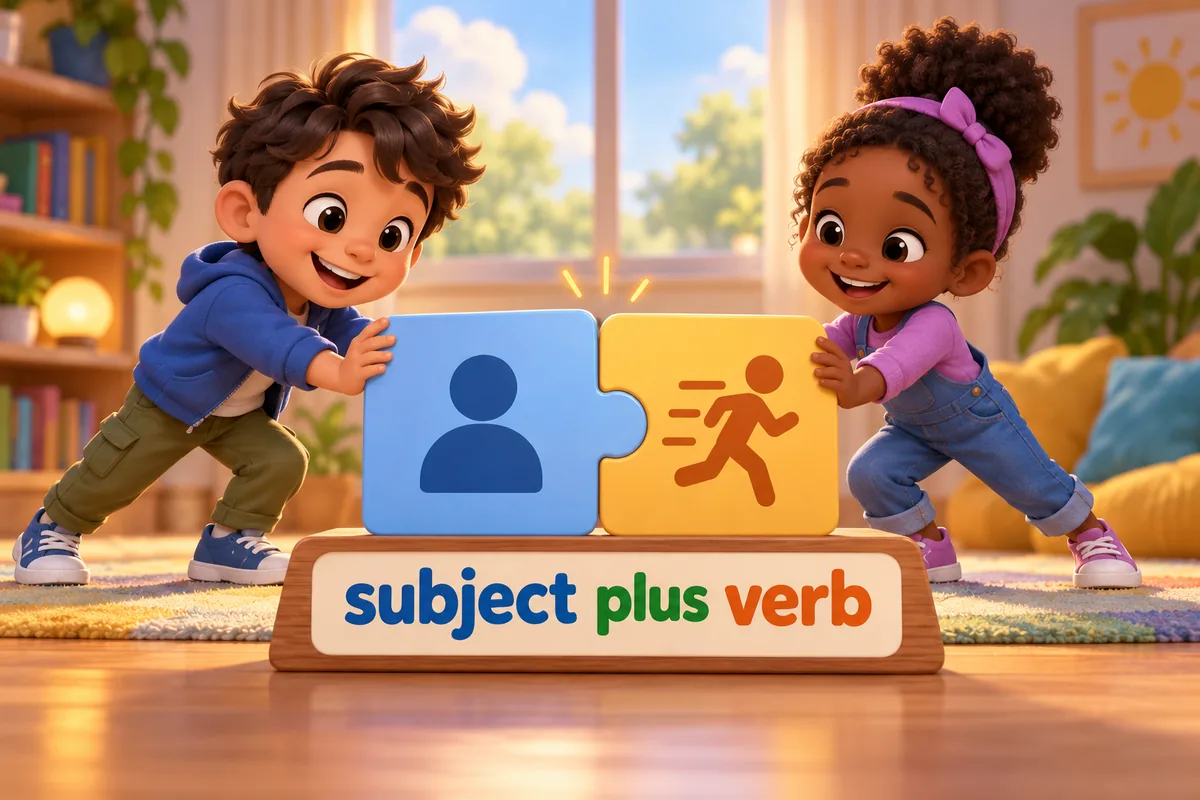
100 simple sentences each contain one independent clause, which means one subject and one verb doing a single job. This list shows the pattern in everyday, classroom, and work settings, and every example stays short enough to copy by hand. Recognising the pattern helps learners write cleanly before they try harder forms.
100 Simple Sentences at a Glance
- A simple sentence has exactly one independent clause.
- One subject and one finite verb make it complete.
- It may hold an object or a phrase, but no second clause.
- Simple sentences are the base of compound and complex forms.
- The commonest error is joining two clauses with only a comma.
What Are Simple Sentences?
A simple sentence is a sentence built from one independent clause, which means one subject and one finite verb that together express a single complete idea. It can be very short, as in Birds sing, or it can carry extra phrases, as in The small birds sing loudly in the garden every morning. What keeps it simple is the number of clauses, not the number of words, so a long line with one clause is still a simple sentence.
| Pattern | Example | Parts |
|---|---|---|
| subject + verb | Dogs bark. | one subject, one verb |
| subject + verb + object | She reads a book. | verb with an object |
| subject + linking verb + adjective | The soup is hot. | a state, not an action |
| subject + verb + two objects | Dad gave me a pen. | two objects after the verb |
| subject + verb + phrase | We meet on Mondays. | a time phrase |
How Do You Build a Simple Sentence?
Start with a subject and add one verb that matches it, then add only the detail the idea needs. Keep to a single clause, and if a second complete idea appears, either stop with a full stop or join it with a comma and a joining word. The patterns below cover how detail grows inside one clause.
| Pattern | Example | What it adds |
|---|---|---|
| subject + verb | Fish swim. | the base line |
| + object | Fish eat plants. | what the action reaches |
| + adjective | The fish is orange. | a described state |
| + adverb | Fish swim quickly. | how the action happens |
| + phrase | Fish swim in the pond. | where it happens |
Simple Sentences: Examples Across Contexts
Each line below is one clause, whatever its length. The note beside it shows what the single clause is doing.
| Context | Sentence | Why it works |
|---|---|---|
| Home | The kettle boiled. | one subject and one verb. |
| School | My teacher explained the sum. | a single complete clause. |
| Work | The team met at nine. | a time phrase inside one clause. |
| Weather | Rain fell all afternoon. | one subject, one verb, one phrase. |
| Travel | The train left the station. | a plain subject-verb-object line. |
| Shopping | She bought fresh bread. | one action on one object. |
| Sports | He scored a goal. | a single past event. |
| Cooking | The sauce tastes sweet. | a linking verb and adjective. |
| Nature | The river flows to the sea. | a place phrase in one clause. |
| I sent the file yesterday. | a time word inside one clause. | |
| Story | The old gate creaked. | one subject with a vivid verb. |
| Study | We reviewed the notes. | a single past action. |
Simple vs Compound vs Complex Sentences
The three sentence types differ by how many clauses they hold, not by length. Selecting the right one lets you control rhythm and how much detail lands in one breath.
| Type | Clauses | Example |
|---|---|---|
| Simple | one independent clause | The bell rang. |
| Compound | two independent clauses joined | The bell rang, and we left. |
| Complex | one independent plus a dependent clause | When the bell rang, we left. |
| Simple (long) | one independent clause with phrases | The old bell rang loudly across the playground. |
| Compound (short) | two short independent clauses | I read, and I wrote. |
A simple sentence gains detail quickly through adding adjectives to simple sentences. The next step after one clause is the pattern of adjective clauses in longer sentences. Even a one-clause line can hold describing words inside one clause without becoming two sentences.
Word Forms and Grammar of Simple Sentences
A simple sentence is complete when its subject and verb agree and no second clause sneaks in. The table pairs each point with a model.
| Grammar point | Rule | Example |
|---|---|---|
| one clause | keep a single subject-verb pair | She sings. |
| subject-verb agreement | match verb number to the subject | She sings; they sing. |
| object order | object follows the verb | She plays the piano. |
| phrase placement | phrases may move without adding a clause | On Mondays we meet. |
| run-on (non-standard) | two clauses need a joining word | She sings, and he plays. |
| fragment (non-standard) | no verb means no sentence | The tall tree |
Common Mistakes With Simple Sentences
She sings, he plays. Write She sings, and he plays. Rule: two independent clauses need a joining word, not a bare comma.
The tall green tree by the gate. Write The tall green tree by the gate fell. Rule: a sentence needs a finite verb.
The dogs runs fast. Write The dogs run fast. Rule: the verb must agree with the subject.
Is very cold today. Write It is very cold today. Rule: the subject must be stated, even when it is a dummy it.
Because I was tired. Write I was tired, so I rested. Rule: a dependent clause cannot stand alone as a simple sentence.
Practice Using Simple Sentences
- Fill in the blank: The birds ______ at dawn. (sing)
- Choose the better word: The dogs (run / runs) in the park.
- Correct the error: Is raining outside.
- Build a sentence: one clause about a book you read.
- Fill in the blank: ______ is cold today. (subject)
- Spot the register: which is one simple sentence, I read the book, and I liked it or I read the book?
Answers
- sing — the plural subject takes the plural verb.
- run — a plural subject takes run.
- It is raining outside. — the subject must be stated.
- Sample: I read a short book. — one subject and one verb.
- It — a dummy subject fills the place before the verb.
- I read the book — it is a single clause, unlike the joined line.
The Bottom Line
100 simple sentences all share one thing: a single independent clause. Length does not matter, because a line with one clause and several phrases is still simple. Learn to find the subject and verb in each sentence, and you can spot fragments and run-ons quickly. Master this base pattern before adding a second clause.
Frequently asked questions about simple sentences
What makes a sentence a simple sentence?
A simple sentence contains exactly one independent clause, which is one subject and one finite verb expressing a complete idea. It may include an object, an adverb, or a phrase, but it must not contain a second clause. That single-clause rule is what separates it from compound and complex sentences.
Can a simple sentence be long?
Yes. Length does not decide the type of sentence; the number of clauses does. The old wooden gate at the end of the lane creaked loudly in the wind is a long simple sentence, because it has one subject and one verb. Adding a second complete idea would turn it into a compound sentence.
What is the difference between a simple sentence and a fragment?
A simple sentence has a subject and a finite verb and expresses a complete idea, while a fragment lacks one of these, as in The tall tree by the gate. A fragment cannot stand alone as a sentence, however much detail it carries. Checking for the verb is the fastest way to tell them apart.
How do I join two simple sentences?
Join two simple sentences with a comma and a joining word such as and, but or so, which makes a compound sentence, or with a semicolon. A comma alone cannot join them; that produces a run-on. Alternatively, keep them separate with a full stop, or turn one into a dependent clause.