Somnolent is an adjective meaning sleepy or drowsy, and it also describes a place or atmosphere that is quiet and inactive. To use somnolent in a sentence, name what has grown drowsy: “The somnolent village dozed through the long August afternoon.” The word is literary, not medical, so it suits a lazy scene more than a patient.
Somnolent at a glance
- Somnolent is an adjective meaning sleepy, drowsy or causing drowsiness.
- It also describes quiet, inactive places, as in a somnolent village.
- Its noun is somnolence, and the adverb somnolently is rare but valid.
- Typical subjects are afternoons, villages, lectures and heavy meals.
- The commonest error is confusing somnolent with soporific, which means sleep-causing.
What does somnolent mean?
Somnolent is an adjective meaning sleepy or inclined to sleep, and by extension it describes anything that makes people feel that way. The Cambridge entry for somnolent records both the drowsy sense and the quiet-place sense, which is why a person and a village can share the adjective. A place that is merely unhurried and soft in mood is languid, a word about pace and grace; somnolent pushes further, towards actual sleep.
| Sense | Plain meaning | Example sentence |
|---|---|---|
| Sleepy | Drowsy and close to sleep | The warm room left the whole class somnolent. |
| Causing drowsiness | Making people feel sleepy | A somnolent hum came from the old fan. |
| Quiet and inactive | Still, unhurried, almost asleep | They spent a week in a somnolent fishing town. |
One limitation is worth stating plainly. Somnolent is not a medical diagnosis and is not the right word for ordinary tiredness after effort. A hiker at the end of a long climb is weary or exhausted, not somnolent, and a patient with a sleep disorder needs a doctor rather than a literary adjective. Use it for atmosphere and for the edge of sleep.
How do you use somnolent in a sentence?
The adjective works both before a noun and after the verb be, and it rarely needs a preposition. Five patterns cover nearly every real sentence, and the register stays literary or gently formal.
| Pattern | Example | What it signals |
|---|---|---|
| a somnolent + noun | A somnolent town square waited for the evening bus. | Describes a place or atmosphere as almost asleep. |
| be or feel + somnolent | The children felt somnolent after the heavy lunch. | Predicative use for a person drifting towards sleep. |
| grow or become + somnolent | The audience grew somnolent as the hours passed. | Shows sleepiness arriving gradually. |
| a somnolent + quality | There was a somnolent rhythm to the train. | Applies the word to a sound or movement. |
| leave + object + somnolent | The heat left everyone somnolent by noon. | Names a cause that produces drowsiness. |
Native writers rarely apply somnolent to themselves in speech, where sleepy or drowsy sounds natural. The adjective earns its keep in description, where it can carry a whole mood in one word, and its near neighbour sleepy is the plain version for everyday use.
Somnolent in a sentence: examples across contexts
Somnolent keeps its meaning and shifts its subject from people to places. The eleven sentences below move from a warm classroom to a travel diary, and each one shows what has grown drowsy and why.
| Context | Example sentence | Why this works |
|---|---|---|
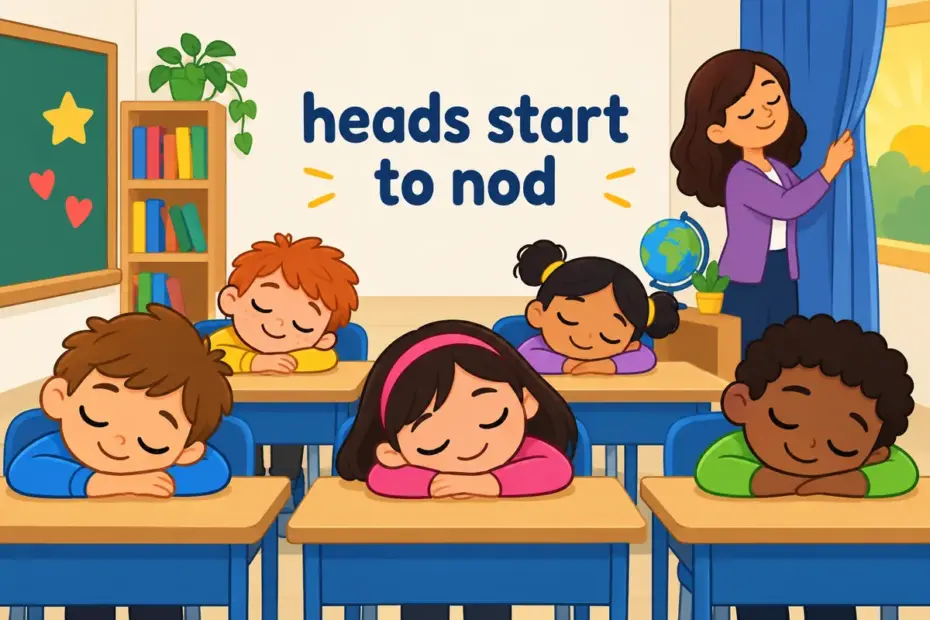
| Classroom | The warm room and the droning film left the class somnolent. | Two causes make the drowsiness easy for a young reader to feel. |
| Workplace email | The afternoon slot tends to be somnolent, so we keep it short. | Turns a mood into a practical scheduling reason. |
| Travel writing | We reached a somnolent harbour where boats slept on flat water. | Paints a still, unhurried place in a single adjective. |
| News report | The somnolent market woke abruptly when the figures were released. | Contrasts stillness with a sudden event. |
| Medical writing | Patients reported feeling somnolent in the first week of treatment. | Uses the word neutrally to describe a reported state. |
| Literary description | A somnolent hush settled over the house after the guests left. | Applies the adjective to an atmosphere rather than a person. |
| Conversation | That long drive made me somnolent, so we stopped for coffee. | The mild everyday use, with its consequence attached. |
| Nature writing | The pond lay somnolent under a blanket of summer weed. | Describes stillness in the natural world. |
| History essay | A somnolent border district became a flashpoint within a month. | Sets up a later reversal of the mood. |
| Restaurant review | The somnolent hum of the dining room suited a slow supper. | Uses the word for a pleasant, low-key atmosphere. |
| Poetry commentary | The poem’s somnolent rhythm imitates the tide it describes. | Connects a sound pattern to a described scene. |
Only the medical and conversation examples describe a person directly; the rest use somnolent of places, sounds and moods. That skew is the clearest signal of where the word feels at home, and it is why nodding off is the more human phrase in ordinary talk.
Somnolent vs drowsy, lethargic and torpid
Somnolent belongs to a small family of sleep-adjacent adjectives and agrees with none of them completely. Drowsy is the everyday word for the edge of sleep, lethargic is a clinical-sounding word for a lack of energy, and torpid is a formal word for the heavy stillness of animals in cold or heat.
| Attribute | somnolent | drowsy | lethargic | torpid |
|---|---|---|---|---|
| Core meaning | Sleepy or sleep-inducing | Almost asleep | Lacking energy or alertness | Sluggish and inactive |
| Typical subject | People, places, sounds, moods | People, especially children | People, sometimes after illness | Animals, and things in cold or heat |
| Tone | Literary and soft | Plain and neutral | Clinical or negative | Formal and heavy |
| Usual pattern | a somnolent afternoon | a drowsy child | lethargic after surgery | a torpid lizard |
| What it implies | Near sleep, often pleasant | Nodding towards sleep | A loss of energy that may be a symptom | A slow, near-motionless state |
Verdict: choose drowsy for a person who is drowsy and about to sleep, lethargic when lethargic describes a worrying lack of energy, torpid for the torpid stillness of an animal, and somnolent when the mood is soft, literary and shared by a place or a group.
Word forms and grammar of somnolent
Somnolent builds a small, tidy family, and the noun somnolence is the form most writers actually need. The table also lists the clumsy coinage learners invent by attaching another suffix.
| Form | Part of speech | Example |
|---|---|---|
| somnolent | adjective | The somnolent dog stretched by the fire. |
| somnolently | adverb, rare | He blinked somnolently at the bright screen. |
| somnolence | noun | Afternoon somnolence gripped the whole office. |
| somnolency | noun, archaic variant | Avoid it in modern writing; use somnolence. |
| somnolentness | non-standard, avoid | Write somnolence; the noun has its own ending. |
| soporific | adjective, different role | A soporific speech sends listeners to sleep. |
The distinction in the last row is the one that repays practice: somnolent describes the sleepy state, while soporific describes the quality that produces it. A somnolent audience is already drowsy; a soporific speaker is the reason.
Somnolent in literature and everyday writing
Somnolent is one of the words that mark a writer’s register. It appears in fiction and travel writing far more often than in reports, and it tends to slow a sentence down on purpose. The table below maps where it fits and what a plainer writer would put instead.
| Register | Example | What it adds |
|---|---|---|
| Literary fiction | The somnolent train carried them towards the coast. | A soft, drowsy mood in a single word. |
| Travel feature | A somnolent market town, unchanged for decades. | A sense of stillness and time passing slowly. |
| Neutral report | Residents described the town as sleepy in winter. | Plain accuracy; somnolent would sound too soft here. |
| Everyday speech | I felt drowsy after the long drive. | Directness; somnolent would sound precious. |
The pattern is consistent: the more a writer wants to set a mood, the more somnolent earns its place, and the more a writer wants to state a fact, the more sleepy, drowsy or tired serves better.
Common mistakes with somnolent
- Incorrect:
The lecture was so somnolent that half the hall fell asleep.Correct: The lecture was so soporific that half the hall fell asleep. Rule: Soporific means sleep-causing; somnolent means already sleepy, so use it of the audience. - Incorrect:
I was somnolent to sleep after the night shift.Correct: I was so somnolent that I could sleep after the night shift. Rule: Somnolent does not take a to-phrase of purpose; use a that-clause instead. - Incorrect:
She felt somnolent of the heat.Correct: She felt somnolent from the heat. Rule: The cause takes from, not of, when it is stated at all. - Incorrect:
Somnolent pills finally helped him rest.Correct: Sleeping pills finally helped him rest. Rule: Somnolent describes the drowsy person or mood, not the medicine that causes it. - Incorrect:
The village is somnolent with tourists every July.Correct: The village is sleepy in winter but busy with tourists every July. Rule: Somnolent implies quiet inactivity, which a crowd of visitors contradicts.
Practice using somnolent
Work through the seven items, then read the reasoning rather than only the answer.
- Fill the gap: The hot bus made every passenger ______ before the first stop.
- Choose the better word: The warm milk was so (somnolent / soporific) that the baby slept at once.
- Correct the error: He grew somnolent of the gentle rain on the roof.
- Build a sentence: use a somnolent + noun about a small town in winter.
- Spot the register: which belongs in a travel magazine — the somnolent harbour, or the place where nobody does much?
- Rewrite with somnolence: Everyone in the office felt sleepy after lunch.
- Choose the better word: After the marathon she was (somnolent / weary) rather than sleepy.
Answers
- somnolent — the adjective follows make and describes the drowsy passengers.
- soporific — the milk causes sleep, so the quality word is required.
- He grew somnolent from the gentle rain on the roof — the cause takes from.
- Model answer: A somnolent town in winter closes its shutters by four o’clock.
- The somnolent harbour — a travel feature welcomes the evocative adjective.
- Afternoon somnolence settled over the office — the noun names the sleepy state.
- weary — tiredness after effort is weariness, not the literary somnolent.
The bottom line
Use somnolent in a sentence for soft, literary drowsiness, whether it belongs to a person, a place or a sound, and keep it away from clinical claims. The two details that decide most sentences are these: somnolent describes the sleepy state while soporific names the cause, and the word settles most naturally on scenes and moods rather than on ordinary people. Where a plainer tone is wanted, sluggish and drowsy do the same work without the literary weight.
Frequently asked questions about somnolent
What does somnolent mean?
Somnolent means sleepy or drowsy, and it can also describe something that causes drowsiness, such as a warm room or a steady hum. It extends easily to places, so a quiet, inactive town can be called somnolent. The word is literary rather than clinical, and it suits atmosphere as much as people.
Is somnolent a medical term?
It appears in medical writing, where patients may be described as somnolent, but it is not a diagnosis. Doctors are more likely to use drowsy, or a specific clinical term, when describing a symptom. Outside medicine, somnolent belongs to description and atmosphere rather than to any assessment of health.
What is the difference between somnolent and soporific?
Somnolent describes the state of being sleepy, while soporific describes something that makes people sleepy. A somnolent audience is already drowsy, and a soporific speech is the reason they became so. The pair is easy to mix, so check whether the sentence names the sleepy thing or the sleep-causing one.
What is the noun form of somnolent?
The noun is somnolence, meaning sleepiness or a drowsy state. You might write that afternoon somnolence settled over the office. An older variant, somnolency, appears in older texts but is now rare. The adverb somnolently also exists, as in he blinked somnolently, though it is uncommon.