Run around means to be very busy moving from place to place, or to spend time somewhere without a clear purpose. To use run around in a sentence, let the person be the subject and add a place or time phrase: “I ran around all morning.” The phrase is intransitive, so it takes no direct object.
Run around at a glance
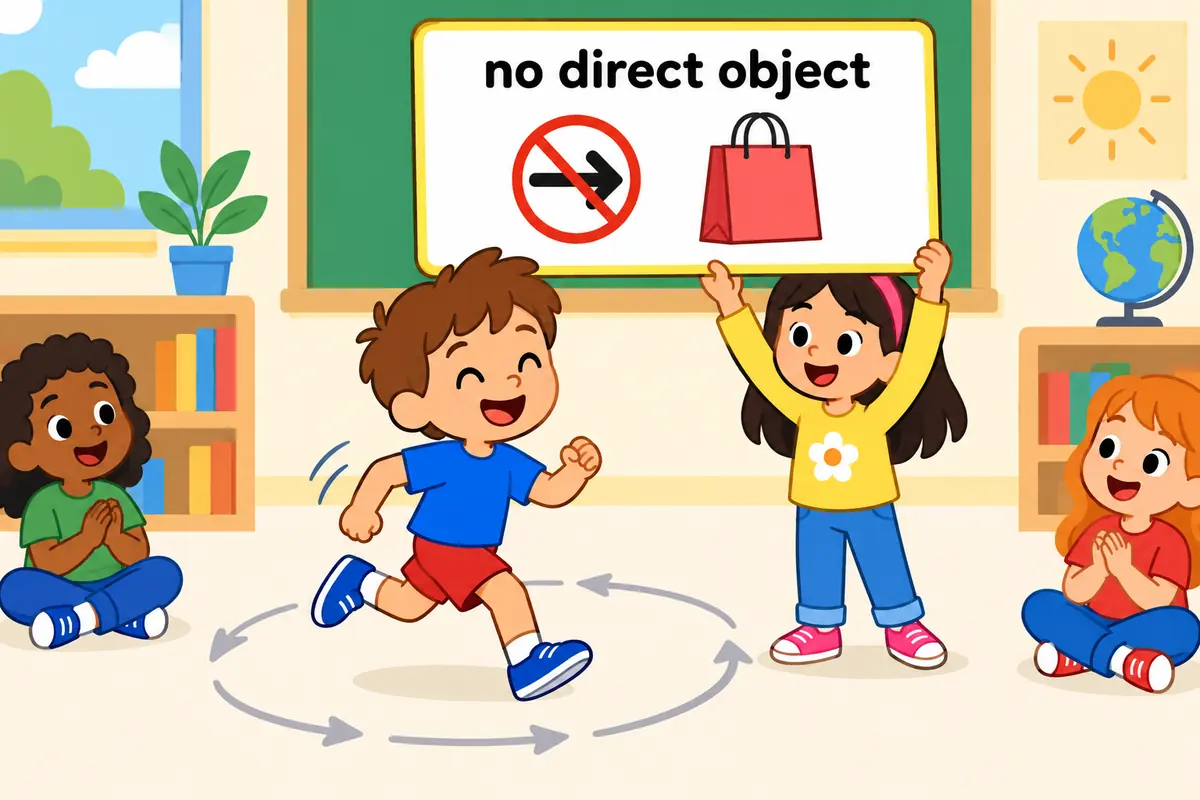
- Run around is an intransitive phrasal verb, so no direct object can follow it.
- It describes busy movement or aimless activity, not one completed task.
- A prepositional use, run around the field, means literally circle the area.
- The noun form is one word: give someone the runaround means to delay them with excuses.
- The commonest error is writing the noun as two words or adding a direct object.
What does run around mean?
Run around is a phrasal verb with two linked senses: being frantically busy, as in I ran around all day, and spending time somewhere in a loose or aimless way, as in they run around with the wrong crowd. The Cambridge entry for run around also records the noun runaround, the runaround you give somebody who is being kept waiting.
| Sense | Plain meaning | Example sentence |
|---|---|---|
| Be very busy | Rush from one thing to another | I ran around all morning before the meeting. |
| Spend time aimlessly | Hang about in a place or group | They run around with older cousins all summer. |
| Give the runaround | Delay somebody with excuses | The office gave us the runaround for weeks. |
| Circle a place | Move around an area (prepositional) | The children ran around the field twice. |
Because the phrase is intransitive, a direct object is impossible: you run around, but you never run around the errands. That single fact separates it from transitive phrasal verbs such as push around, which must take a person. Register matters too, since run around belongs to speech and light writing rather than to formal reports.
Run around is the wrong choice when one specific journey is meant; go, walk or drive is then the plain verb. It also sounds informal, so reports usually pick a clearer phrase.
How do you use run around in a sentence?
Run around is intransitive, and its meaning shifts with the phrase that follows, so it is never a synonym for fooling around or for plain walking. Two patterns need care. In she runs around after the twins, around is locked to after and the phrase means caring for busy people, not aimless motion. In the dog ran around the garden, around is a preposition and the garden is the ground being circled, so the sentence describes an area rather than a mood. Choosing between them depends on what follows the verb, not on emphasis.
| Pattern | Example | What it signals |
|---|---|---|
| run around + time phrase | We ran around all afternoon. | Intransitive busy movement, no object. |
| run around + with + person | He runs around with the older boys. | Names a loose social circle. |
| run around + after + person | She runs around after the twins. | Prepositional: caring for somebody busy. |
| run around + place (preposition) | The dog ran around the garden. | Literal circling of a named area. |
| give + somebody + the runaround | The agency gave me the runaround. | The noun means evasive delay. |
Run around in a sentence: examples across contexts
Run around suits informal descriptions of busy or aimless movement, and its noun form has a sharper edge.
| Context | Example sentence | Why this works |
|---|---|---|
| Family at home | I ran around all morning getting the children ready. | Everyday speech shows non-stop busyness. |
| Workplace email | Please stop running around between meetings and reply today. | A manager names scattered activity. |
| News report | Residents ran around the streets as the storm approached. | Reporting captures urgent movement. |
| School playground | The younger children ran around the field until the bell. | The prepositional use names an area. |
| Parenting | He runs around with a noisy group after school. | The with-pattern describes a social circle. |
| Customer service | The airline gave passengers the runaround for three days. | The noun form means evasive delay. |
| Sports coaching | Do not run around; hold your position. | A coach contrasts hustle with purpose. |
| Health advice | Running around all day is not the same as real exercise. | A writer separates busyness from training. |
| Storytelling | The puppy ran around the table in happy circles. | Concrete action suits the literal sense. |
| Travel chat | We ran around the old town for hours and saw nothing. | The phrase admits aimless wandering. |
| Hospital | Paramedics ran around the ward through the night shift. | High-pressure work shows the phrase in its natural setting. |
| Market trading | Traders ran around the floor as prices swung wildly. | Financial colour leans on the same busy movement. |
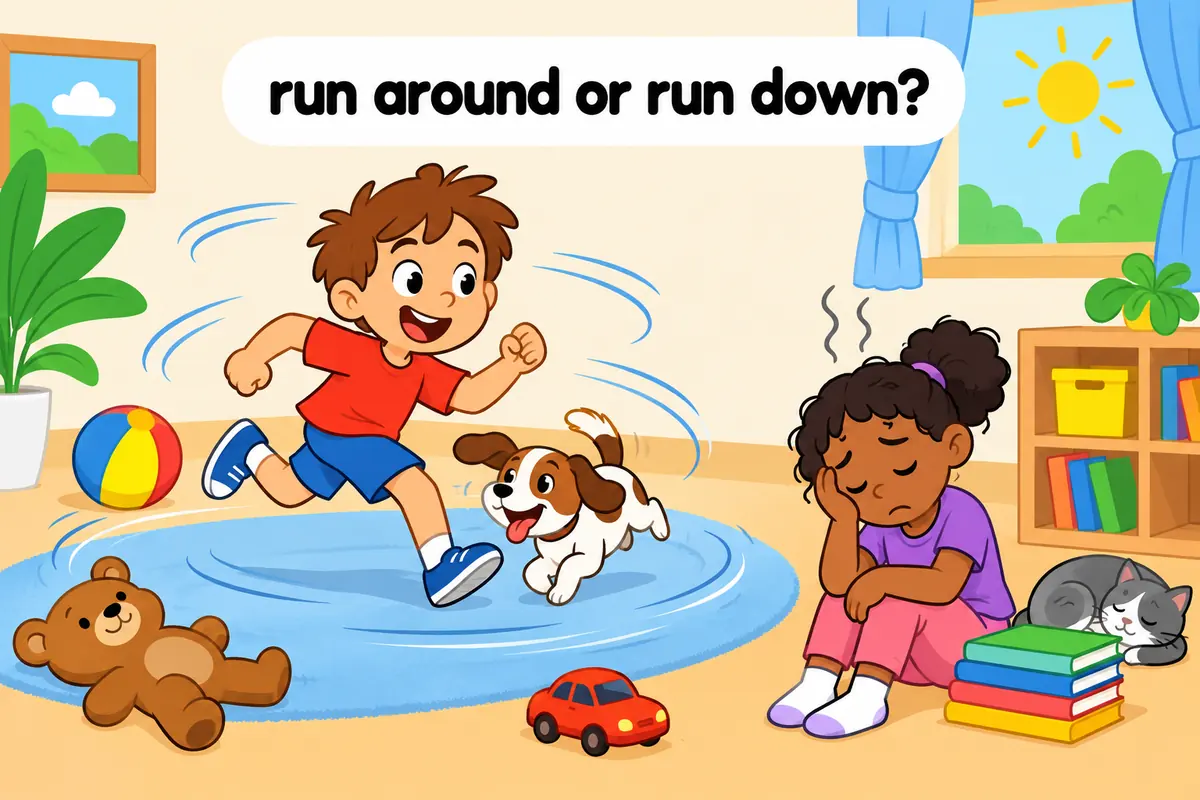
Run around vs run down
Run around and run down begin with the same verb but part company quickly: one describes movement, the other criticism or exhaustion.
| Attribute | run around | run down |
|---|---|---|
| Core meaning | Be busy or move about | Criticise, exhaust, or hit with a vehicle |
| Transitivity | Intransitive | Often transitive |
| Typical object | None, or a with or after phrase | A person, a battery or a pedestrian |
| Register | Informal and spoken | Neutral, often negative |
| Example | ran around all day | ran down her rival |
Keep run around for busy movement and run down for blame or tiredness, since only the second can take a person as its object. The transitivity test settles most doubts: run down can take a direct object, so you can run down a rival or run down a battery, while run around refuses one. If a sentence needs a person or thing right after the verb, run around is almost certainly the wrong choice.
Word forms and grammar of run around
Run around inflects on run and stays intransitive, while the noun closes into one word, much like the pair in turn around and turnaround. Nothing changes inside the phrase itself, so running around is the only progressive form and the particle never drifts away from the verb. The noun runaround also survives in the fixed phrase give somebody the runaround, where it never means movement at all but evasive delay.
| Form | Part of speech | Example |
|---|---|---|
| run around | phrasal verb, base | They run around after school. |
| runs around | third-person singular | She runs around all morning. |
| ran around | past tense | We ran around the park. |
| running around | present participle | He is running around again. |
| runaround | noun, one word | They gave us the runaround. |
| run a round (non-standard) | spelling error | Wrong: the agency gave me the run a round. Right: the runaround. |
Common mistakes with run around
Most run around errors come from adding a direct object or from writing the noun in two words. Waiting without moving is hanging around, which is a different kind of idling. Unlike push around, which takes a person as its object, run around never takes a direct object at all.
- Incorrect:
I ran around the errands this morning.Correct: I ran the errands this morning. Rule: Run around is intransitive, so it cannot take errands as a direct object. - Incorrect:
The office gave me the run around.Correct: The office gave me the runaround. Rule: The noun is one word, runaround, when it means evasive delay. - Incorrect:
We ran around for finish the task.Correct: We ran around trying to finish the task. Rule: An intransitive phrase needs a participle or preposition after it, never a bare for plus verb. - Incorrect:
The bad news ran around him.Correct: The bad news ran him down. Rule: Run down means exhaust or criticise; run around never takes a direct object. - Incorrect:
We ran around the city all day to sightseeing.Correct: We ran around the city all day sightseeing. Rule: The intransitive phrase takes a participle or a preposition, never to plus a bare verb.
Practice using run around
Work through the seven items, then read the reasoning rather than only the answers.
- Fill the gap: The children ______ the playground until it was time to go home.
- Choose the better word: Tired shoppers were (running around / running down) from one shop to the next.
- Correct the error: The helpline gave me the run around for a week.
- Build a sentence: use run around after about a parent caring for twins.
- Spot the register: which belongs in a news report — residents ran around the streets, or everyone was rushing about like mad?
- Rewrite for a formal report: People ran around all day. Use hurried.
- Correct the error: She ran around the shopping list before dinner.
- Correct the error: He run around the park every evening after school.
Answers
- ran around — the children moved about the playground with no single object.
- running around — the shoppers were busy moving about, not exhausted or criticised.
- The helpline gave me the runaround for a week — the noun is one word.
- Model answer: She ran around after the twins from breakfast until bedtime.
- Residents ran around the streets — a report keeps the phrasing neutral and specific.
- People hurried all day — formal writing prefers a single precise verb.
- She ran through the shopping list before dinner — run around is intransitive, so it cannot take the list as an object.
- He runs around the park every evening — the third-person singular adds s to run, and the prepositional around keeps the area intact.
The bottom line
Use run around in a sentence when somebody is busy moving about or spending time without a fixed purpose, and keep it intransitive so no direct object follows. Two nuances settle most sentences: the noun form is the single word runaround, as in give somebody the runaround, and a literal circle of an area is the prepositional use. When the meaning is criticism or exhaustion, run down is the verb you want.
Frequently asked questions about run around
Is run around one word or two?
The verb is two words, run around, as in we ran around all morning. The noun is one word, runaround, as in the office gave us the runaround. Meaning guides the spelling: action keeps the verb separate, while the evasive-delay noun closes up. Mixing the two is the commonest written slip.
Does run around take an object?
No, not a direct object. Run around is intransitive, so you cannot run around the errands. A prepositional phrase may follow when you mean literally circling an area, as in ran around the field, but that is a different pattern from the busy-movement sense and never takes a thing as the object.
What does give someone the runaround mean?
It means to delay somebody with evasions instead of giving a straight answer. The receptionist gave us the runaround means we were passed from desk to desk without help. Here the word is a noun, spelled as one word, and it carries a complaint rather than praise.
Is run around formal or informal?
Run around is informal and mostly spoken. Reports and business writing replace it with clearer verbs such as rush, hurry or move between, because the phrase is vague about what was actually done. The noun runaround does appear in journalism, usually when a company is criticised for evading a customer.