Savant means a person of deep learning or outstanding natural ability in a single field. To use savant in a sentence, name the field and the person’s unusual command of it: “A maths savant solved the puzzle in seconds.” The word carries admiration, so it suits careful, formal writing.
Savant at a glance
- Savant is a countable noun; its plural is savants, and savant-like works as a hyphenated adjective.
- One sense names a learned person or scholar; the second names rare ability concentrated in one area.
- The commonest pattern is savant in a subject or an adjective plus savant, as in a musical savant.
- The register is formal and admiring, so it rarely appears in casual conversation.
- The commonest error is using savant for anyone clever, when depth in one field is the point.
What does savant mean?
Savant is a noun meaning a learned person, or a person with exceptional ability in one narrow area. The Cambridge entry for savant records the sense of a person of great knowledge, and the extended sense has become the one readers meet most often. A scholar of ancient languages is a savant in the older sense, while a child who plays a concerto by ear is a savant in the newer one. Both share the idea of depth.
| Sense | Plain meaning | Example sentence |
|---|---|---|
| Learned person | A scholar with deep knowledge | The old professor was a savant of medieval law. |
| Rare single skill | Exceptional ability in one narrow field | A piano savant can repeat a melody after one hearing. |
| Attributive use | The word placed before a noun | Her savant memory for dates surprised the archivists. |
| Fixed clinical phrase | Savant syndrome as a written term | Researchers describe the pattern as savant syndrome. |
One limitation is worth stating plainly. Savant is not a general compliment for cleverness, and it is not a diagnosis. A bright student who does well in every subject is not a savant; the word points to unusual depth, often in a single area. It also says nothing about the person’s other abilities, so writers should avoid implying that a savant must struggle elsewhere.
How do you use savant in a sentence?
Savant works either as a plain noun or in front of another noun, and the field marker tells the reader where the ability lies. The frames below cover the shapes that sound natural in English and the one pair that sounds translated.
| Pattern | Example | What it signals |
|---|---|---|
| a savant in + field | He is a savant in number theory. | Names the subject where the depth appears. |
| a savant at + activity | She is a savant at recalling melodies. | Names a repeated activity rather than a school subject. |
| adjective + savant | The orchestra hired a violin savant. | Compresses the field into a single adjective. |
| be regarded as a savant | The critics came to regard him as a savant. | Reports other people’s judgement rather than a fact. |
| savant-like + noun | Her savant-like focus impressed the team. | Compares behaviour to a savant without labelling a person. |
| savant + of + field | The engineer was a savant of bridge design. | Formal and slightly literary, best kept for writing. |
The frame that marks a learner is a savant of doing something, which copies other languages. English prefers a savant at chess or a chess savant, and reserving savant of for a body of knowledge keeps the sentence idiomatic.
Savant in a sentence: examples across contexts
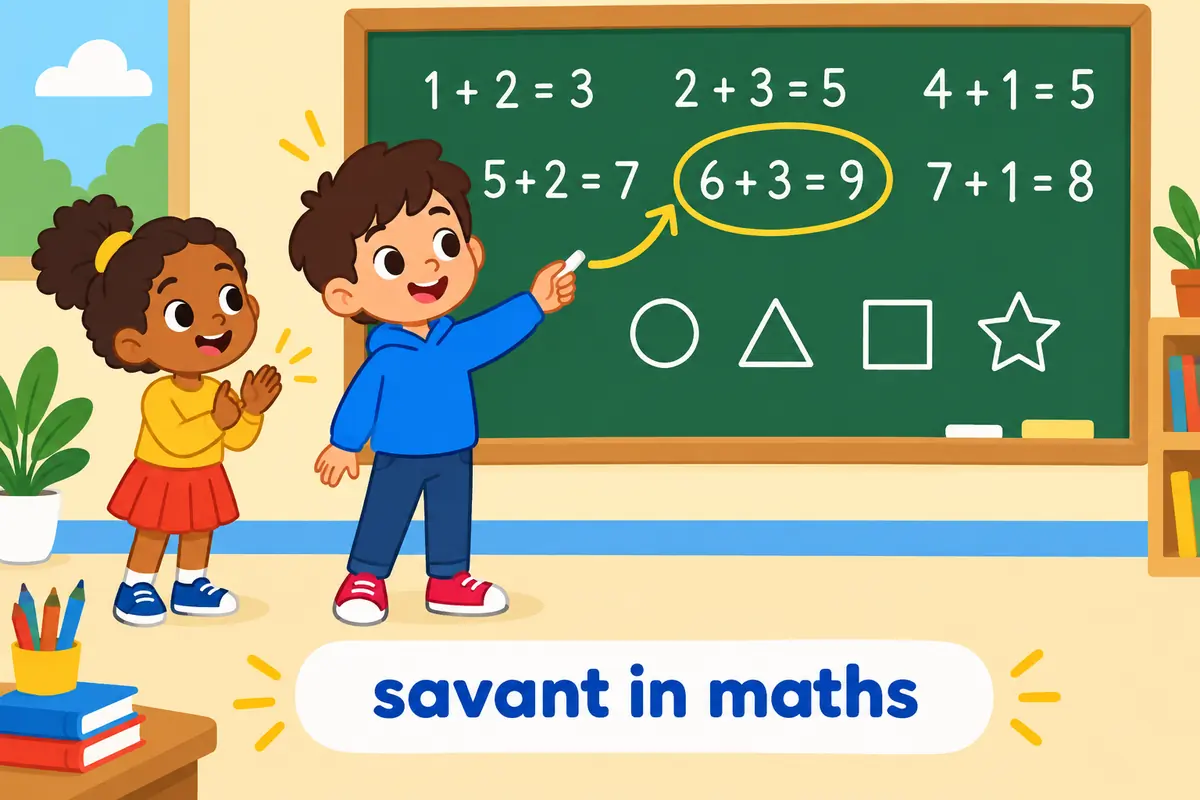
Savant keeps its meaning of concentrated depth as the setting changes, from the classroom to the concert hall. Each sentence below names the field, because a savant without a field reads as an empty compliment.
| Context | Example sentence | Why this works |
|---|---|---|
| Classroom | The class called Mira a maths savant after she finished the sheet in five minutes. | Names the subject and the evidence of speed. |
| Workplace email | We should ask the data savant on the second floor to check the model. | Light, informal use inside a known team. |
| News report | The paper described her as a savant of early Chinese poetry. | A formal attribution with the field made explicit. |
| Science writing | Case studies of savant syndrome describe extraordinary drawing from memory. | Uses the fixed phrase and avoids labelling a person. |
| Music review | A teenage piano savant held the hall silent for a full minute. | An adjective plus savant compresses the field into one image. |
| Film criticism | The film follows a chess savant who cannot explain his own moves. | The pattern savant who plus a clause adds a human condition. |
| Academic prose | Historians treat him as a savant rather than an original thinker. | The contrast sharpens what savant does and does not claim. |
| History essay | By thirty she was a savant of navigation and little else. | The closing phrase limits the praise, which the word implies. |
| Conversation | My uncle is a savant with anything mechanical. | With a practical domain sounds natural in speech. |
| Sports writing | Coaches treated the young keeper as a positioning savant. | An invented compound uses the attributive slot. |
Notice that no example uses savant as a rank or title. The word is a description, and English speakers apply it to a person only when a specific field is visible in the same sentence.
Savant vs genius, prodigy and polymath
Four words describe unusual ability, and each measures it differently. Savant measures depth in one area; genius measures original power; prodigy measures early achievement; polymath measures breadth across separate fields. Writers who praise a young genius for one skill often mean savant or prodigy instead.
| Attribute | savant | genius | prodigy | polymath |
|---|---|---|---|---|
| What is measured | Depth in one field | Original creative power | Early exceptional talent | Breadth across many fields |
| Typical age | Any age | Any age | A child or young person | Usually an adult |
| Range | Often narrow | Often wide | Focused on one craft | Deliberately wide |
| Common pairing | A musical savant | A creative genius | A child prodigy | A Renaissance polymath |
| Implied contrast | Ability beside other differences | Ordinary talent | Adult performance | The single specialist |
Verdict: choose savant for concentrated depth, genius for original power, prodigy when the person is young, and call a polymath someone whose expertise spans several fields.
Word forms and grammar of savant
Savant is a countable noun, so it takes an article and forms a regular plural. Its derived forms are uncommon and mostly literary, which is worth knowing before reaching for one.
| Form | Part of speech | Example |
|---|---|---|
| savant | noun, singular | The archive named one savant among its founders. |
| savants | noun, plural | Two savants disagreed about the same inscription. |
| savant | noun as modifier | A savant memory can hold entire timetables. |
| savant-like | hyphenated adjective | His savant-like recall of names startled everyone. |
| savantism | noun, rare | Writers rarely use savantism outside specialist prose. |
| savante | noun, dated feminine | The form savante now reads as old-fashioned. |
The related word an erudite reader describes wide book learning as an adjective, where savant names the person. Keep the two apart, because a sentence can call someone erudite far more loosely than it can call them a savant.
Common mistakes with savant
- Incorrect:
She is a savant of mathematics.Correct: She is a savant in mathematics, or a mathematical savant. Rule: English marks the field with in or an adjective, not with of. - Incorrect:
Every clever pupil is a savant.Correct: Only pupils with unusual depth in one field are savants. Rule: Savant is not a synonym for clever; it names concentrated ability. - Incorrect:
The report called him an idiot savant.Correct: The report described him as a savant with a remarkable memory. Rule: The old phrase is widely avoided as insulting, so name the ability instead. - Incorrect:
He is the savant of the football team.Correct: He is the team’s expert on set pieces. Rule: Savant is too strong for ordinary skill and sounds odd with a sports team. - Incorrect:
Her savantness impressed the judges.Correct: Her savant-like talent impressed the judges. Rule: There is no everyday noun savantness; use the hyphenated adjective.
Practice using savant
Work through the seven items, then read the reasons so each pattern becomes automatic.
- Fill the gap: The festival invited a young ______ at the piano.
- Choose the better word: The child finished every subject early, so teachers called her a (savant / prodigy / polymath) in general studies.
- Correct the error: He is a savant of ancient maps.
- Build a sentence: use a savant at about someone who remembers every route.
- Spot the register: which belongs in a formal report: the archive holds a savant of local law, or my mate is a total savant, honestly?
- Rewrite with the adjective: She has the focus of a savant. Use savant-like.
- Replace the insulting phrase: The old article called him an idiot savant. Rewrite it with a respectful field name.
Answers
- savant, because adjective plus savant names the instrument compactly.
- prodigy, because the praise is about early all-round achievement, which savant does not cover.
- He is a savant in ancient maps, because English marks the field with in, not of.
- Model answer: She is a savant at remembering every route through the old town.
- The archive holds a savant of local law, because a report avoids slang and the first person.
- Her savant-like focus impressed the judges, because the hyphenated adjective describes the quality.
- Model answer: The article described him as a savant with extraordinary recall of dates.
The bottom line
Use savant in a sentence when you mean unusual depth of knowledge or ability in one field, and always name that field so the praise has a subject. The two nuances that decide most sentences are these: the word is countable, so it takes an article, and it describes a person rather than a general level of intelligence. Where the achievement is early and wide, call the young performer an expert or a prodigy instead, because savant is narrow by design.
Frequently asked questions about savant
Is savant a compliment or an insult?
Used plainly, savant is a compliment about unusual depth in one field. It becomes an insult only through older phrases that mock the person, and those are now avoided. The safe habit is to name the field, as in a savant at chess, so the praise stays specific.
Can savant describe a child?
Yes. Savant has no age limit, so it can describe a child with extraordinary ability in one area. If the emphasis is on youth and early achievement rather than narrow depth, prodigy is the more exact word. Many news reports choose savant precisely because it points to depth over age.
What is the plural of savant?
The plural is savants, formed by adding s, because savant is a countable noun. The form savantes is not standard English. A related feminine form, savante, exists but now reads as dated, so modern writing simply uses savant for any person of either gender.
Does savant mean the same as genius?
No. Savant points to exceptional depth in one field, while genius points to original creative power, which may spread across many fields. A savant may reproduce existing mastery brilliantly, whereas a genius is usually measured by what nobody produced before. The two words overlap but measure different things.