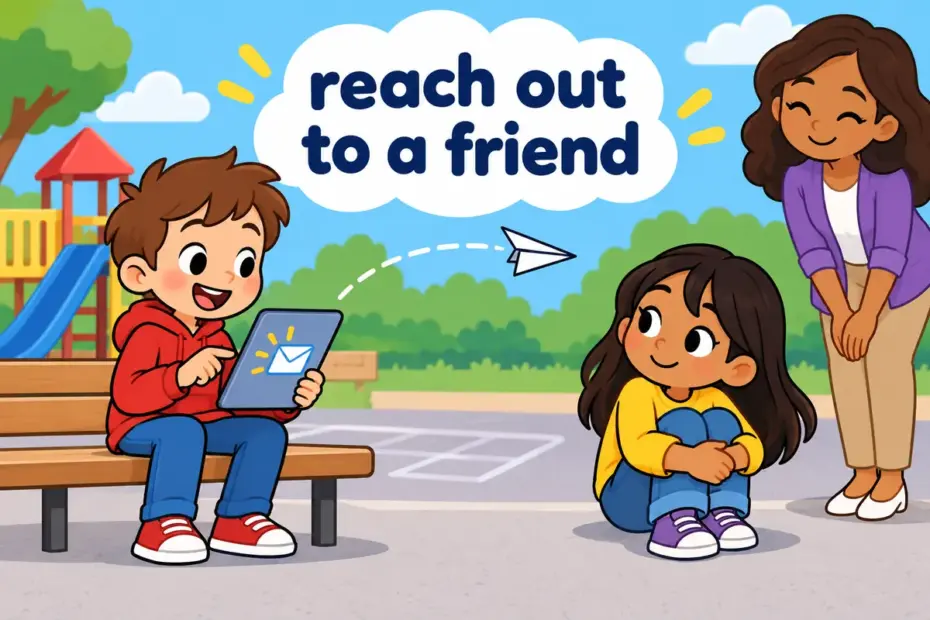
To reach out to someone is to contact them, usually to offer help, ask for something, or begin a relationship. In a sentence reach out to takes a person as its object, as in reach out to a friend. The expression is a phrasal verb, so its three words stay together.
Reach out to at a glance
- Reach out to is a phrasal verb meaning to make contact with a person.
- The object is almost always a person, a group or an organisation.
- Its forms change the verb only: reaches out to, reached out to, reaching out to.
- The commonest collocations are reach out to a friend, to a colleague and to a stranger.
- The usual learner slip is dropping to before the person, as in reach out a friend.
What does reach out to mean?
Reach out to is a phrasal verb meaning to try to communicate with someone, especially in order to help, ask, or connect. The Cambridge entry for reach out to treats it as a single unit, and the literal picture of extending a hand survives in every sense.
| Sense | Plain meaning | Example sentence |
|---|---|---|
| Contact someone | Try to start or renew communication | She reached out to her old tutor last week. |
| Offer help | Make contact in order to support someone | Neighbours reached out to the flooded family. |
| Seek advice or a favour | Approach a person for something you need | He reached out to a mentor for guidance. |
| Literal stretch | Extend a hand toward something | The toddler reached out to the puppy. |
One limitation is worth stating plainly. Reach out to describes the attempt, not its success: you can reach out to someone and get no reply. It is also mild and constructive, so it fits a friendly email far better than a demand. Where the point is simply that contact happened, contact someone directly is the plainer verb.
How do you use reach out to in a sentence?
Keep the three words together and put the person after to. Five patterns cover almost every real sentence, and the ones with about or for show what the contact is for rather than who receives it.
| Pattern | Example | What it signals |
|---|---|---|
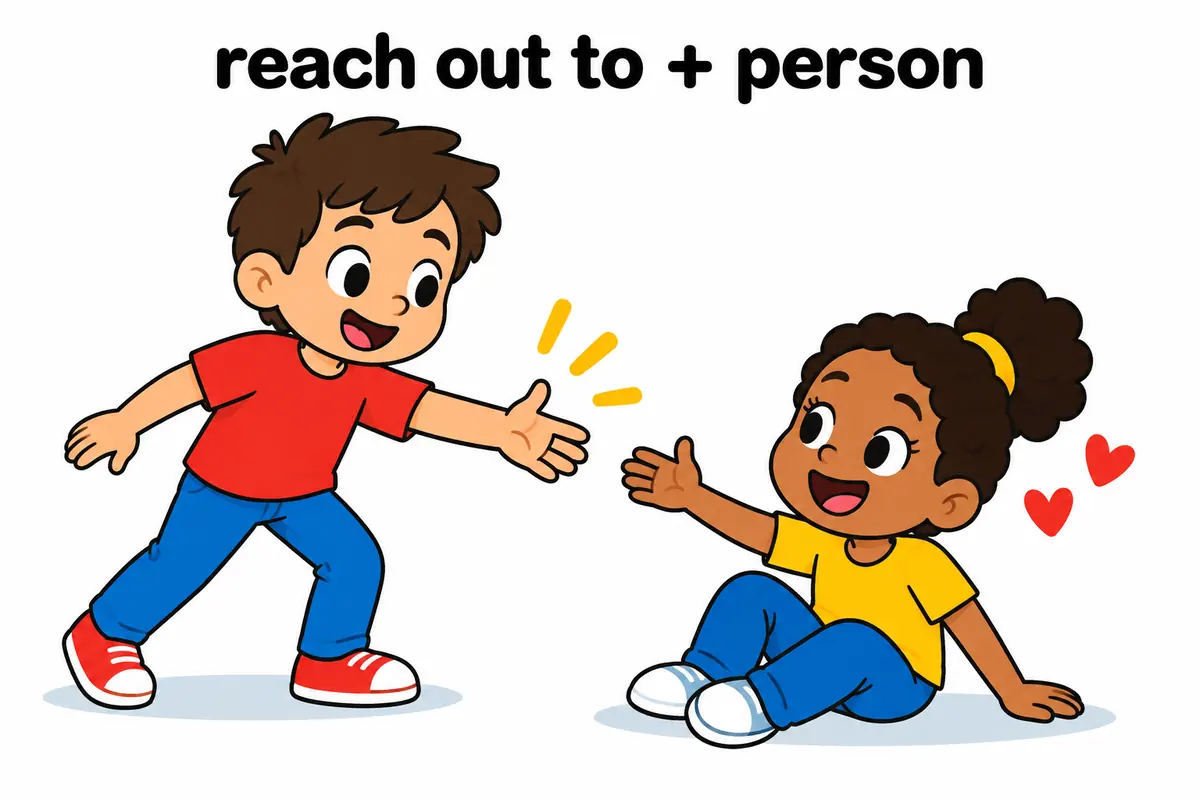
| reach out to + person | I will reach out to the new neighbour tomorrow. | The core pattern: contact aimed at a person. |
| reach out to + person + about | She reached out to her manager about the rota. | Names the subject of the contact. |
| reach out to + group | The council reached out to local clubs for ideas. | A wider audience rather than one person. |
| reach out to + someone + for | They reached out to us for support. | Says what is being requested. |
| reach out (object omitted) | If you are struggling, reach out. | The person is understood from context. |
When the goal is two-way contact rather than a first approach, connect with a colleague or approach the organisers often reads more naturally, because both suggest an exchange rather than a one-sided move.
Reach out to in a sentence: examples across contexts
The phrase barely changes meaning across registers, but the reason for the contact does. The ten sentences below move from a school corridor to a customer helpline, and each one names who is being contacted and why.
| Context | Example sentence | Why this works |
|---|---|---|
| Classroom | Our teacher asked us to reach out to the new pupil at break. | A concrete act of kindness any reader can picture. |
| Playground | He reached out to the boy sitting alone and offered a game of catch. | Names the recipient and the purpose in one line. |
| Workplace email | I am reaching out to confirm tomorrow’s meeting. | A courteous opener that states the reason for writing. |
| Customer service | Please reach out to our team if the fault returns. | An invitation framed as help, not obligation. |
| Recruitment | She reached out to three former managers for references. | Shows a specific request directed at named people. |
| News report | The charity reached out to families cut off by the flood. | Gives the agent and the people affected. |
| Academic writing | We reached out to the original authors for the raw data. | Formal research context, yet the phrase stays plain. |
| Networking | After the talk, he reached out to the speaker on a professional network. | Names the platform only through the action. |
| Community notice | Volunteers will reach out to every household this weekend. | A group as the recipient, with a clear timeline. |
| Conversation | I finally reached out to my cousin after two quiet years. | The phrase carries the emotional weight without extra words. |
Only the workplace email and the community notice use the phrase with a purpose clause; the rest let the recipient carry the meaning. That balance is the sign of a writer who trusts the idiom.
Reach out to vs get in touch and contact
Reach out to overlaps with two expressions and matches neither exactly. Get in touch is the neutral everyday phrase, while contact is the shortest and most formal of the three. A brief touch base with a client is a check-in, not a first approach, which is the clearest way to feel the difference.
| Attribute | reach out to | get in touch | contact |
|---|---|---|---|
| Core job | Make a warm first move toward someone | Arrange to communicate with someone | Communicate with someone |
| Tone | Friendly and deliberate | Casual and neutral | Neutral to formal |
| Implies effort | Yes, you take the initiative | Some, a mutual step | No, it states a fact |
| Typical object | A person, group or organisation | A person or a business | A person, office or helpline |
| Register | Warm professional and personal | Everyday conversation | Professional and formal |
Verdict: choose reach out to when you are making a considerate first approach, get in touch for a relaxed invitation, and contact when you simply need to state that communication occurs.
Word forms and grammar of reach out to
As a fixed expression, reach out to allows only limited variation inside it. The table shows what may change, what may not, and the near neighbours learners confuse it with.
| Variation | Allowed? | Example |
|---|---|---|
| Change the tense or agreement | Yes | She reaches out to new staff on their first day. |
| Change to past or participle | Yes | He reached out to us after the meeting. |
| Drop to before a person | No | Write reach out to a friend, never reach out a friend. |
| Use out without the verb reach | No | The phrase is fixed; outreach is a separate noun. |
| Replace to with for before a person | No | Reach out for help names a thing, not a person. |
| Separate the words | No | Do not write reach a friend out to. |
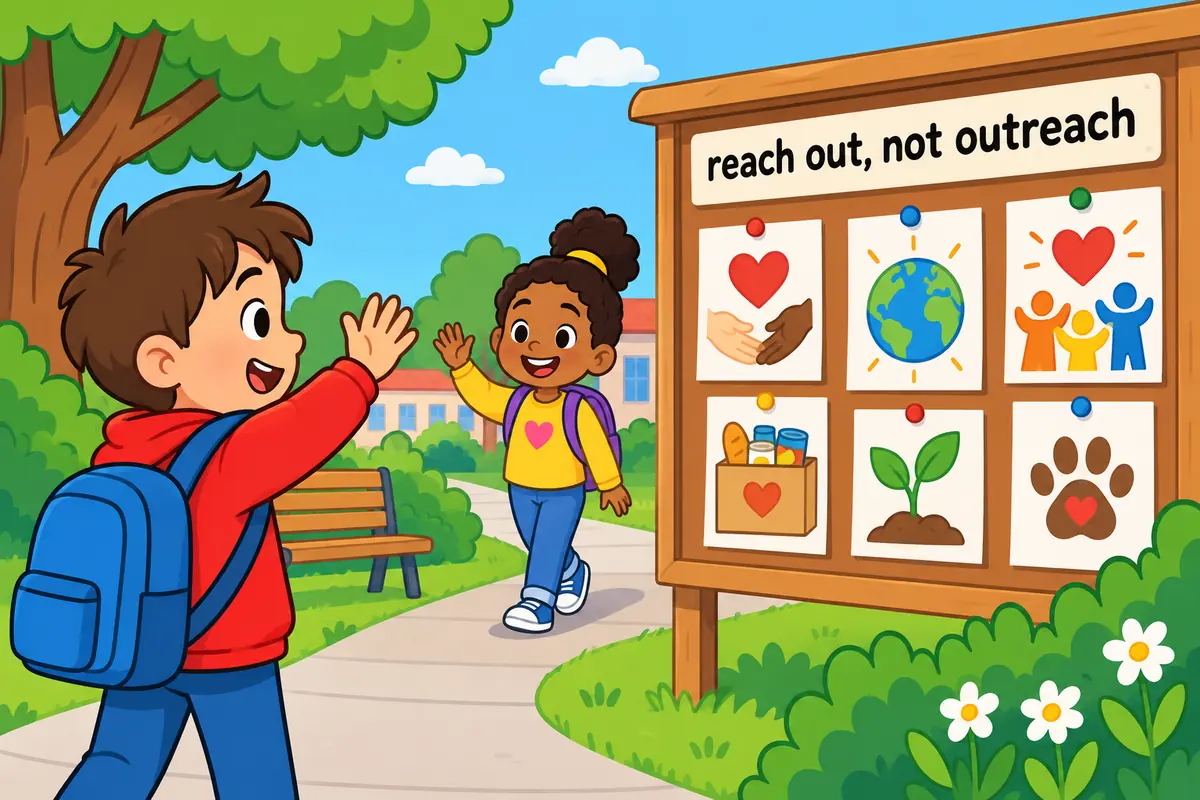
The single word outreach is a different part of speech: it is the noun for an organised effort, as in a community outreach programme, and it never takes a personal object in the way the verb phrase does.
Common mistakes with reach out to
- Incorrect:
I reached out my teacher about the project.Correct: I reached out to my teacher about the project. Rule: A person as object always needs the preposition to. - Incorrect:
She reached out at the manager for advice.Correct: She reached out to the manager for advice. Rule: The fixed preposition is to, never at. - Incorrect:
We will reach out the community next month.Correct: We will reach out to the community next month. Rule: A group as object also takes to. - Incorrect:
He reached out to at the office.Correct: He reached out to us at the office. Rule: To must be followed by its object, not by another preposition. - Incorrect:
Our reach out to families continues this year.Correct: Our outreach to families continues this year. Rule: Use the noun outreach when the effort, not the act, is the subject.
Practice using reach out to
Work through the seven items, then read the reason beside each answer rather than only the key.
- Fill the gap: Please ______ your tutor if the deadline is unclear.
- Choose the better word: I will (reach out to / reach) the supplier about the delay.
- Correct the error: The school reached out the parents by text.
- Build a sentence: use reach out to a classmate about a missed lesson.
- Spot the register: which belongs in a formal email – I am reaching out to confirm the booking, or just giving you a shout?
- Change the form: rewrite He reaches out to clients every Friday in the past tense.
- Fix the noun: Our reach out to volunteers doubled this year.
Answers
- reach out to – the person follows to, and the request is the subject matter.
- reach out to – a person as object needs the full phrase; bare reach would need a physical object.
- The school reached out to the parents by text – the group as object still takes to.
- Model answer: I reached out to a classmate who had missed the lesson.
- I am reaching out to confirm the booking – a formal email avoids the slangy shout.
- He reached out to clients every Friday – only the verb changes tense.
- Our outreach to volunteers doubled this year – the noun outreach replaces the verb phrase.
The bottom line
Use reach out to in a sentence when you are making a warm, deliberate approach to a person, and keep the three words together before that person. The two details that decide most sentences are these: the preposition to never drops before an object, and only the verb changes to mark tense or agreement. Where you simply need to state that communication happens, communicate with the team or contact is the plainer choice.
Frequently asked questions about reach out to
Is reach out to formal or informal?
The phrase sits in the middle. It is warm enough for a friendly note and accepted in professional email, where it opens a request without sounding abrupt. Only in very formal legal or academic writing does the plainer verb contact usually replace it, because it states the fact without the friendly framing.
Can you reach out to a company?
Yes. The object may be a person, a team, an organisation or a business, so you can reach out to a supplier, a school or a helpline. What does not change is the preposition to, which stays even when the recipient is a company rather than one person.
What is the difference between reach out to and outreach?
Reach out to is a verb phrase describing one act of contact. Outreach is a noun for an organised effort, as in a community outreach programme. The verb takes a personal object after to, while the noun usually appears before another noun or after a preposition.
Why do people say reach out instead of contact?
Reach out sounds warmer and less administrative than contact, so it suits help, networking and apologies. The literal image of extending a hand makes the approach feel considerate. When brevity or neutrality matters more than warmth, contact does the same job in one word.