Someone vs somebody is a choice of style rather than meaning, because someone and somebody are interchangeable in every sentence. Use someone when the writing is formal or the rhythm wants two syllables; use somebody when the tone is relaxed or a three-syllable beat fits. The grammar never changes.
Someone and somebody at a glance
- Someone and somebody are indefinite pronouns with the same meaning.
- Both take a singular verb, as in someone is and somebody is.
- Someone leans slightly formal and written; somebody leans slightly conversational.
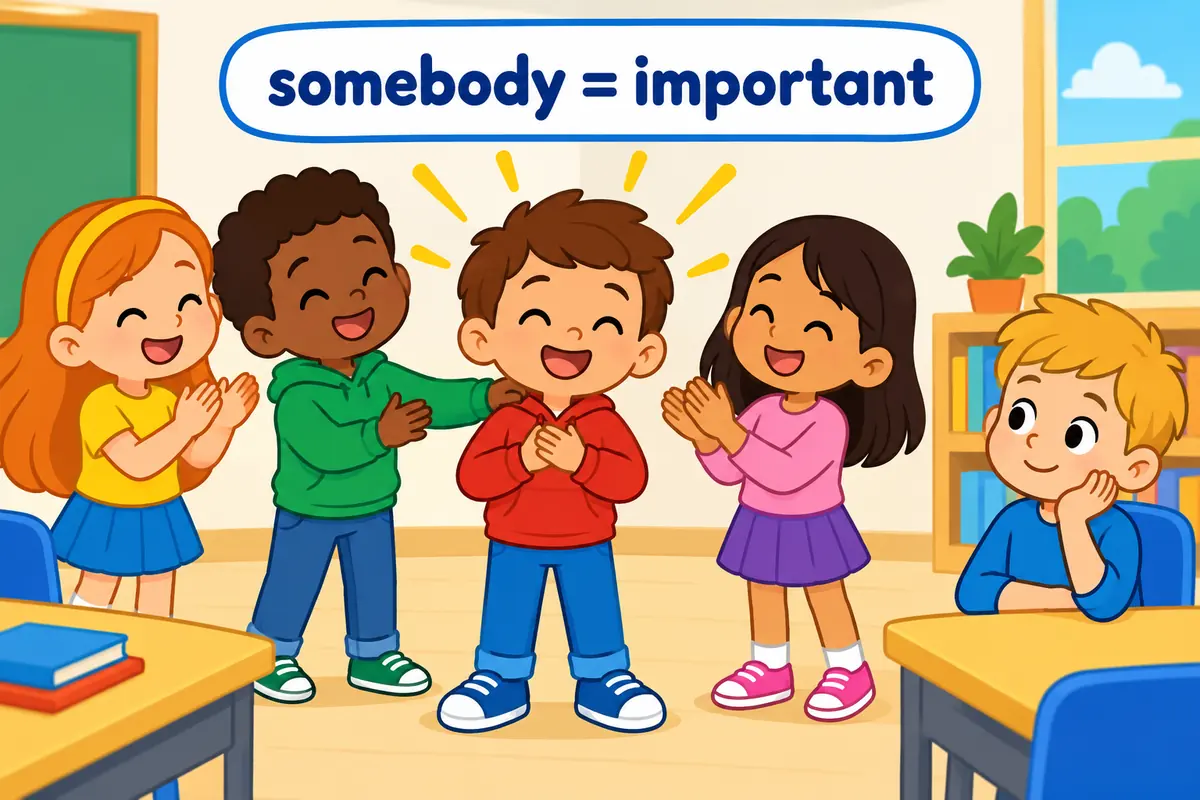
- Somebody can also mean an important person, a sense someone rarely carries.
- The usual learner slip is mixing them with anyone or anybody in questions and negatives.
What do someone and somebody mean?
Someone and somebody are indefinite pronouns meaning an unspecified person, and the Cambridge entry for someone treats them as one word in two spellings. The two run in perfect parallel, so a sentence keeps its meaning whichever you choose.
| Word | Meaning | Flavour | Example |
|---|---|---|---|
| someone | An unspecified person | Slightly formal, common in writing | Someone left a note on the desk. |
| somebody | An unspecified person | Slightly relaxed, common in speech | Somebody left a note on the desk. |
| somebody, second sense | An important person | Idiomatic, always somebody | She wants to be somebody one day. |
One limitation is worth stating plainly. The pair carries no difference in grammar, politeness or formality strong enough to make one wrong. A formal document can use somebody, and a chat can use someone. The only firm rule is the second sense of somebody: to mean a person of importance, the choice is fixed. A related pair, anyone and anybody, follows the same style split but appears in questions and negatives.
Someone vs somebody
The master table sets the two words against the criteria that actually influence a writer. Every row shows a real difference in feel or fixed usage, never a difference in meaning.
| Criterion | someone | somebody |
|---|---|---|
| Core meaning | An unspecified person | An unspecified person |
| Typical register | Slightly formal, common in writing | Slightly relaxed, common in speech |
| Syllables | Two | Three |
| Verb agreement | Singular: someone is | Singular: somebody is |
| Second sense | Rare | An important person |
| Fixed compounds | someone else, someone like | somebody else, somebody like |
| Interchangeable | Yes, in this sense | Yes, in this sense |
The practical upshot is that a writer chooses on sound and habit. If a sentence already uses contracted verbs and short words, somebody fits the music; if it uses full verbs and longer words, someone keeps the tone even. Two further criteria matter at the margins: casual conversation turns up somebody more often, while edited prose shows someone ahead, although the gap is small. Neither word changes how a reader judges the formality of a whole document on its own, which is why no editor treats the swap as an error.
Someone and somebody in a sentence: examples across contexts
Because the meaning never shifts, the examples below show the same idea placed in different registers. Watch which word each context prefers, then notice that swapping them would change nothing but the sound.
| Context | Example sentence | Why this works |
|---|---|---|
| Classroom | Someone has watered the plants already. | A neutral written register suits someone. |
| Playground | Somebody took my ball and I want it back. | Relaxed speech naturally reaches for somebody. |
| Workplace email | Could someone confirm the room booking? | A polite request prefers the more formal word. |
| Customer notice | Somebody will help you at the counter. | Warm and spoken, so somebody fits the sign. |
| News report | Someone called the emergency services at dawn. | Formal reporting keeps the more neutral word. |
| Academic writing | Someone must have misread the first table. | Hedges a claim without naming a person. |
| Story dialogue | Somebody answer that phone, please. | Dialogue mimics speech, so somebody sounds right. |
| Formal letter | Someone in your office signed the form. | Keeps a measured tone without accusation. |
| Idiom | He always wanted to be somebody. | The importance sense only works with somebody. |
| Conversation | Somebody told me you moved house. | Everyday speech, three syllables, light rhythm. |
| Team chat | Somebody please add the notes to the shared folder. | Very relaxed, so somebody fits the message. |
| Podcast script | Someone once told me to keep every receipt. | Crafted but spoken, which shows either word can carry a voice. |
| Safety notice | Someone should check the gate every evening. | A mild written instruction keeps the neutral word. |
Only the idiom row is restricted. Every other sentence would survive the swap untouched, which is the clearest proof that the pair differs in style alone. A writer can even mix the two words across a long document; readers notice repetition of meaning long before they notice a switch of style.
Which should you use?
Match the word to the situation and stop worrying about correctness, because both are correct. Four reader situations cover almost every choice a writer faces.
| Situation | Use | Why |
|---|---|---|
| Academic essay or report | someone | The neutral, slightly formal word keeps the tone even. |
| Friendly email or message | somebody | The relaxed word matches the conversational tone. |
| Fiction dialogue | somebody | Spoken lines sound natural with the three-syllable word. |
| Meaning an important person | somebody | This sense is fixed and does not take someone. |
| Unsure, in mixed writing | either | Pick the one that sounds better aloud; meaning is identical. |
| Song lyric or slogan | somebody | Three syllables carry a steady beat and land on the stress. |
| Technical manual | someone | Neutral and unobtrusive, keeping attention on the step. |
A plain test settles it: read the sentence aloud and keep the word that fits the rhythm of the surrounding verbs. Where a flat, desk tone is wanted, someone is the safer default; where a human, spoken tone is wanted, somebody is.
Word forms and grammar of someone and somebody
Both words behave as singular indefinite pronouns, and both build the same forms. The table covers the shapes learners ask about most, including the question and negative pattern that uses a different pair.
| Form | Example | Note |
|---|---|---|
| someone / somebody as subject | Someone is knocking. | Takes a singular verb even though it means a person. |
| possessive | somebody’s coat | The apostrophe goes before the s. |
| with else | someone else answered | Else follows the pronoun and never takes an apostrophe. |
| reflexive | somebody hurt themselves | The reflexive is plural in form, singular in use. |
| questions and negatives | Is anyone there? | Standard writing prefers anyone or anybody here. |
| as a noun | She is somebody now. | Important-person sense, fixed to somebody. |
| possessive with else | somebody else’s turn | The apostrophe attaches to else, not to somebody. |
| later reference | Someone forgot their bag. | Singular they is standard for a person of unknown gender. |
The related words everyone and everybody follow the same style split, and their negative counterpart is nobody, which never becomes no-one in informal speech in quite the same way.
Common mistakes with someone and somebody
- Incorrect:
Someone are at the door.Correct: Someone is at the door. Rule: Both words count as singular, so they take a singular verb. - Incorrect:
I did not see someone in the hall.Correct: I did not see anyone in the hall. Rule: In questions and negatives, standard writing uses anyone or anybody. - Incorrect:
He wants to be someone in this city.Correct: He wants to be somebody in this city. Rule: The important-person sense is fixed to somebody. - Incorrect:
Somebodys bag is on the floor.Correct: Somebody’s bag is on the floor. Rule: The possessive needs an apostrophe before the s. - Incorrect:
Someone of us should call.Correct: One of us should call, or somebody should call. Rule: Someone never takes of a plural group in this way. - Incorrect:
Somebody of the class should volunteer.Correct: Somebody from the class should volunteer. Rule: A group is joined with from, not with of.
Practice using someone and somebody
Work through the six items, then read the reason beside each answer rather than only the key.
- Fill the gap: ______ has left a parcel for you at reception.
- Choose the better word for a formal report: (someone / somebody) raised the alarm before dawn.
- Correct the error: He always dreamed of being someone important in the firm.
- Build a sentence: use somebody else about a missing library book.
- Spot the register: which belongs in a friendly text – somebody got the top mark, or someone obtained the highest score?
- Fix the question: Somebody can help me with this form?
Answers
- Someone – either word fits, and the neutral written choice is someone.
- someone – a formal report prefers the slightly more formal of the pair.
- He always dreamed of being somebody important – the importance sense belongs to somebody.
- Model answer: Somebody else has borrowed the library book.
- Somebody got the top mark – a friendly text prefers the relaxed word.
- Can somebody help me with this form? – a question keeps the auxiliary at the front.
The bottom line
Use someone or somebody when you mean an unspecified person, and let register and rhythm decide between them. The two details that settle most cases are these: the meaning and grammar are identical, so neither is ever wrong, and only somebody carries the extra sense of an important person. Where the sentence needs a named individual, the noun person is the word to reach for instead. Read the sentence aloud once before deciding, and keep the same choice through the paragraph so the prose does not flicker between two words that mean the same.
Frequently asked questions about someone and somebody
Is it better to write someone or somebody?
Neither is better, and both are correct in any sentence. Editing guides usually lean toward someone for formal writing and somebody for conversation, but the difference is a matter of taste rather than a rule. Choose the one that reads well aloud in the sentence you have written.
Are someone and somebody always interchangeable?
They are interchangeable whenever they mean an unspecified person. The single exception is the sense of an important person, as in she is somebody now, which always uses somebody. Apart from that fixed idiom, swapping one for the other changes only the sound and never the meaning.
Can somebody mean a specific person?
Not by itself. Both words leave the person unnamed on purpose, which is what makes them indefinite pronouns. If you need to signal that a particular person is meant, name them or use a noun such as the visitor. Somebody stays vague unless the surrounding sentence narrows it.
Do someone and somebody take a singular verb?
Yes. Both count as singular, so the verb is singular, as in someone is calling and somebody has arrived. The reflexive and tag questions still use the plural form they, because the pronoun does not indicate gender, so somebody hurt themselves and someone called, did they are both standard.