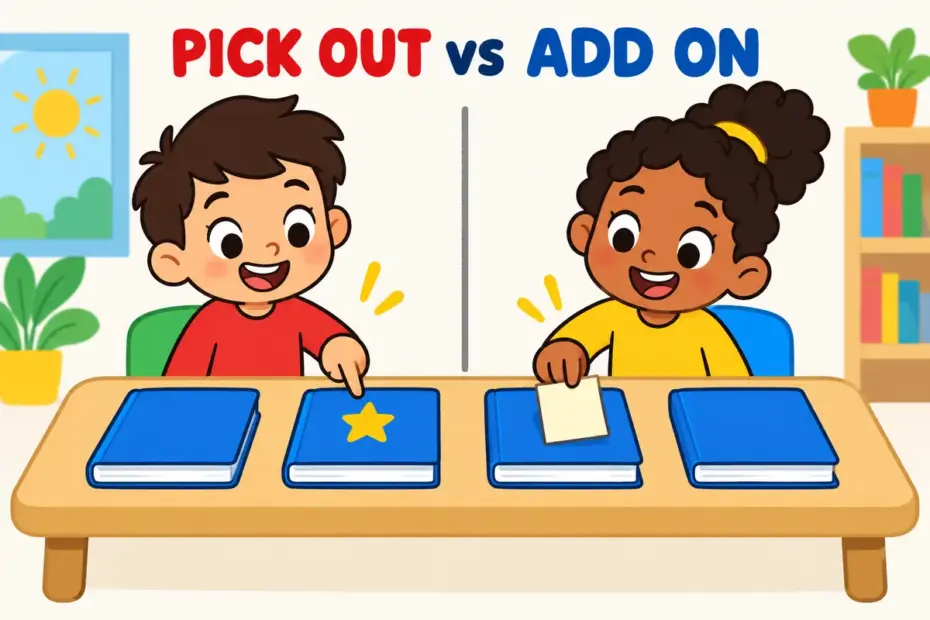
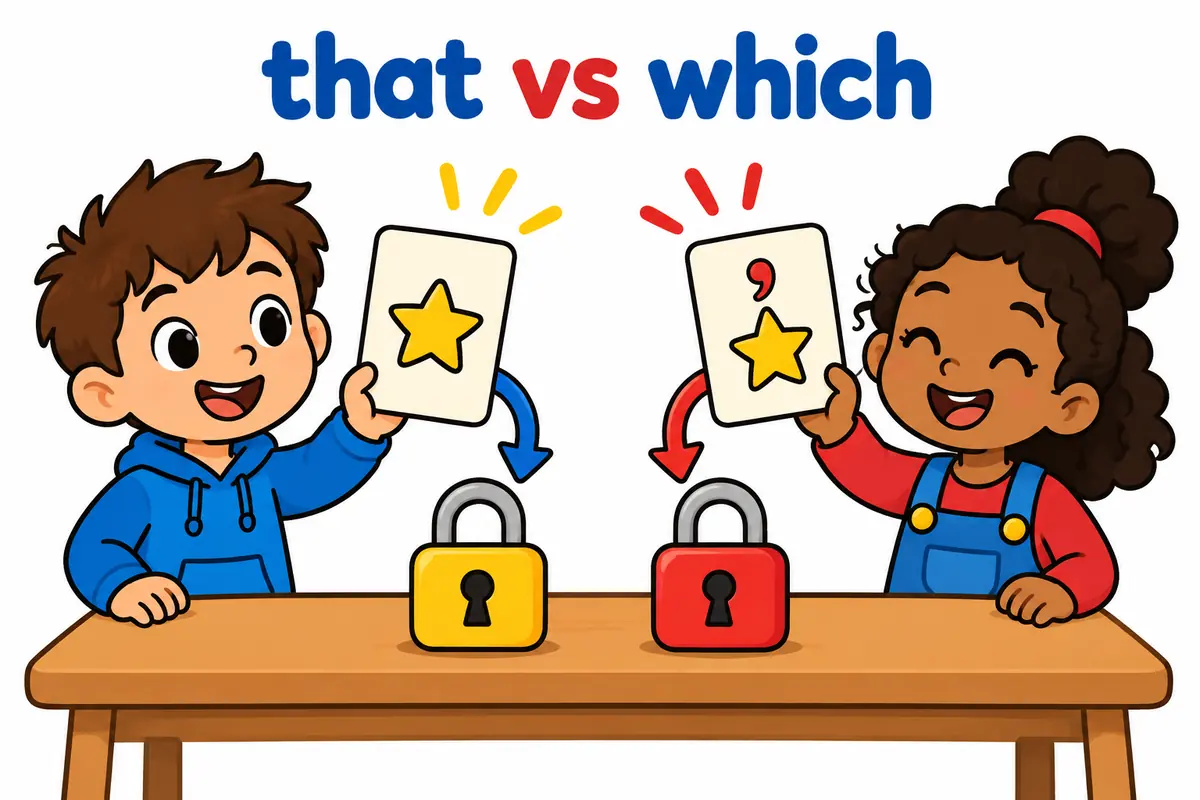
The that vs which rule reduces to one question: does the clause identify the noun or merely add to it? Use that for identifying clauses, with no comma before it, and which for adding clauses, which need a comma. The tool “that picks out, which adds on” holds in nearly every sentence you will write.
That vs which at a glance
- That and which are both relative pronouns that introduce a clause describing a noun.
- That introduces identifying clauses and never follows a comma in that job.
- Which introduces adding clauses and is separated by commas.
- Which can follow a preposition, as in the city in which she lives; that cannot.
- American editors favour that for identifying clauses; British writing often uses which.
What does that vs which mean?
That and which are relative pronouns, words that tie a clause to a noun so the clause can describe it. The noun they describe is called the antecedent, and the whole job is to tell the reader which noun you mean or to add a fact about it. The Cambridge entry for that and the Cambridge entry for which both record this relative use, and the difference is not meaning but function. That marks a clause the sentence cannot lose; which, after a comma, marks one it can. One limitation is worth stating plainly: the rule is a convention of edited prose, not a law of grammar, and readers will understand a swapped pair even when an editor would not allow it. The dedicated page on which covers its other jobs as a question word and a connector.
| Term | What it does | Example |
|---|---|---|
| that clause | Identifies which noun you mean | The road that leads north is closed. |
| which clause | Adds extra detail about a noun already identified | The road, which leads north, is closed. |
That vs which: the master comparison
Seven criteria decide almost every real case, and each one has a firm answer rather than a preference. Read down the two middle columns to see the pattern.
| Criterion | that | which |
|---|---|---|
| Clause type | Identifying, also called restrictive or essential | Adding, also called non-restrictive or extra |
| Punctuation | No comma before the clause | Comma before and after the clause |
| Can the clause be removed? | No; the sentence needs it to make sense | Yes; the sentence still stands without it |
| After a preposition | Never allowed: not in that she lives | Standard: in which she lives |
| Following a comma | Never used in this role | Required after the comma |
| Typical register | Common in speech and in edited American prose | Common in formal and British prose |
| Ambiguity risk | Low, because it pins the noun down | Higher if the comma is dropped |
The single test that settles the table: delete the clause. If the sentence still tells you which noun you meant, the clause was adding information, so use which with commas. If the noun becomes unclear, the clause was identifying, so use that.
How do you use that and which in a sentence?
Both pronouns sit at the head of a clause and are followed by a verb or a subject plus verb. Five patterns cover nearly every sentence, and only the first two carry the famous rule. A relative clause always attaches to the noun directly in front of it.
| Pattern | Example | What it signals |
|---|---|---|
| noun + that + clause | The key that opens the safe is missing. | Identifies one key among several; no comma. |
| noun + comma + which + clause | The key, which was bent, still opened the safe. | Adds a detail about a key already known; commas both sides. |
| preposition + which | The box in which she kept the keys was locked. | The pronoun follows a preposition, so that is impossible. |
| that after only, all or a superlative | It was the only key that still worked. | These frames almost always demand an identifying clause. |
| comma + which for a whole clause | She lost the key, which delayed everyone. | Which can point back to the entire first clause. |
The preposition row is the one place a beginner can be certain without thinking about commas at all: if the word in appears in front of the pronoun, only which will do.
That vs which in a sentence: examples across contexts
The contrast stays the same as the register changes. Each pair below keeps one noun and shows what the pronoun does to it, so the comma tells the whole story.
| Context | Example sentence | Why this works |
|---|---|---|
| Classroom | The experiment that produced no bubbles was the control. | That singles out one experiment from the set. |
| Classroom | The experiment, which lasted an hour, produced no bubbles. | The commas mark removable detail. |
| Workplace email | The file that you sent on Friday is missing. | That identifies which file among many. |
| Workplace email | The earlier draft, which nobody had read, was circulated. | Which adds a fact about a known draft. |
| News report | The bridge that crosses the river is closed. | That pins down which bridge the story means. |
| News report | The old bridge, which opened in 1890, is closed. | Which supplies background without identifying. |
| Academic writing | The sample that met the criteria was small. | That restricts the sample to the qualifying cases. |
| Academic writing | The sample, which was drawn from two schools, was small. | Which adds the method as an aside. |
| Legal drafting | The clause that limits liability survives the redraft. | That identifies the one clause in question. |
| Technical writing | The server that dropped the packet logged an error. | That names the exact server among many. |
| Conversation | The film that we watched last night was far too long. | That is the natural spoken form. |
| Literary prose | A quiet lane, which he had never noticed, ran beside the field. | Which slows the sentence to add atmosphere. |
Read the two classroom rows side by side: the words barely change, but the comma moves the reader from one instrument to one experiment already known.
Which should you use?
Five situations map to a firm recommendation, and none of them needs the hedge “it depends”.
| Situation | Use | Why |
|---|---|---|
| Several nouns could fit and the clause names the right one | that, no comma | The clause is doing essential identifying work. |
| The noun is already clear and the clause adds a fact | which, with commas | The sentence survives if the clause is cut. |
| A preposition stands before the pronoun | which | That can never follow a preposition. |
| The clause comments on the whole first clause | which, with a comma | Only which can reach back to an entire statement. |
| You are writing for a chiefly British readership | either, but stay consistent | British editing accepts which for identifying clauses. |
If you remember one line, make it this: when the comma is present, use which; when the comma is absent, use that.
Word forms and grammar of that and which
Both words wear several hats, and mixing up their non-relative jobs causes as many errors as the comma rule. The table sets the jobs side by side.
| Form | Job in the sentence | Example |
|---|---|---|
| that | relative pronoun, identifying | The key that opens the safe is missing. |
| that | demonstrative determiner | That key is the spare. |
| that | conjunction after verbs like say and know | She said that she was ready. |
| which | relative pronoun, adding or identifying | The key, which was bent, still worked. |
| which | interrogative determiner or pronoun | Which key opens the safe? |
The conjunction that is not a relative pronoun and takes no comma rule at all; it simply joins a reporting verb to its clause.
Common mistakes with that and which
- Incorrect:
The report, that was late, still passed.Correct: The report, which was late, still passed. Rule: That never follows a comma in a relative clause. - Incorrect:
The house in that she lives is old.Correct: The house in which she lives is old. Rule: A preposition cannot precede that. - Incorrect:
My bike which has a red seat is the fastest.Correct: My bike that has a red seat is the fastest, or My bike, which has a red seat, is the fastest. Rule: An identifying clause takes that and no comma; an adding clause takes both commas. - Incorrect:
She missed the train, that annoyed everyone.Correct: She missed the train, which annoyed everyone. Rule: Only which can comment on a whole clause, and it keeps the comma. - Incorrect:
It was the only door which had a lock.Correct: It was the only door that had a lock. Rule: Only, all and superlatives normally take an identifying that.
Practice using that and which
Work through the seven items, then read the reasoning in the answers rather than only the key. Each answer explains the comma as well as the pronoun.
- Fill the gap: The phone ______ rang twice belongs to Maya.
- Fill the gap: The phone, ______ was cracked, still worked.
- Choose the better word: The town in (that / which) we stayed was quiet.
- Correct the error: The letter, that arrived late, changed the plan.
- Build a sentence: use an identifying that clause about one book among several on a shelf.
- Spot the register: which belongs in a formal report — the study, which ran for two years, was small, or the study that ran two years was small?
- Explain the comma: The garden which we planted is full of bees. Where must a comma go, and what changes?
Answers
- that — the clause identifies which phone, so it takes that and no comma.
- which — the commas mark removable detail, so the adding pronoun is required.
- which — the preposition in sits directly before the pronoun, and that cannot follow it.
- The letter, which arrived late, changed the plan — that cannot follow a comma in this role.
- Model answer: The book that has the blue cover is the one I borrowed.
- The study, which ran for two years, was small — the commas suit formal prose that treats the detail as extra.
- Add a comma before which and one after planted if the clause adds detail; if it identifies which garden, keep that with no comma.
The bottom line
Choose that for an identifying clause and no comma, and which for an adding clause wrapped in commas, and the that vs which decision is settled. Two nuances resolve the awkward cases: a preposition before the pronoun forces which, and only which can comment on an entire clause. When the older usage of which for identifying clauses appears in British text, it is a style choice rather than an error.
Frequently asked questions about that vs which
Does a comma always go before which?
Not always, but the comma is the clearest signal. When which introduces an adding clause, commas go before and after it. When British writers use which in an identifying clause, there is no comma. If you keep the comma with which and leave it out with that, your sentences will match most edited prose.
Why can that not follow a preposition?
That is a relative pronoun that cannot serve as the object of a preposition, so a phrase like in that she lives is impossible. The fix is either in which she lives or a stranded preposition at the end, the house that she lives in. Both are grammatical, and the second is common in speech.
Is which more formal than that?
Which appears more often in formal and British writing, while that dominates speech and edited American prose. The formality comes from the commas around an adding clause more than from the pronoun itself. A formal report can still use that whenever the clause identifies the noun.
Can I leave that out of a sentence?
You can sometimes, but only when that is working as a conjunction, as in I think she is right. A relative that cannot simply vanish, because the clause needs its subject or object pronoun. The key that opens the safe cannot become the key opens the safe without changing the sentence.