Granular means made of small grains or broken into fine, detailed parts. To use granular in a sentence, place it before the noun it describes: “The report offers granular data on each class.” The adjective almost never stands alone, so the noun following it carries the meaning.
Granular at a glance
- Granular is an adjective; its noun is granularity and its adverb granularly is rare.
- The literal sense means made of grains; the business sense means divided into small, detailed parts.
- Granular usually comes before a noun: granular detail, granular data, granular level.
- Granular belongs to technical, business and academic writing rather than casual talk.
- The commonest learner error is treating granular as a noun, as in the granulars.
- The word names the size of the parts, so it never means accurate or important by itself.
What does granular mean?
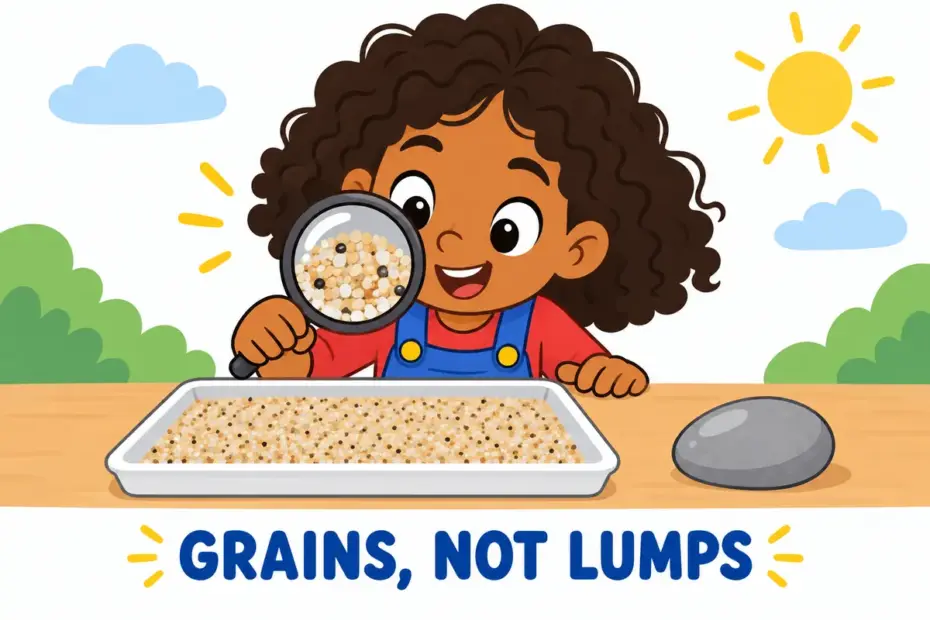
Granular is an adjective meaning made of small grains or, in its modern technical sense, detailed and divided into small parts. The Cambridge entry for granular records both the physical and the figurative senses. A sentence about sand, sugar or soil uses the first, while a sentence about a budget, a schedule or a dataset uses the second. Where a writer means only that a statement is exact, specific is the plainer choice.
| Sense | Plain meaning | Example sentence |
|---|---|---|
| Physical | Made of many small grains or particles | The soil here is granular and drains quickly. |
| Detailed | Broken into small, separate parts | The dashboard gives granular sales figures by region. |
| Describing a surface | Having a rough, grain-like texture | The old photograph shows a granular texture across the sky. |
One limitation is worth stating. Granular is not a synonym for important or accurate: a granular report is one broken into small parts, not one that is automatically correct. In everyday speech the word can sound like office jargon, and detailed often serves the reader better.
How do you use granular in a sentence?
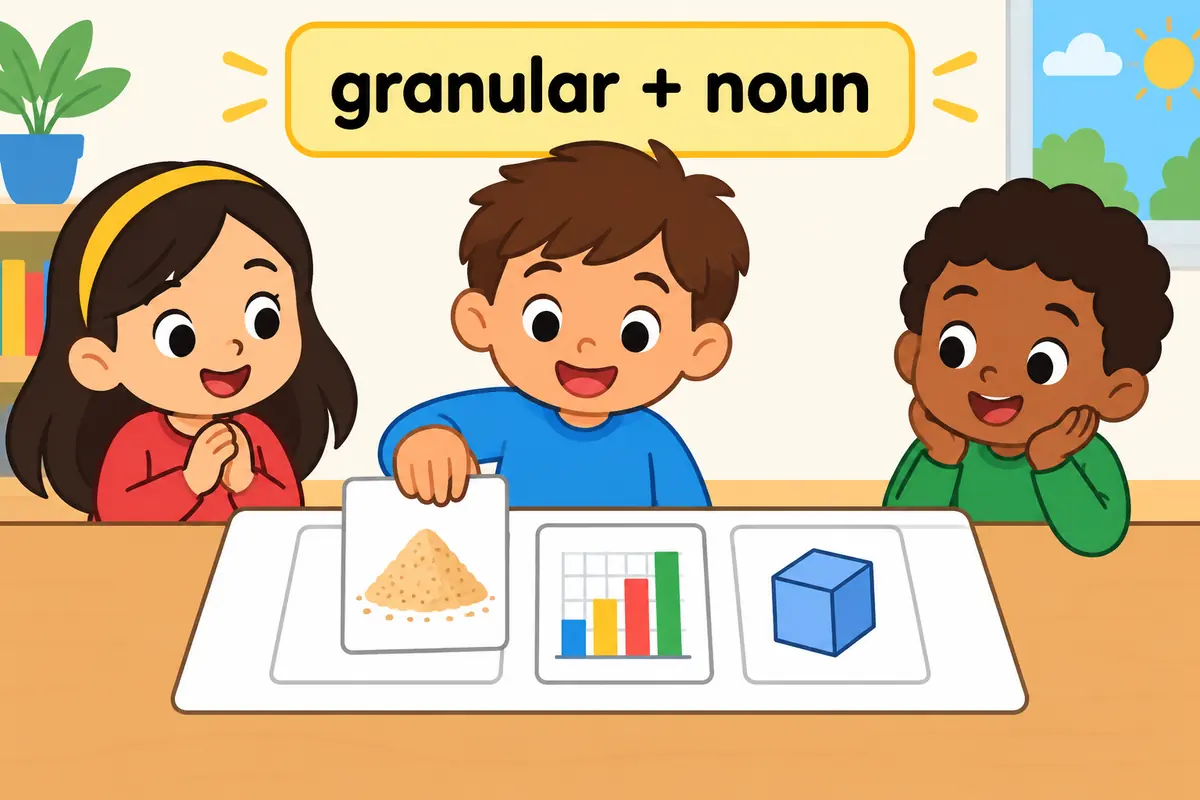
Granular works as a plain adjective, so the pattern is almost always adjective plus noun. Five shapes cover nearly every real sentence, and the phrase at a granular level is the one that turns up most often in business writing.
| Pattern | Example | What it signals |
|---|---|---|
| granular + noun | The team needs granular cost data. | The noun names what is broken into small pieces. |
| at a granular level | We reviewed the accounts at a granular level. | Detail is the viewpoint rather than the object. |
| down to a granular level | The audit went down to a granular level. | Movement from broad figures to fine ones. |
| more / most granular | This year figures are more granular. | Comparison; longer forms beat granularer. |
| granular + of a whole | A granular breakdown of the budget helps the board. | The noun after of names the larger thing divided. |
Granular in a sentence: examples across contexts
Granular changes context more than it changes meaning. The twelve sentences below keep the same adjective while moving from a classroom to a boardroom, and each one names the larger thing that has been broken into small pieces.
| Context | Example sentence | Why this works |
|---|---|---|
| Classroom | The teacher asked for a granular account of how the plant grew. | The noun account is broken into daily steps a pupil can list. |
| Workplace email | Please send a granular breakdown of the travel costs. | Breakdown signals the small parts the manager wants. |
| News report | The inquiry produced a granular picture of the missing hour. | Picture plus granular separates detail from opinion. |
| Technical writing | The log records events at a granular level. | Level names the scale at which records are written. |
| Science writing | The sample showed a granular structure under the lens. | Uses the literal sense of small, separate grains. |
| Data analysis | This dashboard is more granular than last quarter’s. | The comparison shows the word takes more and most. |
| Academic prose | A granular reading of the letters reveals a shifting tone. | Reading plus granular means close, part-by-part attention. |
| Business planning | The forecast is granular enough to price each route. | Enough shows granular can be graded against a job. |
| Quality control | Inspectors kept a granular record of every batch. | Record plus granular implies a line for each unit. |
| Legal drafting | The clause needs a granular definition of each term. | Definition plus granular means one line per term. |
| Manufacturing | The plant tracks granular output figures by machine. | Output plus granular names the unit being counted. |
| Conversation | That is too granular for me right now. | The word survives in speech as a judgement of detail. |
Only the last sentence drops the following noun, and even there the missing word is understood as level. That is why a learner can nearly always fix a doubtful sentence by adding the noun the adjective describes. A useful test is to ask what has been broken into small pieces, because the answer names the missing noun.
Granular vs grainy
Granular and grainy share the idea of grain but point at different things. Grainy describes a surface or a photograph with visible grain or noise, while granular describes a substance made of grains or information split into small parts. A grainy photograph is a poor copy; a granular dataset is one you can zoom into.
| Attribute | granular | grainy |
|---|---|---|
| Core meaning | Made of grains; detailed and split into small parts | Covered with visible grain or noise |
| Typical nouns | data, detail, level, breakdown | photo, film, texture, screen |
| Connotation | Precise, controlled, technical | Rough, imperfect, low quality |
| Literal use | Sand, sugar, soil | Photographs, recordings, screens |
| Opposite | Coarse, broad | Smooth, clear |
| Pairs with | at a granular level, granular enough | a grainy photo, visible grain |
Verdict: choose granular when something is made of grains or broken into fine parts, and grainy when the grain is a flaw on a surface. If you mean exact and clearly stated, precise avoids both words.
Word forms and grammar of granular
Granular changes form regularly, and its noun granularity is common in technical writing. The compound fine-grained covers the same ground when the pieces or the detail are especially small.
| Form | Part of speech | Example |
|---|---|---|
| granular | adjective | A granular view helps the reviewer. |
| granularity | noun | The data can be split to any granularity. |
| granularly | adverb, rare | The figures were granularly recorded. |
| granule | noun, related | Each granule of sugar dissolved in the cup. |
| granulated | adjective, related | The recipe calls for granulated sugar. |
| more / most granular | comparative forms | The second sheet is the most granular. |
| grain | noun, related | A single grain of rice is easy to see. |
The noun ends in -ity, like many abstract nouns, so granularity is never plural. The related verb granulate means to form grains and appears mainly in cooking and industry.
Common mistakes with granular
Most granular errors come from treating an adjective as a noun or from reaching for an -er comparative. The six corrections below show the rule behind each.
- Incorrect:
The report was very granulars.Correct: The report was very granular. Rule: granular is an adjective and never takes a plural s. - Incorrect:
Please give me the granular.Correct: Please give me the granular detail. Rule: the adjective needs a noun unless the context has already named one. - Incorrect:
This sheet is more grainier than that one.Correct: This sheet is more granular than that one. Rule: use more granular for detail and grainier only for a flawed surface. - Incorrect:
We need granular of the budget.Correct: We need a granular view of the budget. Rule: granular does not take of directly; add the noun it describes. - Incorrect:
The sugar is very granularly.Correct: The sugar is very granular. Rule: the adverb granularly describes an action, not a state. - Incorrect:
We need a granularer forecast.Correct: We need a more granular forecast. Rule: longer adjectives take more and most rather than an -er ending.
Practice using granular
Work through the seven items, then read the reason beside each answer rather than only the key.
- Fill the gap: The manager wanted a ______ breakdown of every expense.
- Choose the better word: The old photograph looked (granular / grainy).
- Correct the error: The figures were presented at a granular.
- Build a sentence: use at a granular level about a school timetable.
- Spot the register: which belongs in a data report — the dataset is granular by postcode, or that is too granular for me?
- Rewrite with the noun: The team analysed the sales in close detail. Use granularity instead.
- Correct the error: The planner asked for a granularer schedule.
Answers
- granular — the breakdown is split into small parts, which is the adjective’s job.
- grainy — a photograph’s visible grain is a flaw, not fine detail.
- The figures were presented at a granular level — granular needs a noun after at.
- Model answer: The committee reviewed the timetable at a granular level, checking each lesson slot.
- The dataset is granular by postcode — a report names the unit and avoids the spoken judgement.
- The team analysed the sales at a high granularity — the noun keeps the same meaning.
- The planner asked for a more granular schedule — longer adjectives take more, not -er.
The bottom line
Use granular in a sentence when you need an adjective for something made of grains or split into small, detailed parts. The two decisions that matter most are these: granular almost always sits before a noun, and it describes the size of the pieces rather than their importance. Choose coarse when you mean a texture of large, separate pieces instead.

Frequently asked questions about granular
Is granular a formal word?
Granular belongs to technical, business and academic writing, where a breakdown into small parts matters. In casual conversation the same idea is usually just detailed. Saying the figures are granular in a message to a friend sounds like office jargon, while a planning document would use the word without comment.
What does granular mean in data work?
In data work granular means recorded at a fine level, so each row or category is small enough to examine on its own. Granular data by postcode is finer than data by city. The opposite is aggregate, and neither is automatically better, because finer detail costs more to collect and store.
What is the difference between granular and grainy?
Granular describes something made of grains or split into small parts, and it is usually neutral or positive. Grainy describes visible grain or noise, and it is usually a flaw. A granular dataset is detailed by design, while a grainy photo is unclear by accident.
Can granular describe sand?
Yes. Sand, sugar, soil and coffee are granular when their particles are small and separate. This literal sense is the older one, and the business sense grew from it. If you mean that a surface feels rough rather than that a substance is made of grains, grainy is the safer word.