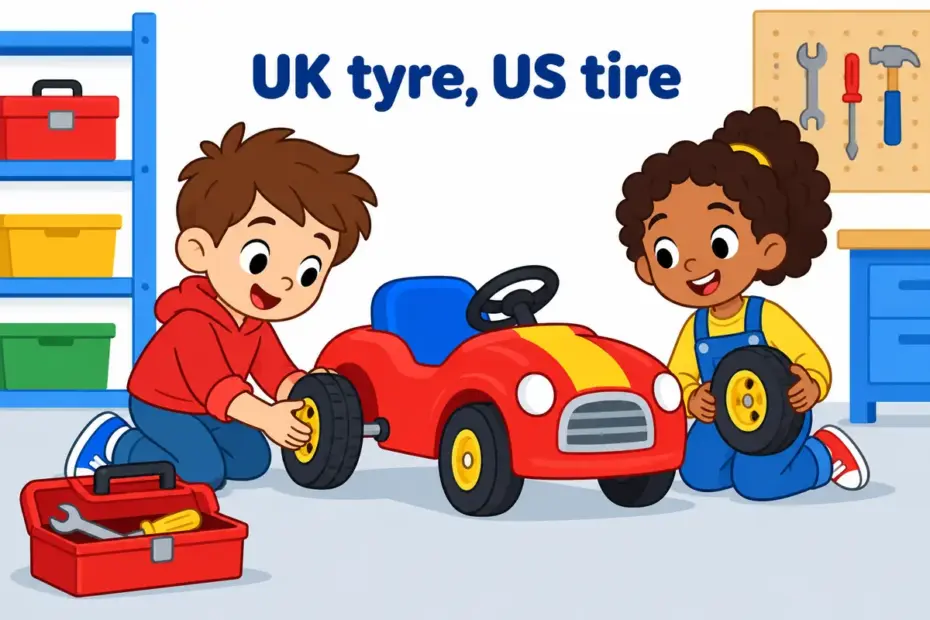
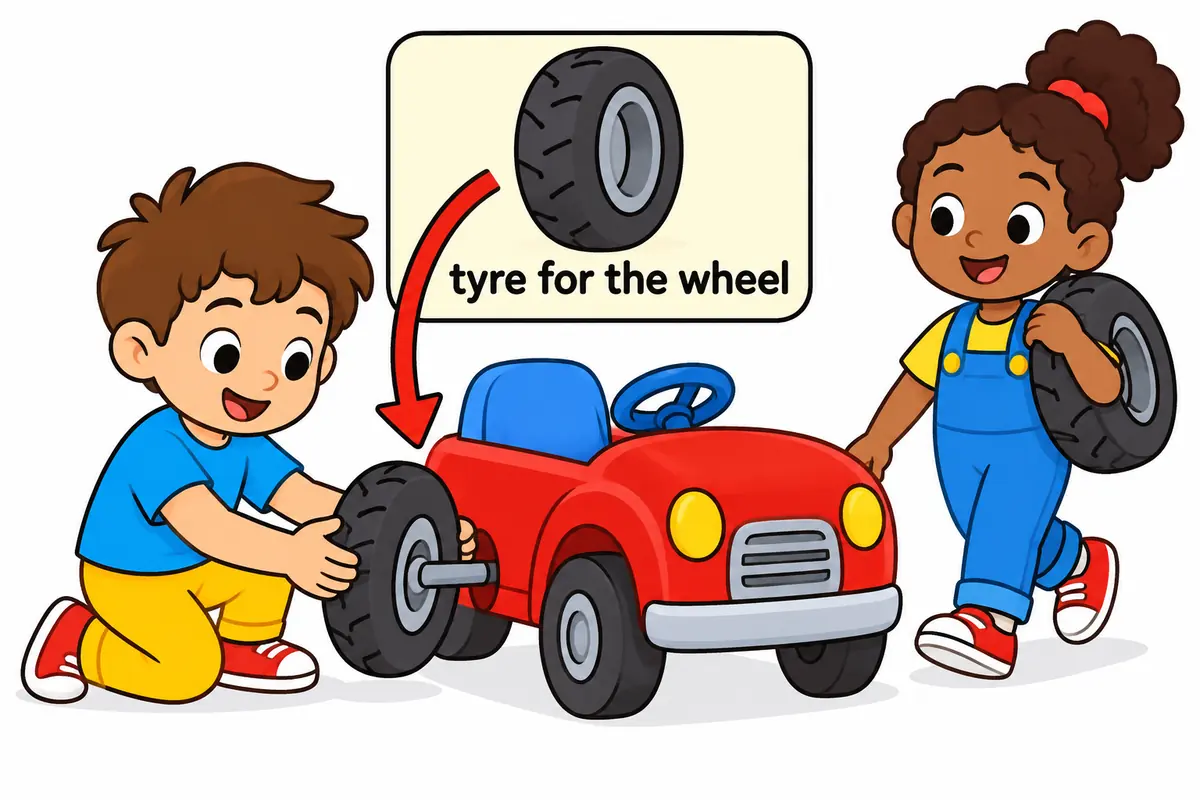
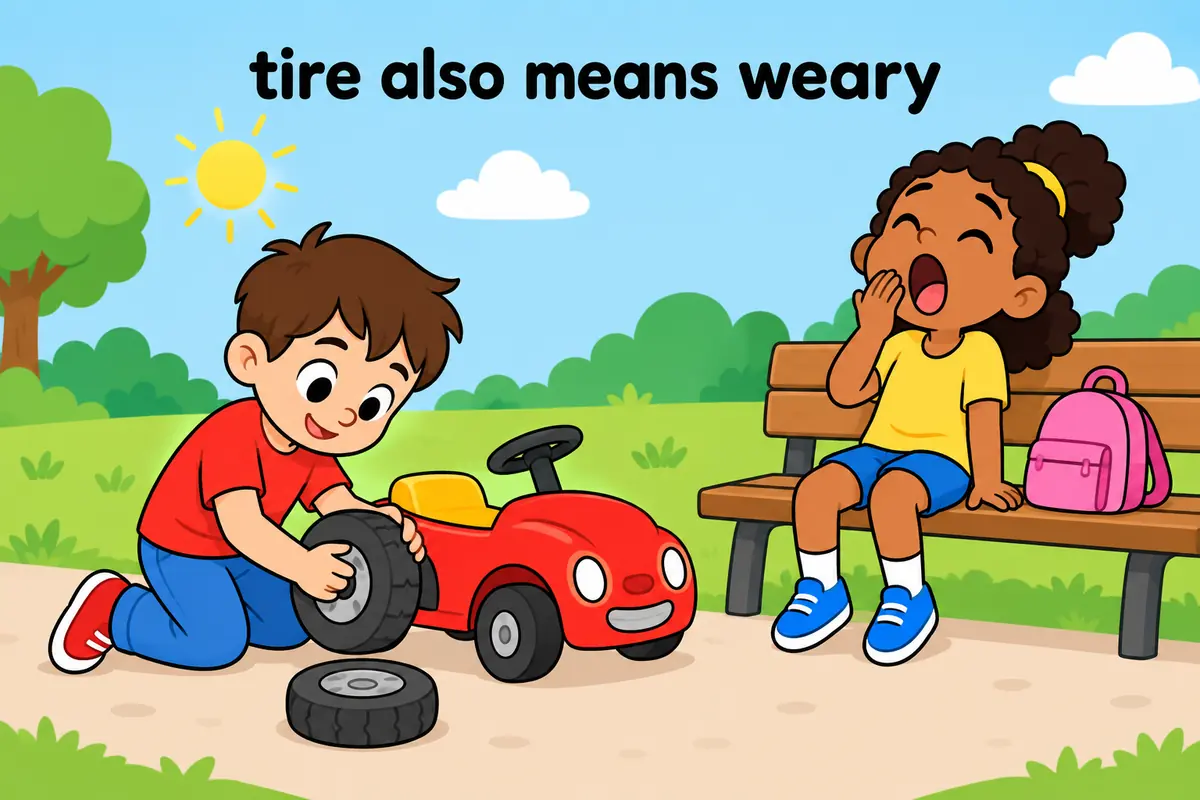
The tyre vs tire question comes down to geography: British English writes tyre for the rubber wheel, and American English writes tire. Choose tyre in UK, Irish, Australian and Indian writing, choose tire in US writing, and remember that tire is also a verb meaning to grow weary. Both spellings share one pronunciation.
Tyre vs tire at a glance
- Tyre and tire are two spellings of the same noun, the rubber ring around a wheel.
- Tyres is the British plural; tires is the American plural.
- British, Irish, Australian and Indian English use tyre; American and Canadian English use tire.
- Tire has a second life as a verb meaning to grow weary, and tyre never does.
- The commonest error is mixing the two spellings inside one document or matching the wrong one to the audience.
What does tyre vs tire mean?
Tyre and tire are the same word for a wheel covering, divided only by spelling convention. The Cambridge entry for tyre gives it as the British form, and the Merriam-Webster entry points to tire as the American equivalent. The Cambridge entry for tire and the Merriam-Webster entry also record the separate verb.
As a noun, tire names the same object in American English: the rubber ring that fits around a wheel and grips the road. A spare tyre and a spare tire are identical items. As a verb, tire means to make or become weary, and that sense belongs to both dialects, spelled tire everywhere.
One limitation is worth stating. The two spellings are not interchangeable inside a single text. A page that uses tyre in one paragraph and tire in the next looks careless rather than international, so the real decision is which convention the whole document will follow.
Tyre vs tire compared
The table sets the two spellings against the decisions writers actually make. Nothing here changes the pronunciation, only the conventions that surround each form.
| Attribute | tyre | tire |
|---|---|---|
| Core meaning | Rubber covering around a wheel | Same object, American spelling |
| Main regions | UK, Ireland, Australia, India | United States and Canada |
| Plural form | tyres | tires |
| Other senses | Noun only | Noun and the verb to grow weary |
| Related forms | tyred is non-standard | tired, tiring, tireless |
| Global reach | Standard in its regions | Widely recognised everywhere |
| What it signals | A British-style text | An American-style text |
Which should you use?
Five situations cover almost every real choice, and each one has a firm answer.
- Writing for a US or Canadian audience: use tire, because it is the local standard.
- Writing for a UK, Irish, Australian or Indian audience: use tyre to match house style.
- Writing for a mixed international audience: pick one spelling and keep it, since consistency matters more than the choice.
- Using the verb meaning to grow weary: always tire, even in British English.
- Quoting a brand, a title or a sign: keep the source spelling rather than converting it.
How do you use tyre and tire in a sentence?
The noun behaves the same in both spellings, and only the verb is fixed as tire. The patterns below show where each form appears and what it signals to a reader.
| Pattern | Example | What it signals |
|---|---|---|
| a tyre or tire, singular | The front tyre was flat. | One countable item, with an article. |
| tyres or tires, plural | We replaced both rear tires. | The plural matches the chosen convention. |
| tyre or tire as a modifier | Check the tyre pressure gauge. | The noun acts like an adjective before another noun. |
| compound nouns | There is no spare tire. | Fixed phrases follow the same spelling rule. |
| tire + object, verb | The long climb tired the walkers. | The verb sense, always spelled tire. |
| tire of + noun, verb | She soon tired of the game. | The verb with of, meaning to lose interest. |
Tyre and tire in a sentence: examples across contexts
The examples below move between British and American settings on purpose. Each sentence uses the spelling that fits its audience and shows what the writer is doing.
| Context | Example sentence | Why this works |
|---|---|---|
| British news report | A lorry shed a tyre on the motorway. | British spelling with British vocabulary. |
| American news report | A truck blew a tire on the interstate. | American spelling with American vocabulary. |
| Car manual, UK | Inflate each tyre to the pressure on the door. | Technical instructions keep one convention. |
| Car manual, US | Rotate the tires every six thousand miles. | The same instruction in American spelling. |
| Workplace email | The car needs a new tyre before Friday. | Everyday language matching the local office. |
| Travel writing | We changed a tyre by the roadside in Kerry. | The setting and spelling agree. |
| Product listing, US | All-season tires with deep tread. | Retail copy follows the market it sells into. |
| Sports commentary | He changed a punctured tyre and rejoined the race. | British coverage keeps tyre throughout. |
| Technical spec | Torque each wheel nut in a star pattern. | The nearby spelling stays consistent. |
| Conversation, verb | That hill will tire anyone carrying a bag. | The verb is tire in every dialect. |
| Book review, verb | Readers may tire of the long chapters. | Tire of means to lose interest. |
| Idiom | He patted his spare tyre and laughed. | The British idiom for a waistline keeps tyre. |
Read the list straight through and the pattern is obvious: the noun follows the region, and the verb never varies. Mixing the two within one piece is the only choice that looks wrong to both audiences.
Word forms and grammar of tyre and tire
The noun has two spellings, while the verb and its adjectives belong to tire alone. The table separates them so the boundary is easy to keep.
| Form | Part of speech | Example |
|---|---|---|
| tyre | noun, British | The tyre burst near the bridge. |
| tire | noun, American | One tire needed air. |
| tires | noun plural, American | The new tires were fitted quickly. |
| tire | verb, base form | Do not tire the children out. |
| tired | adjective, past participle | The tired hikers rested. |
| tiring | adjective, present participle | It was a tiring journey. |
| tireless | adjective | Her tireless work paid off. |
| tyred | spelling – non-standard | Use tired for the adjective, never tyred. |
Common mistakes with tyre and tire
- Incorrect:
The mechanic checked all four tyres on the American truck.Correct: The mechanic checked all four tires on the American truck. Rule: Match the spelling to the audience; American writing uses tire. - Incorrect:
I tyre of long meetings.Correct: I tire of long meetings. Rule: The verb meaning to grow weary is always spelled tire, in every dialect. - Incorrect:
He looked tyred after the trip.Correct: He looked tired after the trip. Rule: The adjective is tired; tyred is not a word. - Incorrect:
The bicycle tyres is flat.Correct: The bicycle tyres are flat. Rule: The plural noun takes a plural verb, whichever spelling is used. - Incorrect:
Tyre the children out before bed.Correct: Tire the children out before bed. Rule: The verb form is tire even in British English.
Tyres, tires and the words around them
The spelling choice spreads to the whole vocabulary of wheels, so a document that decides on tyre must keep that decision in every related word. The table below gathers the terms a driver or writer meets most often, with the British form shown first.
| British term | American term | What it means |
|---|---|---|
| tyre | tire | The rubber ring around a wheel. |
| spare tyre | spare tire | The emergency wheel covering kept in the boot or trunk. |
| tyre pressure | tire pressure | The inflation level measured in pounds or bars. |
| tyre tread | tire tread | The grooved surface that grips the road. |
| puncture | flat tire | The same problem, named differently on each side. |
| wheel | wheel | The metal or alloy rim, spelled the same everywhere. |
Two traps sit inside this list. First, wheel does not change spelling, so a sentence about tyre pressure still writes alloy wheel. Second, the verb tire and its adjectives tired, tiring and tireless keep the American spelling even in British texts, which means a British garage sells tyres but a long drive still tires the driver.
Practice using tyre and tire
Work through the six items, then read the reasoning beside each answer.
- Fill the gap: The garage replaced the front ______ on the London taxi. (tyre / tire)
- Choose the better word: After the long climb, the walkers began to (tyre / tire).
- Correct the error: The US factory ships all four tyres with the car.
- Build a sentence: use spare tyre about a car journey in Australia.
- Spot the register: which belongs in a British newspaper – A tyre blew on the M6, or A tire blew on the M6?
- Rewrite for a US audience: The tyre pressure warning light came on. Change the spelling.
Answers
- tyre – the London setting calls for the British spelling.
- tire – the verb to grow weary is always spelled tire, even in British English.
- The US factory ships all four tires with the car – American writing uses tires.
- Model answer: We packed a spare tyre for the long drive across Australia.
- A tyre blew on the M6 – the British paper and British road name keep tyre.
- The tire pressure warning light came on – American English spells the noun tire.
The bottom line
Use tyre in British, Irish, Australian and Indian writing, use tire in American and Canadian writing, and never let the two spellings share a page. The two facts that settle the tyre vs tire choice are that the noun simply follows the region, and that the verb meaning to grow weary is tire everywhere. When a mixed audience is reading, consistency matters more than which convention you pick.
Frequently asked questions about tyre and tire
Is tyre used in American English?
American English uses tire for the wheel covering, so a US reader expects tire in every context. Tyre does appear in American writing when a source, a brand or a British quotation keeps it, but the general convention is firm. If your audience is American, write tire.
How do you spell the plural of tyre?
The British plural is tyres, as in all four tyres were new. The American plural is tires, as in all four tires were new. Each plural simply adds s to its own singular. Do not mix them, because one text should follow a single spelling system from start to finish.
Does tyre have a verb form?
No. The verb meaning to make or become weary is spelled tire in both British and American English, so a British writer still writes the climb tired us. Only the noun has two spellings. That is why tyred is wrong as an adjective and tired fills the role everywhere.
What does a spare tyre mean?
In the literal sense it is the extra wheel covering kept in a car for emergencies. In informal British and American English, a spare tyre also means a roll of fat around the waist, usually said with a laugh. The noun keeps its regional spelling in both senses.