Dragon adjectives can describe a fictional creature’s shape, movement, temperament, or imagined powers: winged, serpentine, watchful, or flame-bright. For a specific cultural artwork, identify its place and period instead of treating every dragon as alike. A Komodo dragon is a real monitor lizard, so describe its observed anatomy—not mythical wings or fire.
At a glance: decide which dragon you mean
Fantasy or fiction: choose details that fit your own creature and scene. Myth, art, or cultural history: name the specific work, community, place, and period when known; symbols are not universal. Komodo dragon: describe a real lizard using observable or sourced facts. The setting determines which adjectives are accurate.
Fantasy dragons, cultural imagery, and a real animal
“Dragon” can refer to an invented creature in a story, a figure in a particular myth or artwork, or the Komodo monitor lizard. These subjects overlap in name but not in evidence: wings and magical breath belong to an imagined creature unless a story or picture supplies them; a zoological description should stick to the animal.
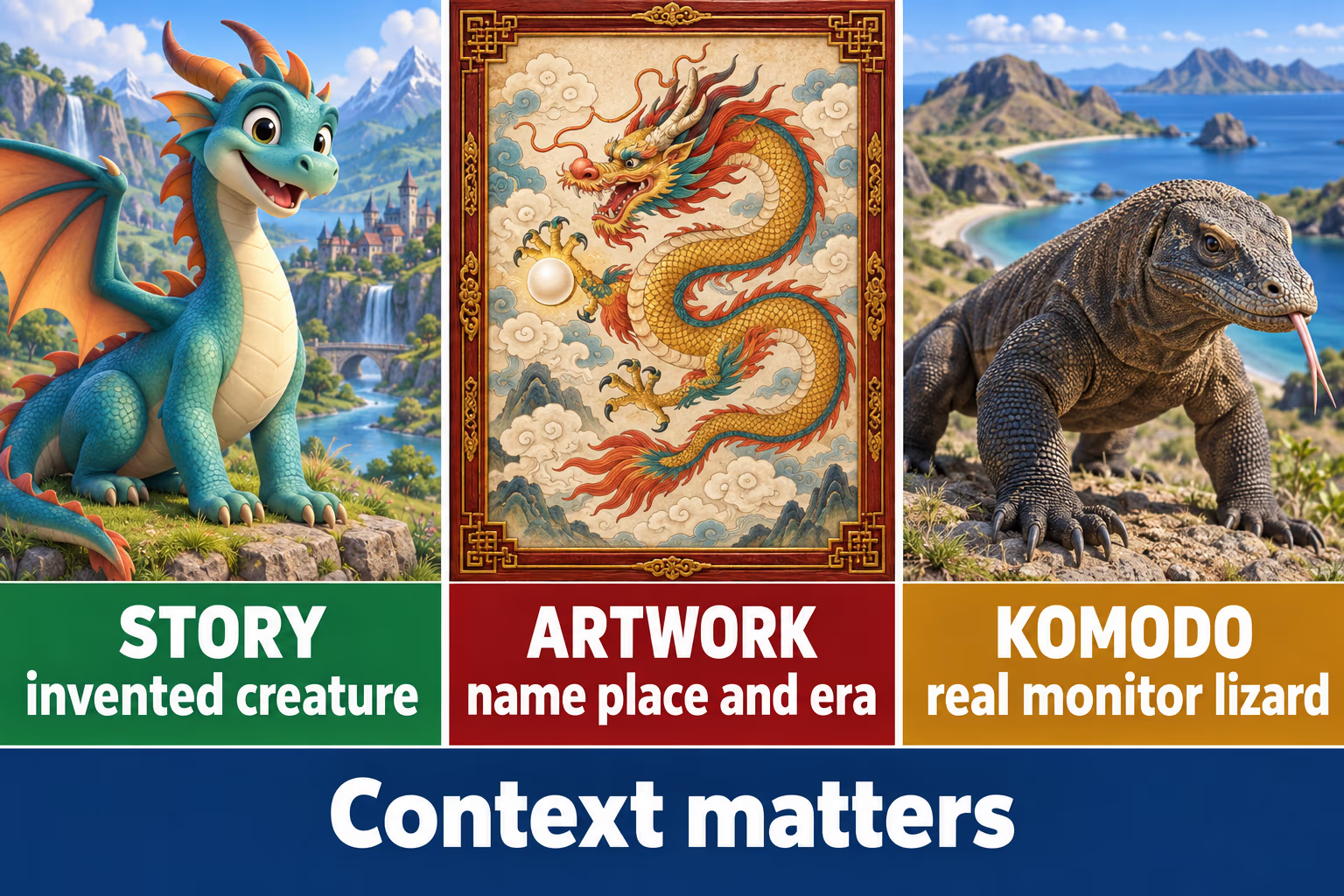
Describe a specific mythic or artistic tradition
Dragon imagery varies across communities, periods, objects, and stories. For example, a British Museum note for an Edo-period Japanese painting discusses ancient Chinese beliefs associating dragons with clouds and water and their control of rain; the same note describes the painter’s engagement with Chinese and Japanese styles. A separate British Museum record for a Qing-era Chinese water-pot describes dragons as auspicious and associated with water and imperial authority. These are object-specific historical notes, not a rule for every Chinese or Japanese dragon.
The Metropolitan Museum of Art describes the dragons (long) in one late Ming-period Chinese panel as symbols of imperial power and benevolence, shown amid clouds and pursuing a flaming pearl. That interpretation belongs to this work and its setting. When describing another artwork, identify what is visible and consult its own collection record rather than borrowing a symbol from a different tradition.
When you can, replace broad labels such as “Asian dragon” with a precise description of the image, place, period, or named tradition. A source-supported example is clearer than a claim that all dragons from a large region share one meaning. See the British Museum painting record, its Qing water-pot record, and the Met’s panel with dragons amid clouds.
Komodo dragons are living monitor lizards
A Komodo dragon is a real, large monitor lizard, not a winged or fire-breathing mythical creature. The Smithsonian’s National Zoo describes its long tail, strong limbs, large scales, forked tongue, and stone-colored adult appearance. Those details support words such as large, scaly, strong-limbed, and fork-tongued in a factual description. The Zoo also describes a venomous bite, but do not use venomous for other lizards or fictional dragons as if it were a zoological fact. Read the Komodo dragon fact sheet or explore our broader adjectives for animals guide.
Choose a dragon adjective by the detail you notice
Strong description usually begins with one visible feature, movement, or behavior. Then select words that build the mood you want. The categories below are options for a scene or artwork, not a checklist that every dragon must match.
Shape, scales, and other visible features
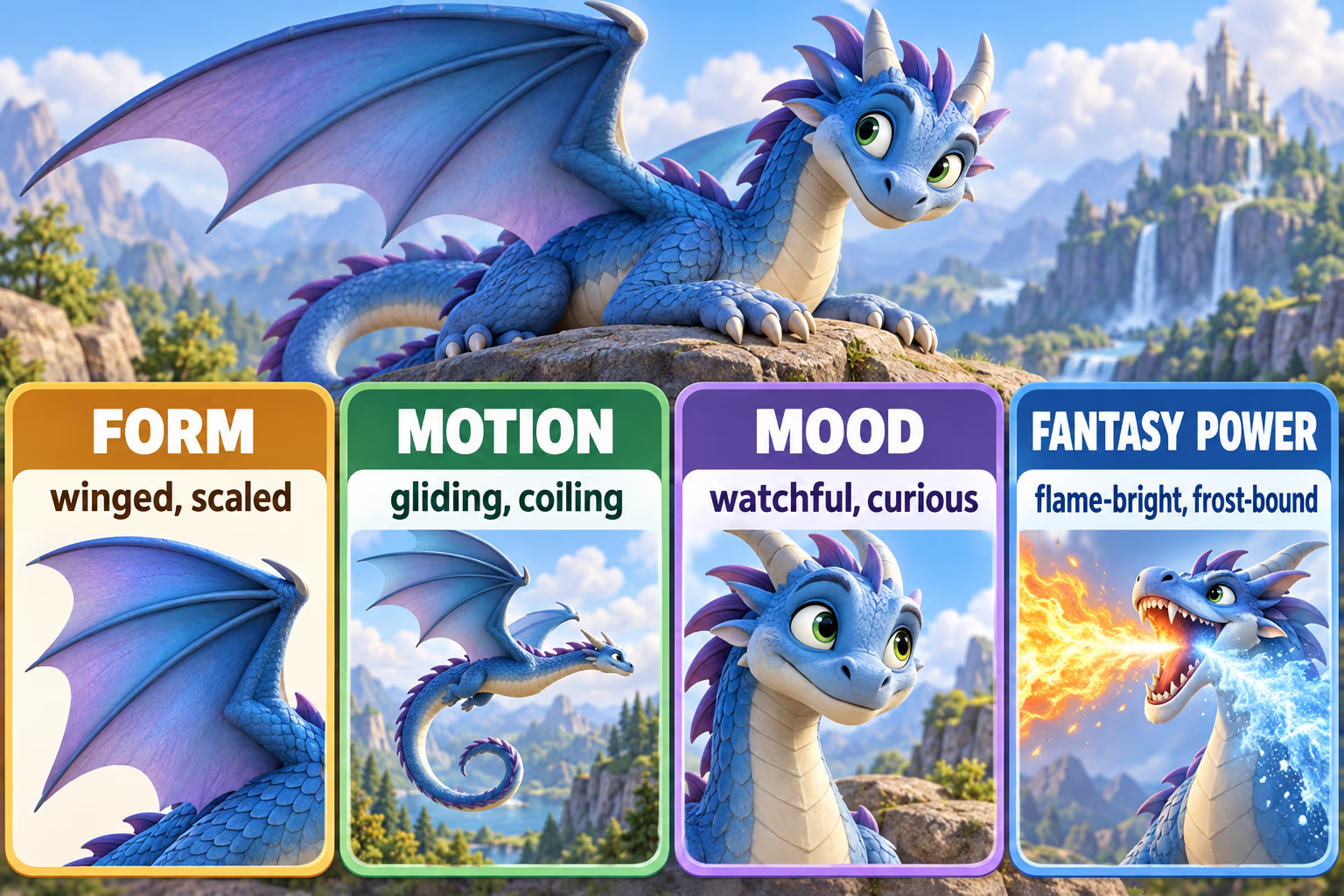
Winged, horned, long-bodied, serpentine, scaled, crested, and four-legged give a reader a form to picture. Armored suggests a protective-looking surface; iridescent describes shifting color in the light. Use a word like wingless or whiskered when that difference matters to your design.
Example: “A narrow, horned dragon with copper scales folded its wing around the lantern.” The sentence combines a few observable features rather than stacking unrelated synonyms.
Movement and sound
Gliding, coiling, lumbering, darting, and soaring describe different motion. Rumbling, rasping, hissing, and silent set an auditory impression. Choose a verb or adjective that fits the creature’s size, setting, and mood: a heavy dragon may lumber across stone, while a slender one might coil around a branch.
Elemental and magical traits for fiction
Flame-breathing, frost-bound, storm-calling, and luminous can describe invented powers. Mark them as part of a fictional creature or a particular story; they are not facts about Komodo lizards or a universal feature of mythic dragons. An elemental adjective works best when the scene shows what it changes.
Example: “The frost-bound dragon left a silver rime across the bridge rails.” The specific effect gives frost-bound meaning beyond a label.
Temperament and story role
Watchful, curious, protective, aloof, playful, and territorial suggest behavior or attitude. Guardian, guide, rival, and antagonist describe a dragon’s relationship to a story, not its anatomy. A dragon can be gentle in one scene and dangerous in another; avoid treating evil or ferocious as a required trait.
Example: “The watchful guardian allowed travelers to pass only after they answered the old riddle.” Its role and action explain the description better than calling every dragon fierce.
A simple way to make a description vivid
Choose one shape detail, one action, and one effect on the scene: “A bronze-scaled dragon coiled around the tower and sent sparks drifting over the rooftops.” For a museum object, state what the image shows and name its source; for a living animal, use observable features and a reliable zoological reference. This keeps inventive language vivid while separating fact from interpretation.
For more imaginative vocabulary, browse adjectives for fantasy. Add only words that sharpen the picture you want readers to see.
Using the original adjective lists below
The original list and examples below are preserved. Read broad labels in their local context: a word can suit one invented character but misrepresent another story, artwork, or animal. If you are describing a specific tradition, artwork, or species, use a precise source and make clear whether a word is an observation or an imaginative choice.
Ever since the days of ancient mythology, dragons have been a popular source of storytelling. These mythological creatures are often imagined as large, ferocious, and powerful beasts, but they can also be kind, wise, and protective.
Whether you’re writing about a friendly fire-breathing dragon or a fearsome ice dragon, there are many adjectives to choose from to describe your dragon in all its glory. Here are some adjectives to get you started.
When it comes to describing a dragon, there are many words that can be used to create an accurate picture. Below are some words that could be used to describe a dragon:
- Ferocious
- Intimidating
- Powerful
- Fierce
- Deadly
- Majestic
- Mythical
- Legendary
- Reptilian
- Scaly
- Breathtaking
Adjectives to Describe a Dragon

Dragon Adjectives With A | B | C
| Adorable | Asian | Breathing |
| Air Lifting | Bearded | Breathtaking |
| Alarming | Benevolent | Bruised |
| Alien | Black | Central |
| Alive | Blue | Certain |
| Anthropomorphic | Bodied | Chafed |
C | D | E
| Chained | Dear | Emblematic |
| Chaldean | Defunct | Enormous |
| Chinese | Devouring | Evil |
| Cursed | Dreadful | Excitable |
| Dead | Eager | Extraordinary |
| Deadlier | Emaciated | Extreme |
F | G
| Fabulous | Fierce | French |
| Fantastic | Fiery | Friendly |
| Favorite | Flaming | Giant |
| Fearful | Flying | Gilded |
| Fearsome | Formidable | Glide |
| Ferocious | Fossilized | Gold |
G | H | I
| Golden | Headed | Hover |
| Grateful | Hideous | Huge |
| Greedy | Holy | Hungry |
| Green | Horrible | Imaginary |
| Grim | Horrid | Impassable |
| Hair Raising | Hostile | Incongruous |
I | J | L | M | N | O
| Individualized | Live | Multi Colored |
| Infamous | Lofty | Mysterious |
| Intelligent | Lonely | Niched |
| Iron | Marvellous | Noxious |
| Japanese | Mighty | Numerous |
| Large | Monstrous | Old |

O | P | R
| Organic | Prancing | Real |
| Oriental | Prodigious | Red |
| Pantomime | Prone | Reluctant |
| Penetrated | Prostrate | Remotest |
| Petrified | Purple | Respecting |
| Phenomenal | Razor Sharp | Revengeful |
S
| Scaly | Small | Spell |
| Silly | Snap | Spine Chilling |
| Sizeable | Soar | Spouting |
| Skimming | Solid | Steal |
| Sleeping | Sowst | Strange |
| Sleepless | Speckled | Stuffed |
S | T | U
| Stupendous | Terrifying | Unjoyful |
| Sturdy | Thirsty | Unpastured |
| Swift | Tiny | Unreasonable |
| Take Wing | Towering | Unrefined |
| Terrible | Traditional | Uplifting |
| Terrific | Turquoise |
V | W
| Vanquished | Weedy | Wonderful |
| Venomous | Wicked | Wounded |
| Veritable | Wild | Writhing |
| Vicious | Wily | |
| Watchful | Winged |
How to describe a dragon?
There are many words that can be used to describe a dragon, depending on its size, shape, and color. Some common words used to describe dragons include massive, ferocious, winged, and scaly.
Dragons can also be described by their elements, such as fire dragons or water dragons. Whatever words you choose to use, make sure they capture the true essence of these amazing creatures!
Words describing dragons might also include:
- enormous
- giant
- hulking
- colossal
- titanic
- monstrous
- behemoth
Final words
There you have it, adjectives to describe a dragon! While we only covered a few adjectives, there are many more out there. Feel free to add to the list in the comments below. And, if you’re looking for more adjectives, be sure to check out our other articles on adjectives for business and adjectives for hard working people. Thanks for reading!
Frequently asked questions about dragon adjectives
What are good adjectives to describe a dragon?
For an imagined dragon, choose words that match its form and behavior: winged, scaled, gliding, watchful, or protective. If it has a fictional power, a phrase such as flame-breathing can work. A specific action or visual detail makes each adjective more vivid.
Are all dragons evil or fire-breathing?
No. Those are familiar choices in some stories, not universal traits. Dragons vary across artworks and traditions, and fictional writers can make them kind, dangerous, curious, protective, or something else. Describe the particular character or source rather than assuming one template.
What is the difference between a mythical dragon and a Komodo dragon?
A mythical or fantasy dragon is a legendary or invented creature whose form and powers depend on the source. A Komodo dragon is a real monitor lizard. For the animal, use observed anatomy and zoological sources; do not imply it has wings or magical breath.
Do dragon symbols mean the same thing in every culture?
No. Meanings vary across traditions and individual works. Museum records describe specific examples of dragons connected with water, rain, auspiciousness, or imperial authority in particular historical contexts. Name the work, place, and period when possible, and avoid presenting one object’s symbolism as universal.
Can “reptilian” describe a dragon?
Yes, when you mean that an imagined creature resembles a reptile, perhaps through scales or a long tail. The word describes an impression; it does not make a mythical dragon a real reptile. For an actual Komodo dragon, use factual descriptors such as large, scaly, or fork-tongued when they fit the animal.


