Supplicate means to ask for something humbly and earnestly, almost always from someone with the power to grant it. To use supplicate in a sentence, name both the request and the person or power being addressed: “The villagers supplicated the governor for aid.” The verb is formal, and it belongs to religious, historical and literary writing rather than everyday speech.
Supplicate at a glance
- Supplicate is a verb meaning to ask or pray humbly and earnestly.
- Its forms are supplicates, supplicated, supplicating, supplication and supplicant.
- The dominant pattern is supplicate + a person or power, or supplicate for + a thing.
- It carries a strong sense of unequal power: the speaker asks someone who can grant.
- The commonest error is using this lofty verb for an ordinary request, such as asking for a discount.
What does supplicate mean?
Supplicate is a verb meaning to ask for something in a humble and earnest way, or to pray humbly to a higher power. The Cambridge entry for supplicate stresses the humility of the request, and that humility is the whole point of the word. The table separates the three situations in which it appears.
| Sense | Plain meaning | Example sentence |
|---|---|---|
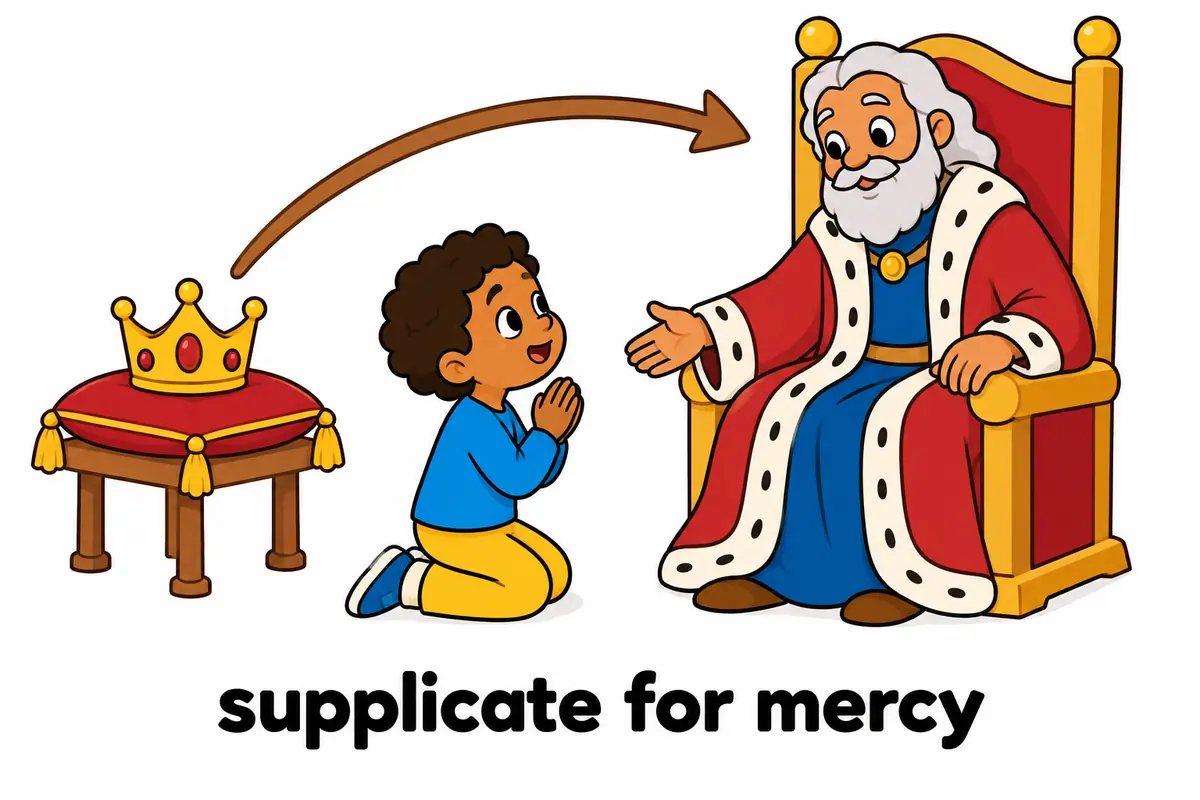
| Beg a person in authority | Ask someone who can grant a request | He supplicated the king for his brother’s life. |
| Pray humbly | Address a god or gods with a petition | The pilgrims supplicated the goddess at the shrine. |
| Make an earnest formal plea | Petition an institution in set language | The town supplicated the parliament for a new bridge. |
Two limitations are worth stating plainly. Supplicate is far too lofty for a routine request, and it usually implies that the person asked holds real power over the answer. Where the request is desperate and emotional rather than ritual, beseech is the closer literary verb; where it is calm and formal, entreat fits an equal better than supplicate fits an inferior.
How do you use supplicate in a sentence?
Supplicate can take the person or power directly as its object, or the thing wanted after for. Five patterns cover almost every real sentence, and the preposition is what tells the two apart.
| Pattern | Example | What it signals |
|---|---|---|
| supplicate + person or power | They supplicated the emperor in person. | The addressee is the direct object. |
| supplicate + person + for + thing | She supplicated the council for clemency. | Names both who is asked and what is wanted. |
| supplicate for + thing | The prisoners supplicated for pardon. | The addressee is understood from context. |
| supplicate + before + person | He supplicated before the altar. | A ritual posture rather than a request. |
| be supplicated by + noun | The governor was supplicated by dozens of families. | Passive voice keeps the petitioner in focus. |
In modern prose the intransitive for-pattern is the safest, because it never leaves the reader wondering who was addressed. Where a request is made to an authority through a written document rather than by a person pleading, plead and file a petition are the practical alternatives.
Supplicate in a sentence: examples across contexts
Supplicate keeps its meaning across registers; what changes is the setting and the balance of power. The twelve sentences below move from a school hall to a temple to a historical chronicle, and each names who is asking whom.
| Context | Example sentence | Why this works |
|---|---|---|
| Historical writing | The envoys supplicated the emperor for a truce. | The verb matches the formality of the court. |
| Religious writing | The congregation supplicated the heavens for rain. | The power addressed explains the humility. |
| Literary prose | She supplicated her father for one more year of study. | The family hierarchy makes the verb believable. |
| Legal petition | The tenants supplicated the court for more time to move. | Names the institution and the specific relief. |
| News report | Villagers supplicated the ministry after the flood. | Sets the plea against a public disaster. |
| Translation of an epic | The hero supplicated the sea god before the voyage. | Keeps the epic register in English. |
| Formal letter | We supplicate your committee for a hearing. | The collective we suits a formal plea. |
| Museum label | A carved figure supplicates the god of the harvest. | Describes an image in the present tense. |
| Opera summary | In the final act, the prisoners supplicate the duke for mercy. | The verb carries the scene’s emotion. |
| Classroom history | Peasants supplicated their lord for seed after the bad harvest. | The power gap is stated in one clause. |
| Devotional writing | Each morning she supplicated the goddess for patience. | A repeated private ritual of asking. |
| Academic prose | Petitioners supplicated the crown for licenses to trade. | Names a historical practice precisely. |
Notice that not one of these sentences could be lifted into a text message without sounding absurd. That mismatch is the surest sign that a learner has reached for supplicate too soon.
Supplicate vs implore
Supplicate and implore both describe earnest asking, but they differ in who may ask, in what tone, and in how much ritual surrounds the request. The table separates the attributes that change the choice.
| Attribute | supplicate | implore | petition |
|---|---|---|---|
| Core idea | Ask humbly from below | Beg emotionally and urgently | Make a formal written request |
| Balance of power | Asker is clearly subordinate | Any, often between equals | Asker appeals to an authority |
| Tone | Ritual, reverent | Urgent, personal | Procedural, calm |
| Typical object | A king, a god, a court | A friend, a parent, a reader | A council, a minister, a board |
| Usual medium | Prayer, chronicle, literature | Speech and literary prose | Signed documents and campaigns |
| Opposite | Command or demand | Ignore or refuse | Decree |
Verdict: choose implore when the fear and urgency are personal, petition when the request is written and formal, and supplicate when the speaker is humble before a power that can simply say no. The three share a meaning but never the same dignity of position.
Word forms and grammar of supplicate
Supplicate follows regular verb endings, and its family supplies two useful nouns that are easier to place than the verb itself. The table lists the forms and marks the one that learners build by mistake.
| Form | Part of speech | Example |
|---|---|---|
| supplicate | verb, base form | They supplicate the court every spring. |
| supplicated | verb, past and past participle | The abbess supplicated the bishop for funds. |
| supplicating | verb, present participle | A supplicating letter reached the palace in May. |
| supplication | noun | He raised his hands in supplication. |
| supplicant | noun, a person | One supplicant waited at the gate all morning. |
| supplicatory | adjective, rare | His supplicatory tone softened the judge. |
| supplicationing | non-standard | Use supplicating; supplicationing is not English. |
The related noun suppliant describes the person who asks, and it is far more common in literature than the verb. Note that despite the shared spelling, supplier and supplies are unrelated in meaning and must not be linked to this family in a sentence.
Common mistakes with supplicate
- Incorrect:
He supplicated to the manager for a refund.Correct: He asked the manager for a refund. Rule: Supplicate is too lofty for a routine request, and it takes the person directly rather than after to. - Incorrect:
She supplicated for the gods.Correct: She supplicated the gods for mercy. Rule: The power being addressed is the object; for introduces the thing wanted. - Incorrect:
He supplicated that the king would help.Correct: He supplicated the king for help. Rule: Supplicate takes a noun object or a for-phrase, never a that-clause. - Incorrect:
Her supplicate moved the crowd.Correct: Her supplication moved the crowd. Rule: The noun is supplication; supplicate is only a verb. - Incorrect:
The supplier supplicated a better price.Correct: The supplier begged for a better price. Rule: Supplier is unrelated in meaning to supplicate, and a trade request is too ordinary for the verb.
Practice using supplicate
Work through the eight items, then read the reason beside each answer rather than only the key.
- Fill the gap: In the old chronicle, the villagers ______ the duke for grain.
- Choose the better word: The letter to the council was a formal (supplication / supplier).
- Correct the error: The customer supplicated to the shop for a refund.
- Build a sentence: use supplicate for about a community asking for clean water.
- Spot the register: which belongs in a translation of an epic — the hero supplicated the sea god, or the hero asked the sea god nicely?
- Rewrite with the noun: The prisoners supplicated the duke for mercy. Use supplication instead.
- Match the person noun: the one who supplicates is the ______.
- Fix the clause: The abbess supplicated that the bishop would send money.
Answers
- supplicated — the duke is the power addressed and for introduces what is wanted.
- supplication — the noun names the formal plea; supplier is an unrelated trade word.
- The customer asked the shop for a refund — supplicate is too lofty and takes the person directly.
- Model answer: The villagers supplicated the ministry for clean water.
- The hero supplicated the sea god — an epic translation keeps the reverent verb.
- The prisoners made a supplication to the duke for mercy — the noun takes a verb such as made or a phrase with in.
- supplicant — the noun for the person who asks is supplicant.
- The abbess supplicated the bishop for money — supplicate cannot take a that-clause.
The bottom line
Use supplicate in a sentence when someone humble asks a person or power that can grant or refuse, and keep it for religious, historical and literary settings. The two nuances that decide most sentences are these: the power addressed is the direct object, while for introduces the thing wanted, and the verb implies an unequal relationship that everyday requests do not have. Where the plea is personal and urgent, implore is the better literary choice.

Frequently asked questions about supplicate
Is supplicate still used today?
The verb survives mainly in religious writing, historical fiction and translations of older texts, where formal ceremony is part of the meaning. In ordinary life it has been replaced by ask, beg or appeal. Its noun supplication is more common, appearing in prayer, poetry and descriptions of a formal plea to an authority.
What is the difference between supplicate and implore?
Supplicate is humble and ritual, used when the speaker stands below a person or god who can grant the request. Implore is emotional and urgent, and it can pass between equals. A prisoner supplicates a judge for mercy, while a friend implores a friend to stay. Supplicate implies power, implore implies feeling.
Does supplicate take an object?
It can take the person or power directly, as in she supplicated the king, and it can stand alone with for before the thing wanted, as in they supplicated for pardon. What it never takes is a that-clause, so he supplicated that the king would help must be rewritten as he supplicated the king for help.
What is a supplicant?
A supplicant is the person who supplicates, the one making the humble request. The noun names the asker rather than the act, so one supplicant waited at the gate describes a single petitioner. The related adjective suppliant describes the same person or their manner, as in a suppliant gesture.