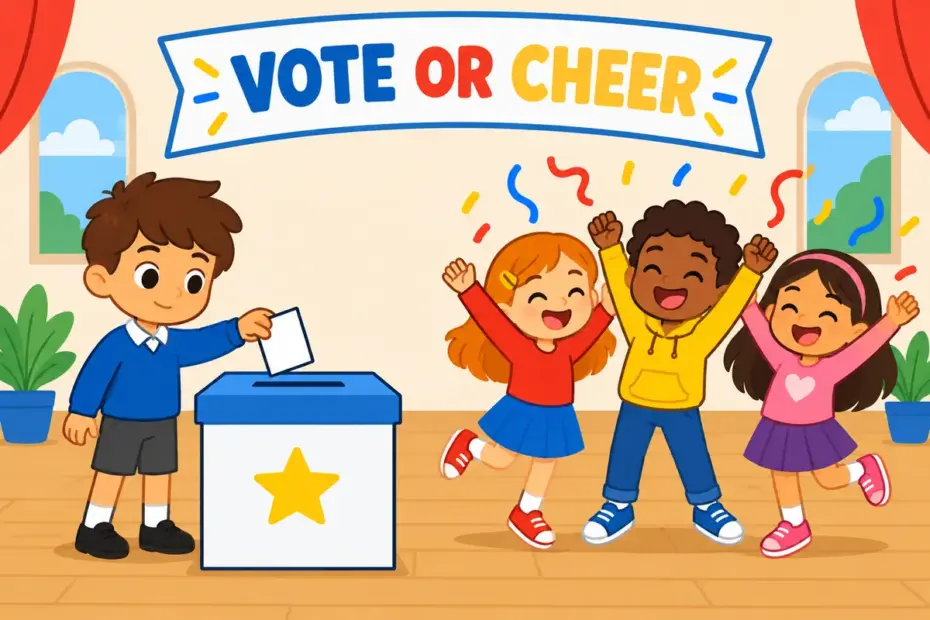
The choice in yea vs yay is simple: write yea for a formal affirmative, especially a vote, and yay for a shout of joy. Yea belongs in minutes, statutes and the phrase the yeas have it; yay belongs in celebrations such as “Yay, we won!” The two words sound identical, which is why they are so often swapped.
Yea vs yay at a glance
- Yea is a noun and adverb for a formal affirmative, especially an affirmative vote.
- Yay is an interjection that expresses joy, triumph or approval.
- The two words are homophones, both pronounced to rhyme with day.
- Yea appears in minutes, statutes and the fixed phrase the yeas have it.
- Yay appears in cheers, messages, posters and children’s celebrations.
- The commonest error is using yay for a vote or yea for a cheer.
Yea vs yay: the master comparison
Eight criteria decide almost every case, and each one points the same way. Read the table from left to right and the two words never overlap.
| Criterion | Yea | Yay |
|---|---|---|
| Part of speech | Noun and adverb | Interjection |
| Core meaning | A formal yes or an affirmative vote | An exclamation of joy or approval |
| Typical setting | Legislatures, minutes, formal votes | Celebrations, chats, posters |
| Register | Formal, legal and historical | Informal and emotional |
| Example sentence | The motion passed with fifty yeas. | Yay! The show starts tonight. |
| Grammar of number | Countable: one yea, many yeas | Stands alone; almost never pluralised |
| Common partner | Nay, the opposite vote | Hooray and woohoo, fellow cheers |
| Homophone note | Sounds exactly like yay | Sounds exactly like yea |
The criterion that settles most arguments is setting. If the sentence could appear in a written record of a vote, the word is yea. If the sentence could be shouted at a party, the word is yay.
What does yea mean, and what does yay mean?
Yea is a noun and adverb meaning a formal yes, especially an affirmative vote. The Cambridge entry for yea records both the vote sense and an older adverb sense meaning indeed or truly. In a legislature, a yea is an affirmative vote, and its opposite is a nay. In older prose, yea introduces an emphatic statement, as in a solemn declaration.
Yay is an interjection, a word that carries feeling rather than grammatical meaning. The Cambridge entry for yay defines it as an exclamation of joy or approval. It stands alone or opens a sentence, as in yay for the weekend, and it never takes a subject or an object. It is a cheer in the simplest sense, and its fellows include hurrah and woohoo.
| Word | Sense | Example sentence |
|---|---|---|
| Yea | An affirmative vote | Forty yeas carried the motion. |
| Yea | An old-fashioned adverb for indeed | Yea, the truth will out. |
| Yay | Joy at good news | Yay! We passed the test. |
| Yay | Approval of a thing | Yay for long weekends. |
Neither word is the ordinary way to say yes. The everyday spoken form is yeah, and the neutral standard form is yes. Yea and yay are specialised: yea counts a vote, while yay voices feeling. Using either one as a general substitute for yes is the mistake that reveals a writer is unsure of the pair.
How do you use yea and yay in a sentence?
Yea behaves like a countable noun or a formal adverb, so it can be pluralised and counted. Yay behaves like a pure interjection, so it stands alone and carries no grammar of number. That single difference explains why the patterns below never mix.
| Pattern | Example | What it signals |
|---|---|---|
| yea as a countable noun | The bill passed by sixty yeas to forty nays. | Counts votes in a record |
| yea as a formal adverb | Yea, we shall prevail. | Elevated or historical declaration |
| yea in a fixed phrase | The yeas have it. | The chair announces the result |
| yay as an interjection | Yay! We finished the project. | Spontaneous joy |
| yay + for + noun | Yay for long weekends. | Approval of a thing or event |
| yay repeated | Yay, yay, yay! | Heightened excitement |
If you need a plural, you need yea, because only yea can be counted. If the word sits alone with an exclamation mark, you need yay, because only yay carries that burst of feeling. No sentence in standard English uses both senses at once.
Yea vs yay in a sentence: examples across contexts
Each setting makes the choice obvious once the context is named. The table gives ten registers, alternating between the two words, with the reason each sentence works.
| Context | Example sentence | Why this works |
|---|---|---|
| Legislative minutes | The motion carried with twenty-three yeas and nine nays. | Yea is the countable vote word. |
| Children’s party | Yay! The magician is here. | Yay voices instant delight. |
| Historical speech | Yea, the long struggle is over. | The adverb sense belongs to elevated prose. |
| Group chat | Yay for a three-day weekend. | Yay plus for approves an event. |
| Court record | The clerk recorded four yeas and two nays. | Yea appears in a formal tally. |
| Sports crowd | Yay! What a finish! | Yay matches a spontaneous cheer. |
| School council | The chair declared that the yeas had it. | The fixed phrase uses yea, not yay. |
| Greeting card | Yay, you did it! | Yay suits a warm written cheer. |
| Statute summary | A two-thirds majority of yeas is required. | Yea names the affirmative votes. |
| Social post | Yay for small wins. | Yay keeps an informal, upbeat tone. |
Word forms and grammar of yea and yay
The two words are covered in parallel so the contrast in their grammar stays visible. The table also marks the shapes that are not standard.
| Form | Part of speech | Example |
|---|---|---|
| yea | Noun, singular | One yea is enough to carry the motion. |
| yeas | Noun, plural | The yeas outnumbered the nays. |
| yea | Adverb, formal or archaic | Yea, it is so. |
| nay | Noun, the opposite vote | Three nays were recorded. |
| yay | Interjection | Yay! We made it. |
| yay for | Interjection plus preposition | Yay for sunshine. |
| yays and nays | Non-standard | Avoid; the correct plural pair is yeas and nays. |
The key grammatical fact is that yay has no plural worth using, because an interjection is not a thing you can count. The moment a sentence needs yeas and nays, the word must be yea. A third word, yeah, is a separate informal yes and never appears in a vote.
Common mistakes with yea and yay
- Incorrect: The yays have it. Correct: The yeas have it. Rule: a formal vote uses the countable noun yea.
- Incorrect: Yea! I passed my driving test! Correct: Yay! I passed my driving test! Rule: a shout of joy uses the interjection yay.
- Incorrect: All the yay votes were counted. Correct: All the yea votes were counted. Rule: votes are yeas, never yays.
- Incorrect: She shouted yea from the back row. Correct: She shouted yay from the back row. Rule: a cheer is yay; yea is written, not shouted.
- Incorrect: Yea, that sounds fine to me. Correct: Yeah, that sounds fine to me. Rule: the everyday spoken yes is yeah, not yea.
- Incorrect: Please vote yay or nay. Correct: Please vote yea or nay. Rule: the paired opposite is nay, so the affirmative is yea.
Practice using yea and yay
- Fill in the blank: The motion passed with thirty ______ and twelve nays.
- Choose the better word: ______! The concert starts in an hour. (Yea / Yay)
- Correct the error: The chair announced that the yays had it.
- Build a sentence: use yea as a countable noun about a school council vote.
- Spot the register: which sentence belongs in formal minutes? (a) Yay, we won the vote! (b) The yeas carried the motion.
- Fill in the blank: ______ for a quiet evening at home.
- Correct the error: She yelled yea when her team scored.
- Fill in the blank: In older writing, ______ often means truly or indeed.
Answers
- yeas — votes are counted with the noun yea.
- Yay — an exclamation of excitement takes yay.
- The chair announced that the yeas had it. — the fixed phrase uses yea.
- Model: The council recorded nine yeas and three nays. — yea works as a countable noun.
- (b) The yeas carried the motion. — formal minutes use yea.
- Yay — approval of a thing takes the interjection yay.
- She yelled yay when her team scored. — a cheer is yay, not yea.
- yea — the archaic adverb sense means truly or indeed.
Which should you use?
Four common situations map to a firm answer, so there is no need to guess.
- Writing the minutes of a formal vote: use yea, because the result must be counted.
- Cheering with friends in a group chat: use yay, because the feeling is the whole message.
- Quoting a statute, a treaty or a historical speech: use yea, because the register is formal.
- Congratulating a child on a prize: use yay, because the tone is warm and celebratory.
- Agreeing casually in a message: use yeah, because neither yea nor yay means a plain spoken yes.
The bottom line
Yea vs yay comes down to setting and grammar: yea is the countable, formal affirmative of a vote, and yay is the uncountable exclamation of joy. Write yea in minutes, statutes and historical prose, and write yay in cheers, messages and celebrations. When you simply mean a casual yes, choose yeah, which is neither of the two.
Frequently asked questions about yea vs yay
Are yea and yay pronounced the same?
Yes. Yea and yay are homophones, so both rhyme with day and sound identical in speech. The difference between them exists only in writing and in grammar, which is exactly why spellcheckers cannot help and why the choice must be made from meaning. A third homophone, yeah, is also pronounced the same way in relaxed speech.
When is yea used in modern English?
Yea survives mainly in formal voting, where it names an affirmative vote, and in the fixed phrase the yeas have it. It also appears in historical, legal and religious writing. Outside those settings it sounds archaic, and everyday speech uses yes or yeah instead. Its countable plural, yeas, is still standard in minutes.
Can yay be used as a noun?
Yay is almost always an interjection, so it stands alone and expresses feeling. It is occasionally written as a casual noun meaning a cheer, but that use is informal and has no settled plural. In any formal context, avoid treating yay as a countable thing and use yea whenever votes are being counted.
What is the opposite of yea in a vote?
The opposite of yea is nay. A recorded vote is described as a count of yeas and nays, and a member votes yea to support a motion or nay to oppose it. Because the pair is fixed, the affirmative must be yea; writing yay in that phrase is the single most common mistake with these two words.