
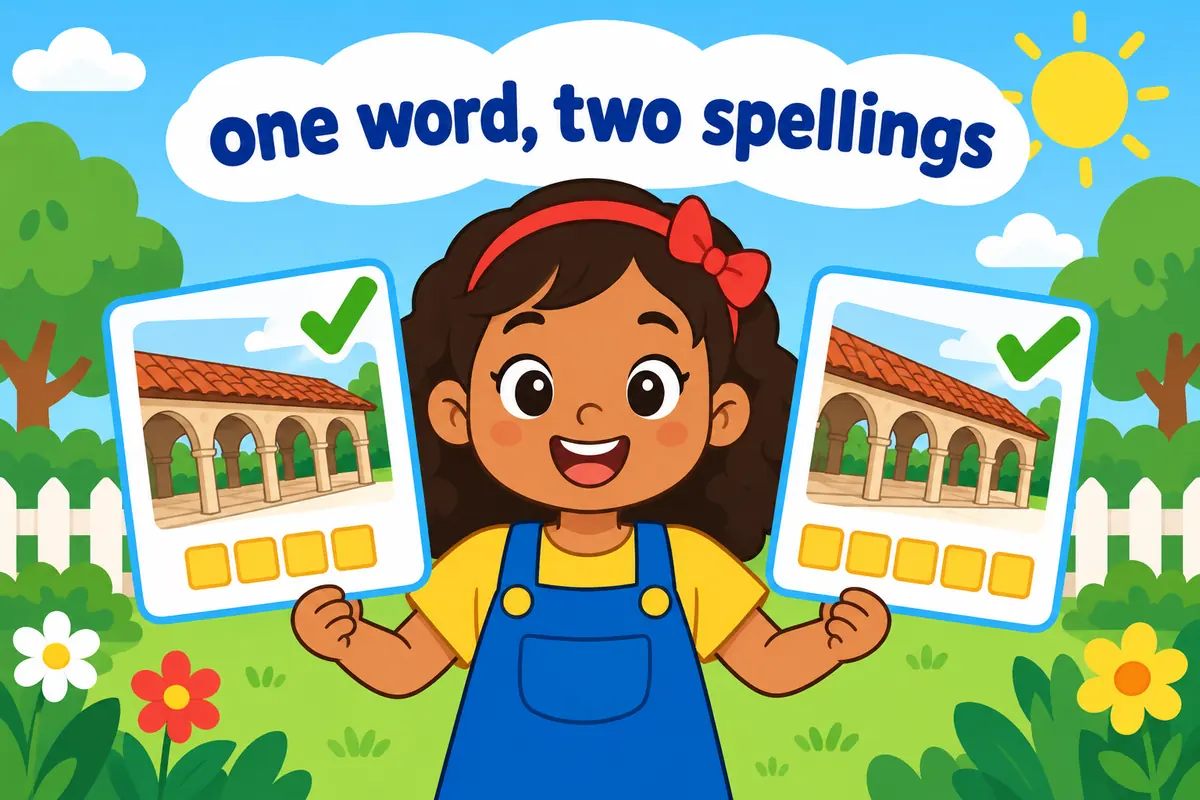
Veranda vs verandah is a choice of spelling, not of meaning: use veranda for American and general international writing, and verandah for historical, British or Indian contexts. Both name the same roofed gallery along a building, and both are pronounced the same way.
Veranda vs verandah at a glance
- Veranda and verandah are one word with two accepted spellings and a single meaning.
- Veranda is the usual spelling in American and general international English.
- Verandah is a listed variant, common in British historical, Indian and Australian writing.
- Both are pronounced /vəˈræn.də/ and both take a plural s.
- The choice is a style decision, so pick one form and keep it consistent.
Veranda vs verandah: the decision table
The two forms are identical in meaning, so every row below compares spelling convention rather than sense.
| Criterion | Veranda | Verandah |
|---|---|---|
| Dictionary status | The headword in standard dictionaries | Listed as an accepted variant spelling |
| Modern publishing | The dominant spelling in books and news | Less common and slightly older in feel |
| Regional pull | American and general international English | British historical, Indian and Australian English |
| Pronunciation | /vəˈræn.də/ | Identical |
| Meaning | A roofed, open-sided gallery along a building | Identical |
| Plural | verandas | verandahs |
| Register | Neutral and current | Literary, historical or regional in flavour |
| Search reach | Returns far more results | Much rarer in indexes |
Which should you use?
Use veranda unless a specific reason pulls you toward verandah. The table below matches the common reader situations to a firm recommendation.
| Your situation | Recommendation | Why |
|---|---|---|
| American or international publication | veranda | It is the standard spelling readers expect. |
| Historical novel set in the 1800s | verandah | The h matches the period feel and older British texts. |
| Indian or Australian English context | verandah | The h form stays common in regional writing. |
| Website aimed at a global audience | veranda | The commoner spelling returns more searches. |
| Quoting a source that uses the h | Keep verandah | Never alter a direct quotation. |
Two smaller rules follow from that advice. First, match the spelling to the subject: a feature on a Rajasthani guesthouse can keep the h, while a listing for a Florida beach house reads better with veranda. Second, if house style fixes one form, follow it everywhere, and change the other only inside a direct quotation.
What does veranda mean?
Veranda is a noun meaning a roofed, open-sided gallery or porch attached to the outside of a building, usually at ground level. The Cambridge entry for veranda treats it as the main form, while the Cambridge entry for verandah gives the same definition under the variant spelling. The word has travelled widely, which is why the h form survives in the speech and fiction of several regions.
Veranda belongs to a small family of outdoor spaces that learners often mix up. Each one differs in where it sits and whether it has a roof.
| Structure | How it differs from a veranda |
|---|---|
| Balcony | Projects from an upper floor with no ground-level base, while a veranda runs along the wall at ground level. |
| Porch | Usually shelters a doorway and may be small, while a veranda stretches along the side of a house. |
| Patio | An open paved area at ground level, often without a roof, while a veranda is defined by its roof. |
| Terrace | A raised or level platform, sometimes roofed, while a veranda always leans against the building. |
| Portico | A formal columned entrance, while a veranda is a long, informal gallery for sitting. |
The word is also familiar from the veranda page, where dozens of example sentences show it in real use. The point to carry forward is that veranda and verandah never mean different things, so no context requires one form for a balcony and the other for a gallery.
How do you use veranda and verandah in a sentence?
Both spellings follow exactly the same grammar, so the patterns below apply whichever form you choose.
| Pattern | Example | What it signals |
|---|---|---|
| on the veranda | We drank tea on the veranda. | The usual preposition for this raised space. |
| the veranda of/at + place | The veranda of the old hotel faced the sea. | Locates the gallery on a building. |
| veranda + noun compound | The veranda roof leaked in the storm. | Names a part of the structure. |
| plural verandas / verandahs | Both verandahs were screened against insects. | Plural adds s to either spelling. |
| a veranda wraps/overlooks/runs | A wide veranda wrapped around the house. | Describes shape and position. |
Veranda and verandah in a sentence: examples across contexts
| Context | Example sentence | Why this works |
|---|---|---|
| Classroom | Our teacher read to us on the veranda while the rain fell. | Everyday setting with the standard spelling. |
| Travel writing | Guests gathered on the verandah each evening to watch the sunset. | The h matches a regional, older hotel. |
| Historical fiction | She wrote letters on the verandah until the lamp burned low. | Period feel suits the h form. |
| Real-estate listing | The cottage has a wide veranda with space for a table. | Neutral spelling for a broad market. |
| News report | Storm damage tore the veranda from the coastal cafe. | Clear description of a structure. |
| Indian English feature | The family slept on the verandah on hot nights. | Regional convention uses the h. |
| Architecture notes | A deep veranda shades the western wall from afternoon sun. | Technical but plain function. |
| Personal letter | I will be on the veranda if you call. | Casual, current spelling. |
| Academic writing | Verandas reduce indoor heat in tropical housing. | The common spelling in scholarship. |
| Quotation in an essay | The traveller praised the verandah that overlooked the bay. | Keep the original spelling inside a quote. |
| Tourism brochure | Each room opens onto a shaded veranda above the garden. | Selling feature with the common spelling. |
| Local history | The verandahs of the old quarter were rebuilt after the fire. | A regional past suits the variant form. |
Word forms and grammar of veranda and verandah
| Form | Part of speech | Example |
|---|---|---|
| veranda | noun, standard spelling | A cool veranda faced the garden. |
| verandah | noun, variant spelling | They rebuilt the wooden verandah. |
| verandas | plural, standard | The two verandas held a dozen chairs. |
| verandahs | plural, variant | Verandahs shaded both wings of the house. |
| verandaed | adjective, rare | Prefer a plain phrase such as with a veranda. |
| veranda-style | compound adjective | A veranda-style roof covered the walkway. |
Never write verandah’s for the plural. The apostrophe belongs only to the possessive, as in the verandah’s paint, and adding one to a plural is the most common spelling error with either form. A single style guide rule, applied throughout a document, removes the whole problem.
Common mistakes with veranda and verandah
- Incorrect:
The house had a large veranda and a small verandah.Correct: The house had a large veranda and a small veranda. Rule: the two words mean the same thing, so mixing them in one text is inconsistent. - Incorrect:
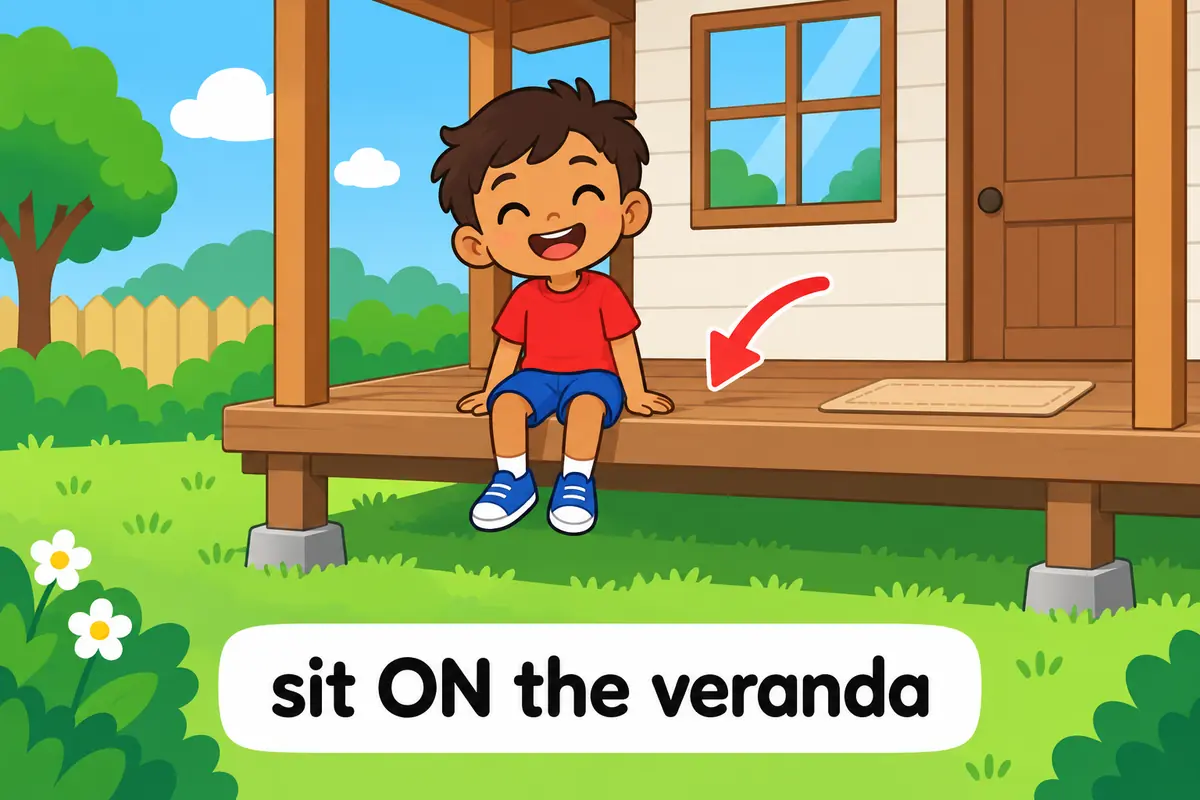
We sat in the veranda after lunch.Correct: We sat on the veranda after lunch. Rule: you sit on a platform, so veranda takes on. - Incorrect:
The balcony wrapped around the house at ground level.Correct: The veranda wrapped around the house at ground level. Rule: a balcony projects from an upper floor; a ground-level roofed gallery is a veranda. - Incorrect:
Both verandah’s needed repair.Correct: Both verandahs needed repair. Rule: the plural takes no apostrophe. - Incorrect:
the houses verandahCorrect: the house’s verandah. Rule: the possessive needs an apostrophe, unlike the plural. - Incorrect:
The porch runs the whole length of the building.Correct: The veranda runs the whole length of the building. Rule: a long gallery along a wall is a veranda, while a porch shelters the entrance.
The cure for nearly every item above is a single decision made before drafting. Choose veranda or verandah for the whole document, then apply it to the noun, the plural and any compound adjective. Readers notice a mixed text long before they notice which form it chose, and consistency is the only rule these two spellings really demand.
Practice using veranda and verandah
- Fill in the blank: We ate breakfast on the ______ while the garden woke up.
- Choose the better form: a historical novel set in colonial India should use (veranda / verandah).
- Correct the error: The family sat in the verandah.
- Build a sentence: use veranda about a coastal hotel facing the sea (pattern: on the veranda).
- Spot the register: which form fits a modern American real-estate listing, veranda or verandah?
- Correct the error: Both verandah’s were repainted.
- Fill in the blank: A deep ______ shades the western wall from the afternoon sun.
Answers
- veranda. Either spelling works, but the standard form suits a general sentence.
- verandah. The h matches the historical British and Indian setting of the novel.
- The family sat on the verandah. A veranda is a platform, so it takes on, not in.
- Model: Guests watched the sunset on the veranda of the coastal hotel. The pattern on the veranda is standard.
- veranda. It is the neutral, current spelling that a broad market expects.
- Both verandahs were repainted. The plural takes no apostrophe.
- veranda. The sentence describes a roofed gallery, whatever spelling the writer prefers.
The bottom line
Veranda vs verandah comes down to spelling, not sense, so use veranda for modern American and international writing and reserve verandah for historical, British or Indian contexts. Keep one spelling consistent within a document, and never treat the two as different structures. If you remember only one rule, let it be that both words describe the same roofed gallery, so a veranda sentence and a verandah sentence differ by a single letter.
Frequently asked questions about veranda and verandah
What is a veranda used for?
A veranda gives shaded outdoor space along a building, so people use it for sitting, eating and drying things, and it also cools the wall behind it by blocking direct sun. In hot climates it works as an extra room in the evening. The purpose is the same whichever spelling a writer chooses.
Is a veranda the same as a porch or balcony?
No. A porch usually shelters the entrance and may be small, while a balcony projects from an upper floor with no ground-level base. A veranda is a long roofed gallery that runs along the outside wall at ground level. It overlaps with a terrace but keeps its roof and its lean against the building.
Why do some writers add an h to verandah?
The h form reflects older British spelling that travelled through colonial trade routes, and it stayed standard in the English of India and parts of Australia. Dictionaries list it as an accepted variant of veranda. Modern editors in America and most international publishing simply prefer the shorter form.
Is verandah common in Indian English?
Yes. Verandah remains a familiar spelling in Indian English, where the gallery itself is a common feature of homes and older buildings. British and Australian writing also use it, especially in fiction and historical description. For a global audience, veranda is the safer default.