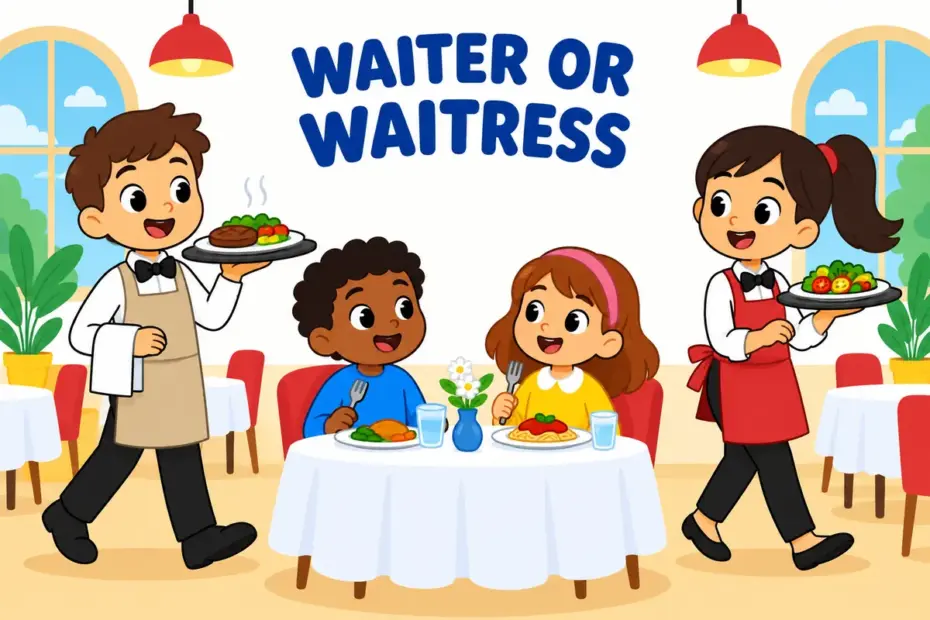
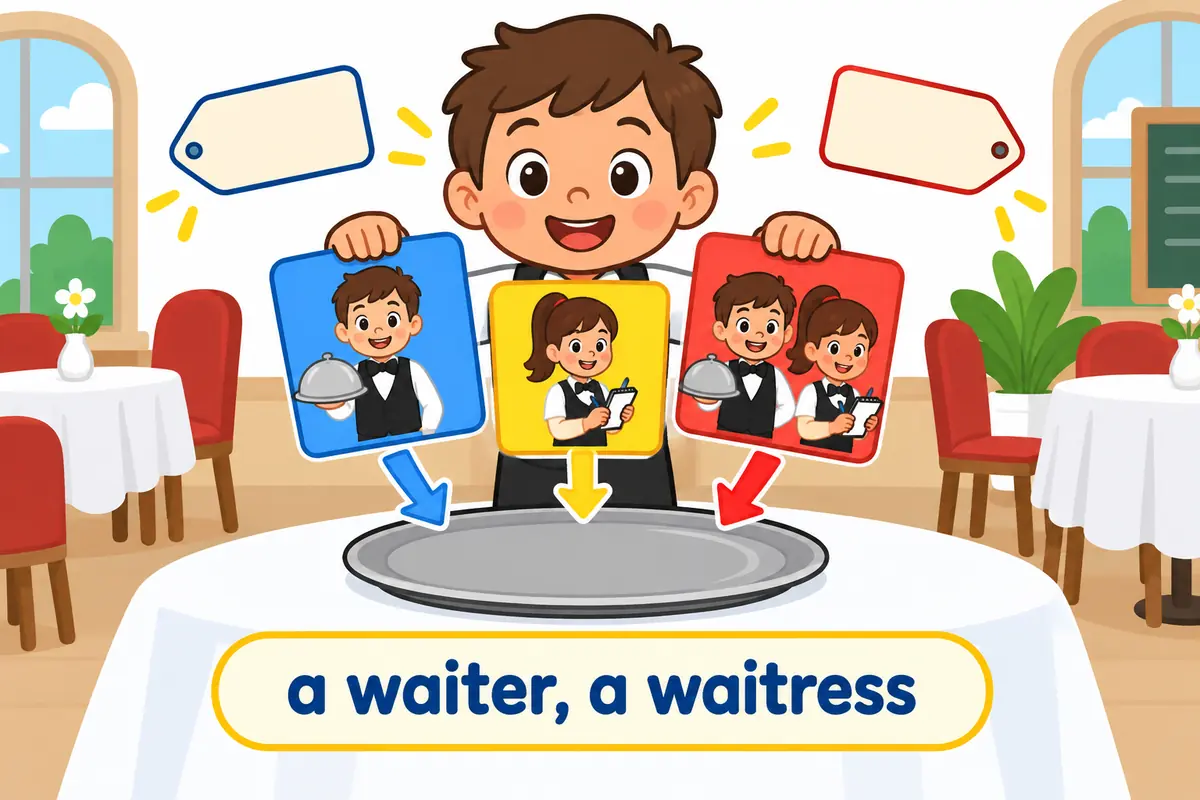
Waiter vs waitress is a choice between a gender-neutral job title and a female-specific one. Use waiter as the safe default whenever the server’s gender is unknown or irrelevant, and keep waitress for casual, historical or quoted settings where a woman’s gender genuinely matters. Many restaurants now avoid both words and say server.
- Waiter is a noun for a person who serves food; its plural is waiters.
- Waitress is a noun for a female server; its plural is waitresses.
- Waiter works as a gender-neutral default; waitress is marked as female.
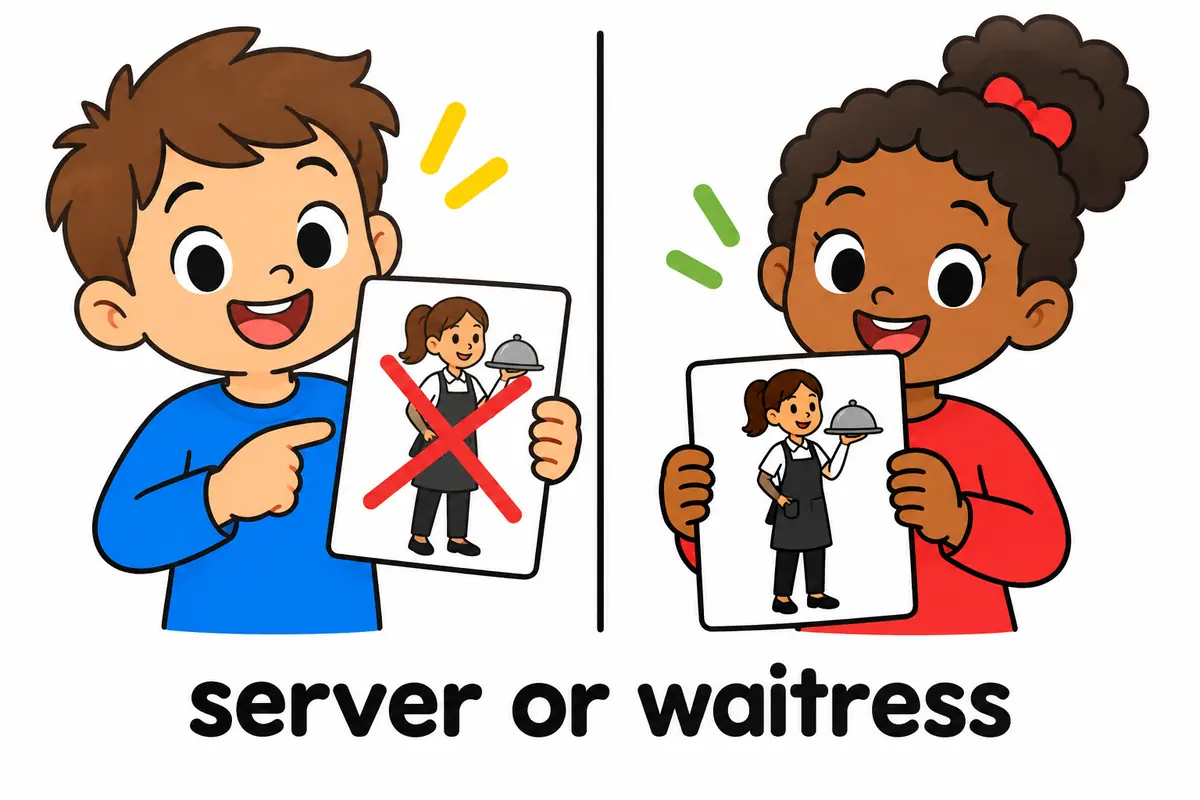
- Server is the fully neutral alternative and is the safest choice in job ads and formal writing.
- The commonest error is mismatching waitress with a masculine pronoun.
What do waiter and waitress mean?
Waiter is a noun meaning a person who serves food and drink in a restaurant. Waitress means the same job performed by a woman. The Cambridge entry for waiter treats it as the general term, while the waitress entry marks the female form, and that difference in markedness is the whole decision. A diner who asks for the patron at table six is naming the customer, not the server, which is a separate role.
| Word | Plain meaning | Gender | Example sentence |
|---|---|---|---|
| waiter | A person who serves food and drink | Neutral; sometimes male by default | The waiter brought the menu and the specials board. |
| waitress | A woman who serves food and drink | Female | The waitress recommended the soup of the day. |
| server | A person who serves food and drink | Neutral | Our server knew every dish on the menu. |
Waiter works as the unmarked term and waitress as the marked one: the marked word carries extra information about gender that waiter does not. A sentence can begin with the waiter and finish with he, she or they, while the waitress forces a feminine pronoun. Marked forms tend to fade first from formal writing, and the -ess ending has already gone from most job titles.
Both nouns carry a now-uncommon literal sense of someone who waits, as in a waiter for the bus, and waitress also works as a verb meaning to work in that role, as in she waitressed through college. One limitation matters: neither noun covers a non-binary server, and waitress can read as dated in a professional job advertisement, so server is the safer word when gender is not the point.
Waiter vs waitress: the decision table
Six criteria separate the two words, and only one of them points towards waitress in ordinary writing. Read down the columns rather than across, because the neutral column is the default.
| Criterion | waiter | waitress |
|---|---|---|
| Gender marked | No, neutral with a male tint in old texts | Yes, explicitly female |
| Safe default | Yes, for any server | Only when the person is a woman |
| Formal job title | Standard and widely used | Less common in modern job ads |
| Best setting | News reports, reviews and general writing | Casual speech, fiction and quoted history |
| Pronoun that must follow | he, she or they | she or they |
| Trend in listings | Preferred as the neutral noun | Declining in favour of server |
The decisive criterion is the pronoun that follows, because waitress locks the sentence to a woman while waiter leaves the pronoun free. That is why a careful writer reaches for waiter or server unless the gender is the story.
Waiter vs waitress in a sentence: examples across contexts
The right word depends on the setting. The nine sentences below range from a formal review to a quoted novel, and each one shows why that word fits there.
| Context | Example sentence | Why this works |
|---|---|---|
| Restaurant review | Our waiter knew the wine list and never hovered. | Waiter keeps the review neutral and focused on service. |
| Casual conversation | The waitress at the corner cafe remembered our order. | Natural in speech when the server is a woman. |
| Job advertisement | We are hiring servers for weekend shifts. | Server avoids stating a gender in a listing. |
| News report | A waiter raised the alarm when smoke filled the kitchen. | Neutral term suits reporting where gender is irrelevant. |
| Historical novel | The waitress set down two cups of tea and left. | Waitress fits a period setting with defined roles. |
| Customer service note | The customer asked the waitress for a quieter table. | Names the interaction between diner and server. |
| Hotel writing | Guests can ask any waiter for the breakfast menu. | Waiter reads as the general role for a mixed team. |
| Academic study | Each waitress recorded her own tips across the week. | Waitress tracks a defined, all-female sample. |
| Museum cafe | A waiter refilled the water jugs without being asked. | Keeps a family venue neutral and friendly. |
| Cookbook note | The waitress jotted down the allergy before the order went in. | Shows one identified woman in a practical setting. |
| Travel blog | Our guest at the counter was greeted by a friendly waitress. | Waitress adds warmth in an informal first-person account. |
The third sentence is the one a business should copy, because a job listing gains nothing from revealing the gender of the person it hopes to hire.
Which should you use?
Five ordinary situations cover almost every choice. Pick the row that matches your sentence and follow the recommendation without hedging.
| Situation | Use | Why |
|---|---|---|
| The server’s gender is unknown | waiter or server | Neither assumes a gender. |
| You are writing a job advertisement | server | Neutral wording widens the applicant pool. |
| The server is a woman and the tone is casual | waitress | The female form reads naturally in speech. |
| You are quoting a historical scene | waitress | It matches the period usage and job roles. |
| You want one safe word for all formal writing | server | It is neutral, current and unambiguous. |
A parallel role shows the same trend: a bartender serves drinks whatever their gender, which is why there is no common bar-ess form left in use.
Word forms and grammar of waiter and waitress
Both nouns inflect regularly, and their verb uses matter for accuracy. The table also pairs each with a neighbouring restaurant role, from the host who seats the diners to the busboy who clears the tables.
| Form | Part of speech | Example |
|---|---|---|
| waiter | noun | The waiter brought the bill. |
| waiters | noun, plural | Two waiters covered the terrace. |
| waitress | noun | The waitress took our order. |
| waitresses | noun, plural | The waitresses split the tips. |
| waitressed | verb, past, intransitive | She waitressed through college. |
| waitressing | verb, present participle | Waitressing pays better in summer. |
| waitered | non-standard | Write waited tables, never waitered. |
The pattern behind waitress is the older -ess ending that also produced actress, hostess and stewardess. Most of those forms have narrowed to specific contexts or been replaced, while the base noun now covers all genders. Knowing the trend helps a writer predict which form a modern editor keeps and which one reads as dated.
Common mistakes with waiter and waitress
- Incorrect:
I asked the waitress, but he did not hear.Correct: I asked the waitress, but she did not hear. Rule: waitress is feminine, so a feminine or singular-they pronoun follows. - Incorrect:
She has worked as a waiteress for years.Correct: She has worked as a waitress for years. Rule: the female form ends in -ess, not -eress. - Incorrect:
There were three waiters and two waitress.Correct: There were three waiters and two waitresses. Rule: waitress takes a regular plural. - Incorrect:
He waitressed the tables all evening.Correct: He waited tables all evening. Rule: waitress as a verb is intransitive and takes no direct object. - Incorrect:
Every waitress must wear their own apron.Correct: Every waitress must wear her own apron. Rule: the female noun takes a feminine pronoun in formal prose.
Practice using waiter and waitress
Work through the six items, then check the reasoning rather than only the answer.
- Fill the gap: A ______ showed us to a table by the window. (any gender)
- Fill the gap: The ______ who served us told us her name was Mia.
- Choose the better word: Our company is hiring (waiters / servers) for the new branch.
- Correct the error: I thanked the waitress, but he was already gone.
- Build a sentence: use work as a waitress about a summer job in a seaside cafe.
- Spot the register: which belongs in a news report — A waitress raised the alarm, or A waitress gal raised the alarm?
Answers
- waiter or server — the gender is unknown, so the neutral noun is correct.
- waitress — the pronoun her shows the server is a woman.
- servers — job ads stay neutral and avoid stating a gender.
- I thanked the waitress, but she was already gone — the pronoun must agree with the female noun.
- Model answer: She worked as a waitress at the seaside cafe every summer.
- A waitress raised the alarm — a news report avoids informal words like gal.
The bottom line
The safe answer to waiter vs waitress is to use waiter as the neutral default and reserve waitress for casual, historical or quoted contexts where a woman’s gender genuinely matters. The two nuances that decide most sentences are pronoun agreement and the register of the setting, because waitress is feminine and slightly dated in formal writing. Where neither word feels right, server is the neutral noun that modern listings prefer.
Frequently asked questions about waiter vs waitress
Is waitress still an acceptable word?
Waitress is still correct and widely understood, but it is marked as female and can sound dated in a professional job listing. In conversation and fiction it reads naturally. In business writing, many teams prefer server so that no gender is assumed or advertised.
What is the gender-neutral word for waiter or waitress?
Server is the standard neutral noun, and it works in every register from a menu to a contract. Waiter is also used as a neutral default by many writers. Both avoid stating a gender, while waitress specifically names a woman, so it is the least neutral of the three.
Can waiter refer to a woman?
Yes, in modern usage waiter is often treated as gender-neutral, so the waiter who served us may be a woman. Some readers still hear a male default in the word, which is exactly why server has grown. If you want no ambiguity at all, choose server.
Is waitress a verb as well as a noun?
Yes, waitress is also an intransitive verb meaning to work as a waitress, as in she waitressed during the summer. It takes no direct object, so you never waitress the tables. The noun forms are waitress and waitresses, and the verb forms are waitressed and waitressing.