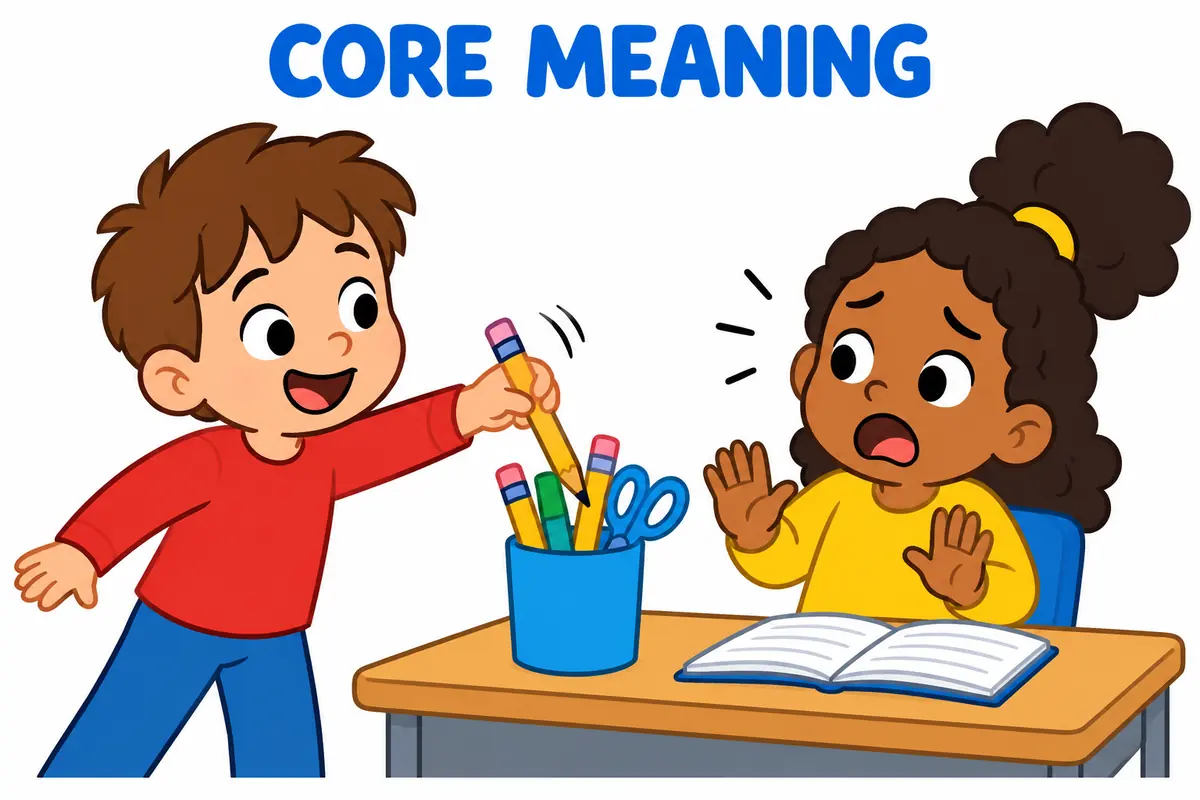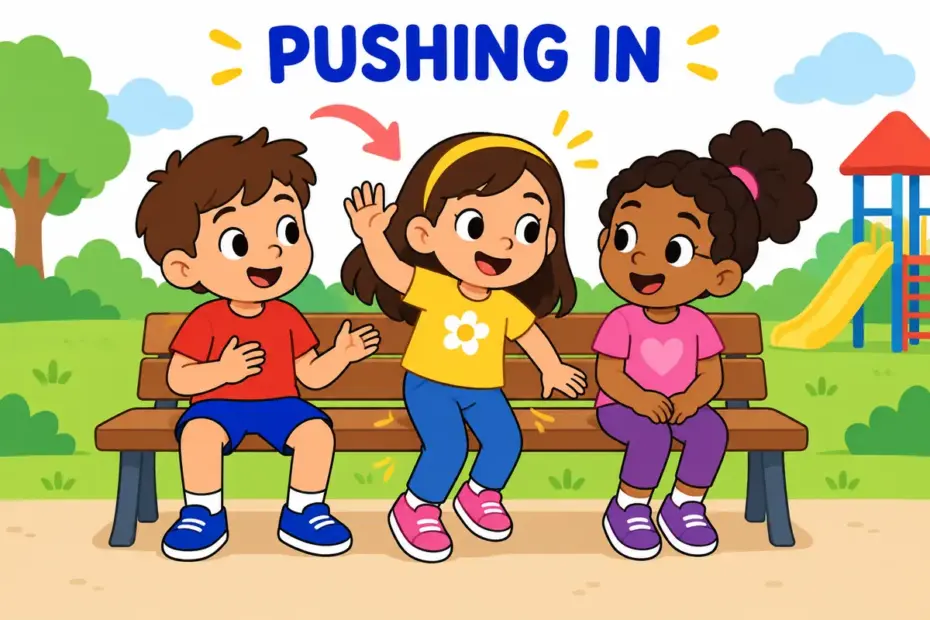
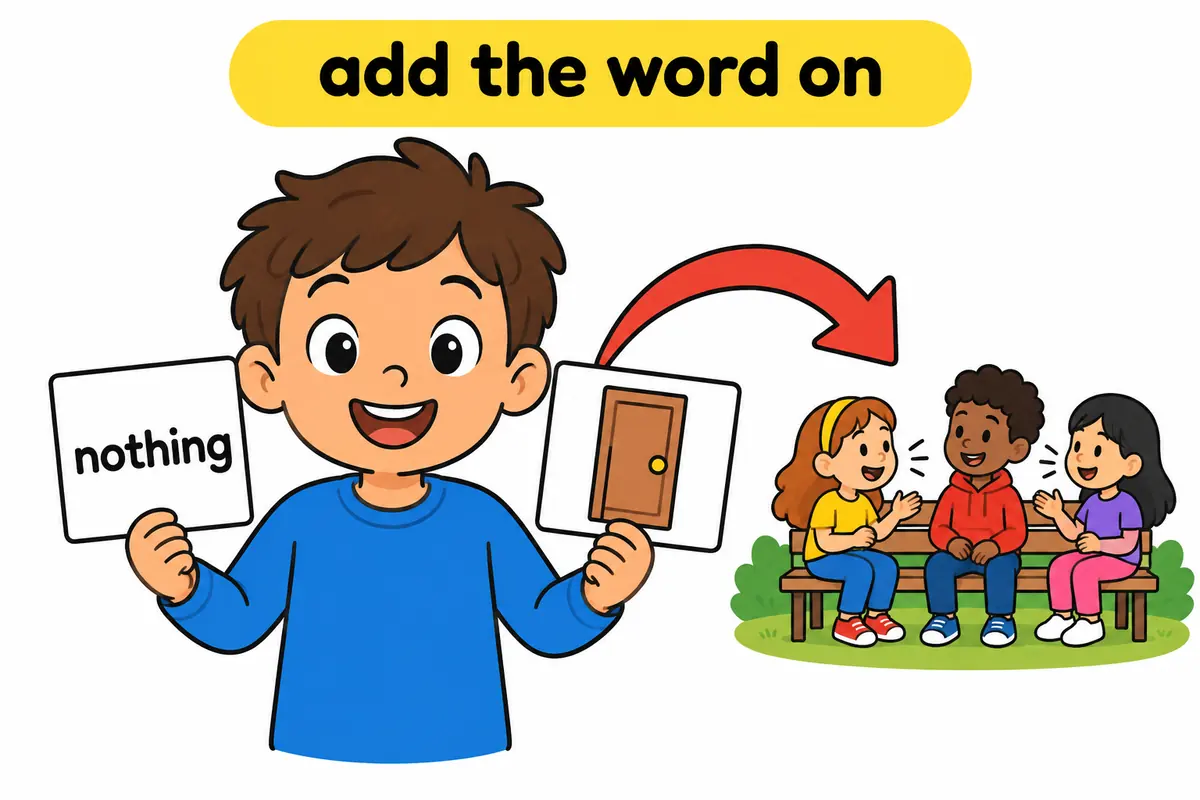
Horn in is an informal phrasal verb meaning to intrude on someone else’s conversation, plans or business. To use horn in in a sentence, add on and name what is being interrupted: “He horned in on our meeting.” The particle never separates from the verb.
Horn in at a glance
- Horn in is an informal phrasal verb; its forms are horns in, horned in and horning in.
- It almost always takes on, as in horn in on a conversation.
- Typical subjects are a colleague, a neighbour, a relative or a rival.
- Horn in belongs to American speech and light journalism, not to formal reports.
- The commonest error is dropping on and writing horn in the discussion.
- Butt in and cut in are close synonyms in everyday American English.
What does horn in mean?
Horn in is a phrasal verb meaning to push into a situation or conversation where you were not invited. The Cambridge entry for horn in centres on this sense of unwanted intrusion, usually followed by on. Where the interference is gentle and social, butt and cut in are the everyday alternatives, because horn in can sound blunt or rude.
| Sense | Plain meaning | Example sentence |
|---|---|---|
| Interrupt a conversation | Join a talk where you are not wanted | She horned in on our private chat. |
| Interfere in a plan | Push into somebody else’s arrangement | A rival firm horned in on the deal. |
| Claim a share | Demand part of something already promised | His cousins horned in on the inheritance. |
One limitation is worth stating plainly. Horn in is not neutral and not formal: it always carries disapproval, so an official report would use interfere, intrude or encroach instead. It also does not mean simply to arrive, and it never describes joining a group by invitation.
How do you use horn in in a sentence?
Horn in needs on when it names the thing being interrupted, and the object of on is always an activity or a domain, never a person. The verb is intransitive, so it never takes a direct object, and the particle in cannot move away from horn.
| Pattern | Example | What it signals |
|---|---|---|
| horn in on + activity | He horned in on their conversation. | The standard form; names the intrusion directly. |
| horn in on + deal | Two investors horned in on the takeover. | Shows a commercial sense of unwanted interference. |
| always or keep + horning in | She keeps horning in on my calls. | The progressive stresses a repeated habit. |
| horn in on + occasion | Nobody asked the cousins to horn in on the wedding. | Ties the verb to a specific social event. |
| try to horn in | He tried to horn in on the credit for the idea. | Adds effort, which is typical of a hostile action. |
The preposition is the test. A native speaker horns in on something, and a learner who writes horn in the meeting has dropped the word that carries the meaning. Because in belongs to the verb, you also say horn in on, not horn on in.
Horn in in a sentence: examples across contexts
Horn in moves from a family kitchen to a boardroom while keeping its disapproving tone. The ten sentences below each name the activity being entered, which is what the verb needs to sound complete.
| Context | Example sentence | Why this works |
|---|---|---|
| Classroom | A new pupil tried to horn in on the science partners’ project. | A gentle school setting shows the intrusion without menace. |
| Home | My little brother always horns in on our board games. | The frequency adverb makes the habit clear. |
| Workplace email | Please don’t horn in on the client thread without checking with me. | A light instruction keeps the informal verb bearable at work. |
| News report | A late bidder horned in on the auction at the final moment. | Neutral reporting frame carries the commercial sense. |
| Sports desk | A rival club horned in on the transfer just before the deadline. | The on-phrase names the contested deal. |
| Opinion column | Every relative horned in on the will, and the lawyers grew rich. | The plural subject shows a widespread, resented intrusion. |
| Customer service | We apologise that a third party horned in on your booking. | A formal apology uses the verb with care around a client. |
| Diary | Two neighbours horned in on the street party and took over. | The second verb, took over, shows the consequence. |
| Media analysis | Politicians keep horning in on debates that experts should lead. | The keep pattern marks a recurring public complaint. |
| Conversation | Sorry to horn in on you two, but the taxi is here. | A polite apology shows the verb used with self-awareness. |
Notice that every sentence names what was entered, from a board game to a takeover. A sentence that leaves that out, such as he horned in again, relies on the reader knowing the situation, which weak writing cannot assume.
Horn in vs butt in and meddle
Horn in overlaps with two verbs and is blunter than either. Butt in is the closest everyday synonym and works with the same on phrase; meddle is broader and describes interfering in other people’s affairs over time.
| Attribute | horn in | butt in | meddle |
|---|---|---|---|
| Core job | Push into a conversation or plan uninvited | Interrupt boldly and suddenly | Interfere in other people’s affairs |
| Typical object | On a chat, a deal, a call, a wedding | On a talk or a queue | In a marriage, a dispute, a decision |
| Register | Informal, American | Informal | Neutral to formal |
| Implies rudeness | Yes | Yes, often | Yes, but quietly |
| Needs on | Usually | Usually | No, it takes in |
| Describes a single act | Yes | Yes | No, it suggests a pattern |
Verdict: choose butt in for a sudden interruption, meddle for steady interference in private affairs, and horn in when someone pushes into a conversation, deal or plan where they do not belong.
Word forms and grammar of horn in
Horn in inflects on the verb horn and keeps its particle in place. The table also lists the lookalikes learners confuse with it, including butt in, cut in and the unrelated noun horn.
| Form | Part of speech | Example |
|---|---|---|
| horn in | phrasal verb, base form | Try not to horn in on their plan. |
| horns in | phrasal verb, third person singular | He horns in on every discussion. |
| horned in | phrasal verb, past and past participle | They horned in on the sale last week. |
| horning in | phrasal verb, present participle | She is always horning in on us. |
| horn in on | phrasal verb plus preposition | Nobody wants you to horn in on our call. |
| butt in | phrasal verb, close synonym | Sorry to butt in. |
| horn | noun, different meaning | The car horn startled the pigeons. |
Particles cluster around this verb: a phone line can break in on a call, and a guest may need to call in to a radio show, yet horn in always keeps its in and adds on before the activity.
Common mistakes with horn in
- Incorrect:
He horned in the conversation.Correct: He horned in on the conversation. Rule: Horn in takes on before the activity it interrupts. - Incorrect:
She horned on in the meeting.Correct: She horned in on the meeting. Rule: In belongs to the verb, so in comes before on. - Incorrect:
Please do not horn in on me.Correct: Please do not horn in on my discussion. Rule: The object of on is an activity, not a person. - Incorrect:
The report noted that staff horned in on the procedure.Correct: The report noted that staff interfered with the procedure. Rule: Horn in is informal and disapproving, so formal writing needs a neutral verb. - Incorrect:
The car horned in on the conversation.Correct: The car horn interrupted our conversation. Rule: The verb horn in describes a person pushing in, not a noise.
Practice using horn in
Work through the eight items, then read the answers for the reason each one is right.
- Fill the gap: A cousin tried to ______ on the family business.
- Choose the better word: In the formal minutes, we wrote that a contractor (horned in / encroached) on the project.
- Correct the error: Stop horning on in when I am talking.
- Build a sentence: use horn in on about a newcomer joining a private study group.
- Spot the register: which belongs in a friendly text — sorry to horn in, or I hereby intrude upon your discussion?
- Rewrite with but in: A neighbour interrupted our chat. Use butt in.
- Fix the object: He always horns in on me.
- Choose the sense: does horn in mean to arrive late or to intrude where you are not wanted?
Answers
- horn in — the family business is the activity being entered, so on follows.
- encroached — formal minutes need the neutral verb, not the informal idiom.
- Stop horning in when I am talking — in stays with horn, and on may be dropped when the situation is obvious.
- Model answer: A new pupil horned in on our study group without being asked.
- Sorry to horn in — the text is informal, and the long version is absurdly stiff.
- A neighbour butted in on our chat — butt in uses the same on phrase.
- He always horns in on our chats — the object of on must be an activity, not a person.
- To intrude where you are not wanted — arrival time is not part of the meaning.
The bottom line
Use horn in in a sentence when somebody pushes into a conversation, deal or plan where they were not invited, and add on before the activity. The two details that decide most sentences are these: the particle stays with the verb, so it is horn in on and never horn on in, and the tone is informal and disapproving, which keeps it out of neutral reports. Where the interference is formal or ongoing, interfere and meddle are the safer choices.
Frequently asked questions about horn in
What does horn in mean?
Horn in means to intrude on a conversation, plan or situation where you are not wanted. It is informal and usually disapproving, so it suggests the intruder was pushy rather than welcome. The verb is almost always followed by on, as in horn in on a deal or horn in on a chat.
Is horn in a formal phrase?
No. Horn in belongs to American speech and lighter journalism, and it carries a clear note of disapproval. A formal report would choose interfere, intrude or encroach instead. The idiom can still appear in a careful workplace email, but only where a mild, human tone is wanted.
Why does horn in take on?
In horn in, the particle in belongs to the verb and shows direction, while on introduces the activity being entered. Put together, the pattern is horn in on something. Dropping on is the commonest error, and reversing them produces the impossible form horn on in.
What is the difference between horn in and butt in?
Both are informal synonyms for interrupting, and both take on. Butt in often suggests a sudden, bold interruption, while horn in stresses pushing into a matter that was not yours. In most everyday sentences the two are interchangeable, but horn in sounds slightly more disapproving.