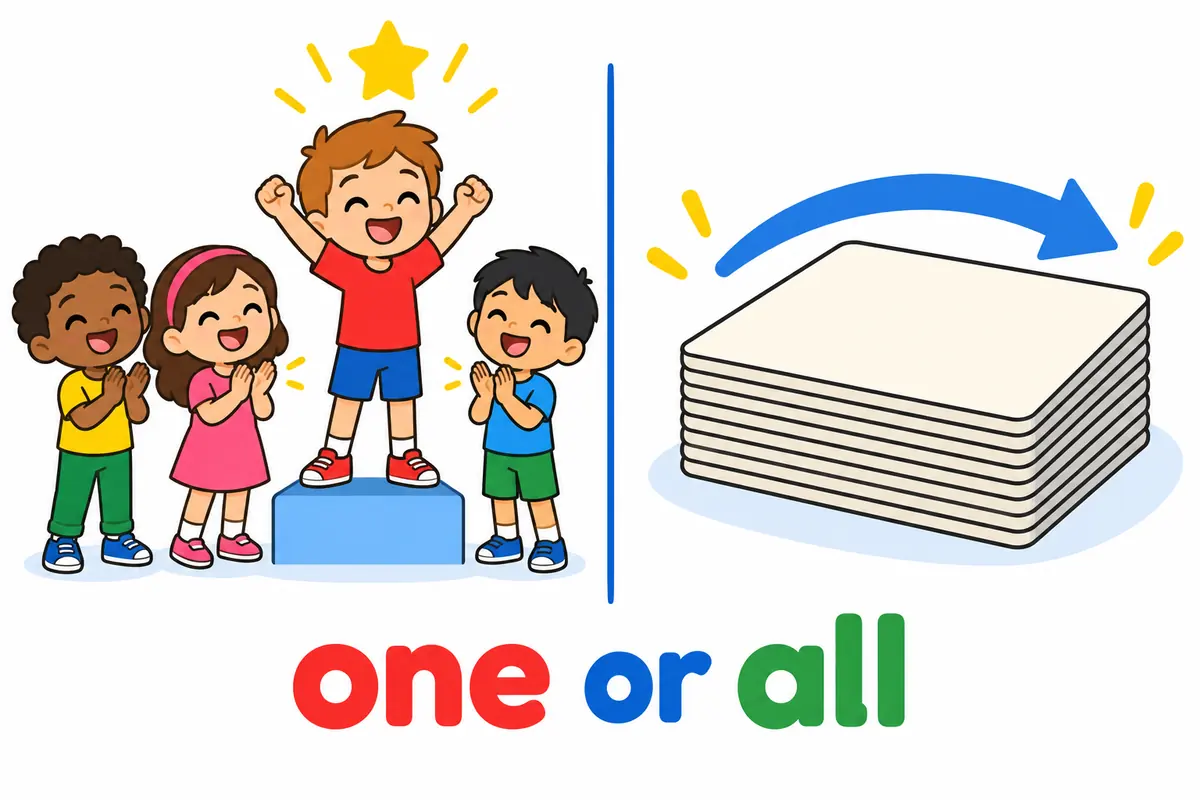
To single out is to choose one person or thing from a group and give them special attention, whether praise or blame. In a sentence, the phrasal verb is separable and often takes for: “The judges singled out one entry for praise.” Because attention is the point, the object is always an individual rather than a whole group.
Single out at a glance
- Single out is a transitive phrasal verb meaning to select one member of a group for attention.
- It is separable: you can single out one essay or single one essay out.
- A pronoun must sit between the verb and the particle: single him out.
- The phrase follows for when it names the reason: singled out for praise or for blame.
- The commonest error is making the whole group the object instead of the individual.
What does single out mean?
Single out is a phrasal verb meaning to choose one person or thing from a group and treat them differently from the rest. The Cambridge entry for single out records this selecting sense and notes that the attention may be favourable or hostile. A neutral alternative is choose, which carries none of the spotlight that single out implies.
| Sense | Plain meaning | Example sentence |
|---|---|---|
| Select for praise | Pick one member to honour | The head singled out two young players. |
| Select for criticism | Pick one member to blame | Reviewers singled out the final chapter. |
| Identify from a group | Pick one out of many | She singled out the faulty tyre at once. |
One limitation is worth stating plainly. Single out does not always mean blame, and it never means excluding someone permanently. The word describes attention, not membership, so a pupil who is singled out for praise stays in the class, and a product singled out for criticism remains on the shelf.
How do you use single out in a sentence?
The verb is transitive and separable, and the separator rule is identical to other particle verbs. The pattern that learners miss most often is the for phrase, which names what the attention is for. Five patterns cover almost every sentence.
| Pattern | Example | What it signals |
|---|---|---|
| single out + object | The report singled out one department. | The commonest order, with the individual straight after the verb. |
| single + object + out | The report singled one department out. | The separated form, identical in meaning. |
| single + pronoun + out | The teacher singled him out at assembly. | A pronoun must sit between verb and particle. |
| single out + object + for + noun | They singled her out for special training. | Names the reason for the attention. |
| be singled out | Two names were singled out for praise. | Passive form, common in reviews and reports. |
Use in rather than of when you name the group: singled out among the finalists, or singled out from the crowd. The reason, when the writer gives one, always arrives in a for phrase. In speech the whole phrase is often compressed, so a manager may simply ask who was singled out and leave both the group and the reason to context.
Single out in a sentence: examples across contexts
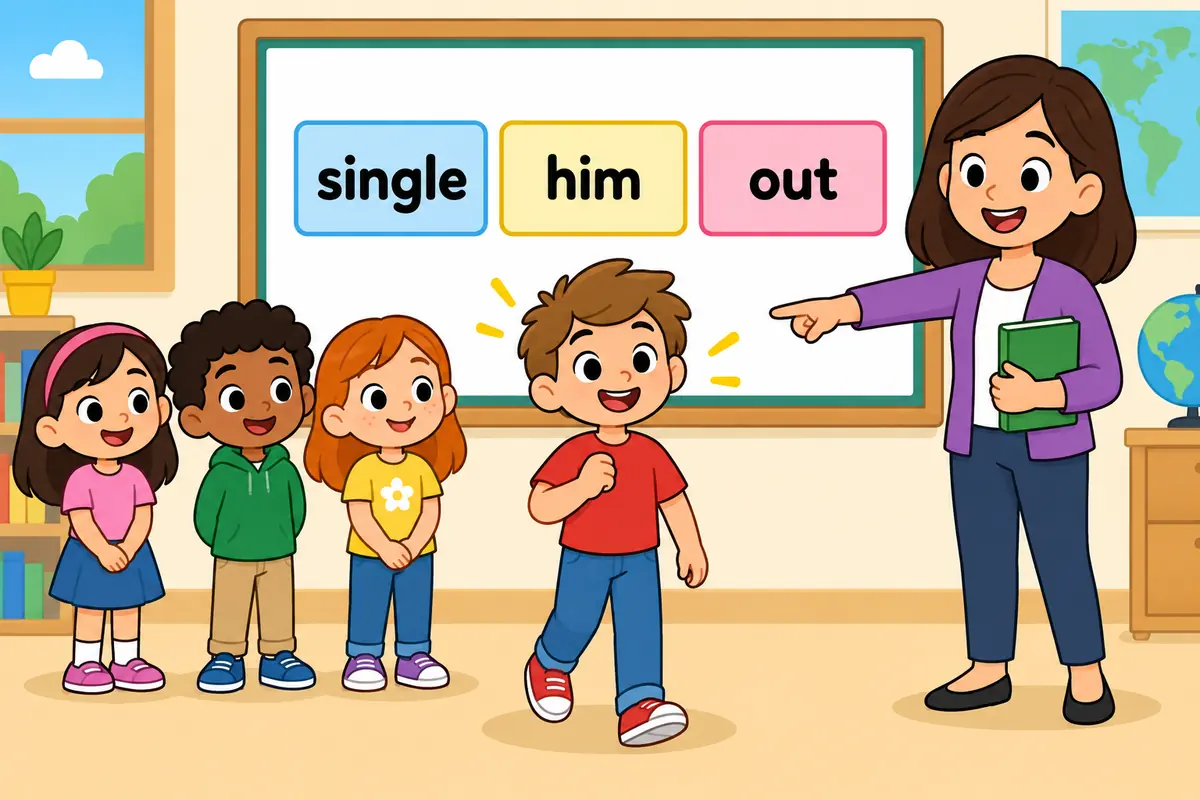
Single out moves easily between warmth and blame, and the surrounding words decide which. The nine sentences below range from a school prize day to a product review, and each one names the individual and, where relevant, the reason.
| Context | Example sentence | Why this works |
|---|---|---|
| Classroom | The teacher singled out Mia for her careful handwriting. | Names the pupil and the reason in a for phrase. |
| Sports report | Pundits singled out the young keeper for two fine saves. | Uses the passive-adjacent past to review a performance. |
| Workplace email | Please do not single anyone out during the briefing. | Places the pronoun correctly between verb and particle. |
| Product review | The critic singled out the battery life as the weak point. | Attaches the criticism to one feature, not the whole product. |
| News report | Investigators singled out three accounts for closer study. | Shows the selecting sense in a neutral register. |
| Charity appeal | Donors singled out the small clinic for their support. | Makes the attention clearly positive. |
| Academic writing | The study singles out two variables that skew the result. | Uses the present tense for a general finding. |
| Conversation | The coach singled me out in front of everyone. | Relaxed speech shows the pronoun form. |
| Performance note | Managers should single out good work as well as mistakes. | Balances the positive and negative uses in one line. |
Notice that only some of those sentences judge. Where the writer wants pure selection with no praise or blame, the plainer verbs target and select do the job without the spotlight. That flexibility is why the phrase suits both a warm staff email and a frosty review, and why a careful writer weighs the tone before using it.
Single out vs pick out and lump together
Single out is often confused with two other phrasal verbs. Pick out means recognise or select with no suggestion of unfair attention, while lump together means the exact opposite, treating individuals as one undifferentiated mass. The verbs select and isolate mark the two ends of that range.
| Attribute | single out | pick out |
|---|---|---|
| Core meaning | Give one member special attention | Recognise or choose one from many |
| Usual connotation | Praise, blame or unfair spotlight | Neutral recognition |
| Typical object | A person, a feature or an entry | A shape, a sound or a face |
| Register | Neutral, common in reports | Everyday and conversational |
| Opposite | lump together | overlook |
| Common follower | for praise, for criticism | from the crowd, by eye |
Verdict: choose single out when the attention itself is the point, pick out when someone simply recognises one item among many, and lump together when a writer wants to say that individuals were treated as an anonymous mass.
Word forms and grammar of single out
The verb inflects on single, never on out, and its gerund form, singling out, is common in reports about unfair treatment. The same out particle builds other verbs such as ask out and back out.
| Form | Part of speech | Example |
|---|---|---|
| single out | phrasal verb, base | I will single out the best drawing. |
| singles out | third person singular | The reviewer singles out one scene. |
| singling out | present participle | Singling out one pupil can backfire. |
| singled out | past and past participle | The chef singled out the local farm. |
| singled out for | verb phrase with for | She was singled out for promotion. |
Keep the tense ending on single: singled out, not single outed. When the object is a pronoun, the particle follows it, so singled him out and never singled out him.
Common mistakes with single out
- Incorrect:
The teacher singled out him for praise.Correct: The teacher singled him out for praise. Rule: A pronoun object must sit between the verb and its particle. - Incorrect:
He was singled out to criticism.Correct: He was singled out for criticism. Rule: The reason takes for, not to. - Incorrect:
The coach singled out that the team played well.Correct: The coach singled the team out for praise. Rule: The verb takes a noun phrase, never a that-clause. - Incorrect:
The teacher singled out the whole class.Correct: The teacher singled out one pupil in the class. Rule: Single out lifts one member from a group, so the object is the individual, not the group. - Incorrect:
They singled the two of them out and lumped them together.Correct: They singled the two of them out, then treated them separately. Rule: Singling out and lumping together are opposites and cannot describe the same action.
Practice using single out
Work through the six items, then check the reasoning rather than only the answers.
- Fill the gap: The judges ______ one photograph for a special mention.
- Choose the better word: At the door she (picked out / singled out) her friend in the crowded hall.
- Correct the error: The manager singled out her for the new project.
- Build a sentence: use be singled out for about a volunteer who received an award.
- Spot the register: which belongs in a neutral review — the critic singled out the score, or the critic totally called out the score?
- Rewrite with the pronoun: The coach singled the new player out. Replace the new player with her.
Answers
- singled out — the object follows the verb in the commonest order.
- picked out — recognising a friend in a crowd is neutral, so no spotlight is implied.
- This sentence is already correct; check the pronoun rule if the object were him, then the manager singled him out — the pronoun stays in the middle.
- Model answer: The volunteer was singled out for a community award.
- The critic singled out the score — a neutral review avoids totally and the informal phrase called out.
- The coach singled her out — the pronoun replaces the full noun between verb and particle.
The bottom line
Use single out in a sentence when one person or thing is lifted from a group and given attention, whether that attention is praise, blame or simple interest. The two nuances that decide most sentences are these: the verb is separable, so a pronoun goes in the middle as single him out, and the reason, when you give one, arrives in a for phrase. If no special spotlight is intended, pick out or select is the safer verb.
Frequently asked questions about single out
Is single out negative or positive?
Single out can be either, because the phrase names attention rather than approval. A pupil singled out for praise has been honoured, while a feature singled out for criticism has been blamed. The surrounding words, especially the for phrase, tell the reader which meaning is intended, so context settles it.
Is single out a separable phrasal verb?
Yes. Single out separates, so you may write single out one essay or single one essay out, and both are standard. The restriction is the same as for other particle verbs: a pronoun must sit between verb and particle, giving single him out rather than single out him.
Can you single out an object rather than a person?
You can. The object may be a thing, a feature or a piece of work, as in reviewers singled out the final chapter. The phrase only requires that one member is picked from a larger set, so products, passages and statistics are all singled out in ordinary writing.
What preposition follows single out?
Single out usually takes for when it names a reason, as in singled out for praise or for blame. When the writer names the group rather than the reason, the preposition is among or from, as in singled out among dozens of entries. No other preposition is standard.