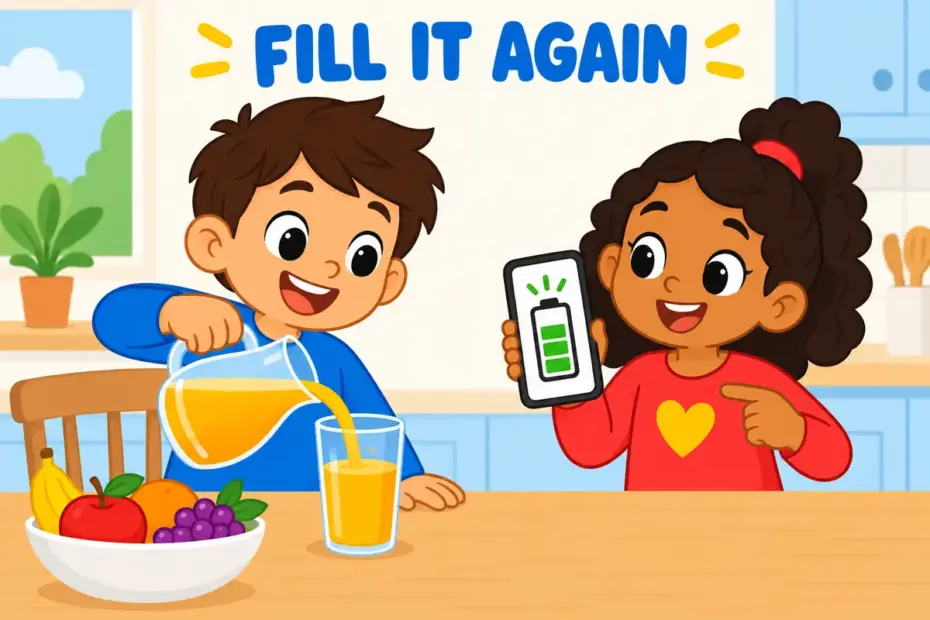
Top up means to add more of something until a container, account or supply is full again. To use top up in a sentence, name what is being refilled and, if you like, what it is refilled with: “He topped up the car with fuel.” The phrasal verb is common in British English and in everyday money talk.
Top up at a glance
- Top up is a transitive phrasal verb: a thing is always topped up.
- Its forms are top up, tops up, topped up and topping up.
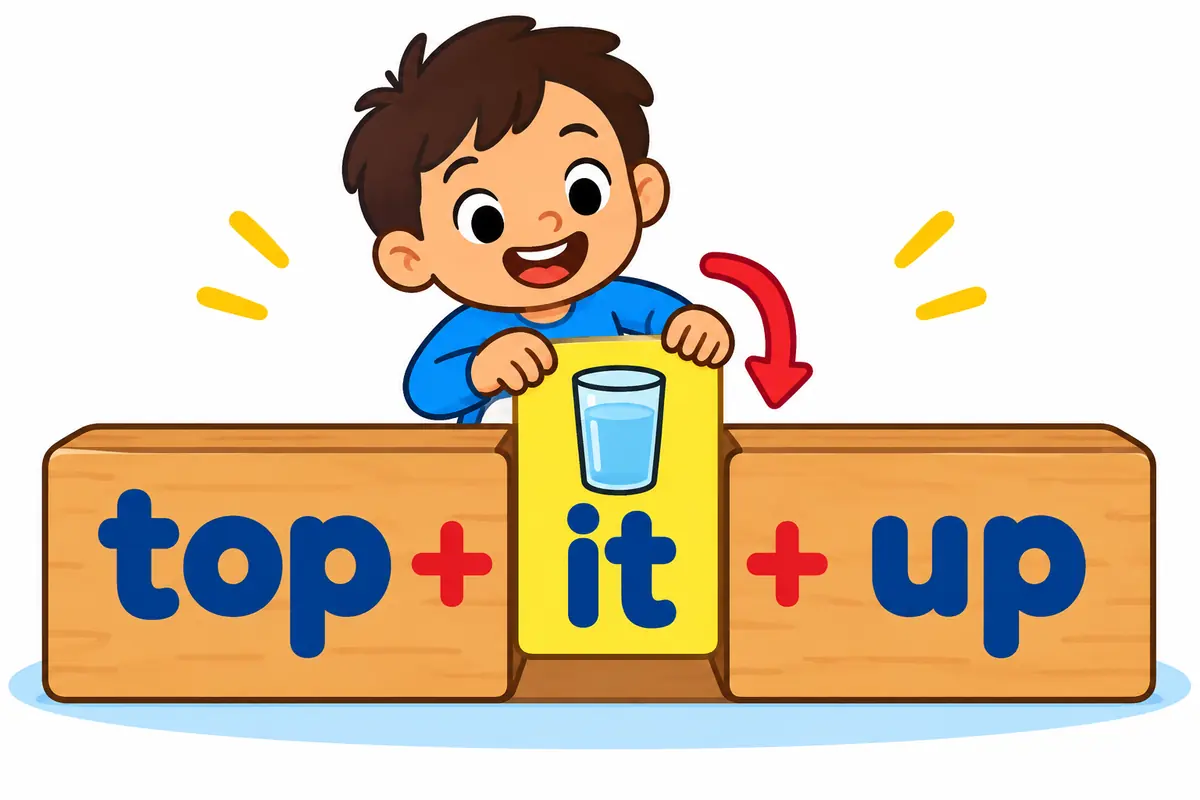
- Pronouns sit between the verb and the particle: top it up, not top up it.
- Usual objects are a tank, a glass, a phone, a card, a meter and a pension.
- The commonest error is confusing it with top off, the American variant.
What does top up mean?
Top up is a phrasal verb meaning to add a little more to something so that it reaches a full or required level. The Cambridge entry for top up records the refill sense, and the same verb extends easily from liquids to money and credit. The table separates the two main settings.
| Sense | Plain meaning | Example sentence |
|---|---|---|
| Refill a container (main) | Add liquid or fuel until it is full again | She topped up the kettle and switched it on. |
| Add money or credit | Put more funds on a card, phone or account | He topped up his travel card at the station. |
| Supplement an amount | Increase a sum so it reaches a target | They topped up the pension before the deadline. |
One limitation is worth stating. Top up means adding to something that already exists; it never means starting from empty. Where a container is dry, you replenish a supply or fill it, and where you simply raise a total, increase or boost fits better.
How do you use top up in a sentence?
Top up is separable, so the object may follow the particle or sit between the verb and it. A pronoun must separate, which is the order learners most often get wrong. Four patterns cover almost every real sentence.
| Pattern | Example | What it signals |
|---|---|---|
| top up + noun | I topped up the tank before the drive. | The plain refill with the object after the particle. |
| top + noun + up | I topped the tank up before the drive. | The same meaning with the object in the middle. |
| top + pronoun + up | I topped it up before the drive. | A pronoun must separate the verb and the particle. |
| top up + with + substance | Top the glass up with lemonade. | Names what is being added, not what is filled. |
Where the addition is not about reaching a level, the verb changes. To raise an amount without a target, boost the total is looser and more general than top up. Because the verb assumes a starting amount, its object is always something already partly there, never a thing created from nothing.
Top up in a sentence: examples across contexts
Top up keeps its shape across very different settings, from a kitchen to a bank app. The nine sentences below show how far the refill idea reaches.
| Context | Example sentence | Why this works |
|---|---|---|
| Home | Top up the bird bath before the heat arrives. | A simple imperative with an everyday object. |
| Driving | We topped up with petrol at the last station before the hills. | Uses with to name the substance added. |
| Cafe work | The barista topped up every cup before it reached the tray. | Shows repeated, small additions rather than one refill. |
| Money | He tops up his phone credit every Friday. | The credit sense, common in British usage. |
| Business | The firm topped up the bonus so every team reached the target. | Uses the supplement sense with a stated purpose. |
| News report | Councils were told to top up their emergency funds. | Formal reporting of a financial refill. |
| Gardening | She topped up the pot with fresh compost each spring. | A dry material shows the verb is not only for liquids. |
| Conversation | Can I top you up? | An idiom offering more of a drink, with the pronoun split. |
| Energy policy | Analysts expect the state to top up the reserve later this year. | Keeps the verb precise in a technical sentence. |
| Car hire | Return the van with a full tank or top it up at the depot. | Uses the split form in an instruction. |
| Gaming | Players top up their in-game currency before a big match. | Extends the credit sense to a digital account. |
| Catering | Waiters top up water glasses without being asked. | Shows the small repeated addition once more. |
| Public transport | Commuters top up their season ticket at the machine. | Fits the credit sense into a daily routine. |
Only the money and business rows leave the kitchen behind entirely, which shows how readily the verb travels into finance.
The verb sits at one end of a small scale. You add a little more to reach a level, complete the order once the target is met, and drain the tank when you want it empty again. Top up covers only the middle step of that sequence.
Top up vs top off
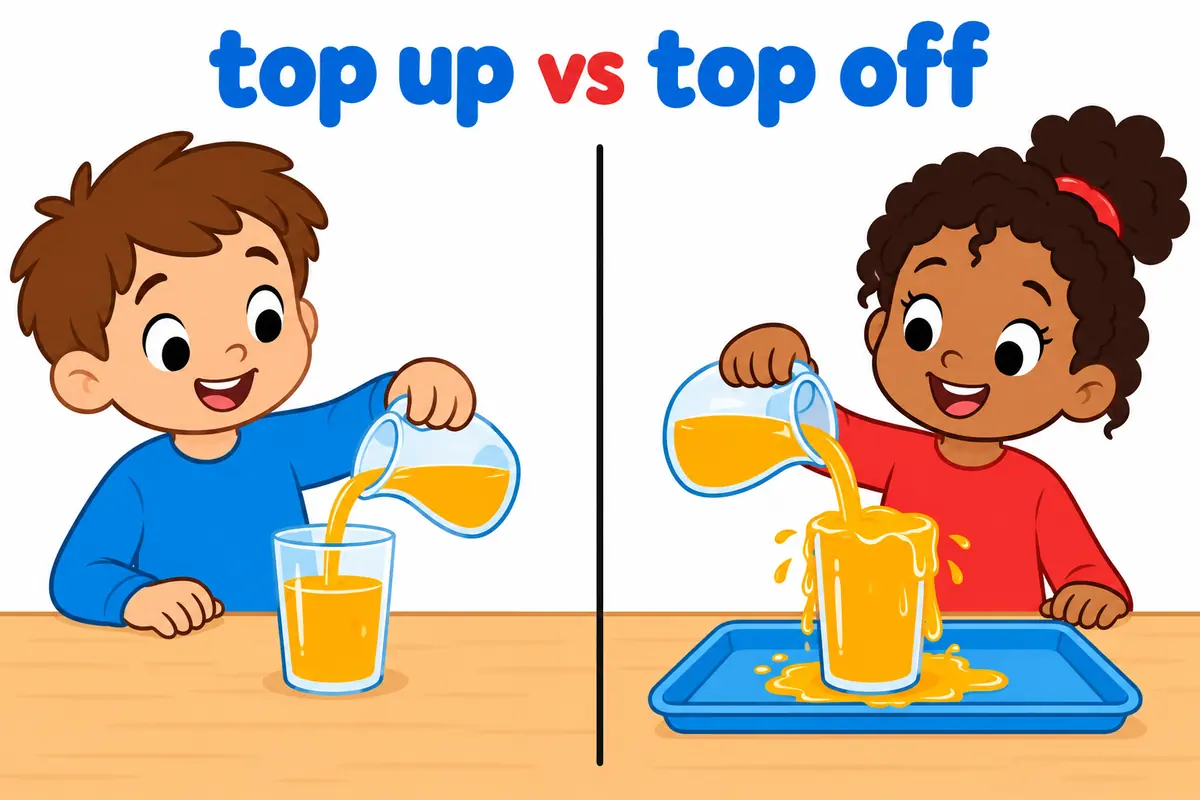
Top up and top off describe nearly the same act, and the difference is largely a matter of region, so the choice usually follows your audience.
| Attribute | top up | top off |
|---|---|---|
| Core meaning | Add more to reach a level | Fill to the very brim |
| Where it is usual | British English | American English |
| Object range | Liquids, fuel, credit, funds | Mostly liquids and fuel |
| Finish point | Full enough to use | Full to the top |
| Separable | Yes; top it up | Yes; top it off |
| Money sense | Common; top up a card | Rare |
Verdict: choose top up for British readers and for money or credit, and top off when a liquid is filled right to the brim. The choice rarely causes confusion in practice, because a listener adjusts to the region rather than the meaning, but a careful editor still matches the verb to the audience.
Phrasal verb grammar of top up
Top up joins the verb top to the particle up. It is transitive and separable, so the object can move, and a pronoun must separate. The particle can strand at the end of a clause, as in the tank needed topping up.
| Form | Part of speech | Example |
|---|---|---|
| top up | base form | Remember to top up the meter. |
| tops up | third person singular | She tops up the water every morning. |
| topped up | past and past participle | We topped up the tank at the border. |
| topping up | present participle | He is topping up his credit at the machine. |
| top-up | hyphenated noun and adjective | A top-up loan covered the gap. |
Other verbs with up work differently. back up a claim means to support it with evidence, so the shared particle hides a very different meaning from top up.
Common mistakes with top up
- Incorrect:
Top up it before we leave.Correct: Top it up before we leave. Rule: A pronoun object separates the verb and the particle. - Incorrect:
She topped up the empty glass to the top.Correct: She filled the empty glass. Rule: Top up means adding to what is already there, not filling from empty. - Incorrect:
I need to top up my money.Correct: I need to top up my card. Rule: Name the container or account, not the money itself, unless it is credit or funds. - Incorrect:
He topped up with the tank.Correct: He topped up the tank with fuel. Rule: The object is the thing filled; with introduces the substance. - Incorrect:
They top up the pension down.Correct: They topped up the pension. Rule: Top up never takes a second particle such as down.
Practice using top up
Work through the six items, then check the reasoning rather than only the answer.
- Fill the gap: Please ______ the kettle before you make the tea.
- Choose the better word: For a British bus card, you (top it up / top it off).
- Correct the error: She topped up it at the machine.
- Build a sentence: use top up with the pronoun it about a phone.
- Spot the register: which suits a bank app – top up your account, or add some money to your account, quick?
- Rewrite with the noun: They added funds until the meter was full. Use top-up.
Answers
- top up – the kettle is the object and the verb stays in the base form after please.
- top it up – a bus card in Britain takes the credit sense of top up.
- She topped it up at the machine – the pronoun must go before the particle.
- Model answer: My phone was low, so I topped it up at the shop.
- Top up your account – short, familiar and correct on an app screen, while the second is wordy.
- They gave the meter a top-up – the hyphenated noun names the added amount.
The bottom line
Use top up in a sentence when you add more to something so it reaches a full or working level, whether the thing is a tank, a card or a pension. The two nuances that decide most sentences are these: it is separable, so a pronoun goes between top and up, and it adds to an existing amount rather than filling from empty. For a liquid filled to the brim, top off is the American choice.
Frequently asked questions about top up
Is top up one word or two?
As a verb it is two words, top up, as in top up the tank. As a noun or adjective it is hyphenated, top-up, as in a top-up card or a top-up loan. Writing topup as one word is non-standard, so keep the space for the verb and the hyphen for the noun.
Is top up British or American?
Top up is especially common in British English, where people top up a phone, a card or a glass. American speakers usually say top off for filling a container, and add to or reload for credit. Both are understood on each side of the Atlantic, but the regional preference is clear.
Is top up separable?
Yes. Top up is separable, so you can write top up the glass or top the glass up. A pronoun must sit between the verb and the particle, giving top it up. The order top up it is not idiomatic. The particle may also strand, as in the tank needs topping up.
Can you top up money or only a card?
You top up a card, an account, a phone or a meter, and you can also top up credit, funds or a pension. The most natural object is the container or account being filled. Saying top up my money sounds vague, so name the account or the credit instead.