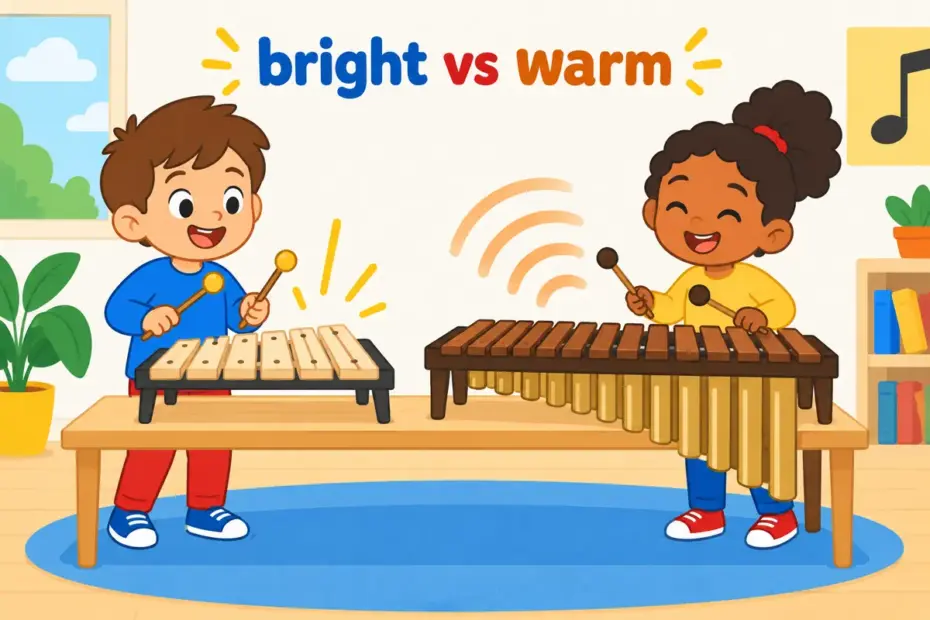
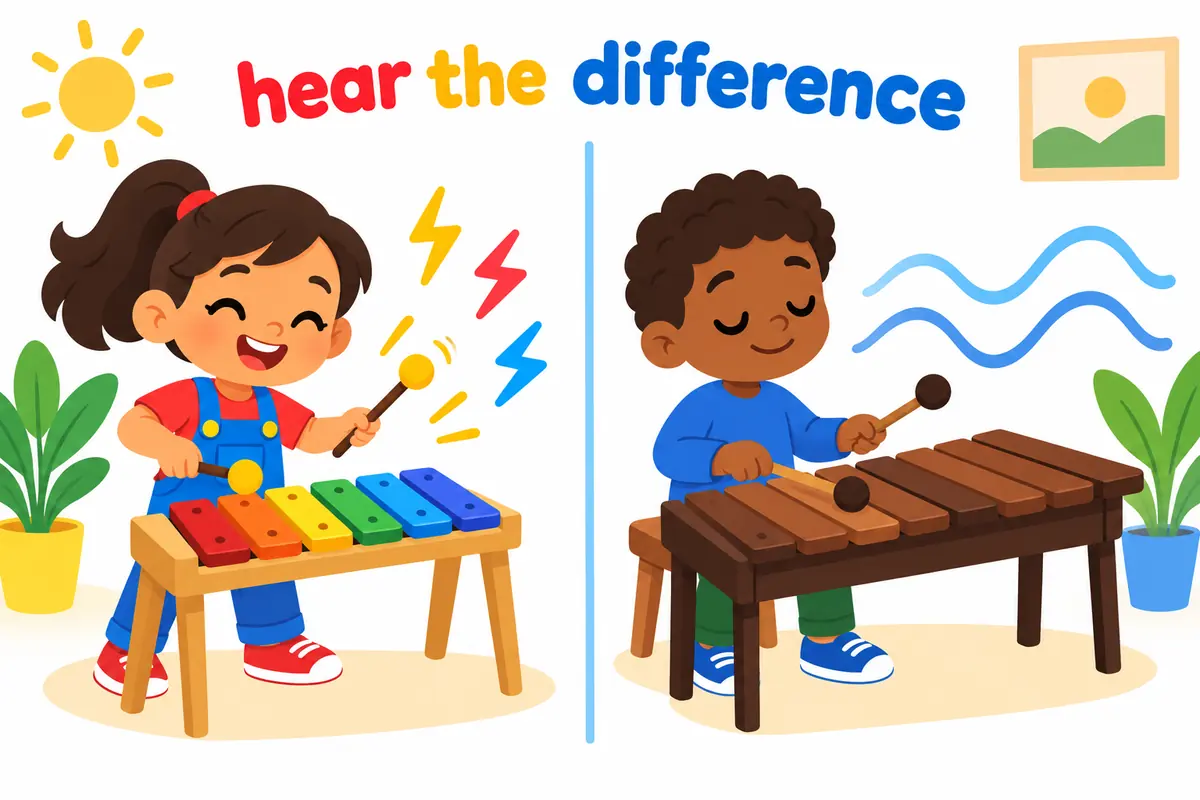
Xylophone vs marimba comes down to one distinction: choose the xylophone for a bright, high, percussive sound that cuts through an ensemble, and the marimba for a warm, low, resonant tone that blends. Both are wooden-bar percussion instruments played with mallets, but the marimba’s wider bars and long resonator tubes make the richer, rounder sound.
Xylophone vs marimba at a glance
- Both are percussion instruments with wooden bars struck by mallets, and both are countable nouns that take a or an.
- The xylophone is the higher, brighter instrument, with narrow bars and hard mallets.
- The marimba is the lower, warmer instrument, with wider bars, yarn mallets and long resonator tubes.
- As nouns, the forms are xylophone and xylophonist, marimba and marimba player.
- The commonest error is using the two names as if the sound were the same, when the tone is the whole point of the choice.
Xylophone vs marimba: the decision table
Six criteria decide almost every real choice. Read across each row and the two instruments separate quickly: one is built to mark the rhythm and the other to carry a melody.
| Criterion | Xylophone | Marimba |
|---|---|---|
| Bars and mallets | Narrow hardwood bars, struck with hard mallets | Wider bars, struck with yarn-wrapped mallets |
| Signature tone | Bright, sharp and percussive | Warm, mellow and rounded |
| Range | Higher; a school model covers only a few octaves | Lower and wider; a concert model covers four or five octaves |
| Resonators | Short tubes, or none on the simplest models | Long graduated tubes that deepen the sound |
| Typical setting | Orchestral accents, school music, cartoon scores | Solo and chamber music, Latin and African ensembles |
| How it behaves in a group | Cuts through and marks the rhythm | Blends and carries a melody or harmony |
Which should you use?
Match the instrument to the job in front of you. The five situations below cover most real decisions, and each names the sound that does the work.
| Your situation | Choose | Why |
|---|---|---|
| You need a bright accent that pierces the mix | xylophone | Hard bars and mallets give short, cutting notes |
| You want a low singing line that blends | marimba | Long bars and resonators give a warm sustained tone |
| You are teaching rhythm to a young class | xylophone | Small, sturdy and loud enough for a whole room |
| You are writing a solo wood-mallet piece | marimba | The wide range supports chords and melody together |
| You are scoring a playful cartoon sting | xylophone | The short brittle notes read as comic movement |
What do xylophone and marimba mean?
A xylophone is a percussion instrument made of a row of wooden bars struck with mallets, and its narrow, hard-tuned bars give a bright, sharp tone. The Cambridge entry for xylophone and the Merriam-Webster entry for xylophone both define it by those struck wooden bars, without naming a size.
A marimba is a percussion instrument with a row of wooden bars and long resonator tubes beneath them, struck with mallets. The Cambridge entry for marimba and the Merriam-Webster entry for marimba describe the deeper, more resonant instrument, and the resonator tubes are the physical reason for that depth. In instrument families a marimba is often treated as the larger, lower cousin of the xylophone.
| Instrument | Core definition | Sentence |
|---|---|---|
| xylophone | A percussion instrument of wooden bars struck with mallets | A xylophone rang out above the brass. |
| marimba | A percussion instrument of wooden bars with resonator tubes, struck with mallets | A marimba murmured under the melody. |
One honest limitation belongs here: the line is not absolute. Some makers fit xylophones with resonators too, and a large xylophone can sound full and low. The reliable difference is the combination of bar width, mallet hardness, range and resonator length, not the name on the frame.
How do you use xylophone and marimba in a sentence?
Both words are countable nouns, so they take a or an, both name instruments you play, and both are struck with hard mallets or soft ones. Five patterns cover nearly every sentence about them.
| Pattern | Example | What it signals |
|---|---|---|
| a + instrument | The school bought a marimba for the hall. | Countable noun with an article for one object. |
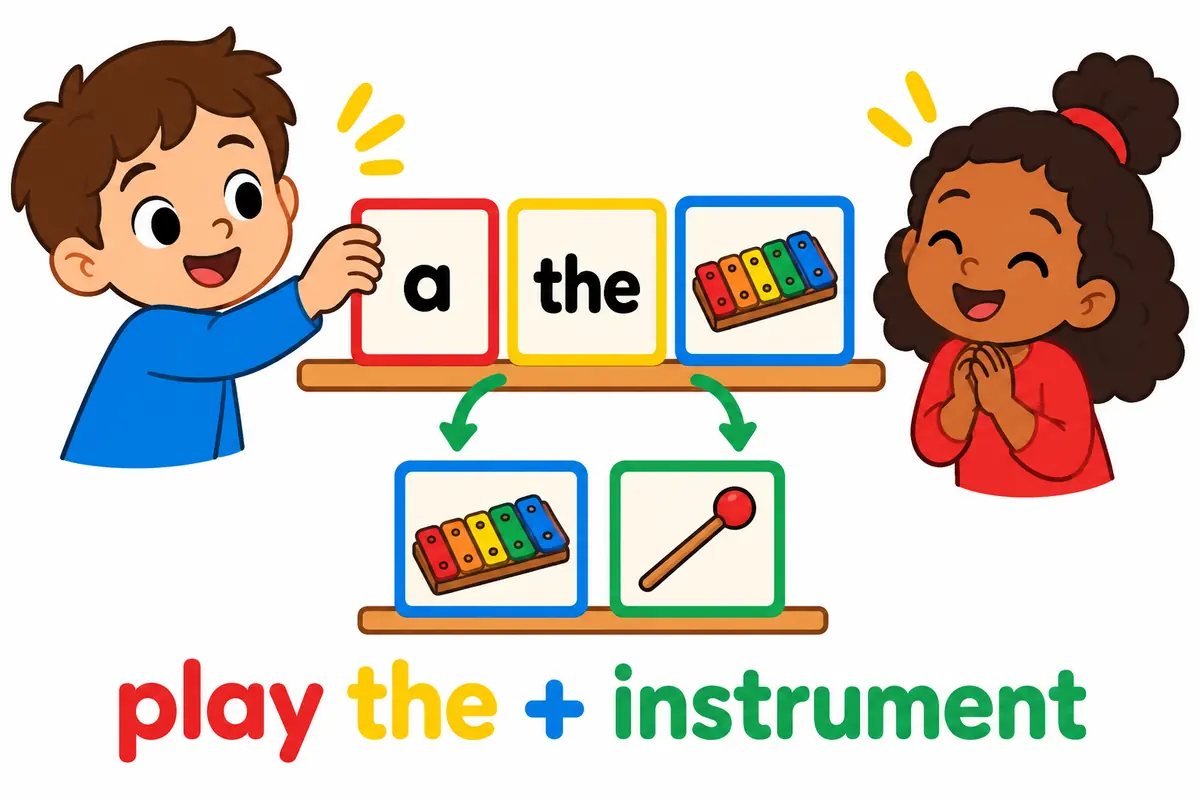
| play the + instrument | She plays the xylophone in the county orchestra. | The definite article marks the instrument performed on. |
| instrument + noun adjunct | He wrote a marimba solo for the recital. | The instrument modifies the piece or part. |
| on the + instrument | The theme sits on the marimba, not the strings. | Names which instrument carries a line. |
| plural general | Marimbas are common in Latin dance bands. | A bare plural names the instrument as a class. |
The same article rule applies to every instrument, so a learner who writes she plays xylophone will be understood but will sound unfinished. To name the person, use xylophonist or the phrase marimba player, because marimbist is rarer.
Xylophone vs marimba in a sentence: examples across contexts
The two names appear wherever people describe, choose, teach or care for wooden-bar instruments. The nine sentences below move from a programme note to a music shop, and each one makes the tone do the deciding.
| Context | Example sentence | Why this works |
|---|---|---|
| Orchestra programme note | The opening theme passes to the xylophone in sharp repeated notes. | The bright repeated figure is exactly what a xylophone excels at. |
| Classroom | Each child takes a turn on the marimba while the class keeps the pulse. | A marimba suits a gentle rotating activity in a class. |
| Music shop | This marimba covers five octaves, while the classroom xylophone beside it covers far fewer. | The range gap decides which instrument a buyer needs. |
| Latin band | The marimba carries the melody over the bass line. | A warm instrument leading a band is a natural marimba role. |
| Film score | A lone xylophone figure lightens the chase scene. | The brittle notes read as playful rather than threatening. |
| Academic essay | Xylophone and marimba differ in bar width, resonator length and mallet hardness. | Names the three physical causes of the sound difference. |
| Conversation | I always mix up the two until I hear the low notes of a marimba. | Shows the pitch test that separates them by ear. |
| Instrument care | Wipe the marimba bars with a soft cloth; save the hard mallets for the xylophone. | Pairs the softer instrument with softer treatment. |
| Concert review | The encore gave the marimba the melody and the xylophone the accents. | Shows the two dividing roles inside one piece. |
Every sentence keeps the instruments in the same grammatical shape: an article, a noun, and a role in the music. The choice is always about tone and range, never about which word is more correct.
Word forms and grammar of xylophone and marimba
Both names follow a parallel pattern. The instrument is the base noun, a player is formed with -ist or with the word player, and the instrument doubles as a noun adjunct before another noun.
| Form | Part of speech | Example |
|---|---|---|
| xylophone | noun | A xylophone stood in the corner of the hall. |
| xylophonist | noun, a player | The xylophonist rehearsed before the doors opened. |
| xylophone | noun adjunct | She wrote a xylophone part for the march. |
| marimba | noun | A marimba filled the concert hall with low notes. |
| marimba player | noun phrase, a player | The marimba player used four mallets at once. |
| marimba | noun adjunct | He composed a marimba solo for the recital. |
The two words share the plural that makes them nouns of class: xylophones and marimbas. Where a writer needs a verb, English supplies play rather than turning the instrument into one, so the marimba player plays the marimba and never marimbas it.
Common mistakes with xylophone and marimba
- Incorrect:
The warm low notes of the xylophone filled the hall.Correct: The warm low notes of the marimba filled the hall. Rule: Warm and low describe the marimba; a xylophone is bright and high. - Incorrect:
She plays xylophone in the orchestra.Correct: She plays the xylophone in the orchestra. Rule: An instrument performed on takes the definite article. - Incorrect:
The metal-barred xylophone rang across the playground.Correct: The metal-barred glockenspiel rang across the playground. Rule: Metal bars belong to a glockenspiel; a xylophone has wooden bars. - Incorrect:
He marimbas the melody very well.Correct: He plays the marimba very well. Rule: Instrument names are nouns, not verbs, in standard English. - Incorrect:
They bought a xylophone that covers five low octaves.Correct: They bought a marimba that covers five low octaves. Rule: A wide, low range points to a marimba.
Practice using xylophone and marimba
Work through the six items, then read the reason beside each answer rather than only the key.
- Choose the better word: For a low, singing melody under the strings, write for the (xylophone / marimba).
- Fill the gap: Each player strikes the ______ with mallets wrapped in yarn.
- Correct the error: The bright, cutting accents come from the marimba at the back.
- Build a sentence: use play the with one of the instruments about an orchestra member.
- Spot the register: which belongs in a concert programme — the marimba carries the theme, or the marimba does the tune bit?
- Rewrite in a question: The difference between the two instruments is their tone.
Answers
- marimba — a low, singing line is the marimba’s strength.
- marimba — yarn-wrapped mallets belong to the marimba; a xylophone takes hard mallets.
- The bright, cutting accents come from the xylophone at the back — bright cutting tones are the xylophone’s.
- Model answer: The new member plays the marimba in the youth orchestra.
- The marimba carries the theme — a programme keeps the concise formal phrase.
- How do the two instruments differ in tone? — the question form paraphrases the statement.
The bottom line
For xylophone vs marimba, let the sound decide: use the xylophone for bright, high, percussive accents, and the marimba for warm, low, resonant melody and harmony. The two points that settle most choices are these: bar width and mallet hardness control the tone, and the marimba’s longer resonators give it the deeper voice. Both are wooden-bar percussion instruments, so the article before each is the same.
Frequently asked questions about xylophone vs marimba
Is a marimba a type of xylophone?
In broad family terms the marimba is treated as the larger, lower relative of the xylophone, and some classifications group them together. As instruments they are still distinct, because the marimba has wider bars, longer resonator tubes and a warmer sound. A player chooses the name by the tone and range, not by the family tree.
What mallets do you use on each instrument?
Hard mallets, often with rubber or plastic heads, suit the xylophone and help produce its bright, cutting tone. Softer mallets wrapped in yarn suit the marimba, softening the attack and letting the low notes resonate. Using yarn mallets on a xylophone makes it sound dull, while hard mallets on a marimba sound harsh.
Is the xylophone hard to learn?
The xylophone is one of the easier percussion instruments to start on, because the bars are laid out like a keyboard and a beginner can play a tune with two mallets. The marimba is usually taken up later, once a player can handle four mallets and read across a wider range. Both reward steady practice.
What is the difference between a xylophone and a glockenspiel?
A xylophone has wooden bars, while a glockenspiel has metal bars. That single material change gives the glockenspiel a ringing, bell-like tone an octave or more above the xylophone, and it is much smaller. The two are therefore not interchangeable, even though both are struck with small mallets.