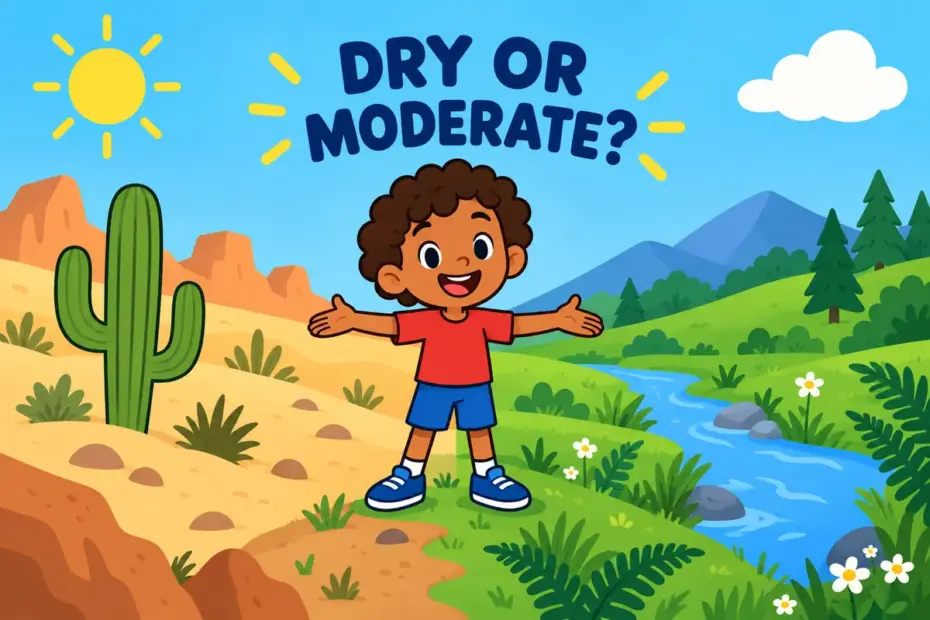
Xeric vs mesic comes down to moisture: use xeric for places and plants that survive on very little water, and mesic for habitats with a moderate, steady supply. Choose the dry word for deserts, cactus gardens and sandy slopes, and the middle word for ferns, moss and rich woodland soil.
Xeric vs mesic at a glance
- Both words are adjectives from ecology, describing how much water a place or species needs.
- Xeric means very dry; mesic means moderately moist, in the middle of the water scale.
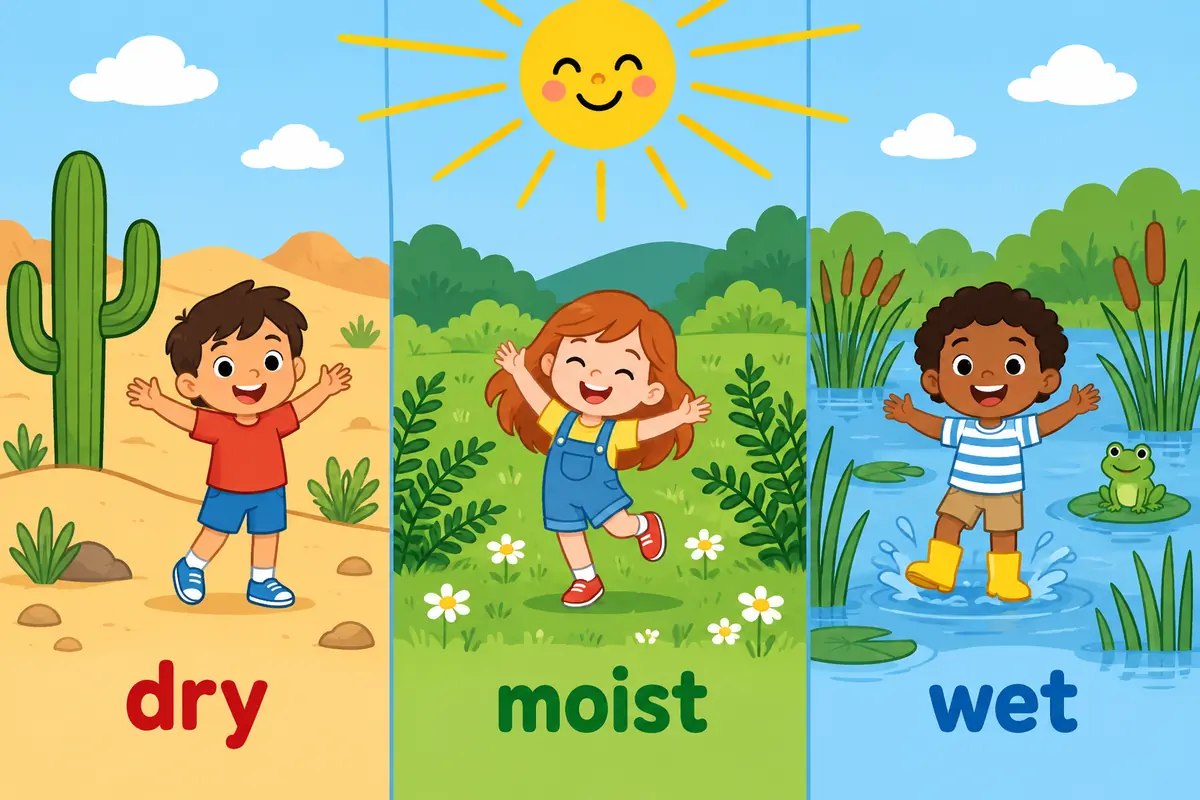
- A third term, hydric, means wet, and completes the gradient dry, moderate, wet.
- The usual partners are xeric habitat and mesic forest; neither word takes a comparative form.
- The commonest error is calling a marsh mesic when it is wet enough to be hydric.
Xeric vs mesic: the master comparison
The two words describe positions on one continuous moisture gradient rather than opposite teams, so most disagreements about them come down to where a site actually sits. The table below sets six decision-weighted criteria side by side.
| Criterion | Xeric | Mesic |
|---|---|---|
| Core meaning | Very dry, or adapted to very dry conditions | Moderately moist, neither dry nor wet |
| Water supply | Scarce, and often seasonal | Steady and adequate |
| Typical habitats | Deserts, dunes, rocky ridges, sandy slopes | Woodlands, meadows, river terraces |
| Typical plants | Cacti, succulents, sagebrush, drought shrubs | Ferns, mosses, maples, clover |
| Contrast partner | Mesic and hydric | Xeric and hydric |
| Misreading risk | Mistaken for merely warm | Mistaken for outright wet |
Read the gradient as a line. Xeric sits at the dry end, hydric at the wet end, and mesic is the wide middle where most gardens, farm fields and temperate forests fall. That is why mesic is the quieter word: it describes the ordinary case that rarely needs naming.
Which should you use?
Match the word to the site, not to the climate zone, and the choice usually makes itself. The five situations below cover most writing about plants, soil and land.
| Your situation | Use | Reason |
|---|---|---|
| A desert trail, dune or cactus bed | xeric | Water is scarce for most of the year, which is the defining condition. |
| A fern gully or mossy woodland | mesic | Moisture is steady but the ground never stays saturated. |
| A soil survey comparing several plots | both | The words mark the dry and middle points of one measured gradient. |
| A marsh that floods every spring | hydric | Neither word fits a site that is wet, so the third term is correct. |
| A general essay on rainfall | arid or dry | Outside ecology, the plain words are clearer than either technical term. |
What do xeric and mesic mean?
Xeric is an adjective meaning very dry, or adapted to very dry conditions; mesic is an adjective meaning moderately moist. The Cambridge entry for xeric ties the first to low moisture, and the Cambridge entry for mesic ties the second to a moderate amount. Both belong to ecology, botany and soil science, where they name points on a water scale rather than absolute amounts. The dedicated page for xeric shows the adjective across dry habitats, while arid covers the broader dry climate that xeric narrows.
| Word | Plain meaning | Example sentence |
|---|---|---|
| xeric | Very dry; adapted to little water | Cacti thrive in xeric conditions. |
| mesic | Moderately moist; neither dry nor wet | Ferns prefer mesic woodland. |
| hydric | Wet; saturated for much of the year | The hydric corner flooded each spring. |
One limitation is worth stating plainly. Neither word tells you a temperature, a rainfall total or a soil type, so both are vague outside a described habitat. In a gardener’s note, dry and moist will usually serve better than xeric and mesic, which sound clinical in casual writing.
How do you use xeric and mesic in a sentence?
Both words are adjectives, so they sit before a noun or after the verb be, exactly like dry and moist. They almost always modify a habitat, a soil or a plant community rather than a single object. Four patterns carry nearly every sentence.
| Pattern | Example | What it signals |
|---|---|---|
| xeric / mesic + habitat noun | The survey mapped a mesic meadow. | The adjective describes a place and its moisture. |
| be + xeric / mesic | The slope is xeric for most of the year. | Predicate use, often with a time qualifier. |
| xeric / mesic + species | Xeric shrubs recovered first after the fire. | Describes plants grouped by water need. |
| xeric / mesic + soil | Mesic soil holds the spring rain. | Applies the word to the growing medium itself. |
Because the words already mean dry and moist, avoid layering a second moisture word on top. A humid climate is not automatically mesic, since humidity measures air while mesic describes the water available to roots.

Xeric and mesic in a sentence: examples across contexts
The two words change setting more than meaning. The ten sentences below move from a garden bed to a field-survey report, and each shows which word a writer in that setting would actually reach for.
| Context | Example sentence | Why this works |
|---|---|---|
| Gardening | A xeric border of succulents needs almost no watering. | Names a planting style built on scarce water. |
| Botany | The species is restricted to xeric ridges. | Points to the dry sites where the plant survives. |
| Ecology survey | We sampled three mesic plots beside the stream. | Mesic marks the moderate moisture of the plots. |
| Forestry | Mesic slopes carry taller timber than the dry spurs. | Contrasts moisture with growth. |
| Soil science | The xeric soils drained within an hour of the rain. | Uses the word for the medium, not the plants. |
| Conservation | Restoring the mesic meadow brought the butterflies back. | Ties a habitat type to a measured outcome. |
| Field guide | Look for the lizard on warm, xeric slopes. | Pairs moisture with temperature as a search clue. |
| Climate writing | A warmer decade is shifting some mesic sites toward xeric. | Uses both words to describe a change. |
| Farm planning | Only mesic fields were sown with the thirsty crop. | Matches a water need to a site type. |
| Conversation | That bank is a bit dry, really xeric. | Shows the word used loosely in speech, with a hedge. |
Sites that dry out each summer sit at the boundary, and careful writers hedge: seasonally dry is more accurate than xeric when the moisture shortage lasts only part of the year.
Word forms and grammar of xeric and mesic
Neither adjective inflects: there is no xericker or more mesic. Related nouns and a handful of derived forms carry the same root, and the table shows which ones are safe to use.
| Form | Part of speech | Example |
|---|---|---|
| xeric | adjective | The garden is deliberately xeric. |
| mesic | adjective | The valley floor stays mesic all summer. |
| xerophyte | noun | A cactus is a classic xerophyte. |
| xeriscape | noun and verb | They xeriscaped the front yard. |
| hydric | adjective | Hydric soils are saturated for long spells. |
A useful parallel is the trio of clothing words used in weather reports, warm, mild and cold: each is a point on a scale, and none is the true opposite of another. Xeric, mesic and hydric work the same way, which is why a sentence can move a site from mesic toward drought conditions without any contradiction.
Common mistakes with xeric and mesic
- Incorrect:
The rainforest is xeric.Correct: The rainforest is mesic, or even hydric. Rule: Xeric means very dry, so a rainy forest cannot be xeric. - Incorrect:
Xeric plants need plenty of water.Correct: Xeric plants tolerate very little water. Rule: The word describes a low water need, not a large one. - Incorrect:
The marsh is mesic and floods each spring.Correct: The marsh is hydric and floods each spring. Rule: A saturated site is hydric; mesic means moderate, not waterlogged. - Incorrect:
an xeric borderCorrect: a xeric border. Rule: Xeric begins with a z sound, so it takes a rather than an. - Incorrect:
This soil is more xeric than that one, the most xeric of all.Correct: This soil is drier than that one, the driest of all. Rule: The adjective has no comparative or superlative form; use dry for degrees.
Practice using xeric and mesic
Work through the six items, then read the reasons that sit with the answers.
- Fill the gap: A garden of cacti and gravel is described as ______.
- Choose the better word: The streamside meadow stays (xeric / mesic) through the summer.
- Correct the error: The bog is mesic for most of the year.
- Build a sentence: use xeric habitat about a sandy ridge in a nature report.
- Spot the register: which belongs in a field-survey report — the plot is mesic, or the plot is pretty damp?
- Fix the article: an mesic slope.
Answers
- xeric — the planting is designed around very little water.
- mesic — steady moderate moisture fits a streamside meadow; xeric would mean very dry.
- The bog is hydric for most of the year — a saturated site is hydric, not mesic.
- Model answer: The survey found lizards only on the xeric habitat of the sandy ridge.
- The plot is mesic — a survey prefers the precise technical adjective to pretty damp.
- a mesic slope — mesic begins with an m sound, so it takes a, never an.
The bottom line
Use xeric for very dry sites and the plants that survive them, and mesic for habitats with moderate, steady moisture. The two details that decide most sentences are that both words are adjectives with no comparative form, and that the scale has a third point, hydric, for genuinely wet ground. When the site is a saturated marsh or a humid tropical hollow, neither word is the right tool.
Frequently asked questions about xeric and mesic
What does xeric mean in gardening?
In gardening, xeric describes a planting designed for very little water, using succulents, gravel mulch and drought-tolerant shrubs. It names a watering strategy as much as a climate. A xeric border still needs occasional deep watering while its plants establish, but it is planned to survive on rainfall afterwards.
What is the difference between mesic and hydric?
Mesic means moderately moist, while hydric means wet or saturated. A mesic meadow holds steady moisture that drains freely; a hydric soil stays waterlogged for much of the year and often shows mottled colours. The two sit next to each other on the same scale, with hydric at the wet end.
Can a plant be both xeric and mesic?
A single plant is usually classed one way, but individual species cover a range. A shrub sold as drought-tolerant may grow best in mesic soil and merely survive in xeric ground. Botanical guides therefore give a range, such as dry to mesic slopes, rather than a single fixed label.
Are xeric and mesic used outside ecology?
Rarely, and they sound technical when they are. Landscapers use xeric for low-water garden design, and some climate writing borrows both words to describe shifting moisture. In general prose, dry and moist are clearer and need no glossary, so reserve the technical pair for specialist audiences.