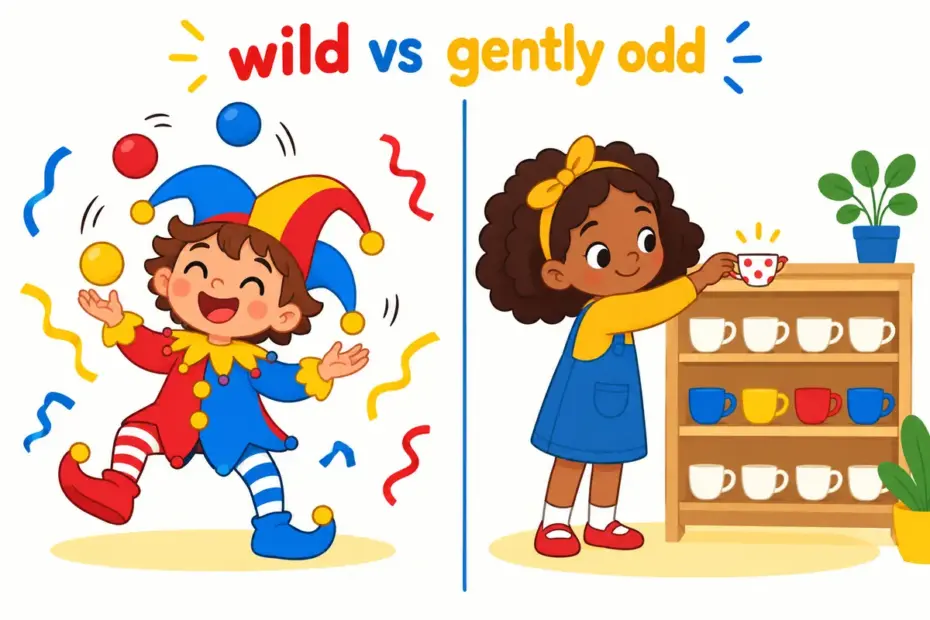
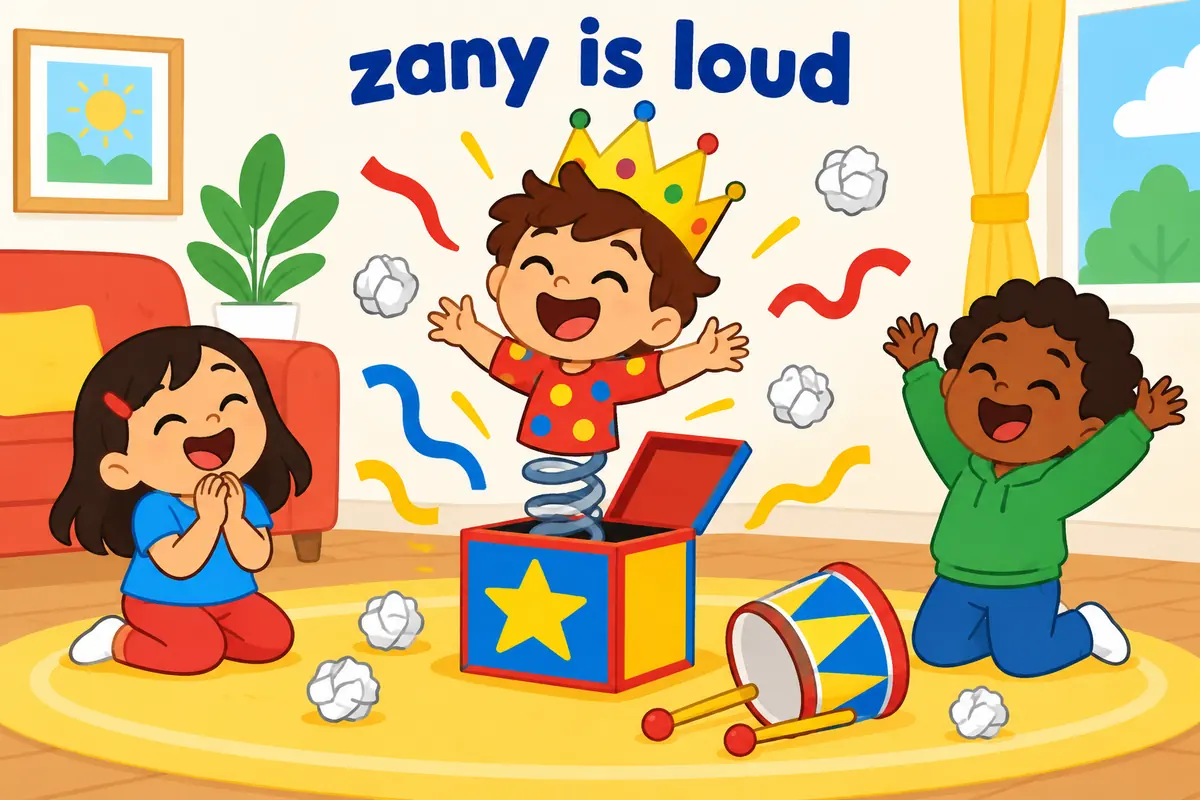
Zany vs quirky is the choice between comedy that is wildly silly and an oddity that is small and harmless. Use zany for performances, jokes and situations that are chaotic, and quirky for a specific, likeable quirk in a person, place or design. A clown act is zany; a cafe that labels every table with a different bird is quirky.
Zany vs quirky at a glance
- Zany is an adjective, and sometimes a noun, for wild comic silliness; quirky is an adjective for an endearing oddity.
- Zany pushes past ordinary humour; quirky stays gentle and specific.
- Zany often describes a person, act or style; quirky often describes a detail, habit, taste or design.
- Both are informal in tone, though quirky is the safer choice in professional writing.
- Only zany carries a hint of deliberate craziness; quirky never implies chaos.
- The commonest error is calling a small, charming detail zany when quirky fits better.
Zany vs quirky: the master comparison
The two words overlap on the idea of being unusual, and that is where the confusion starts. The table below separates them on the criteria that decide a real sentence.
| Attribute | zany | quirky |
|---|---|---|
| Core meaning | Wildly silly and comic | Pleasantly odd in one small way |
| Intensity | High energy, near chaos | Low key, understated |
| Tone | Boisterous, often laugh-out-loud | Warm, affectionate, sometimes wry |
| Typical subject | A person, act, plot or outfit | A habit, taste, detail or design |
| What it implies | Deliberate craziness, entertainment | A likeable difference, no threat |
| Register | Informal | Informal but usable in relaxed professional writing |
| Also a noun | Yes, a zany is a comic performer | No, but the noun quirk exists |
| Safe for a person | Risky if aimed at someone serious | Usually kind |
What do zany and quirky mean?
Zany is an adjective meaning wildly silly in a comic way, and it can act as a noun for an amusing performer. The Cambridge entry for zany centres on clownish humour, which is why the word suits physical comedy. Quirky is an adjective meaning attractively odd, and the Cambridge entry for quirky stresses a mild, likeable strangeness rather than a comic explosion. The two sit at opposite ends of the same scale.
| Word | Part of speech | Core meaning | Example sentence |
|---|---|---|---|
| zany | adjective | Wildly silly and comic | The zany sketch ended with three pies in the air. |
| zany | noun | A comic performer | The old zany never repeated the same gag twice. |
| quirky | adjective | Pleasantly odd in a small way | They chose a quirky cafe with mismatched chairs. |
The dedicated zany page explores the louder half of this comparison, and its opposite, conventional, describes whatever follows the expected pattern.
One limitation is worth stating plainly. Zany can wound when it is aimed at a serious person, because it suggests they are ridiculous. Quirky can sound like faint praise if the speaker means merely strange, so writers often add a positive word such as charming or clever to make the warmth clear.
How do you use zany and quirky in a sentence?
Both words are adjectives, so they sit before a noun or after a linking verb. The difference shows up in what they are allowed to describe: zany scales a whole performance, while quirky attaches to one detail. Zany can also stand alone as a noun, but quirky cannot.
| Pattern | Example | What it signals |
|---|---|---|
| zany + noun | They staged a zany version of the play. | Labels a whole work as wildly comic. |
| linking verb + zany | The finale was zany from start to finish. | Describes the energy of an event. |
| zany as a noun | The festival hired a zany to host the night. | Names a comic performer. |
| quirky + noun | She has a quirky habit of naming her plants. | Flags one small, likeable detail. |
| linking verb + quirky | The new library feels quirky rather than grand. | Describes character, not chaos. |
When the sense is simply amusing, the commoner word is funny, which carries no hint of craziness or oddity.
Zany and quirky in a sentence: examples across contexts
The ten sentences below keep one word for chaos and the other for charm, so the contrast stays visible in every register.
| Context | Example sentence | Why this works |
|---|---|---|
| Comedy review | The second half was zany, with props flying across the stage. | Zany covers a whole chaotic performance. |
| Workplace email | We kept the mascot but gave it a quirky hat. | Quirky marks one small design detail. |
| Classroom | The teacher’s zany science demo ended in foam. | Zany signals deliberate, comic energy. |
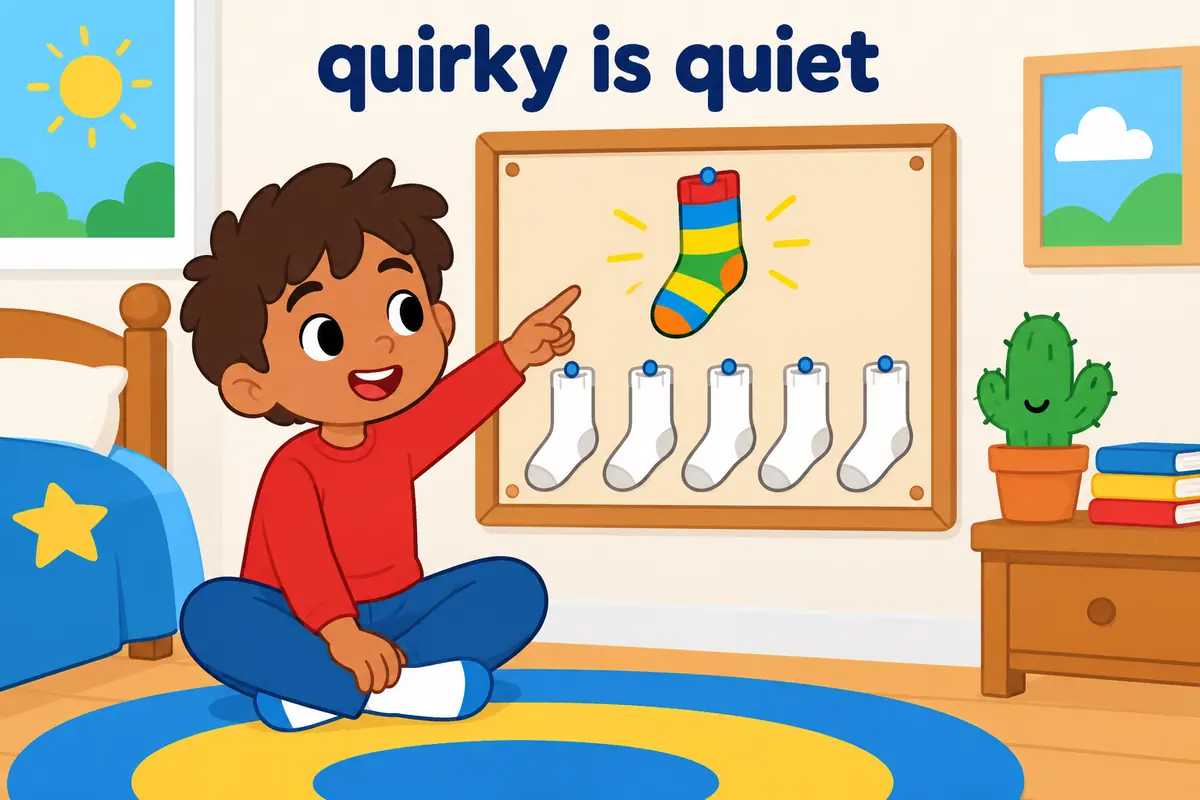
| Fashion writing | She pairs a plain coat with quirky socks. | Quirky attaches to a single accessory. |
| Conversation | Our neighbour is quirky but very kind. | Quirky is gentle and safe for a person. |
| News feature | The town’s zany festival draws thousands each year. | Zany sells the event as gloriously silly. |
| Academic writing | Participants preferred the quirky design to the standard one. | Quirky survives in formal prose as mild oddity. |
| Marketing copy | A zany launch video went viral in a day. | Zany promises loud entertainment. |
| Travel writing | The lane is lined with quirky little shops. | Quirky gives warm, low-key character. |
| Sports reporting | His zany celebration delighted the crowd. | Zany describes a comically wild moment. |
| Cooking show | The host turned the tasting into a zany game with blindfolds. | A whole activity is labelled chaotic fun. |
| Product review | The quirky lid opens in a way nobody expects. | One surprising mechanism earns the label. |
Which should you use?
Match the word to the size of the oddity and the tone you want. The table maps five common reader situations to a firm recommendation.
| Situation | Better word | Why |
|---|---|---|
| Describing a chaotic comedy show | zany | The energy is loud, physical and deliberately silly. |
| Describing a friend’s harmless habit | quirky | One small detail is being noticed kindly. |
| Writing a report or proposal | quirky | Quirky reads as neutral; zany can sound unserious. |
| Praising one unusual product feature | quirky | The feature is a charming difference, not a spectacle. |
| Describing a wild party game | zany | The game is meant to be chaotic fun. |
Verdict: pick zany when the comedy is the point and quirky when the charm is. If you cannot decide, ask whether the thing is loud or merely different; loud favours zany, different favours quirky.
Word forms and grammar of zany and quirky
Both adjectives take comparative and superlative forms, and both build adverbs that are less common than the adjectives themselves. The noun forms differ: zany has its own noun, zanies, while quirky borrows quirk and quirkiness.
| Form | Part of speech | Example |
|---|---|---|
| zany | adjective, base | A zany plan can still work. |
| zanier | adjective, comparative | Tonight’s show is zanier than last week’s. |
| zaniest | adjective, superlative | That was the zaniest stunt of the tour. |
| zany | noun, plural zanies | Two zanies shared the bill. |
| quirky | adjective, base | She wears quirky glasses. |
| quirkier | adjective, comparative | This cafe is quirkier than the last one. |
| quirkiness | noun | Their quirkiness is a selling point. |
| more zany | non-standard comparative | Prefer zanier; more zany is not wrong but is less common. |
The adjective eccentric is the formal cousin of quirky, and it sounds more like a judgement than a compliment.
Common mistakes with zany and quirky
- Incorrect:
The filing system is quite zany.Correct: The filing system is quite quirky. Rule: A mild oddity is quirky; zany would suggest chaos. - Incorrect:
The party was quirky, with music and foam everywhere.Correct: The party was zany, with music and foam everywhere. Rule: Loud, chaotic fun belongs to zany. - Incorrect:
He is a quirky performer who never stands still.Correct: He is a zany performer who never stands still. Rule: On-stage wildness is zany, not quirky. - Incorrect:
She has a very quirk sense of humour.Correct: She has a very quirky sense of humour. Rule: Use the adjective quirky before a noun, not the noun quirk. - Incorrect:
That was quircky.Correct: That was quirky. Rule: Quirky is spelled without a c after the r.
Practice using zany and quirky
Work through the six items, then read the reasoning rather than only the key.
- Fill the gap: The street market is full of ______ little stalls selling nothing useful.
- Choose the better word: The comedian’s (zany / quirky) entrance involved a unicycle and three horns.
- Correct the error: Our new intern is a bit zany but very organised.
- Build a sentence: use quirky about one unusual feature of a school library.
- Spot the register: which fits a company report — the product has a quirky handle, or the product is totally zany?
- Rewrite with the noun: The design is quirky. Use quirkiness instead.
Answers
- quirky — small stalls with charm are odd in a gentle way, not chaotic.
- zany — the unicycle and horns make the entrance loud and comic.
- Our new intern is a bit quirky but very organised — zany would wrongly suggest chaos.
- Model answer: The library keeps a quirky shelf of books arranged by colour.
- The product has a quirky handle — a report avoids zany and the casual totally.
- The quirkiness of the design won several awards — the noun names the quality itself.
The bottom line
Use zany for comedy that is wild and deliberately chaotic, and quirky for a small, likeable oddity. The two decision points are intensity and size: zany covers a whole performance or mood, while quirky attaches to one habit, detail or design. When you only mean amusing, madcap and funny are useful alternatives, and the formal idiosyncratic covers quirkiness in academic prose.
Frequently asked questions about zany vs quirky
Is quirky a compliment?
Usually it is. Quirky suggests a likeable, harmless difference rather than a fault, so describing a cafe or a friend as quirky sounds warm. In a formal report it becomes neutral, and only in a sharp tone could it imply merely strange. Adding charming removes any doubt.
Can zany describe a person?
It can, but the effect depends on the person. Zany suits a performer who is deliberately comic, and it lands badly on someone serious, where it implies they are ridiculous. When you want a gentle word for a person’s habits, quirky is the safer and kinder option.
What is the noun form of quirky?
The adjective quirky has two related nouns: quirk, meaning one odd habit or feature, and quirkiness, meaning the quality of being quirky. Zany is different, because it works as a noun itself, with the plural zanies for comic performers. Choose quirk for one detail, quirkiness for a general quality.
Is zany a formal word?
No. Zany is informal and belongs in reviews, marketing and conversation, where loud comedy is the subject. Academic and professional writing usually prefers quirky or idiosyncratic, which carry less noise. In a job application, describing yourself as zany would undercut a serious tone.