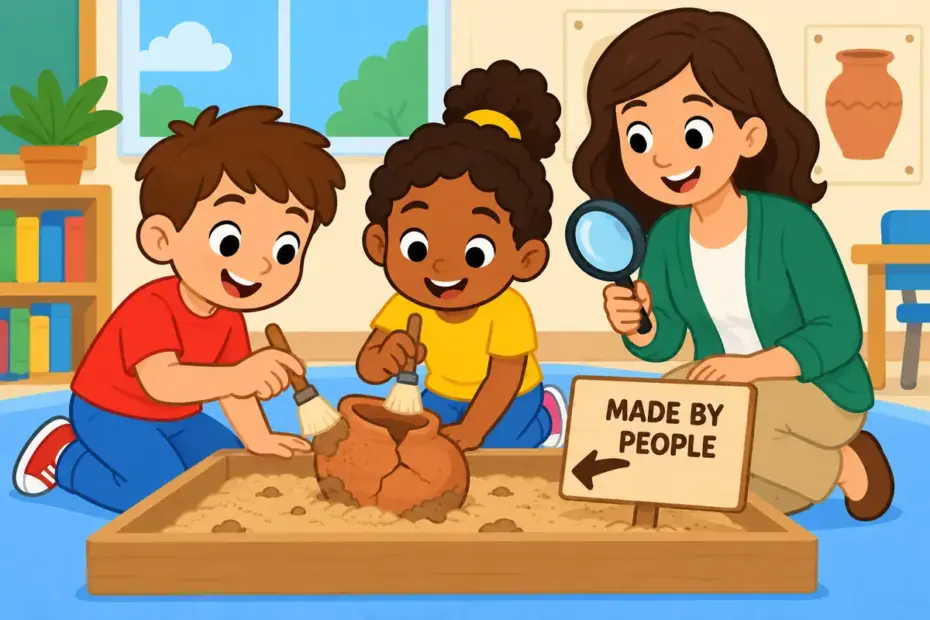
Artifact is a noun for an object made by human hands, especially one that survives from an earlier culture: a clay cup from a riverbed is a genuine artifact. The same word also names a false result produced by a machine or method, so context alone decides which sense a sentence carries.
Artifact at a glance
- Artifact is a countable noun; its plural is artifacts.
- The dominant pattern is artifact from or artifact of, naming an origin.
- It covers three senses: a cultural object, a spurious technical result, and a software byproduct.
- The American spelling is artifact; British English often writes artefact.
- The commonest error is calling a natural object an artifact, although no human shaped it.
What does artifact mean?
Artifact is a noun meaning an object made by a human being, especially one of historical or cultural interest. The Cambridge entry for artifact records both the physical sense and the technical sense of an unintended result, and the two are easy to tell apart once you spot the context.
| Sense | Plain meaning | Example sentence |
|---|---|---|
| Cultural object | A thing shaped by people and preserved | The dig uncovered a bronze artifact from the first century. |
| Spurious technical result | A false feature caused by the method or machine | The bright band on the scan was an artifact of the new lens. |
| Software byproduct | A file produced during a build or process | The pipeline stored each build artifact for a week. |
One limitation is worth stating plainly. Artifact is not a synonym for fossil or bone, because it insists that people made the thing. A natural item studied in a lab is a specimen, which pairs with artifact as its opposite. A natural object was never shaped by human hands, so it is not an artifact.
Two further details matter for accuracy. First, the noun is countable, so a bare artifact with no article sounds like a label rather than a sentence. Second, ordinary speech often stretches the word to mean any old keepsake, a looser use that a museum label would avoid.
How do you use artifact in a sentence?
Artifact is countable, so it appears with an article, a number or a plural. Beyond that, a small group of prepositions fixes the sense: from and of point to a culture or period, while of a process signals the technical meaning.
| Pattern | Example | What it signals |
|---|---|---|
| artifact from + place or time | The artifact from the tomb is now on display. | Names where the object was recovered. |
| artifact of + culture or period | A stone artifact of the Bronze Age lay in the silt. | Ties the object to a named culture. |
| an artifact of + process | The rings were an artifact of the printing process. | The technical, false-result sense. |
| a build or software artifact | The engineer archived every build artifact. | The computing sense of a produced file. |
| an artifact + be dated to | The artifacts were dated to the early Iron Age. | Reports scholarly dating, not the writer’s guess. |
One practical test separates the senses quickly. If you can put the object on a table and photograph it, the cultural sense is probably intended; if the noun names a pattern that ought not to be there, the technical sense is at work.

Artifact in a sentence: examples across contexts
Artifact moves between the museum, the laboratory and the software repository without changing its core idea of something produced. The ten contexts below show how reliably the surrounding words announce the sense.
| Context | Example sentence | Why this works |
|---|---|---|
| Museum label | The artifact dates from the late Bronze Age. | Pairs the noun with a scholarly date. |
| Archaeology | Each artifact was photographed before it was lifted. | Shows careful fieldwork practice. |
| Medical imaging | The dark streak proved to be an artifact of the scan. | Uses the false-result sense with of. |
| Software | The build artifact was published with the release notes. | Frames a produced file as an artifact. |
| Classroom | Our class made an artifact box for the history corner. | Uses the word in a child-friendly project. |
| News report | Customs returned the artifact to its country of origin. | Places the noun in a legal, public story. |
| Conversation | That old tin is not valuable, but it is a lovely artifact. | Uses the noun loosely for a keepsake. |
| Academic writing | The artifact was catalogued under a secure reference number. | Keeps the tone formal and precise. |
| Digital preservation | Every digital artifact was copied to two archives. | Extends the noun to born-digital material. |
| Forensics | Investigators treated the tool as an artifact of the crime. | Applies the made-object sense to evidence. |
Objects from antiquity reach museums through excavation and careful recording, and the wider word object covers anything you can hold, made or natural.
Notice how the surrounding words do the work. A date, a museum or a trench signals the cultural sense within a few words, while a lens, a printer or a pipeline signals the technical sense. Readers rarely need the context spelled out, because the nouns that keep company with artifact are themselves a fingerprint.
Artifact vs artifice
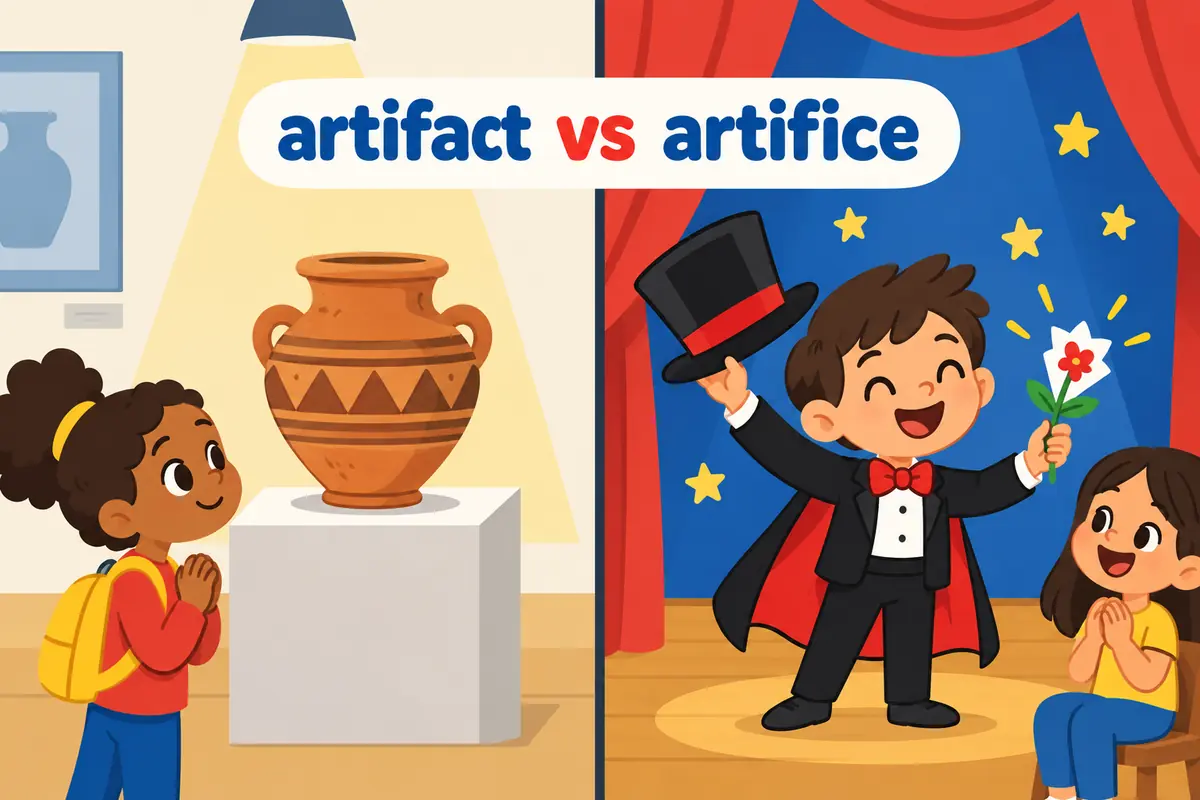
Artifact and artifice share six letters and almost nothing else. An artifact is a real thing that somebody made, while artifice is a clever device or trick, often one meant to mislead. The look-alike word artifice means a clever trick rather than a made thing.
| Attribute | artifact | artifice |
|---|---|---|
| Part of speech | Noun, countable | Noun, usually uncountable |
| Core meaning | An object made by people | A clever trick or contrivance |
| What it names | A physical or digital thing | A method, ruse or sleight |
| Connotation | Neutral to scholarly | Often slightly negative |
| Typical companion | Museum, excavation, build | Deception, cunning, charm |
| Register | Academic and technical | Literary and formal |
Verdict: reach for artifact whenever the noun is a thing you could display, and choose artifice when the noun is a trick somebody performs. A near relative, the small curious object called a curio, stresses novelty more than research value, and a family piece is an heirloom rather than a site find.
Word forms and grammar of artifact
Artifact is regular in grammar and has only a handful of derived forms, most of them technical. The spelling does vary by region, which is worth knowing before you edit a manuscript that has crossed the Atlantic.
| Form | Part of speech | Example |
|---|---|---|
| artifact | noun, singular | The artifact was wrapped in acid-free paper. |
| artifacts | noun, plural | Several artifacts were found in the same layer. |
| artefact | noun, British spelling | The British catalogue lists it as an artefact. |
| artifactual | adjective, technical | The artifactual evidence was catalogued separately. |
| artifactually | adverb, rare technical | The signal was artifactually distorted. |
The forms are stable, but the regional spelling is not. A writer who moves between American and British publications should pick one spelling per document, because mixing artifact and artefact in the same paragraph looks like an oversight rather than a choice.
Common mistakes with artifact
- Incorrect:
The fossil was an artifact because it was old.Correct: The fossil was a natural specimen, not an artifact, because no human had shaped it. Rule: artifact requires human making; age alone does not qualify an object. - Incorrect:
The museum bought many artifact last year.Correct: The museum bought many artifacts last year. Rule: artifact is countable, so a plural needs the -s. - Incorrect:
The scan artifact turned out to be a small tumour.Correct: The scan showed an artifact, not a tumour. Rule: the technical artifact is a false feature, so it is by definition not the real finding. - Incorrect:
Her excuse was a clever artifact.Correct: Her excuse was a clever artifice. Rule: artifice means a trick; artifact means a made object. - Incorrect:
Artifacts from the dig was displayed in the hall.Correct: Artifacts from the dig were displayed in the hall. Rule: a plural subject takes were, not was.
Practice using artifact
Work through the seven items, then read the reasons as closely as the answers.
- Fill the gap: The ______ from the shipwreck is now in a coastal museum.
- Choose the better word: A shell that nobody shaped is a (specimen / artifact), not a made object.
- Correct the error: The dig discovered many artifact near the old wall.
- Build a sentence: use an artifact from about a coin found in a garden.
- Spot the sense: does the glow on the photograph show an artifact of the lens, or a real light?
- Correct the error: Her flattery was a clever artifact.
- Rewrite in the plural: The artifact was catalogued under a reference number.
Answers
- artifact — the object was made and then lost, which is the cultural sense.
- specimen — nobody shaped the shell, so it lacks the human making that artifact requires.
- The dig discovered many artifacts near the old wall — a plural countable noun needs the -s.
- Model answer: An artifact from a Roman villa turned up under the rose bed.
- It is an artifact of the lens — a mark made by the equipment rather than a feature of the subject.
- Her flattery was a clever artifice — artifice names the trick, artifact the made object.
- The artifacts were catalogued under reference numbers — both the noun and the verb must become plural.
The bottom line
Use artifact in a sentence for an object made by human hands, especially one recovered from an earlier culture, and keep the noun countable with a clear origin phrase. Two nuances decide most sentences: the technical sense names a false result produced by a method, so it is never the real finding, and the British spelling artefact is equally correct. Where the thing was never shaped by people, specimen or object is the honest word.
Frequently asked questions about artifact
Is it spelled artifact or artefact?
Both spellings are correct and the choice is regional. American English prefers artifact, while British English often writes artefact. Scholarly journals usually fix one spelling for the whole issue, so check the house style before you submit. The pronunciation is the same either way.
What makes an object an artifact?
An object is an artifact when a human being made or modified it. A shaped stone tool, a fired pot and a written tablet all qualify, while a bone, a shell or a crystal does not, however old it is. Human shaping, not age or rarity, is the deciding test.
Can artifact mean a mistake in a scan?
Yes. In imaging and measurement, an artifact is a feature produced by the instrument or the method rather than by the subject. A bright ring on a scan may be an artifact of the lens, which is why radiologists check equipment before trusting an unusual mark.
What is the difference between artifact and artifice?
An artifact is a thing that people made, such as a tool or a pot. Artifice is a clever trick or contrivance, often used to deceive or to charm. The two words look alike but belong to different families, one about objects and the other about methods.