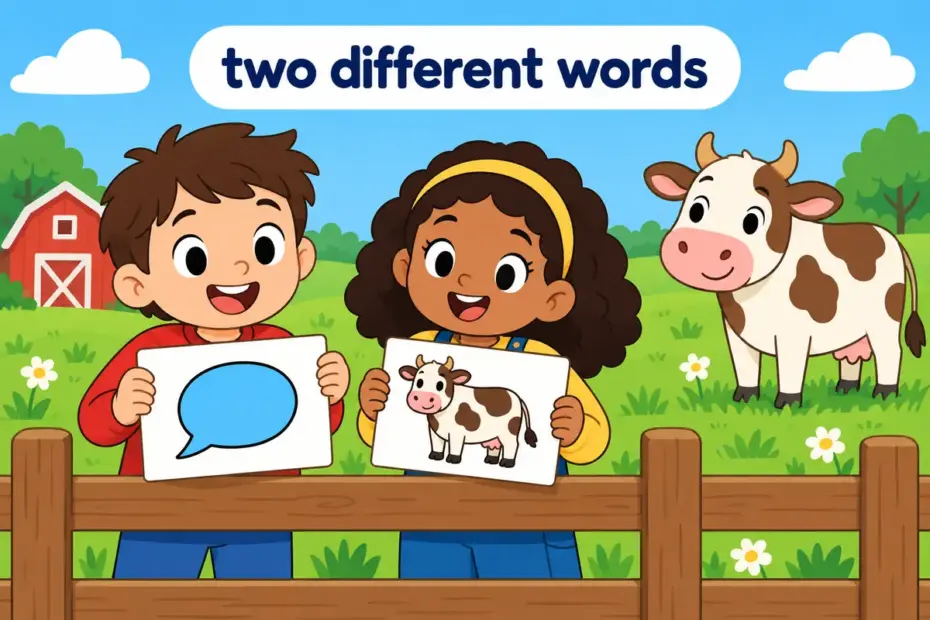
Utter vs udder is a spelling mix-up rather than a real choice: utter means complete or to say something aloud, while udder is the milk-producing organ of a cow. The subject of the sentence decides which one you need. “She gave an utter denial” and “the udder was full” show the split.
Utter vs udder at a glance
- Utter is both an adjective meaning complete and a verb meaning to say aloud.
- Udder is a noun for the milk organ of cows, sheep and goats, and it is never a verb.
- Utter as an intensifier attaches to abstract nouns such as nonsense, contempt or failure.
- Utter as a verb usually takes an object such as a word, a sound or a prayer.
- The commonest error is writing udder for utter, because the two sound nearly identical.
What do utter and udder mean?
Utter is two words in one form: an adjective meaning complete or absolute, and a verb meaning to say something aloud. Udder is a single noun naming the bag of milk glands on cattle. The Cambridge entry for utter and the Cambridge entry for udder keep the meanings apart, and the part of speech is the first thing to check. For a full set of models of the verb, see utter in a sentence.
| Word | Part of speech | Meaning | Example |
|---|---|---|---|
| utter | adjective | Complete or absolute | That is utter nonsense. |
| utter | verb | Say something aloud | She would not utter a sound. |
| udder | noun | Milk organ of cattle | The udder was warm and full. |
One honest limitation applies to the adjective. Utter is ungraded, so you cannot say very utter nonsense or more utter, because the word already means complete. For a sense that can be graded, use total or complete instead.
Both words share the same short opening vowel, so the ear cannot reliably tell them apart. Only the spelling and the grammatical role separate them, which is why the mix-up survives even among fluent writers. When you edit, check the part of speech before you check the sound.
Utter vs udder: the full comparison
The two words share almost nothing once you line them up. Every row below has a specific value, because the choice is mechanical, not a matter of taste.
| Criterion | utter | udder |
|---|---|---|
| Part of speech | Adjective and verb | Noun only |
| Core meaning | Complete, or to say aloud | The milk organ of cattle |
| What it describes | Ideas, statements, silences, sounds | Cows, sheep, goats |
| Sentence position | Before a noun, or before an object | Subject or object of a clause |
| Register | Formal in the adjective sense | Neutral and agricultural |
| Common partners | nonsense, contempt, failure, word, sound | full, swollen, milk, dairy |
| Countable | No | Yes, one udder and two udders |
The same sentence never accepts both: a full udder describes an animal, and utter silence describes a room.
The animal side belongs to farm writing about cattle, while the speech side overlaps with express, which is a fuller verb than utter, and with mumble, which means to utter words unclearly.
Which should you use?
Match the situation to the part of speech and the choice becomes automatic. Five common cases cover almost every sentence a learner writes.
| Situation | Choose | Reason |
|---|---|---|
| Describing how complete something is | utter | The adjective sits before an abstract noun. |
| Reporting that a sound was made | utter | The verb needs a person and an object. |
| Talking about a dairy animal | udder | Only the noun names the organ. |
| Writing about milking equipment | udder | The noun names what is cleaned or inspected. |
| Meaning total, with no farm context | utter | Udder would simply be a misspelling. |
The test is quick: if a cow is involved, the answer is udder; if the idea is completeness or speech, it is utter.
The pair confuses writers because both spellings are common: utter appears in formal prose about language and intensity, and udder appears in farming, cooking and children’s books about milk. A misspelling in either direction reads oddly, so the part-of-speech check is worth the extra second.
Utter and udder in a sentence: examples across contexts
The two words rarely meet, so each example stays on one side of the split. Notice how often the adjective utter is paired with a negative noun.
| Context | Example sentence | Why this works |
|---|---|---|
| Classroom | The class fell into utter silence when the results appeared. | The adjective precedes an abstract noun. |
| Workplace email | The delay was utter chaos for the whole team. | A negative noun is the adjective’s natural partner. |
| News report | She did not utter a word to reporters. | The verb takes a noun object after a negated auxiliary. |
| Farm report | The vet checked the udder of the dairy herd. | The noun names the organ and names the animal. |
| Scientific writing | The model could not utter a signed word. | Shows the verb used of a system, not a person. |
| Conversation | That excuse is utter rubbish. | The adjective is common in informal speech too. |
| Children’s story | The calf stayed close to the udder. | The noun appears in a simple physical scene. |
| Public speaking | He uttered the oath in a steady voice. | The verb reports a single spoken act. |
| Agriculture journal | Clean the udder before milking begins. | The noun appears in an instruction. |
| Court report | The witness uttered a short reply to the clerk. | The verb reports one brief spoken act. |
| Business memo | The launch was an utter success by every measure. | The adjective pairs with an abstract noun, here a positive one. |
| Veterinary note | The udder showed no sign of swelling. | The noun appears in a clinical observation. |
Only the adjective occupies the position before the noun; the verb and the noun occupy the middle and end of their clauses.
Utter vs sheer and absolute
Utter belongs to a small group of ungraded intensifiers. Sheer and absolute can mean complete as well, but only utter also works as a verb.
| Attribute | utter | sheer | absolute |
|---|---|---|---|
| Meaning | Complete, often with a negative | Nothing but; also very steep | Complete and unquestionable |
| Typical noun | nonsense, contempt, failure | luck, delight, size | silence, certainty, refusal |
| Gradable | No | No in this sense | No in this sense |
| Register | Formal | Neutral to literary | Formal |
| Can be a verb | Yes, to say aloud | No | No |
Verdict: utter is the only one of the three that can also report speech, so choose it when you need both the intensifier and the verb.
Word forms and grammar of utter and udder
Utter follows regular verb endings, adds the adverb utterly, and keeps the noun utterance. Udder is a plain countable noun with a regular plural.
| Form | Part of speech | Example |
|---|---|---|
| utter | adjective | He showed utter contempt for the rules. |
| utter | verb, base form | They will utter the pledge together. |
| utters | verb, third person singular | He rarely utters a complaint. |
| uttered | verb, past and past participle | She uttered one careful sentence. |
| uttering | verb, present participle | He was uttering a warning. |
| utterly | adverb | The plan failed utterly. |
| utterance | noun | One utterance changed the mood. |
| udder | noun | The udder was examined at dawn. |
| udders | noun, plural | Both udders were clean. |
Keep the adverb utterly for manner, as in utterly wrong, and the adjective utter for the flat statement, as in utter nonsense.
Utterance is countable when it names a single spoken statement and uncountable in linguistics, where it names the act of speaking. The adjective keeps no plural form at all, so utters is always the verb.
Common mistakes with utter and udder
- Incorrect:
The cow’s utter was full.Correct: The cow’s udder was full. Rule: Udder is the noun for the organ; utter is never a body part. - Incorrect:
She uddered a few words.Correct: She uttered a few words. Rule: The verb is utter, and udder is never a verb. - Incorrect:
That is a very utter mess.Correct: That is utter nonsense. Rule: Utter is ungraded, so very cannot modify it. - Incorrect:
He spoke with utter.Correct: He spoke with utter contempt. Rule: The adjective needs an abstract noun after it. - Incorrect:
The udder silence worried us.Correct: The utter silence worried us. Rule: Choose by meaning, not by sound.
Practice using utter and udder
Work through the six items, then check the reasoning rather than only the answer.
- Fill the gap: The herd stood still while the farmer cleaned each ______.
- Choose the better word: The room fell into (utter / udder) silence.
- Correct the error: She did not udder a single word.
- Build a sentence: use the verb utter about a witness and an oath.
- Spot the register: which belongs in a farm log — The udder was warm, or The silence was utter?
- Rewrite with the adverb: The plan was a complete failure. Use utterly instead.
Answers
- udder — the noun names the organ the farmer cleans, and the plural use fits a herd.
- utter — the adjective precedes the abstract noun silence.
- She did not utter a single word — the verb is utter and the object is a word.
- Model answer: The witness uttered the oath in a clear voice.
- The udder was warm — a farm log describes the animal, so it uses the noun.
- The plan failed utterly — the adverb utterly modifies the verb failed.
The bottom line
Utter vs udder comes down to meaning and part of speech: utter is an adjective meaning complete or a verb meaning to say aloud, while udder is the noun for a milk organ. Two details decide the wording: utter is ungraded, so it never takes very, and udder is countable, so it takes a determiner. If no animal is present, udder is almost always the wrong spelling.
Frequently asked questions about utter and udder
Is utter a formal word?
Utter is formal in its adjective sense, where it appears in phrases such as utter contempt or utter silence. The verb is less marked and simply means to say aloud, as in she did not utter a word. Everyday speech prefers total for the adjective and say for the verb.
Can utter be both a verb and an adjective?
Yes. As an adjective it means complete and sits before a noun, as in utter chaos. As a verb it means to say aloud and takes an object, as in he uttered a warning. The same spelling covers both jobs, so the position in the sentence tells you which is meant.
Is udder used only for cows?
No. An udder belongs to any female mammal with a single milk bag, including cows, sheep, goats and deer. In everyday writing it appears most with dairy cattle, as in the vet checked the udder, but the noun itself is not limited to one species.
How do you remember utter or udder?
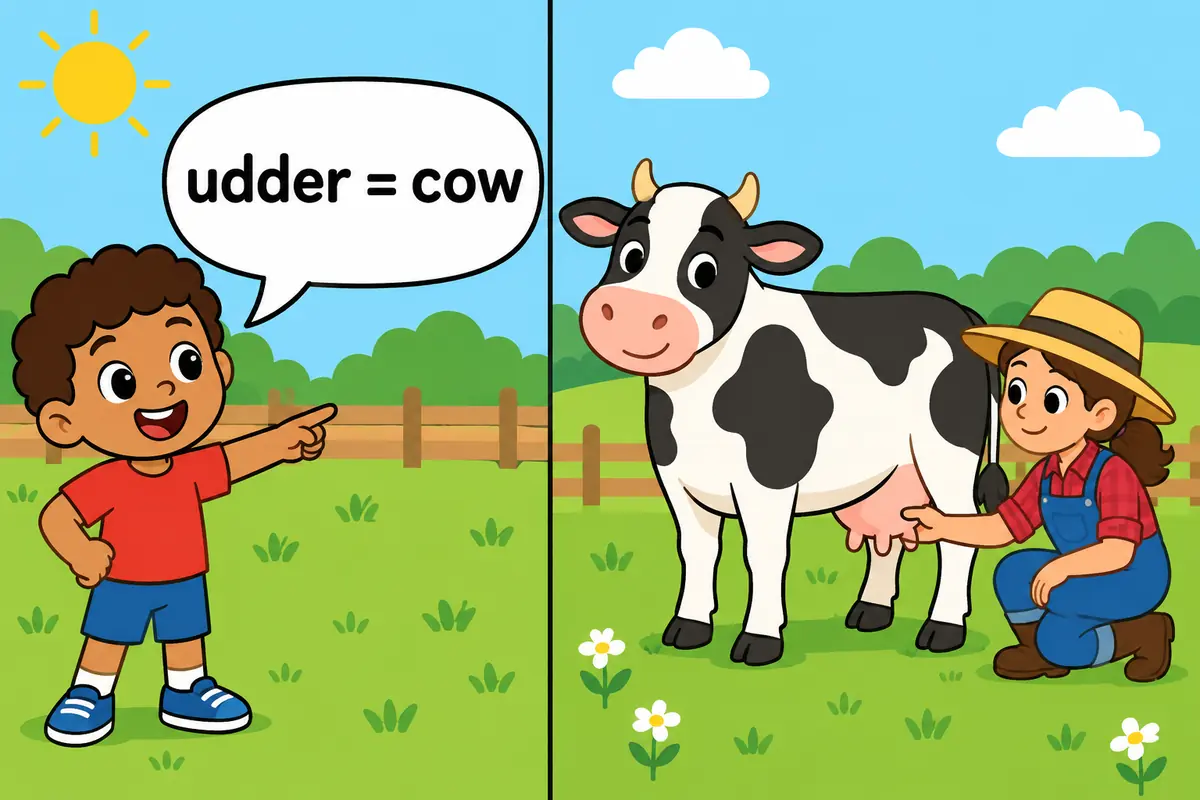
Link each spelling to a picture. Udder begins like udder-cow and appears on a farm; utter begins like utter a word and describes speech or completeness. If the sentence mentions an animal, choose udder; if it needs an intensifier or a speaking verb, choose utter.