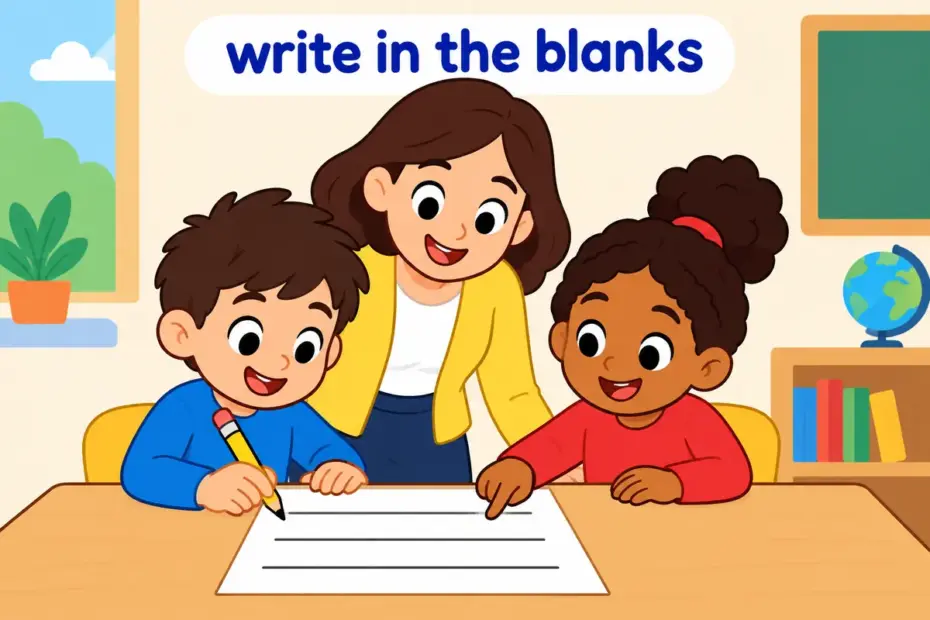
Fill in means to complete a form, to do somebody else’s job while they are away, or to give them the details they missed. To use fill in in a sentence, keep the object close to the verb: “Fill in your name.” The phrase is transitive and separable, so a pronoun sits in the middle.
Fill in at a glance
- Fill in is a transitive phrasal verb with four senses: complete, substitute, inform and cover.
- It is separable, so the object may follow in or come before it: fill in the form, fill the form in.
- A pronoun must sit between the verb and the particle: fill it in, never fill in it.
- The base form is fill in; the others are fills in, filled in and filling in.
- British English completes a form with fill in, while American English usually uses fill out.
- The commonest error is confusing fill in with fill up, which means to make something full.
What does fill in mean?
Fill in is a phrasal verb meaning to complete a form or blank, to substitute for somebody, to inform somebody, or to cover a hole. The Cambridge entry for fill in keeps these senses apart, and the grammar differs between them: the first three take a person or an object, while the covering sense takes a gap or a ditch. The plainer verb for the first sense is complete, and for the covering sense you can plug a hole instead. When the meaning is inform, inform works but sounds more formal than fill someone in.
| Sense | Plain meaning | Example sentence |
|---|---|---|
| Complete | Write the required information in a form or blank | Fill in the form in black ink. |
| Substitute | Do somebody’s job while they are away | Can you fill in for me on Friday? |
| Inform | Give somebody the details they missed | Let me fill you in on the plan. |
| Cover a hole | Add material until a surface is level | The workers filled in the potholes. |
One honest limitation belongs here. Fill in is the British way to complete a form, because American English usually says fill out, so an American reader may find fill in a form slightly odd. The phrase also never means to make a container full: that is fill up. Keep the two apart, because a sentence about filling in a form has nothing to do with filling up a tank.
How do you use fill in in a sentence?
Fill in is transitive and separable, which means the object must be present and may sit on either side of the particle. The six patterns below cover the senses and the placement rules, and the pronoun pattern is the one that decides correctness.
| Pattern | Example | What it signals |
|---|---|---|
| fill in + object | Fill in your address at the top. | The core separable pattern. |
| fill + object + in | Fill the form in and sign it. | The particle strands after the noun. |
| fill + pronoun + in | Fill it in before you leave. | A pronoun must sit in the middle. |
| fill in for + person | She filled in for the coach. | The substitute sense; the phrase is fixed. |
| fill + person + in on + topic | Please fill me in on the changes. | The inform sense with a pronoun object. |
| fill in + gap | Crews filled in the ditch. | The cover-a-hole sense. |
Two grammar points follow from the table. First, the particle can be stranded after a noun object but not after a pronoun, so fill the form in is fine while fill it in is the only correct order. Second, the substitute sense is fixed, which is why you cannot say fill the coach in for. To substitute is a close synonym, and to brief somebody is the formal version of filling them in.
Fill in in a sentence: examples across contexts
Fill in keeps its four senses while moving from a school office to a building site. The eleven sentences below each show the sense and the object, which is where most mistakes appear.
| Context | Example sentence | Why this works |
|---|---|---|
| Classroom | Fill in the date at the top of the page. | The simplest complete-a-blank instruction. |
| School office | Parents must fill in a consent form before the trip. | Uses the British form-completion sense. |
| Workplace email | Please fill it in and return it by Friday. | Shows the pronoun sitting in the middle. |
| Job rota | Marta filled in for the night nurse twice last week. | Uses the fixed substitute sense. |
| Team briefing | Let me fill you in on the new safety rules. | Uses the inform sense with a pronoun. |
| News report | Crews filled in the sinkhole on the high street. | Uses the cover-a-hole sense. |
| Customer service | Fill in your order number so we can trace the parcel. | Combines the blank with a purpose. |
| Medical form | Nurses asked him to fill the questionnaire in alone. | Shows the particle stranded after a noun. |
| Volunteering | Two students filled in at the last minute. | Uses the substitute sense without for when the role is understood. |
| Conversation | Fill me in when you get back, and do not leave anything out. | Pairs the inform sense with a pronoun. |
| Gardening | They filled in the old pond and planted a lawn. | Extends the cover sense to a garden feature. |
The substitute and inform rows need the most care, because those senses change the grammar rather than just the meaning. One phrasal verb with the same particle, butt in, means to interrupt, which is a very different way of putting in than completing a form.
Fill in vs fill out
Fill in and fill out both complete a form, and the difference is mostly regional. British and Commonwealth writers fill in a form, while American writers fill it out. Fill out carries an extra sense that fill in does not: to become fuller, as a young person fills out, or a shirt fills out across the shoulders. Fill in carries senses of its own that fill out lacks, namely substitute, inform and cover a hole.
| Attribute | fill in | fill out |
|---|---|---|
| Region | British and Commonwealth | Chiefly American |
| Complete a form | Yes | Yes |
| Substitute | Yes, fill in for | No |
| Inform | Yes, fill someone in | No |
| Become fuller | No | Yes |
| Typical sentence | Fill in the form. | Fill out the form. |
Verdict: choose fill in for British audiences and for the substitute and inform senses everywhere, and choose fill out for American audiences completing a form.
Word forms and grammar of fill in
Fill in changes through the verb fill, and one derived form becomes a hyphenated noun. The table lists the forms that matter, including the American variant.
| Form | Part of speech | Example |
|---|---|---|
| fill in | phrasal verb, base | Fill in the first page only. |
| fills in | phrasal verb, third person | She fills in the register each morning. |
| filled in | phrasal verb, past | He filled in the form before lunch. |
| filling in | phrasal verb, participle | They are filling in the last section now. |
| fill in for | fixed substitute phrase | I fill in for the manager on Mondays. |
| fill someone in | fixed inform phrase | Fill her in on the timetable. |
| a fill-in | hyphenated noun or adjective | The fill-in teacher took the class. |
| fill out | American variant and fuller sense | Fill out the form in blue ink. |
The hyphenated fill-in is a noun or an adjective, as in a fill-in teacher, so it never takes the object of the verb phrase. Keep the spoken form and the written noun apart, and remember that fill up, with the particle up, describes making a container full rather than completing a page.
Common mistakes with fill in
- Incorrect:
Fill me on the details.Correct: Fill me in on the details. Rule: The particle in is required in the inform sense. - Incorrect:
She filled in the application form out.Correct: She filled in the application form. Rule: Fill in already means complete, so out is unnecessary. - Incorrect:
Can you fill in me for the meeting?Correct: Can you fill in for me at the meeting? Rule: The substitute sense takes for before the person replaced. - Incorrect:
He filled up the survey last night.Correct: He filled in the survey last night. Rule: Fill up means make something full; fill in means complete. - Incorrect:
Fill in it before you leave.Correct: Fill it in before you leave. Rule: A pronoun object must sit between the verb and the particle. - Incorrect:
The workers filled the pothole in up.Correct: The workers filled the pothole in. Rule: Fill in is separable, but the particle is in, not in up.
Practice using fill in
Work through the seven items, then read the reasons, because each reason names the rule that decides the answer.
- Fill the gap: Please ______ this form before your appointment.
- Choose the better verb: British readers complete a form with (fill in / fill up).
- Correct the error: Fill in it and hand it to the office.
- Build a sentence: use fill in for about a teacher who is away.
- Spot the register: which fits a workplace email, let me fill you in on the changes, or let me give you the lowdown?
- Rewrite with a pronoun: Fill in the form before Friday. Replace the form with it.
- Explain the contrast: write one sentence using fill up correctly.
Answers
- fill in — the form is completed, and fill in is the British verb for that sense.
- fill in — fill up means make full, which does not fit a form.
- Fill it in and hand it to the office — the pronoun must sit between fill and in.
- Model answer: Mr Patel will fill in for the science teacher while she is on leave.
- Let me fill you in on the changes — a workplace email keeps a neutral tone and avoids slang.
- Fill it in before Friday — the pronoun replaces the form and moves into the middle.
- Model answer: Fill up the water bottles before the hike begins.
The bottom line
Use fill in in a sentence to complete a form, to substitute for somebody, to inform them, or to cover a hole, and keep the object next to the verb. Two points decide most sentences: the phrase is separable, so a pronoun belongs between fill and in, and British readers fill in a form while American readers fill it out. Where the sense is to make something full, reach for fill up instead.

Frequently asked questions about fill in
Is it fill in or fill out?
Both complete a form, and the choice is mostly regional. British and Commonwealth writers say fill in a form, while American writers say fill out a form. Fill out also means to become fuller, as a person or a shirt fills out, and fill in has extra senses of substituting, informing and covering a hole.
What does fill someone in mean?
To fill someone in means to give them the information they missed, and it usually takes on before the topic, as in fill me in on the plan. The person is the object and must sit between fill and in, so the order is fill me in, never fill in me. This sense is common in workplaces.
Can fill in mean to replace someone?
Yes, and that sense is fixed as fill in for plus the person, as in she filled in for the coach. It means doing somebody else’s job on a temporary basis. Because the sense is fixed, you cannot separate the words or move the for, so fill the coach in for is wrong.
Is fill in one word or two?
As a verb phrase it is two words, fill in, as in fill in the form. As a noun or an adjective it takes a hyphen and forms one unit, as in a fill-in teacher or a quick fill-in. The unhyphenated two word form is always the verb, and it always needs an object.