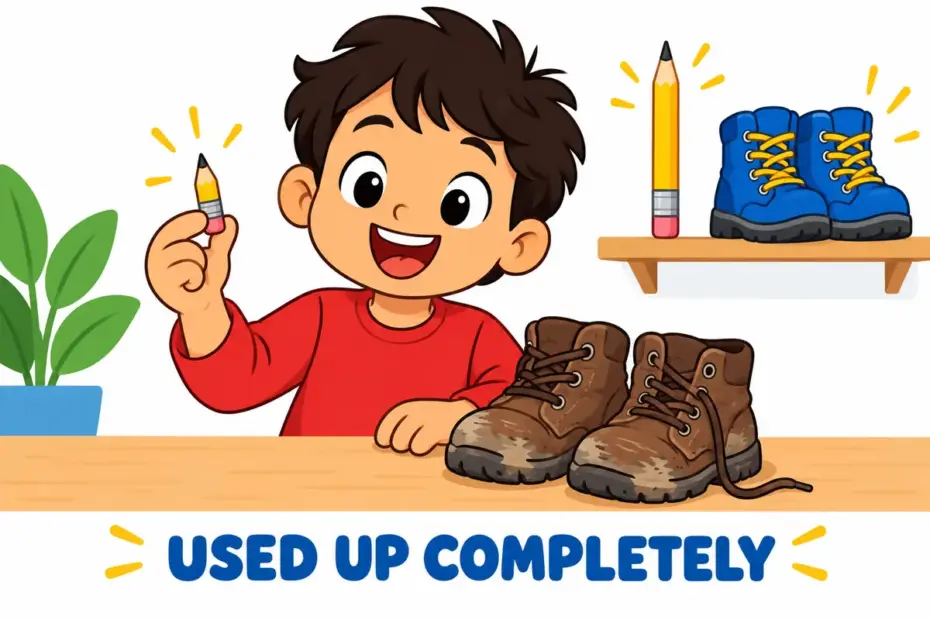
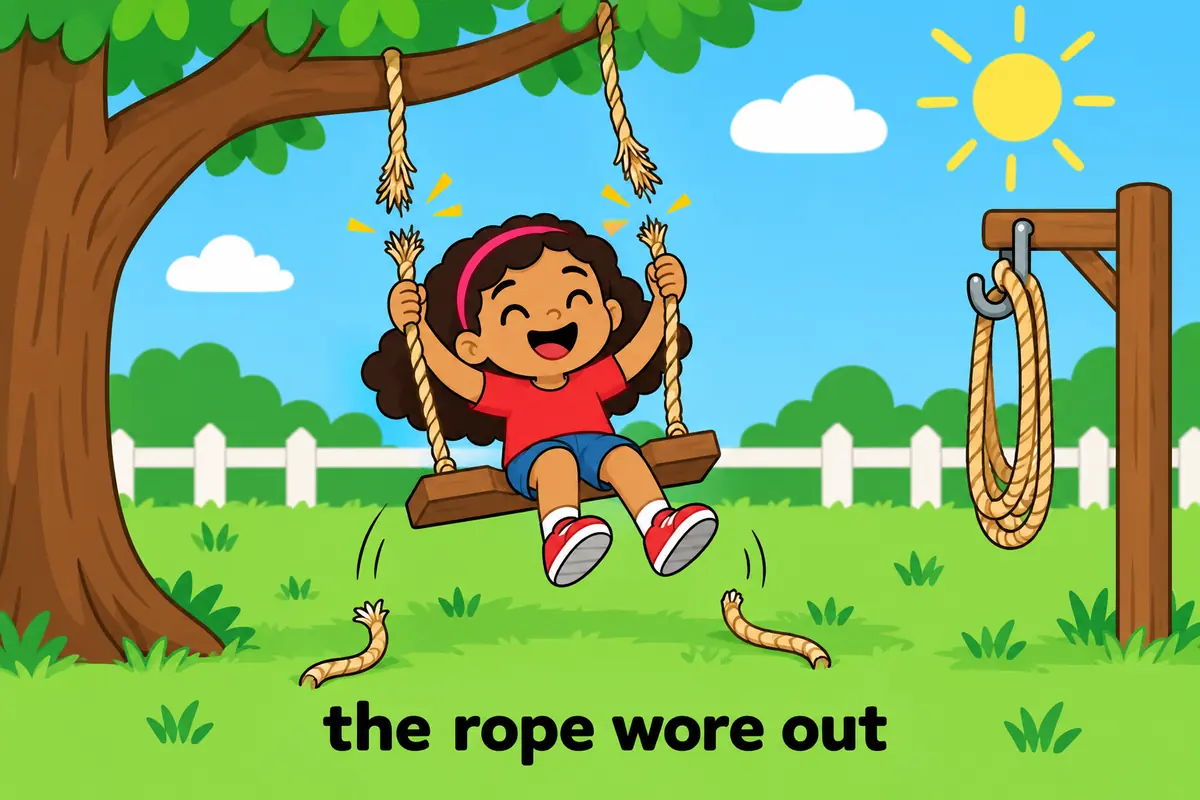
Wear out means to become unusable through long use, or to exhaust someone completely. To use wear out in a sentence, decide whether the subject is a thing that is used up or a person who is tired: “The rope wore out after one season,” and “The long climb wore the hikers out.”
Wear out at a glance
- Wear out is a phrasal verb; only wear changes, giving wears out, wore out and worn out.
- One core meaning covers objects: to become unusable, or to use something until it is damaged.
- The second core meaning covers people: to make someone extremely tired.
- As an adjective, worn out describes anything exhausted or used up.
- The verb is separable when it has an object, so a pronoun goes before out: it wore me out.
- The commonest error is confusing wear out with wear off, which means to fade gradually.
What does wear out mean?
Wear out is a phrasal verb with two core meanings joined by the idea of something being used until little is left. The Cambridge entry for wear out records both the sense of becoming useless through use and the sense of making someone very tired. The two are easy to keep apart once you notice whether the subject is a thing or a person. The near-synonym exhaust covers the person sense alone, which makes it useful when the subject is a machine or a workload rather than old shoes.
| Sense | Plain meaning | Example sentence |
|---|---|---|
| Become unusable | A thing is used until it stops working | The rope wore out after one season of hauling. |
| Use until damaged | A person uses something until it is spoiled | He wore out three pairs of boots that year. |
| Exhaust a person | Make someone extremely tired | The long climb wore the hikers out. |
| Overstay a welcome | Fixed idiom: make oneself unwelcome by staying or asking too long | The visitor wore out his welcome by Friday. |
One limitation is worth stating plainly. Wear out does not mean the same as wear off. An effect such as excitement or pain wears off, meaning it fades by itself, while a thing wears out, meaning it is destroyed by use. Confusing the two particles is the mistake that marks a learner faster than anything else with this verb, because the sentence still sounds almost right.
Notice also that wear out always implies time and repetition. A glass does not wear out when it is dropped once; it breaks. Wear out describes the slow, cumulative damage of daily use, whether the object is a stair carpet, a battery or a pair of running shoes.
How do you use wear out in a sentence?
Wear out splits into two grammatical lives. When the subject is the thing being used, the verb is intransitive and takes no object. When the subject is a person using something up, or a cause tiring somebody, the verb is transitive and separable: a full noun object may sit on either side of out, but a pronoun must sit in the middle. The table below sets the two lives side by side and shows where the particle is allowed to go.
| Pattern | Example | What it signals |
|---|---|---|
| subject + wear out | The carpet wore out within two years. | Intransitive: the thing itself is used up, and out cannot move. |
| wear out + noun | Traffic wore out the road surface. | Transitive: the subject causes the object to be used up. |
| wear + noun + out | She wore her running shoes out in a month. | The same meaning, with the particle stranded after a full noun. |
| wear + pronoun + out | The children wore me out before noon. | The only correct order for a pronoun object. |
| be worn out | I am worn out after the move. | Passive or adjectival: describes a state of exhaustion or damage. |
| wear out + one’s welcome | Do not wear out your welcome. | Fixed idiom for overstaying, with a possessive before welcome. |
The pronoun test is the fastest way to check separability. If you can replace the object with it or them, the pronoun must go before out, so the noise wore me out is right and the noise wore out me is wrong. The same test works for finish off and every other separable phrasal verb in this pattern.
Wear out in a sentence: examples across contexts
Wear out keeps its shape across registers and changes only in what is being used or who is being tired. The twelve sentences below run from a classroom to an engineering report, and each one shows the object placed on the side of the particle that the grammar demands. Read them in pairs where you can, because the thing sense and the person sense are easiest to separate when they sit next to each other.
| Context | Example sentence | Why this works |
|---|---|---|
| Classroom | The class library books have worn out from years of handling. | A gentle, everyday subject shows the thing sense with no object. |
| Workplace email | That printer has finally worn out, so please use the one upstairs. | A practical notice reports the end of a machine’s life. |
| News report | Heavy lorries wore out the bridge deck decades before its design life ended. | The transitive sense blames a cause for the damage. |
| Sports report | A punishing schedule wore out the squad by the final month. | Uses the person sense for a group that is exhausted. |
| Parenting | Two hours at the playground wore me out completely. | Shows the pronoun sitting before the particle. |
| Engineering note | The bearings wore out early because the lubricant was never changed. | A technical register still uses the plain thing sense. |
| Travel writing | We wore out our boots on the coastal path. | The people act, and the boots are the object used up. |
| Fashion column | Shoppers wear out cheap trainers far faster than they expect. | General habit, so the plural subject takes the base verb. |
| Health advice | Do not let a busy week wear you out. | An imperative with a pronoun object keeps the warning personal. |
| Gardening | The same beds have worn out after twenty seasons of planting. | Extends the thing sense to soil that is depleted. |
| Academic prose | The batteries wore out well before the experiment finished. | Neutral reporting with a concrete, measurable subject. |
| Conversation | You look worn out; sit down for a minute. | The adjectival form reports a state rather than an action. |
Two of the twelve sentences use worn out as an adjective rather than as a verb. That shift is common and useful, because worn out as an adjective can describe not only people but also shoes, batteries and even an idea that no longer convinces. A wearer can be weary after a long day, but only when energy is truly spent do we say the person is worn out.
Fabric gives a second, quieter clue to the word’s history. Cloth frays at the edges first, and only after many more washings does it wear out altogether. The same order applies to most things: small damage appears, then spreads, until the object can no longer do its job.
Wear out vs tire out
The nearest confusable is tire out, or simply tire, and the difference lies in degree and in what is being used. Wear out means total exhaustion that takes time to build, and it alone also means to use an object up. Tire out means to make someone tired without suggesting that they are spent beyond recovery.
| Attribute | wear out | tire out |
|---|---|---|
| Core meaning | Exhaust completely, or use a thing up | Make someone tired |
| Degree | Total, often after a long build-up | Mild to moderate |
| Objects allowed | People and things | People and animals |
| Result | A spent state that needs real rest | Sleepiness that a short break fixed |
| Tone | Informal and vivid | Neutral and mild |
Verdict: choose wear out when the subject is genuinely spent or a thing is used up, and tire out when the person is merely weary; if you are describing something that steadily loses strength, deplete is the more technical choice.
Word forms and grammar of wear out
Only wear changes; out never does. The table lists the forms, including the adjectival worn out and the related particle word that learners mix up.
| Form | Part of speech | Example |
|---|---|---|
| wear out | phrasal verb, base form | Cheap soles wear out fast. |
| wears out | third person singular | The motor wears out after a year. |
| wore out | past tense | The batteries wore out at midnight. |
| worn out | past participle | My runners are worn out. |
| worn out | adjective | She felt worn out all week. |
| wearing out | present participle and gerund | The constant rubbing is wearing out the cable. |
| wear off | different phrasal verb | The painkiller wore off in an hour. |
Keep worn out and wore out apart by testing the sentence. If a form of be or become sits in front, you need the participle worn, as in the shoes are worn out. If the sentence reports a past event with no helper, you need the past tense wore, as in the shoes wore out last winter.
Common mistakes with wear out
- Incorrect:
The long day wore out me.Correct: The long day wore me out. Rule: A pronoun object must sit before the particle out. - Incorrect:
I am wore out after the trip.Correct: I am worn out after the trip. Rule: After be, use the participle worn, not the past tense wore. - Incorrect:
The shoes wore out themselves in a month.Correct: The shoes wore out in a month. Rule: The thing sense is intransitive, so it takes no reflexive object. - Incorrect:
The excitement wore out after an hour.Correct: The excitement wore off after an hour. Rule: Effects fade and wear off; objects and people wear out. - Incorrect:
The children are wearing out.Correct: The children are wearing me out. Rule: The person sense is transitive, so it names who is being exhausted. - Incorrect:
The car is worn out of use.Correct: The car is worn out. Rule: Worn out is complete on its own and takes no of-phrase.
Practice using wear out
Work through the eight items, then check the reasoning rather than only the answer. The set mixes the thing sense and the person sense, so read each sentence twice before you decide.
- Fill the gap: These trainers have ______ after only three months of running.
- Choose the better word: The painkiller finally (wore out / wore off) at noon.
- Correct the error: The long shift wore out the nurses.
- Correct the error: The long shift wore out them.
- Build a sentence: use be worn out about a student after an exam week.
- Spot the register: which belongs in a maintenance log — the bearings wore out early, or the bearings got totally worn out?
- Rewrite with a pronoun object: The toddlers wore out their grandfather. Use him instead of their grandfather.
- Choose in or out: the novelty will wear (off / out) by the weekend.
Answers
- worn out — after have, the participle worn reports the state the trainers have reached.
- wore off — a drug effect fades by itself, so it wears off, not out.
- Already correct — the shift is the cause and the nurses are the object being exhausted.
- The long shift wore them out — a pronoun object must sit before the particle.
- Model answer: After exam week, Mia was completely worn out.
- The bearings wore out early — a log keeps a plain register and avoids the slang totally.
- The toddlers wore him out — the pronoun goes in the middle of the separable verb.
- off — a feeling or novelty fades gradually, which is the job of wear off.
The bottom line
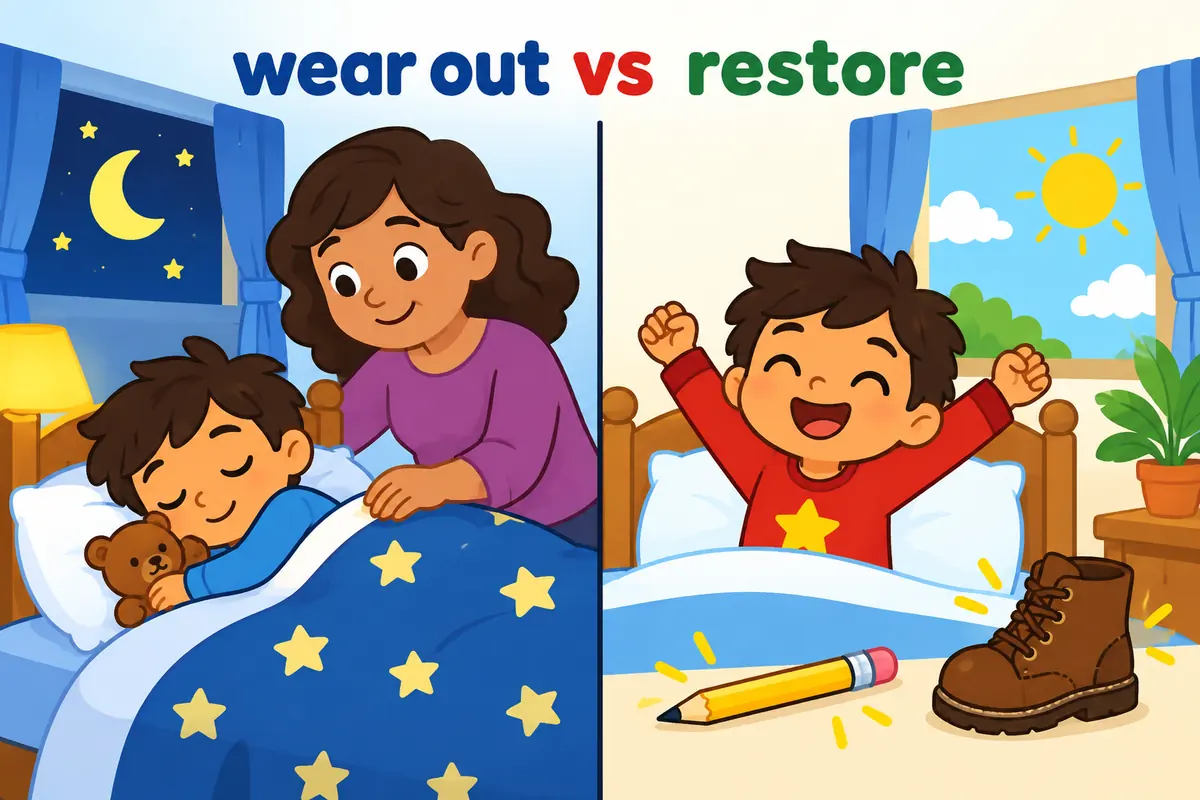
Use wear out in a sentence when something is used until it fails or when a person is exhausted, and let the subject decide the grammar: a thing wears out intransitively, while a cause wears someone or something out transitively. The two nuances that decide most sentences are that a pronoun object must sit before out, and that wear out is not wear off, which describes something fading instead. When the object is brought back to full strength, restore is the word the sentence wants.
Frequently asked questions about wear out
Is wear out separable?
Yes, wear out is separable, so a full noun may go on either side: the trip wore out the hikers or the trip wore the hikers out. A pronoun object, however, must sit in the middle, so the trip wore them out is correct and the trip wore out them is not. The thing sense is intransitive.
What is the difference between wear out and wear off?
Wear out means to use something up or to exhaust someone, as in these shoes have worn out. Wear off means to fade gradually, and it describes effects such as pain, excitement or a drug, as in the medicine wore off. Remember that out points to damage and off points to disappearance.
Can wear out describe a person?
Yes, wear out describes a person in its exhaustion sense, usually after effort or stress has built up over time. A demanding week can wear you out, and the adjective worn out reports the resulting state. Because the sense is transitive, the sentence must name who is being exhausted, as in the journey wore me out.
What is the past tense of wear out?
The past tense is wore out, as in the battery wore out overnight. The past participle is worn out, used after have or be, as in the battery has worn out and the battery is worn out. Mixing them, as in the battery is wore out, is one of the most common errors with this verb.