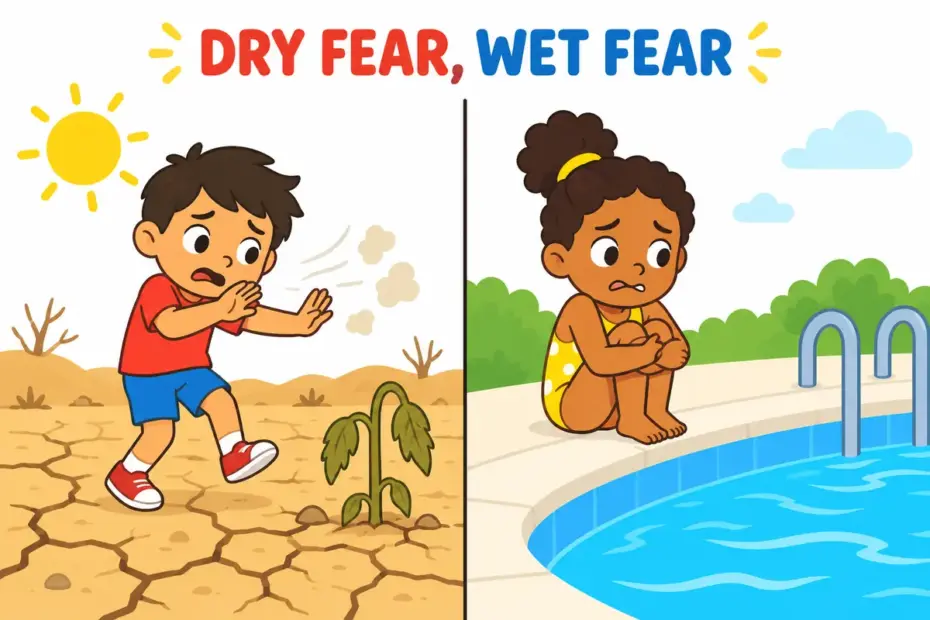
Xerophobia vs hydrophobia comes down to what is feared, and the answer is simple: xerophobia is a fear of dryness, while hydrophobia is a fear of water. Use hydrophobia for water and for the rabies symptom, reserve xerophobia for dryness, and use hydrophobic for water-repelling surfaces.
Xerophobia vs hydrophobia at a glance
- Xerophobia is a rare noun for a fear of dryness or dry places; hydrophobia is a noun for a fear of water.
- Hydrophobia also names the historic rabies symptom in which a patient dreads water.
- Hydrophobic is the adjective, used both for a fear of water and for water-repelling materials.
- Neither term changes to show tense; both are nouns and follow a verb or a preposition.
- The usual patterns are a fear of water, a phobia of water, and have hydrophobia.
- The commonest error is using hydrophobia for a water-repelling surface instead of hydrophobic.
Xerophobia vs hydrophobia: the master comparison
The two words are near mirror images, so the fastest way to choose is to work down the criteria that actually change a reader’s mind. The table weighs seven of them, and the deciding row is always the first: what is feared.
| Criterion | xerophobia | hydrophobia |
|---|---|---|
| What is feared | Dryness, dry air or dry places | Water, swimming or drinking |
| Combining form | xero-, meaning dry, as in xerophyte | hydro-, meaning water, as in hydroelectric |
| Second meaning | None common | A historic name for the rabies symptom |
| Typical settings | Phobia glossaries and rare usage lists | Medicine, medical history and general phobia lists |
| Register | Rare and technical | More familiar, with a clinical sense |
| Adjective form | xerophobic, rare | hydrophobic, common |
| Chief confusion | With xerophyte, a dry-adapted plant | With hydrophobic, a water-repelling material |
The asymmetry in register is the point most readers miss. Hydrophobia appears in general dictionaries and in medical history, so it carries weight, while xerophobia turns up mostly in long lists of unusual phobias, so it needs a plain explanation beside it. Presenting the two as equals in a sentence can therefore mislead.
What do xerophobia and hydrophobia mean?
Xerophobia and hydrophobia are both nouns naming fears, and they sit at opposite ends of the same scale. The Cambridge entry for xerophobia records a dread of dryness or dry conditions, and the Cambridge entry for hydrophobia records a dread of water together with its medical use. The wider family of phobia words follows the same shape, naming a fear by adding a Greek prefix to the suffix -phobia.
| Term | Principal sense | Example sentence |
|---|---|---|
| xerophobia | Fear of dryness, dry air or dry places | Her xerophobia made desert travel unbearable. |
| xerophobia | Rare, loose use for anxiety about drought | Farmers spoke of a xerophobia as the wells dropped. |
| hydrophobia | Fear of water, swimming or drinking | His hydrophobia kept him out of the sea. |
| hydrophobia | Historic medical name for the rabies symptom | Old case notes described hydrophobia before the fever worsened. |
One limitation should shape how you write about either term. Xerophobia is rare and mostly technical, so a sentence that simply means a dislike of dry heat is clearer without it; say the person dislikes dry air rather than inventing a clinical label. Hydrophobia, by contrast, is not the adjective for a water-repelling surface, and using it that way confuses a fear with a material property.
How do you use xerophobia and hydrophobia in a sentence?
Both words are ordinary nouns, so the grammar is restraint rather than complexity. The natural frame for each is a fear of plus the thing feared, and the clinical frame is have plus the noun. The five patterns below cover almost every real sentence, and only the last one concerns the water-repelling adjective rather than a fear.
| Pattern | Example | What it signals |
|---|---|---|
| a fear of + noun | a fear of water | The plain paraphrase most editors prefer. |
| have + term | She has hydrophobia. | Clinical or formal statement of the condition. |
| a phobia of + noun | a phobia of dry air | General, slightly informal wording. |
| term as symptom subject | Hydrophobia appeared on the third day. | Medical-history use for the rabies sign. |
| hydrophobic + noun | a hydrophobic coating | Material science, where the word is an adjective. |
A useful test is to ask what the word could fear. If the answer is water, only hydrophobia fits; if the answer is dryness or drought, only xerophobia fits. When the word is doing work on a surface rather than a mind, the adjective hydrophobic takes over and the noun becomes hydrophobicity.

Xerophobia and hydrophobia in a sentence: examples across contexts
The two terms appear in quite different rooms of the language, and the twelve sentences below show the split. Read them in order and notice how often hydrophobia carries a medical or historical sense while xerophobia keeps a cautious, glossary tone.
| Context | Example sentence | Why this works |
|---|---|---|
| Classroom | The lesson contrasted xerophobia, a fear of dryness, with hydrophobia, a fear of water. | Parallel wording keeps the two terms side by side and defines each. |
| Health writing | Hydrophobia is an old name for the rabies symptom, not a separate disease. | Names the medical sense before a reader can guess wrongly. |
| Travel blog | Her xerophobia turned a desert itinerary into a list of excuses. | Uses the rare term for effect while the context explains it. |
| Swimming club | His hydrophobia kept him on the poolside all season. | A concrete setting makes an abstract fear easy to picture. |
| Veterinary note | A rabid dog may show hydrophobia and refuse water. | Technical patience-report register with the clinical sense. |
| Chemistry report | The pan is finished with a hydrophobic layer that sheds water. | Uses the adjective, which belongs to materials, not to fear. |
| Conversation | I do not have hydrophobia; I just dislike cold pools. | Contrasts a clinical term with a mild personal dislike. |
| Academic prose | Specialists rarely write xerophobia, preferring the phrase fear of drought. | Reports the word’s rarity rather than endorsing it. |
| News feature | The word hydrophobia survives mainly in accounts of nineteenth-century rabies. | A historical frame suits the older medical sense. |
| Psychology note | A specific phobia of water is now more often called aquaphobia. | Shows a modern synonym that competes with hydrophobia. |
| Gardening column | Calling a dry-border preference xerophobia would be a joke, not a diagnosis. | Warns against stretching a clinical term for a taste. |
| Etymology sidebar | The prefix xero- means dry, as in xerophyte, a plant built for dry places. | Explains the combining form through a familiar parallel word. |
The same picture holds for the wider vocabulary of unease: a strong dislike may be a aversion, a low, background worry is anxiety, and an intense, anticipatory fear is dread. Only the last of those is close to what a phobia word names.
Which should you use?
Five reader situations cover nearly every choice, and each has a firm answer rather than a hedge. Match the situation to the row, and the sentence almost writes itself.
| Situation | Use | Reason |
|---|---|---|
| Someone fears water, swimming or drinking | hydrophobia | The fear is of water, which is exactly what hydro- names. |
| Someone fears dryness, dry air or drought | xerophobia, or the phrase fear of dryness | The rare term is correct but may need a plain gloss beside it. |
| A medical or historical text describes rabies | hydrophobia | The word is the established name for that symptom. |
| A surface repels water | hydrophobic | The adjective belongs to materials; the property is hydrophobicity. |
| A person simply dislikes something | aversion | A clinical phobia word overstates an ordinary preference. |
The one rule worth memorising is that fear words end in -phobia and description words for surfaces end in -phobic. Keep that pair apart and the two roots do the rest of the work for you.
Word forms and grammar of xerophobia and hydrophobia
The forms run in parallel, with one important gap: only the hydro- family has a widely used adjective. The table lists both families, and the adjective hydrophobic appears in its material sense.
| Form | Part of speech | Example |
|---|---|---|
| xerophobia | noun | Xerophobia is listed among the rare phobias. |
| xerophobic | adjective, rare | A xerophobic patient avoids dry, dusty rooms. |
| hydrophobia | noun | Hydrophobia is a fear of water. |
| hydrophobic | adjective | A hydrophobic fabric repels rain. |
| hydrophobe | noun, rare | Chemists call such a molecule a hydrophobe. |
| hydrophobicity | noun | Hydrophobicity keeps the treated surface dry. |
Neither noun takes a plural in ordinary writing, because a phobia is treated as a single condition. You write a fear of water, not fears of waters, and the same restraint applies to xerophobia when it is used at all.
Common mistakes with xerophobia and hydrophobia
- Incorrect:
The coating is hydrophobia.Correct: The coating is hydrophobic. Rule: The adjective for a water-repelling material is hydrophobic, not the fear noun hydrophobia. - Incorrect:
Her xerophobia kept her from the pool.Correct: Her hydrophobia kept her from the pool. Rule: xerophobia names a fear of dryness, so it cannot describe a fear of water. - Incorrect:
The doctor diagnosed xerophobia.Correct: The doctor noted a fear of dry places. Rule: xerophobia is a rare descriptive label, not a routine diagnosis. - Incorrect:
I have hydrophobia of cold water.Correct: I have an aversion to cold water. Rule: A mild dislike is an aversion, not a clinical phobia. - Incorrect:
He suffers from hydrophobia for water.Correct: He has hydrophobia. Rule: The noun already contains the fear, so it takes no for-phrase. - Incorrect:
Hydrophopia is treated with therapy.Correct: Hydrophobia is treated with therapy. Rule: The ending is -phobia, with a b, matching the Greek root for fear.
Practice using xerophobia and hydrophobia
Work through the seven items, then check the reasoning rather than only the answer. Each one turns on choosing between the two roots or between the noun and the adjective.
- Fill the gap: A fear of water is called ______.
- Fill the gap: A fear of dry places is called ______.
- Choose the better word: The jacket is made from a (hydrophobia / hydrophobic) fabric.
- Correct the error: His xerophobia kept him away from the swimming pool.
- Build a sentence: use hydrophobia in its medical sense about an old case report.
- Spot the register: which belongs in a chemistry report — the surface is hydrophobic, or the surface has a fear of water?
- Choose the plainer word: She has an (aversion / hydrophobia) to very hot rooms.
Answers
- hydrophobia — hydro- means water, and the noun names the fear of it.
- xerophobia — xero- means dry, so it matches dry places rather than water.
- hydrophobic — a material property takes the adjective, not the fear noun.
- His hydrophobia kept him away from the swimming pool — water is feared, so the hydro- word is correct.
- Model answer: The case report described hydrophobia on the third day of the illness.
- The surface is hydrophobic — a report uses the material adjective, not a joke about fear.
- aversion — a mild dislike of hot rooms is not a clinical phobia.
The bottom line
Choose xerophobia vs hydrophobia by asking what is feared: dryness points to xerophobia and water points to hydrophobia, while the adjective hydrophobic covers water-repelling materials. The two nuances that decide most sentences are that hydrophobia also names the rabies symptom, and that xerophobia is a rare term needing a plain gloss beside it. Where the feeling is only a dislike, say fear of nothing and write aversion instead.
Frequently asked questions about xerophobia and hydrophobia
Is xerophobia a real phobia?
Xerophobia is a genuine English word, but it is rare and mostly technical, so you will meet it in glossaries of unusual phobias more often than in clinical writing. If you mean a simple dislike of dry heat or dusty rooms, a plain phrase such as a fear of dry air is clearer and will not puzzle your reader.
Why is hydrophobia linked to rabies?
Hydrophobia became a historic name for rabies because patients in the late stages of the disease develop painful spasms when they try to swallow, so they dread water. That symptom gave the illness the nickname hydrophobia. Modern medicine keeps the word mainly for the symptom, while the disease itself is called rabies.
Is hydrophobia the same as aquaphobia?
They overlap but are not identical. Aquaphobia is the modern general term for a fear of water, used in psychology for a specific phobia. Hydrophobia also means a fear of water, but it carries the extra medical and historical sense of the rabies symptom, so the two are not freely interchangeable in clinical writing.
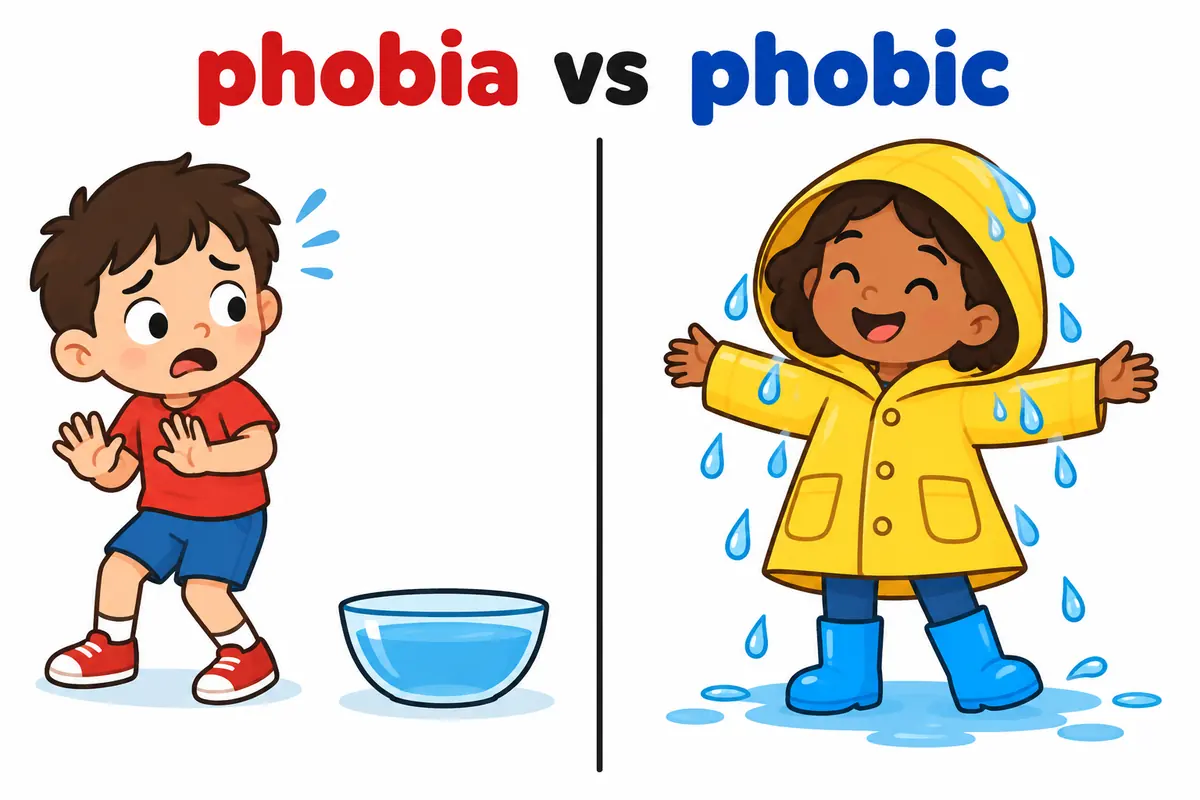
How is hydrophobic different from hydrophobia?
Hydrophobic is an adjective, and hydrophobia is a noun. Hydrophobia names a fear of water, while hydrophobic describes a surface or molecule that repels water in chemistry and material science. The related noun for that property is hydrophobicity. One word is about feelings, and the other is about how a material behaves.