Send back means to return something or someone to the place or the person they came from. To use send back in a sentence, put the thing sent as the object: “Please send the form back by Friday.” The phrasal verb is transitive and separable, and with a pronoun the two halves must split: send it back.
Send back at a glance
- Send back is a transitive phrasal verb meaning to return something to its source.
- It is separable: send back the form and send the form back are both correct.
- A pronoun must go between the parts: send it back, never send back it.
- Common objects are documents, orders, meals, parcels, players and migrants.
- The tone is neutral, but a person sent back carries a harsher edge.
- The particle back cannot be swapped for again without changing the sense.
What does send back mean?
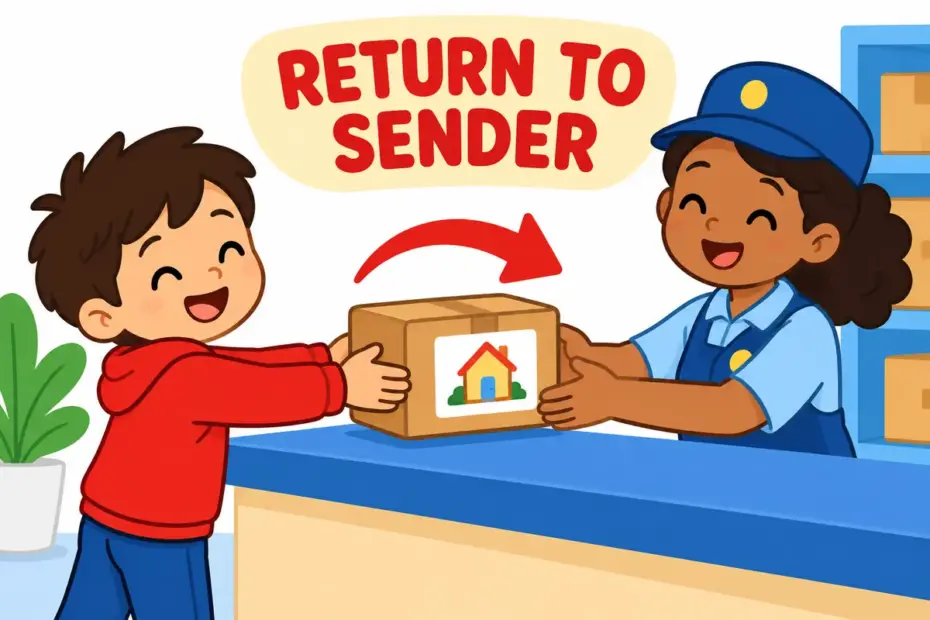
Send back is a transitive phrasal verb meaning to return something or someone to where they came from. The Cambridge entry for send back gives the core sense of returning an item, and the same shape extends to documents, meals and people. Where the thing is money, return is the safer word, because send back says nothing about a refund.
| Sense | Plain meaning | Example sentence |
|---|---|---|
| Return an item | Cause a thing to go back to where it came from | The shop sent back the faulty kettle. |
| Reject and return | Refuse a document or delivery and return it | The editor sent the draft back for revision. |
| Order a person to return | Tell someone to go back to a place | The club sent the young player back to the reserves. |
| Return a ball | In sport, hit or kick something back | She sent the serve back with interest. |
One limitation: send back says nothing about why the thing returns, so it fits returns of every kind. Where the reason is a defect, rejected or faulty may be more precise, and where money changes hands, refund is the word send back cannot replace.
How do you use send back in a sentence?
Send back is transitive and separable. That means the object may follow the whole phrase or sit between the verb and the particle, but a pronoun must take the middle position. The particle cannot come before the object, and the phrase cannot leave back dangling at the end of a clause. The table sets out the legal positions.
| Pattern | Example | What it signals |
|---|---|---|
| send back + object | The courier sent back the parcel. | The object follows the whole phrase. |
| send + object + back | The courier sent the parcel back. | The object sits between verb and particle, equally correct. |
| send + pronoun + back | Send it back today. | A pronoun must take the middle slot. |
| send back + pronoun (avoid) | Not used: send back it is wrong. | The order learners most often get wrong. |
| be sent back | The application was sent back twice. | Passive voice, common in official writing. |
| send back + for + noun | The essay was sent back for correction. | Names the reason for the return. |
The opposite movement has its own verb: to send off a package is to dispatch it away from you, while send back brings it home again.
Send back in a sentence: examples across contexts
Send back moves easily from a kitchen table to a courtroom, and the same separable shape holds in every register. Each sentence below shows where the object sits and what the phrase is being used to do.
| Context | Example sentence | Why this works |
|---|---|---|
| Classroom | The teacher sent back the project for a clearer title. | The for-phrase names the reason for the return. |
| Workplace email | Please send the signed contract back before Friday. | The object sits between verb and particle, formal and natural. |
| News report | Customs sent back the shipment after a paperwork error. | An institutional subject and a neutral tone. |
| Customer service | We will send the replacement back to you within three days. | Shows the phrase with a direction and a recipient. |
| Retail | The customer sent the shoes back because the size was wrong. | The everyday return of goods. |
| Legal writing | The court sent the case back to a lower tribunal. | A formal, standard collocation. |
| Sport | The defender sent the ball back over the net. | The literal, physical sense of returning a ball. |
| Immigration news | Officials sent the family back at the border. | The human sense, which carries a harsher edge. |
| Conversation | Send it back if it does not fit. | The pronoun pattern in everyday speech. |
| Academic | The reviewers sent the manuscript back with detailed comments. | A scholarly register and a with-phrase. |
| Travel | The airline sent our bags back on the next flight. | A person as agent and a thing as object. |
| Email reply | I have sent your query back to the accounts team. | The routing sense inside one organisation. |
Send back vs return
Send back and return overlap, but they part ways on register and on pronouns. return is the neutral, formal verb that fits contracts and notices, while reject adds a judgement that the thing is not acceptable at all.
| Attribute | send back | return | reject |
|---|---|---|---|
| Part of speech | Phrasal verb | Single verb | Single verb |
| Object | A thing or a person | Usually a thing | A thing or an offer |
| Who acts | A sender routes it back | Anyone gives it back | A judge or official refuses it |
| Direction | Stresses the journey back | Stresses the restoring | Stresses the refusal |
| Pronoun rule | Split: send it back | Simple: return it | Simple: reject it |
| Best register | Email, speech, journalism | Contracts and forms | Reviews and formal notices |
Verdict: use send back in speech, email and news writing, return in contracts and formal notices, and reject when the point is that the thing is not acceptable.
Word forms and grammar of send back
Send is irregular, so the past form is sent, and the whole phrase shifts with it. The table also separates send back from two look-alike phrasal verbs.
| Form | Part of speech | Example |
|---|---|---|
| send back | phrasal verb, base form | Send back the receipt with the form. |
| sends back | third person singular | The office sends back incomplete forms. |
| sent back | past and past participle | They sent back the order yesterday. |
| sending back | present participle | Sending back a parcel costs money. |
| send-off | noun, different verb | They gave the team a warm send-off. |
| send back as a noun | non-standard | Use return: a quick return. |
Do not confuse the phrase with bounce back, which means to recover rather than to return, and do not build a one-word noun from send back, because return does that job.
Where send back sits between formal and casual
Send back is neutral in tone but informal in build, so it appears where the writing is allowed to sound like speech. The table links each register to the form of the phrase that suits it.
| Register | Natural form | Note |
|---|---|---|
| Everyday speech | Send it back. | The pronoun form is the default in conversation. |
| Email to a colleague | Please send the file back by five. | The split object keeps a friendly, human tone. |
| Official notice | Items must be sent back within 28 days. | The passive sounds more formal than the active. |
| Contract clause | The Buyer shall return the Goods. | Formal writing usually prefers return to send back. |
| News report | Officials sent the group back at the border. | The active phrase suits plain reporting. |
Common mistakes with send back
- Incorrect:
Please send back it.Correct: Please send it back. Rule: A pronoun must split the phrase. - Incorrect:
She sent back quickly the email.Correct: She sent the email back quickly. Rule: The object goes between verb and particle, with the adverb after. - Incorrect:
He sent back to the office.Correct: He sent the papers back to the office. Rule: The verb is transitive and needs an object. - Incorrect:
Send back me the file.Correct: Send me the file back. Rule: A pronoun object cannot follow back. - Incorrect:
They sent him off back home.Correct: They sent him back home. Rule: Back is the particle here; off belongs to another verb. - Incorrect:
The gift was sent back to return it.Correct: The gift was sent back. Rule: Do not repeat the idea of returning twice.
Practice using send back
Work through the six items, then check the reasoning rather than only the answer.
- Fill the gap: Please ______ the signed form by Friday. (two words)
- Choose the better form: The courier sent (back the parcel / the parcel back) yesterday.
- Correct the error: Can you send back it to me?
- Build a sentence: use send + pronoun + back about a library book.
- Spot the register: which belongs in a formal contract — The Buyer shall return the goods, or Please send the goods back?
- Rewrite with a for-phrase: The teacher sent the essay back. Say why, using for.
Answers
- send back — the object the signed form follows the phrase.
- the parcel back — the object may sit between verb and particle, and here it reads more naturally.
- Can you send it back to me? — the pronoun must split the phrase.
- Model answer: Send it back to the library before the fine starts.
- The Buyer shall return the goods — contracts prefer the single formal verb.
- The teacher sent the essay back for a clearer introduction — the for-phrase names the reason.
The bottom line
Use send back in a sentence to return something or someone to where they came from, and decide where the object sits. The two details that decide most sentences are these: the phrase is separable, so the object may go either side of back, and a pronoun must take the middle slot as in send it back. Where the register is formal, return serves better.
Frequently asked questions about send back
Is send back one word or two?
Send back is always two words as a verb phrase, because back is a particle that stays separate. It is not written as sendback. The only related one-word forms are different verbs, such as the noun send-off, which means a farewell, and those carry a different meaning from returning something to its source.
Can you say send back it?
No. When the object is a pronoun, it must sit between the verb and the particle, so the correct form is send it back. The same rule gives send them back and send us back. With a full noun either position is fine: send back the form or send the form back.
What is the difference between send back and return?
Both mean to give something back, but return is a single, formal verb while send back is a phrasal verb closer to speech. Return is the natural choice in contracts, forms and notices. Send back sounds warmer and more conversational, and it is the usual form in email and journalism.
Can send back be used about people?
Yes. You can send a person back to a place, as when a club sends a young player back to the reserves. When officials send people back at a border, the phrase takes on a harsher, more serious edge than it has when the object is a parcel or a form.