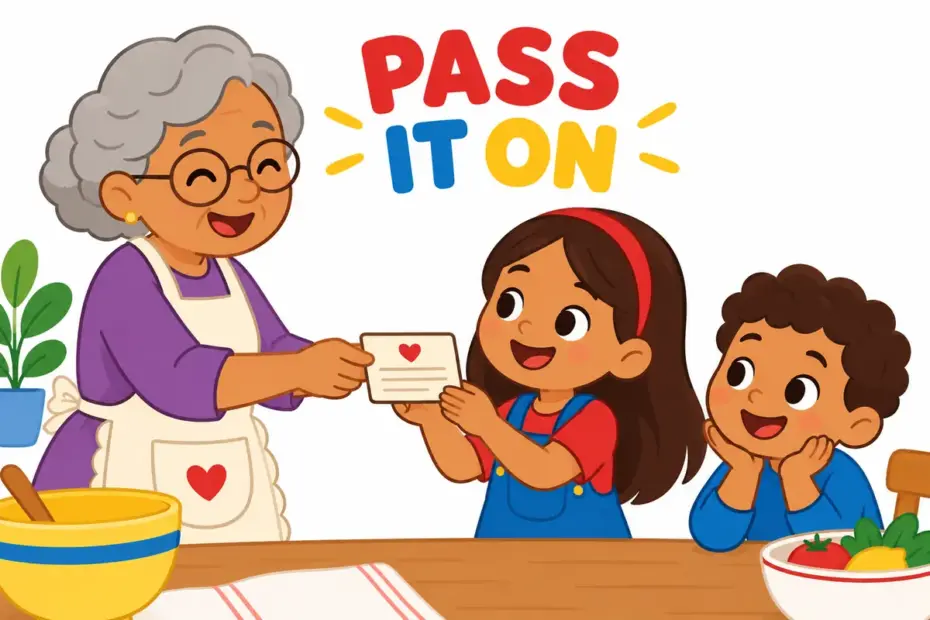
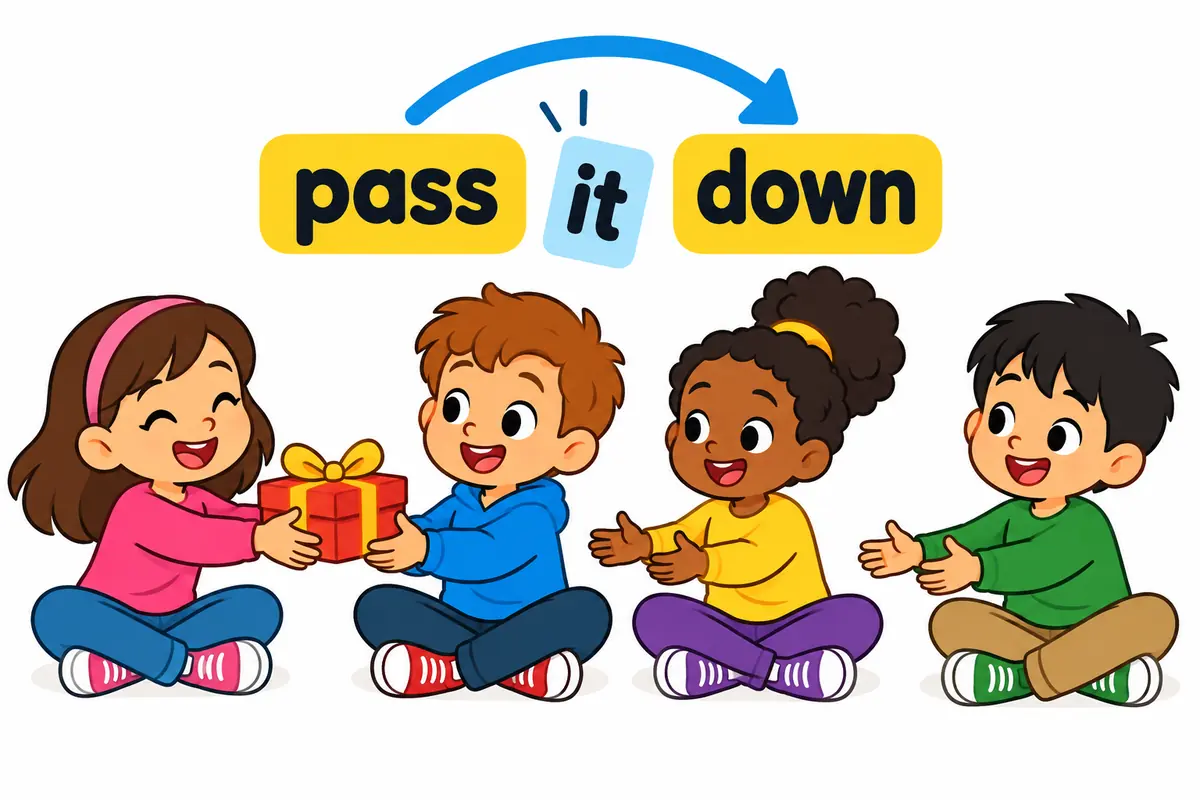
Pass down means to give something to the next generation, or to announce a decision through official channels. To use pass down in a sentence, place the object after the phrase or between its words: “pass down the recipe” or “pass the recipe down.” The verb is separable, so a pronoun sits in the middle.
Pass down at a glance
- Pass down is a transitive, separable phrasal verb; its forms are pass down, passes down, passed down and passing down.
- The commonest sense is to hand an object to a younger person or the next generation.
- A second sense transmits knowledge, stories or traditions between generations.
- A formal third sense announces a decision, as a court passes down a sentence.
- When the object is a pronoun it must sit between the verb and the particle: pass it down.
- The single-word verbs transfer and bequeath cover the same ground in formal writing.
What does pass down mean?
Pass down is a transitive phrasal verb meaning to give something to a younger person or the next generation, to transmit knowledge or tradition, or, in formal use, to announce a decision. The Cambridge entry for pass down records the handing-on sense, which runs from family heirlooms to recipes and folk tales. Where the transfer is official or documented, transmit and transfer are the precise single-word verbs.
| Sense | Plain meaning | Example sentence |
|---|---|---|
| Hand on an object | Give a possession to a younger relative | She passed down her grandmother’s ring. |
| Transmit knowledge or tradition | Carry a skill or story to the next generation | The village passes down its songs orally. |
| Announce officially | Deliver a decision through formal channels | The court passed down its sentence. |
One limitation deserves stating plainly. Pass down is warm and slightly informal in its family senses, and it sounds vague when the exact action matters. In legal and official writing, hand down is the settled verb for a sentence, so pass down can read as an approximation. The phrase also implies a one-way flow from older to younger, which excludes sideways sharing, and it says nothing about whether the thing passed down was worth keeping.
How do you use pass down in a sentence?
Pass down is transitive and separable, so the object may follow the phrase or sit between pass and down, and a pronoun must take the middle slot. Five patterns cover almost every real sentence, and the passive is the one that traditions reach for most.
| Pattern | Example | What it signals |
|---|---|---|
| pass down + object | They pass down the recipe every winter. | Object follows the whole phrase. |
| pass + object + down | They pass the recipe down every winter. | The same meaning with the particle last. |
| pass + pronoun + down | Pass it down to your sister. | A pronoun must sit between verb and particle. |
| be passed down | The story has been passed down for centuries. | The passive keeps the tradition in focus. |
| pass down + to + person | She passed the business down to her son. | Names the recipient of the transfer. |
For a synonym that changes only the verb, hand slots straight into the same pattern and keeps the phrase just as natural.
The passive version, be passed down, is the form you meet most in museums and history books, because it keeps the object rather than the people in focus. The active version puts a named person in charge of the transfer, which is why family sentences usually prefer it.
Pass down in a sentence: examples across contexts
Pass down keeps one grammar while its meaning moves from family heirlooms to court rulings. The ten sentences below show the handing-on, tradition and official senses at work.
| Context | Example sentence | Why this works |
|---|---|---|
| Classroom | The teacher passed the box of paints down to the next row. | Handing-on sense with a named recipient. |
| Family | Her grandmother passed down a handwritten recipe book. | Heirloom sense in a warm register. |
| News report | The court passed down a five-year sentence. | The official announcement sense. |
| Workplace email | Please pass down the updated guidance to your teams. | Instructions moving through a hierarchy. |
| Conversation | These stories were passed down long before anyone wrote them. | Passive voice for an old tradition. |
| Cultural writing | The craft has been passed down through six generations. | Numbers make the continuity concrete. |
| Sports report | The coach passed down the captaincy to the youngest player. | Handing on a role rather than an object. |
| History essay | Oral histories passed down the names of the fallen. | Knowledge transmission in scholarship. |
| Religious writing | The prayer was passed down from teacher to student. | Formal, deliberate transmission. |
| Memoir | Dad passed down his old watch on my eighteenth birthday. | A personal, concrete object marks the moment. |
| Cooking | The head chef passed down her knife skills to the youngest cooks. | A skill transferred by patient demonstration. |
| Community notice | The council passed down the new rules to every tenant. | Formal downward communication with a clear audience. |
Two nearby words cover the receiving and the giving ends of the action: the person who receives an heirloom will inherit it, while a parent who chooses to give a gift is not necessarily passing on a tradition.
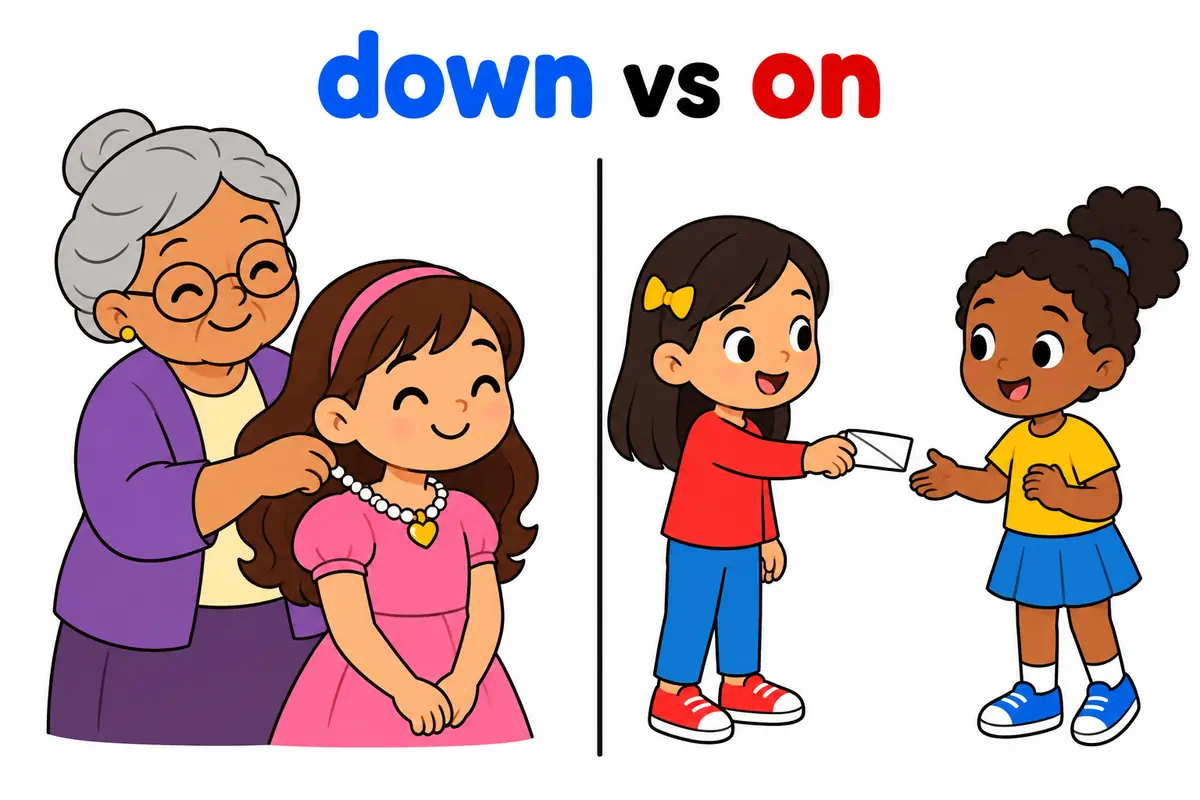
Pass down vs pass on
Pass down and pass on share a base verb and a giving sense, so the choice turns on direction rather than meaning. When the transfer is written into a will, bequeath is the precise legal verb.
| Attribute | pass down | pass on |
|---|---|---|
| Core direction | Downward, to those younger or junior | Onward, often sideways to a peer |
| Typical objects | Heirlooms, recipes, stories, roles | Messages, instructions, opportunities |
| Generation gap | Implied, and usually required | Not required |
| Formality | Neutral to warm | Neutral and very common |
| Separability | Separable: pass it down | Separable: pass it on |
Verdict: use pass down for anything moving from an older generation to a younger one, and pass on for a message or chance that simply travels to the next person. The one fixed rule for both is that a pronoun goes in the middle, never at the end. Where the object is an idea rather than a thing, pass on also carries the sense of declining an offer, as in she passed on the job.
Word forms and grammar of pass down
Pass down inflects through the verb pass, and the participle has become the standard way to describe a long tradition. The table also lists the form learners reach for by mistake.
| Form | Part of speech | Example |
|---|---|---|
| pass down | phrasal verb, base form | They pass down the story each year. |
| passes down | third person singular | She passes down her skill to apprentices. |
| passed down | past and past participle | The ring was passed down in 1974. |
| passing down | present participle | Passing down the recipe takes an afternoon. |
| hand down | variant phrasal verb | The court handed down its verdict. |
| hand-me-down | noun or adjective | He wore his brother’s hand-me-downs. |
Do not confuse pass down with pass over, which means to ignore or skip somebody, often for promotion.
Common mistakes with pass down
The five errors below come from two sources: the position of a pronoun object, and the easy confusion of passed with the unrelated word past.
- Incorrect:
Pass down it to your sister.Correct: Pass it down to your sister. Rule: A pronoun object must sit between the verb and the particle. - Incorrect:
The judge past down the sentence.Correct: The judge passed down the sentence. Rule: Past is a preposition or noun, never the past tense of pass. - Incorrect:
The tradition has been passed down by centuries.Correct: The tradition has been passed down for centuries. Rule: By marks an agent, while for marks a length of time. - Incorrect:
She passed down the salt to her sister.Correct: She passed the salt to her sister. Rule: Pass down implies a generation gap; use pass for sideways sharing. - Incorrect:
The story was passed down from generation by generation.Correct: The story was passed down from generation to generation. Rule: The paired phrase is fixed as from something to something.
Practice using pass down
Work through the six items, then check the reasoning rather than only the answer.
- Fill the gap: These songs have been ______ through the village for two hundred years.
- Choose the better order: The parcel is heavy, so pass (down it / it down).
- Correct the error: The court past down a heavy fine.
- Build a sentence: use pass down about a family recipe.
- Spot the register: which fits a legal report — the judge passed down a sentence, or the judge passed on a sentence?
- Rewrite in the passive: The family has passed the watch down for six generations. Keep the meaning.
Answers
- passed down — the passive needs the past participle of pass.
- it down — a pronoun must sit between the verb and the particle.
- The court passed down a heavy fine — past is not a verb.
- Model answer: My mother passed down her soup recipe on a yellowed card — a concrete object carries the tradition.
- The judge passed down a sentence — pass down is the settled phrase for an official ruling.
- The watch has been passed down for six generations — the passive keeps the watch in focus.
The bottom line
Use pass down in a sentence when something moves from an older person or generation to a younger one, and keep the object close to the phrase. Two facts decide most uses: the verb is separable, so a pronoun must sit between pass and down, and it implies a downward, one-way transfer rather than sideways sharing. For a written bequest, bequeath is the more exact verb.
Frequently asked questions about pass down
Is it pass down or pass on?
Both are correct, but they point in different directions. Pass down moves something from an older generation to a younger one, as with an heirloom or a recipe. Pass on sends a message, instruction or opportunity sideways to the next person, with no age gap required.
Can you say pass down it?
No. Pass down it is never grammatical because a pronoun object must sit between the verb and its particle. Write pass it down instead. This rule holds for every separable phrasal verb, including pass on, pass over and hand down.
Is passed down correct, or is it past down?
Passed down is correct whenever you need the past tense or the past participle of pass, as in the ring was passed down. Past down is always wrong because past is a preposition or a noun, not a verb. The two words sound alike but do different jobs.
What does passing down a sentence mean?
In legal reporting, passing down a sentence means a judge or court formally announces the punishment. The court has passed down a three-year sentence states the ruling. This official sense is narrower than the family sense and belongs in news and legal writing.