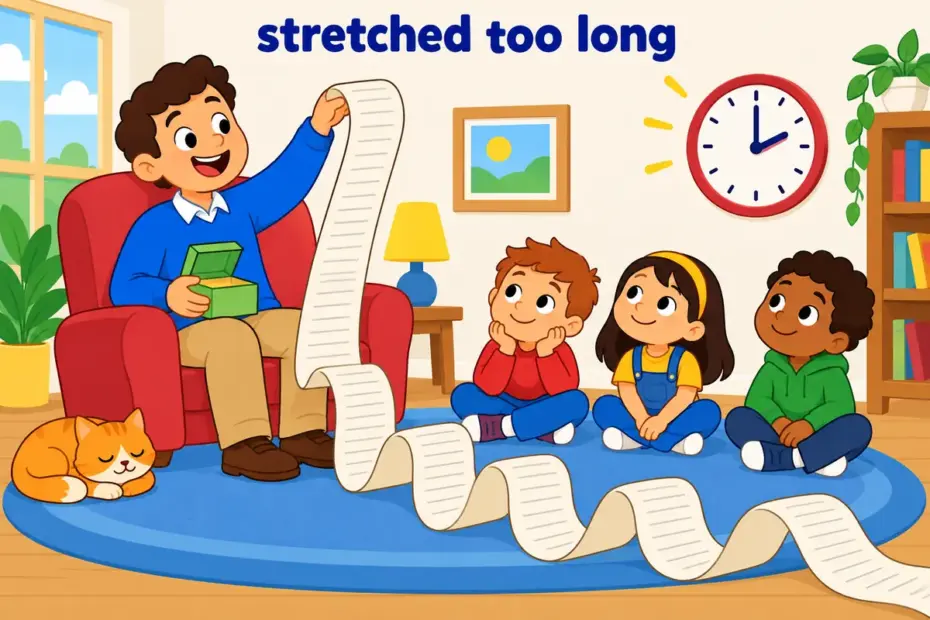
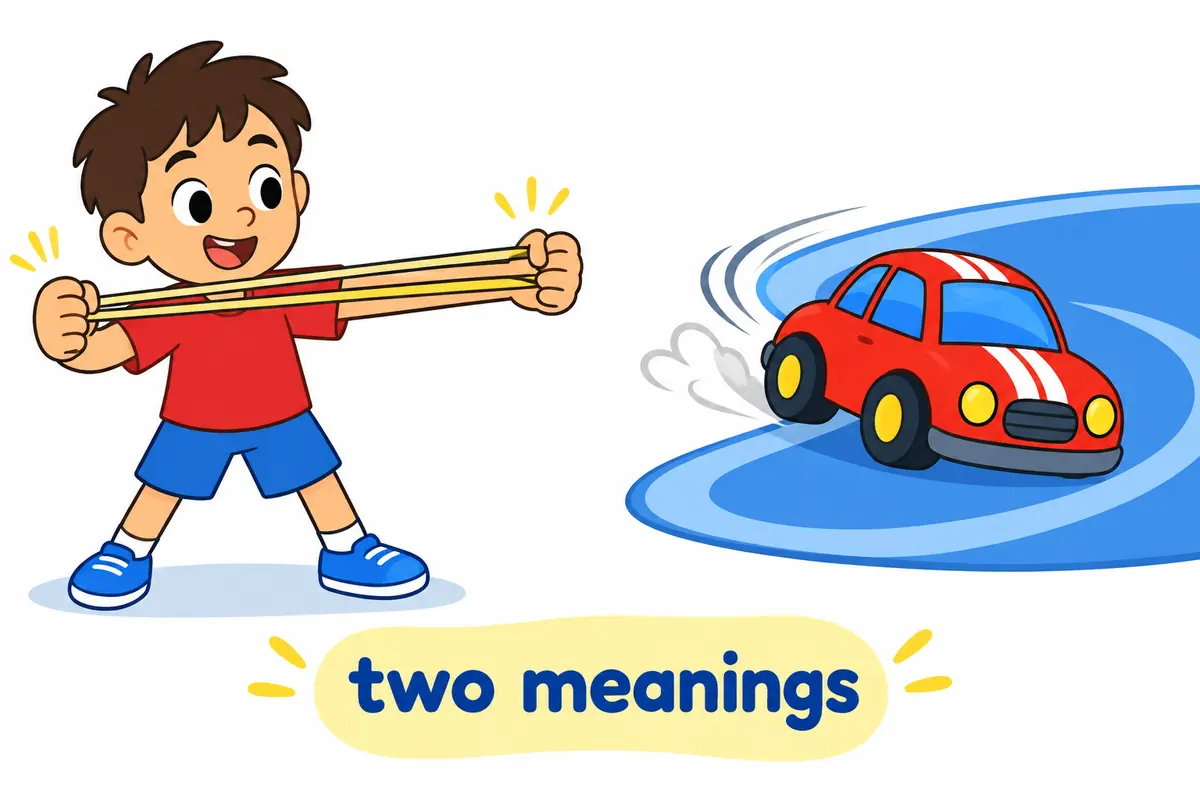
The phrasal verb spin out means to make something last longer than expected, and in informal use it also describes a vehicle skidding or a person feeling dizzy. Both senses keep the same shape, because something spins out or is spun out by someone.
Spin out at a glance
- Spin out is a phrasal verb formed from the verb spin plus the particle out.
- The dominant sense is to prolong or stretch something beyond its natural length.
- A second, informal sense describes a skidding vehicle or a dizzy person losing control.
- The object may follow out or move in front of it, but a pronoun must sit between the words.
- The commonest error is confusing spin out with spin off, which means to create a related product.
What does spin out mean?
Spin out is a phrasal verb meaning to make something last longer than it should, to lose control and rotate, or to feel disoriented. The Cambridge entry for spin out separates the lengthen sense from the informal senses, because the lengthen sense is the one that appears in serious writing. When the aim is simply to make a period longer, prolong a meeting states the idea without the suggestion of waste.
| Sense | Plain meaning | Example sentence |
|---|---|---|
| Prolong | Make something last longer than expected | They spun out the discussion for another hour. |
| Lose control | Skid and rotate, of a vehicle or a moving thing | The van spun out on the icy bend. |
| Feel dizzy | Become disoriented, informal | The heat made the runner spin out near the finish. |
Spin out is not a clean synonym for lengthen. It carries mild disapproval, because it suggests that time is being filled rather than used, so a report would extend a deadline but a talker spins out a story. The skidding sense is informal, and a formal accident report would say the car lost control on the wet road.
How do you use spin out in a sentence?
Spin out is transitive in the lengthen sense and intransitive in the skidding sense, and like many out-phrasal verbs it is separable. A pronoun must sit between the two words, and the passive is common when the process matters more than the person. Where the added time is welcome and deliberate, extend a deadline is the plainer verb.
| Pattern | Example | What it signals |
|---|---|---|
| spin out + object | The director spun out the final scene. | The standard order, with the object after out. |
| spin + object + out | He spun the last chapter out. | Separable form, used when the object is short. |
| spin it out | Do not spin it out any longer. | A pronoun must sit between verb and particle. |
| be spun out | The tale was spun out to fill the hour. | Passive, keeping attention on the thing lengthened. |
| spin out | The car spun out on the wet track. | Intransitive, the losing-control sense. |
Spin out in a sentence: examples across contexts
Spin out changes register more than meaning. The ten sentences below move from a staff meeting to a racetrack, and each one makes clear what is being stretched or lost.
| Context | Example sentence | Why this works |
|---|---|---|
| Workplace email | The team spun out the workshop to fill the afternoon. | Names the event and the unwelcome extra time. |
| News report | The inquiry was spun out over eighteen months. | Passive form keeps the focus on the delay. |
| Academic writing | Critics say the author spins out a single idea across three chapters. | Signals padding with a clear critical stance. |
| Screenwriting | The writers spin out the chase into four separate scenes. | Shows a deliberate stretch in a creative medium. |
| Sports commentary | The leader spun out at the last corner. | Uses the intransitive skidding sense. |
| Motoring report | The rear wheels lost grip and the car spun out. | Explains the cause before the result. |
| Health advice | Going without water can make a walker spin out in the sun. | Uses the informal dizzy sense in plain language. |
| Conversation | Do not spin it out, just tell me the ending. | The pronoun form is idiomatic in speech. |
| Project review | An extra fortnight spun the build out to eleven weeks. | Separable form with a clear time object. |
| Literary criticism | The novelist spins out a small quarrel into a whole book. | Contrasts a small source with a large result. |
The lengthen sense often appears with a fixed time phrase such as for another hour or over three weeks, and a warning verb such as do not usually introduces the pronoun form. A story that runs away from its teller is the natural place for drag a story out, which carries the same complaint. Detail that is added for its own sake, meanwhile, reeling off facts without a point, is what readers mean when they say a piece feels spun out.
The two senses are easy to tell apart once you check the subject. The lengthen sense almost always takes a human subject who chooses to stretch something, while the skidding sense takes the vehicle itself. That is why the same words can describe a talkative host and a turning car without any change of form, and only the subject tells the reader which meaning is active.
Spin out vs prolong
Spin out and prolong both add time, but they differ in tone and in who controls the clock. The table sets them side by side.
| Attribute | spin out | prolong |
|---|---|---|
| Core meaning | Stretch something past its useful length | Make something last longer on purpose |
| Connotation | Often critical, suggests padding | Neutral, can be welcome |
| Typical object | A story, meeting, scene or delay | A life, a stay, a discussion or a moment |
| Typical subject | A talker, writer or filmmaker | A person, treatment or decision |
| Register | Informal to neutral | Neutral to formal |
Verdict: choose prolong when the extra time is neutral or good, as in a treatment that prolongs life, and choose spin out when the extra time feels like filler that shorten a speech would better remove.
Word forms and grammar of spin out
Spin out inflects through its base verb, and the related noun spin-off belongs to a different meaning altogether.
| Form | Part of speech | Example |
|---|---|---|
| spin out | phrasal verb, base | They spin out the show every December. |
| spins out | phrasal verb, third person singular | The speaker spins out every answer. |
| spun out | phrasal verb, past and past participle | The meeting was spun out for two hours. |
| spinning out | phrasal verb, present participle | The car is spinning out on the gravel. |
| spin-off | noun, different meaning | The series became a popular spin-off. |
| spin around | phrasal verb, different meaning | She spun around to face the door. |
The base verb spin is regular here, so the past tense is spun, not spinned. The particle changes the meaning completely, so a startled person spun around to face the door, while a car spun out on a bend. The noun compound spin-out in motorsport describes a car leaving the track, and that use keeps the same spelling.
Common mistakes with spin out
- Incorrect:
The writers spinned out the story.Correct: The writers spun out the story. Rule: The past tense of spin is spun, never spinned. - Incorrect:
They spun out it for an hour.Correct: They spun it out for an hour. Rule: A pronoun object must sit between spin and out. - Incorrect:
The company spun out a new brand.Correct: The company spun off a new brand. Rule: Use spin off for a related product and spin out for stretching time. - Incorrect:
She spun out the deadline by a week.Correct: She extended the deadline by a week. Rule: Spin out suggests unwanted padding; extend is neutral.
Practice using spin out
Work through the seven items, then read the reason beside each answer.
- Fill the gap: The discussion ______ out until well past four o clock.
- Choose the better word: The charity hopes the new drug will (spin out / prolong) patients lives.
- Correct the error: He spinned out the interview with questions about the weather.
- Build a sentence: use spin it out about a classmate stretching a two-minute talk.
- Spot the register: which belongs in a police report, the car spun out on the bend, or the car lost control on the bend?
- Rewrite with a pronoun: The director spun out the final act. Use it.
- Choose the sense: in the sentence the cyclist spun out on the gravel, is the meaning lengthen, skid or feel dizzy?
Answers
- spun, because the past tense of spin is spun and the object is the discussion.
- prolong, because the extra time is wanted and spin out would sound critical.
- He spun out the interview with questions about the weather, because the past tense is spun.
- Model answer: Amina spun it out until the bell rang, but she still had no conclusion.
- The car lost control on the bend, because a formal report avoids the informal skidding sense.
- The director spun it out, because the pronoun must sit between spin and out.
- Skid, because the intransitive sense describes losing control on a surface.
The bottom line
Use spin out in a sentence when something is stretched past its useful length, or informally when a vehicle or a person loses control. The two decisions that settle most uses are sense and tone: the lengthen sense is neutral enough for a review, while the skidding sense is informal and belongs in conversation. Where the extra time is wanted, prolong is the better verb.
Frequently asked questions about spin out
Is spin out the same as spin off?
No. Spin out means to stretch something longer or to lose control, while spin off means to create a related product from an existing one. A television series spins off a new show, but a slow episode spins out a thin plot. The two phrasal verbs share a base verb and nothing else, so keep the particles apart.
Is spin out British or American?
The lengthen sense appears in both American and British writing, while the skidding and dizzy senses are informal and more common in British English. A motoring report on either side of the Atlantic would prefer lost control, because spin out sounds conversational. When in doubt, use the lengthen sense for neutral writing.
Can spin out describe a car?
Yes, the intransitive sense describes a vehicle losing grip and rotating. The pattern takes no object, so you write the car spun out on the ice, not the driver spun the car out, unless the driver deliberately causes the skid. A formal report would replace the phrase with lost control on the ice.
How is spin out different from drag out?
Both criticize extra length, but drag out stresses tedium while spin out stresses padding. A meeting that drags out feels slow to everyone, whereas one that is spun out has been deliberately stretched with filler. Drag out also takes a person as a common object, as in do not drag it out.