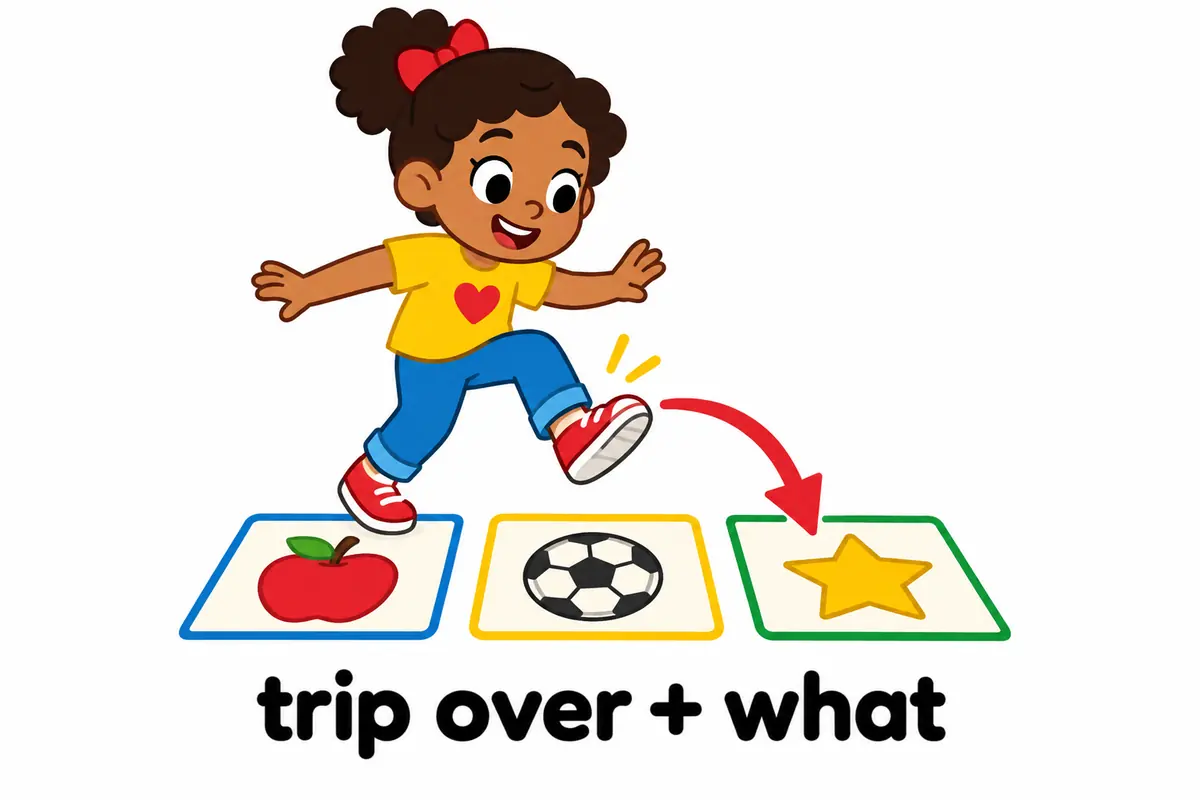
Trip over is a phrasal verb meaning to catch your foot on something and stumble, and it also describes stumbling over your words. To use trip over in a sentence, put the obstacle directly after over: “He tripped over the cable in the hall.” The obstacle always acts as the object.
Trip over at a glance
- Trip over is a phrasal verb; its forms are trip over, trips over, tripped over and tripping over.
- The object follows over: you trip over a cable, a step, a root or a bag.
- A second, figurative sense applies to speech: you trip over a name or a word.
- The verb is not passive and has no reflexive form.
- The commonest error is leaving over without an object, as in she tripped over on the step.
What does trip over mean?
Trip over is a phrasal verb meaning to catch the foot on an obstacle and lose balance, and by extension to falter in speech. The Cambridge entry for trip over keeps the obstacle as the object, which is the pattern that shapes every physical sentence. The figurative sense borrows the same shape: a word or a name becomes the obstacle that the speaker falls across.
| Sense | Plain meaning | Example sentence |
|---|---|---|
| Stumble on an obstacle | Catch the foot and lose balance | She tripped over the rug in the hall. |
| Stumble in speech | Falter while speaking | He tripped over his words during the speech. |
| Move clumsily across | Cross something awkwardly on foot | They tripped over the rocks to reach the shore. |
One limit is worth stating plainly. Trip over is not the same as fall. A person who trips over a cable may stagger and stay upright, while a fall means the body reaches the ground. Most people recover your balance after a stumble without ever touching the floor.
How do you use trip over in a sentence?
The verb follows a small set of shapes, and the physical pattern is the one to learn first. To stumble is the closest single-word synonym, and the base verb trip can stand alone when no obstacle is named.
| Pattern | Example | What it signals |
|---|---|---|
| trip over + obstacle | I tripped over a tree root. | The obstacle follows over and acts as the object. |
| trip over + words | He tripped over her name. | Figurative: the thing that causes the stumble. |
| trip over + oneself | She was tripping over herself to help. | An idiom meaning eager or awkward. |
| trip + adverb | He tripped and fell on the step. | No obstacle named, so the verb stands alone. |
| be tripped up (by) | The witness was tripped up by a question. | Passive of trip up, a different phrase. |
The idiom trip over oneself is the only pattern that changes the meaning, so treat it as a fixed expression rather than a literal stumble. The object after over may be concrete or abstract, and the abstract version is the one that gives learners trouble: a cable and a grammar rule behave the same way, because both are simply what the foot or the tongue catches on.
Trip over in a sentence: examples across contexts
The verb changes setting far more than meaning. The ten sentences below move from a hallway to a radio studio, and each one names what caused the stumble. To slip on the wet floor is caused by the surface itself rather than by an object lying across the path.
| Context | Example sentence | Why this works |
|---|---|---|
| Home | He tripped over the dog bed in the dark. | Names the obstacle and the cause of the stumble. |
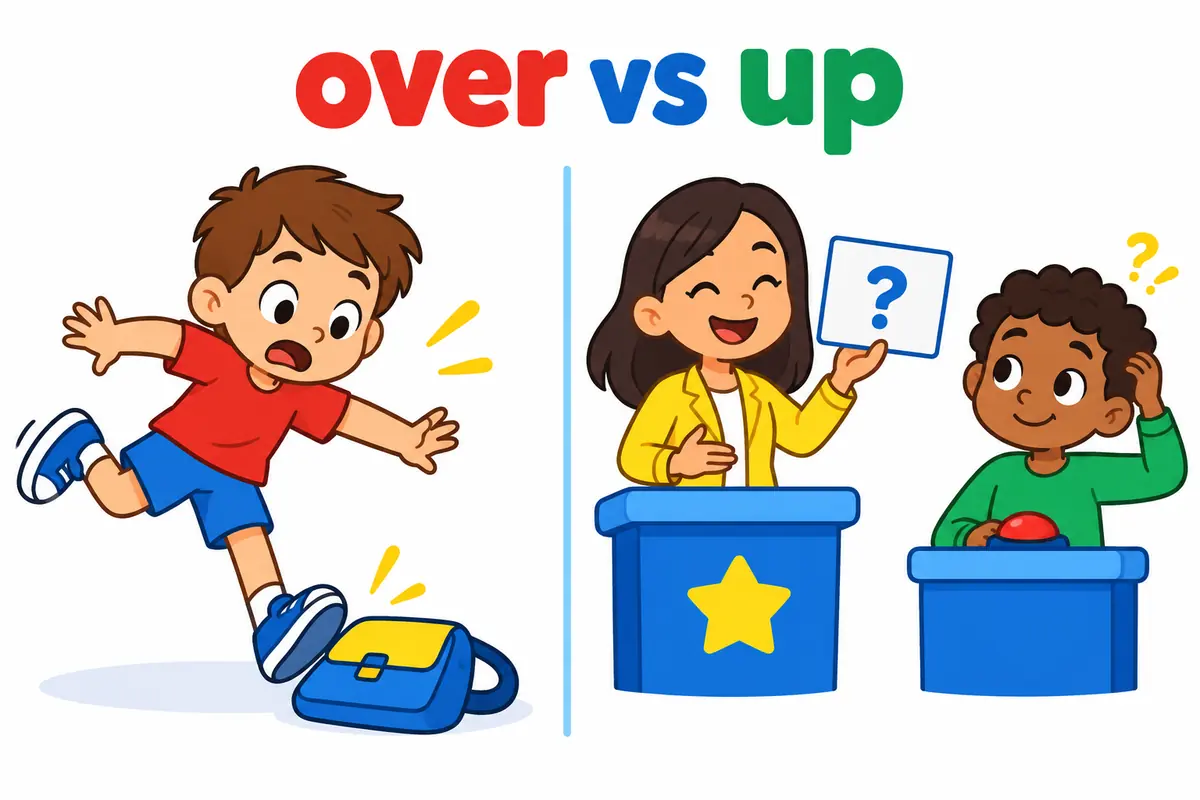
| School | She tripped over a school bag in the corridor. | A familiar, harmless accident. |
| Public speaking | The mayor tripped over a long word and paused. | Switches the obstacle from a thing to a word. |
| Radio interview | He tripped over the guest’s name twice. | Shows the figurative sense with an object. |
| Construction site | Workers must not trip over trailing cables. | A safety rule that uses the physical sense. |
| Hiking guide | You will trip over roots if you watch the view. | Links the stumble to inattention. |
| News report | The runner tripped over a loose shoe lace near the finish. | A concrete cause in a sports story. |
| Theatre | The actor tripped over the edge of the set. | Names a fixed object on a stage. |
| Conversation | I tripped over the doorstep and dropped the tray. | Everyday spoken use with a clear result. |
| Language learning | Beginners trip over irregular verbs all the time. | Extends the metaphor to a difficulty rather than a fall. |
| Care at home | Loose rugs make older people trip over them indoors. | Ties the physical sense to a practical warning. |
| Football report | The striker tripped over the ball and lost possession. | An everyday sports accident with a clear result. |
The last sentence shows how far the metaphor reaches: a grammar point can be an obstacle that learners stumble across.
Trip over vs trip up and fall
Trip over has three close neighbours and is interchangeable with none. Trip up the witness shares the verb but blames the questioner, because trip up means to cause somebody else to make a mistake. Fall describes a different outcome, and slip names a different cause.
| Attribute | trip over | trip up | fall |
|---|---|---|---|
| Core job | Catch the foot on an obstacle | Cause someone to make a mistake | Reach the ground |
| Who is responsible | The walker | The questioner or rival | The walker, given gravity |
| Typical object | A cable, a step or a word | A person or a plan | Nothing; fall is intransitive |
| Implies intent | No | Often yes | No |
| Typical subject | A walker or a speaker | A trick question or a rival | A person or a thing |
Verdict: choose trip over for an obstacle that catches the foot or the voice, trip up when somebody else causes the mistake, and fall only when the body actually reaches the ground.
Word forms and grammar of trip over
Trip over inflects on the verb, and its relatives in meaning are easy to confuse. The table sets out the forms, including the standalone verb and the different phrase trip up.
| Form | Part of speech | Example |
|---|---|---|
| trip over | base phrasal verb | Do not trip over the toolbox. |
| trips over | third person singular | He trips over that rug every morning. |
| tripped over | past and past participle | She tripped over the kerb and laughed. |
| tripping over | present participle | They were tripping over each other to help. |
| trip | verb, no obstacle named | He tripped and caught the rail. |
| tripped up | phrasal verb, different meaning | The question tripped up the witness. |
| trip | noun, a journey or a stumble | They planned a short trip to the coast. |
The noun trip and the verb trip are spelled alike, so only the grammar tells them apart: a trip is a thing, while to trip is an action. Note also that tripped up belongs to the separate phrase trip up, so mixing the two produces a sentence about a mistake that reads like a fall.
Common mistakes with trip over
- Incorrect:
She tripped over on the step.Correct: She tripped on the step. Rule: Over needs an object, while on can stand without one. - Incorrect:
He tripped the cable in the dark.Correct: He tripped over the cable in the dark. Rule: The verb is not transitive with the obstacle. - Incorrect:
The question tripped over the witness.Correct: The question tripped the witness up. Rule: Trip up is the phrase for causing somebody else to err. - Incorrect:
He was tripped over the bag.Correct: He tripped over the bag. Rule: Trip over is not passive; the walker does the tripping. - Incorrect:
I tripped over myself to finish early.Correct: I fell over myself to finish early. Rule: The idiom is fall over oneself, not trip over oneself, in British usage.
Practice using trip over
Work through the seven items, then read the reasons, which explain the pattern rather than only the key.
- Fill the gap: The waiter ______ the corner of the rug and spilled the water.
- Choose the better word: The tricky question (tripped over / tripped up) the nervous candidate.
- Correct the error: She tripped over and grazed her knee.
- Build a sentence: use trip over about a phone charger in a bedroom.
- Spot the register: which belongs in a safety notice — do not trip over the cables, or watch your feet, everyone?
- Rewrite figuratively: The presenter struggled with the long name. Use trip over instead.
- Fix the phrase: The test tripped over the students. Make it mean that the test caused mistakes.
Answers
- tripped over — the rug corner is the obstacle following over.
- tripped up — the question caused the candidate to make a mistake.
- She tripped and grazed her knee — without an object, over is dropped.
- Model answer: He tripped over the phone charger beside the bed.
- Do not trip over the cables — a notice stays plain and uses the precise phrase.
- The presenter tripped over the long name — the figurative sense treats the name as an obstacle.
- The test tripped the students up — trip up is the phrase for causing a mistake.
The bottom line
Use trip over in a sentence for catching the foot on an obstacle, and extend it to speech only when a word or a name is what causes the stumble. The two points that decide most sentences are the object after over, which can never be dropped, and the split from trip up, which blames somebody else for the mistake. Where the body actually reaches the ground, fall is the accurate verb.
Frequently asked questions about trip over
Is trip over one word or two?
Trip over is always two words, because trip is the verb and over is the particle. The pair is never written as tripover or trip-over when it is used as a verb. Only the unrelated noun trip is a single word, and it means a journey or a stumble.
Does trip over always mean falling?
No. To trip over something means to catch the foot and lose balance, and many people recover without falling. The two verbs describe different outcomes: a trip is the stumble and a fall is the arrival on the ground. That is why a sentence can say he tripped over the step but stayed upright.
Why do we say trip over your words?
The phrase borrows the physical pattern and treats a word as an obstacle. A speaker who trips over a long name stumbles on it in the same way a walker stumbles on a root. The object still follows over, which is why the figurative sense feels like a small fall across a sound.
Can you trip over a person?
Yes, when somebody is lying in the way: a child can trip over a sleeping dog or a friend’s outstretched legs. The person is simply the obstacle that follows over. The related idiom trip over oneself, meaning to behave eagerly, is a fixed expression and not a literal stumble.