Cozen means to deceive or trick someone, often by charm or flattery, and it is now rare outside old books and formal prose. To use cozen in a sentence, treat it as a transitive verb and name the person who is fooled: the merchant cozened the villagers. For everyday writing, deceive or cheat is the plainer choice.
Cozen at a glance
- Cozen is a transitive verb; its forms are cozens, cozened and cozening.
- It means to deceive or trick, especially by smooth talk rather than force.
- It also means to obtain something by trickery, as in cozen a fortune from someone.
- The word is literary and old-fashioned; dictionaries usually mark it archaic or rare.
- The commonest error is confusing it with the unrelated word cousin.
What does cozen mean?
Cozen is a verb meaning to deceive or trick a person, usually by flattery, charm or a clever story rather than by force. The Cambridge entry for cozen records the deceiving sense, and a second sense covers obtaining something by trickery, as when a schemer cozens a sum out of a trusting relative. A third, gentler sense means to win someone over by coaxing. The verb implies a slow, smooth manipulation rather than a single lie, which is why it fits stories about a confidence trickster who takes his time.
| Sense | Plain meaning | Example sentence |
|---|---|---|
| Deceive | Trick a person by charm or a false story | The pedlar cozened every customer in the square. |
| Obtain by trickery | Get money or goods from someone by cheating | He cozened a fortune out of his old friend. |
| Win over | Persuade someone gently, by coaxing | She cozened the guard into opening the gate. |
One limitation is worth stating plainly. Cozen is not related to the word cozy, and it never means to comfort anyone. It is also too old-fashioned for most modern writing: a news report says a fraudster deceived or cheated the buyers, and keeps cozen for a deliberate period flavour.
How do you use cozen in a sentence?
Cozen is a single transitive verb, so it always takes a person as its object, and it is never split by a particle. The table shows the frames that appear in real writing, from the bare verb to the out-of pattern for the money that changes hands. The subject is always the person who does the cheating, never the victim, so a passive sentence such as the clerk was cozened quietly shifts the blame onto somebody else.
| Pattern | Example | What it signals |
|---|---|---|
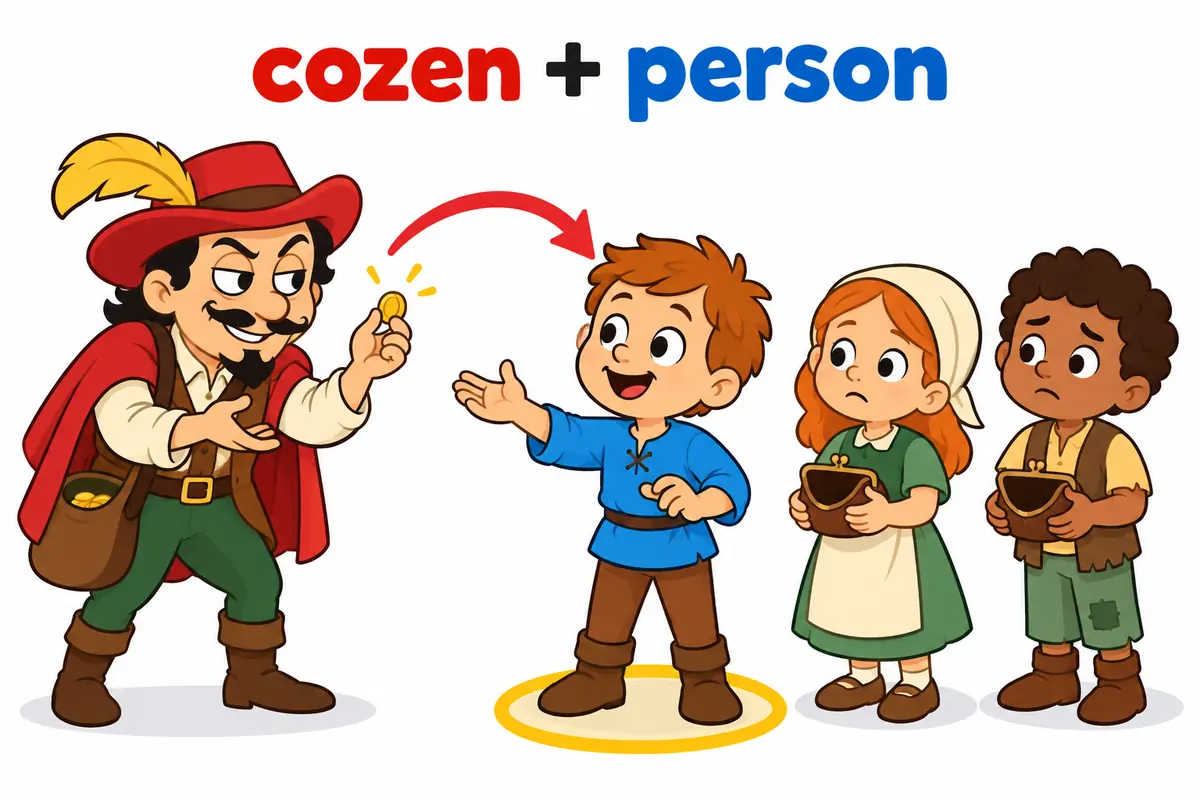
| cozen + person | The rogue cozened the townsfolk. | Trickery is aimed at a group. |
| cozen + person + out of + thing | She cozened him out of his savings. | Names both the victim and the loss. |
| cozen + person + into + action | They cozened the clerk into signing. | Shows what the victim was persuaded to do. |
| be cozened | The widow was cozened by a smooth stranger. | Passive form keeps the victim in view. |
| cozen + thing + from + person | He cozened a ring from the merchant. | Puts the stolen object before from. |
When the register is modern, a plainer verb does the same work. Writers turn to trick or fool for speech, and keep cozen for fiction set in the past.
Cozen in a sentence: examples across contexts
Cozen lives almost entirely in written registers that want an older, warmer word for cheating. The ten sentences below range from historical fiction to academic notes, and each one makes the victim and the trick visible. A good test is to ask whether flattery was part of the scheme: if it was, cozen fits, and if the lie was plain, deceive is enough.
| Context | Example sentence | Why this works |
|---|---|---|
| Historical fiction | The innkeeper cozened travellers who could not read the bill. | A period setting makes the old verb natural. |
| Literary essay | Dickens lets a clerk cozen his master with a forged ledger. | The verb’s age suits commentary on old novels. |
| Stage dialogue | Speak fair, and cozen him before the bell rings. | Imperative mood carries the plotters’ plan. |
| Legal history | Petitions describe brokers who cozened widows of their land. | The out-of pattern names the loss precisely. |
| Translation | She renders the old verb as cozen rather than cheat. | Naming the choice shows why the word survives. |
| Academic note | Scholars argue the phrase came to cozen the crown. | A formal context tolerates the archaic verb. |
| Feature article | The story of the man who cozened a whole town still sells papers. | Light journalism uses it for colour. |
| Poetry | Sweet words cozen the ear before they wound the purse. | The compressed line suits the older register. |
| Conversation | He tried to cozen me into paying twice, but I checked the total. | Deliberate use in speech sounds playful, not neutral. |
| Same family | The hoodwink of a whole village is the plot of the play. | A modern synonym keeps the reader oriented. |
Notice that every sentence supplies either a victim or a scheme. The verb needs that human target, which is why cozen never appears in the flat, subjectless way that a word like happen can.
Cozen vs deceive and hoodwink
Cozen overlaps with two verbs and matches neither. deceive is the neutral, modern word for making someone believe what is false, and hoodwink adds a note of a clever, almost playful swindle. Cozen keeps the strongest sense of charm used as a weapon. The three also differ in blame: cozen and hoodwink point the finger at a clever cheat, while deceive can be accidental as well as deliberate.
| Attribute | cozen | deceive | hoodwink |
|---|---|---|---|
| Core job | Trick by charm or a false story | Make someone believe a falsehood | Cheat by a clever trick |
| Register | Archaic and literary | Neutral, modern | Informal to literary |
| Suggests flattery | Strongly | Not usually | Sometimes playfully |
| Typical object | A person, often a victim | A person, group or self | A person or a group |
| Modern equivalent | Cheat, dupe | Misled, lied to | Duped, outwitted |
| Usable in a report | No, too dated | Yes | Rarely, only in features |
Verdict: use deceive in ordinary writing, hoodwink when the trick was clever, and cozen only when you want the old-fashioned, flattering kind of cheating.
Word forms and grammar of cozen
Cozen inflects like any regular verb, and it has two rare nouns that survive in older texts. The table also marks the lookalike verbs that learners mix it up with.
| Form | Part of speech | Example |
|---|---|---|
| cozen | verb, base form | Do not let a stranger cozen you at the fair. |
| cozens | third person singular | He cozens buyers with a polished smile. |
| cozened | past and past participle | The clerk cozened the widow out of her house. |
| cozening | present participle | Cozening the rich was the rogue’s whole trade. |
| cozenage | noun, rare | The trial exposed a long campaign of cozenage. |
| cozener | noun, rare | A practised cozener knows which story to tell. |
| covet | verb, different meaning | He coveted his neighbour’s land. |
Two lookalikes cause most of the spelling trouble. covet means to long for what belongs to another, and cower means to crouch in fear, so neither belongs in a sentence about cheating.
Common mistakes with cozen
- Incorrect:
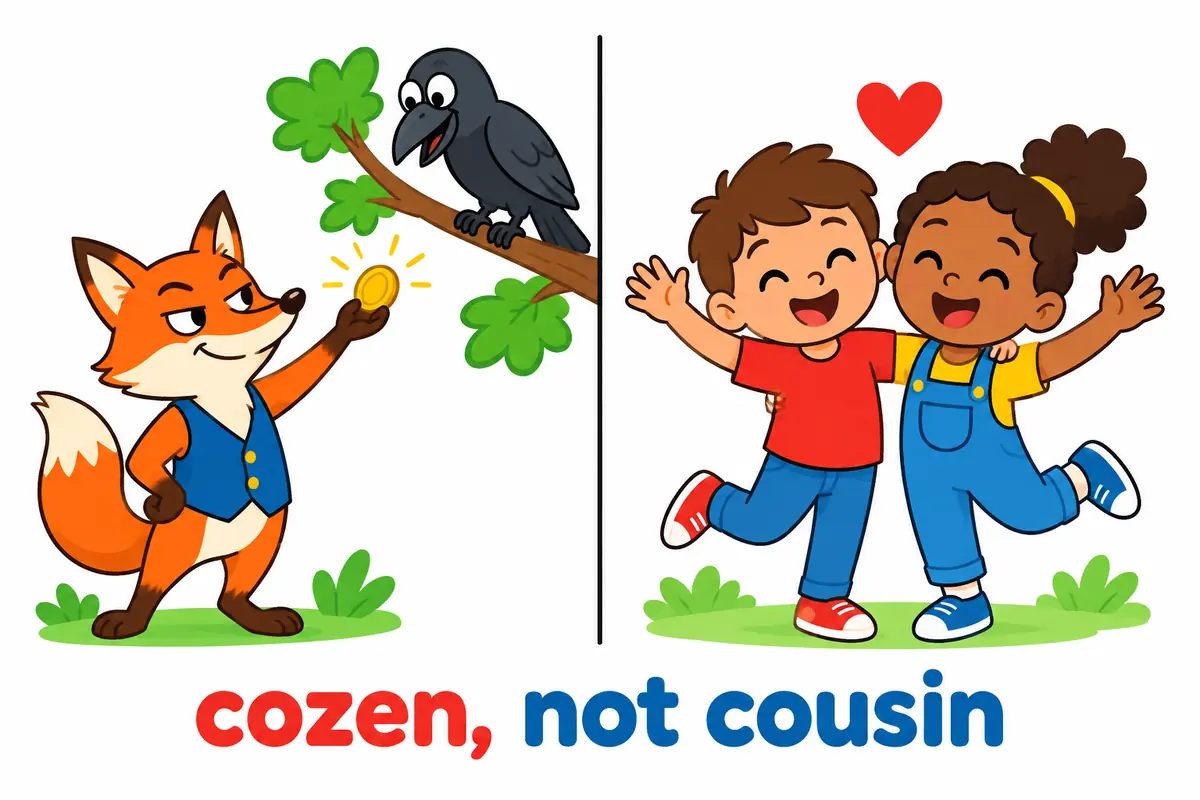
My cozen came to visit on Sunday.Correct: My cousin came to visit on Sunday. Rule: Cozen means to cheat; the relative is cousin. - Incorrect:
The fox cozened from the crow.Correct: The fox cozened the crow. Rule: The verb is transitive, so the victim is the object, with from used only for the thing taken. - Incorrect:
He cozened that the deed was genuine.Correct: He cozened her into signing the deed. Rule: Cozen takes a person, never a that-clause. - Incorrect:
The warm blanket cozened the child.Correct: The warm blanket comforted the child. Rule: Cozen has nothing to do with cozy; it means to deceive. - Incorrect:
They cozened at the market every week.Correct: They cozened shoppers at the market every week. Rule: The verb never stands alone; it needs a person as its object.
Practice using cozen
Work through the six items, then compare your wording with the reasoning in the answers.
- Fill the gap: The swindler ______ the old sailor out of his wages.
- Choose the better word: The letter warned that a smooth talker might (cozen / cower) her.
- Correct the error: He cozened that the ship was safe.
- Build a sentence: use cozen with into about a guard and a gate.
- Spot the register: which belongs in a modern news report — the broker deceived his clients, or the broker cozened his clients?
- Rewrite in the passive: A stranger cozened the widow. Keep the widow in view.
Answers
- cozened — the victim is the object and out of introduces the loss.
- cozen — the sentence needs the verb meaning to cheat, not cower meaning to crouch in fear.
- He cozened them into believing the ship was safe — cozen needs a person as its object.
- Model answer: She cozened the guard into opening the gate.
- The broker deceived his clients — a news report prefers the neutral modern verb.
- The widow was cozened by a stranger — the passive keeps the victim as the subject.
The bottom line
Use cozen in a sentence when you want an old-fashioned, literary word for cheating someone by charm or a smooth story. Two nuances decide most sentences: the verb is transitive and takes a person as its object, and it survives today almost only in fiction and formal prose. In modern writing, beguile and deceive are the plainer alternatives.
Frequently asked questions about cozen
What does cozen mean?
Cozen means to deceive or trick someone, usually by flattery or a clever story rather than by force. It also means to obtain something by trickery, as in cozening a fortune out of a friend. The word is old and literary, and modern equivalents include cheat and dupe.
Is cozen still used today?
Rarely in ordinary speech. Cozen survives mainly in historical fiction, poetry and formal prose that wants an older tone, and dictionaries often mark it archaic or rare. A news report or email about fraud would instead use deceive, cheat or defraud, which sound current and neutral.
What is the difference between cozen and deceive?
Deceive is the neutral, modern verb meaning to make someone believe something false. Cozen is older and narrower, and it stresses charm or smooth talk used to cheat a person. Use deceive in everyday writing and keep cozen for a deliberately old-fashioned effect.
How do you use cozen in a sentence?
Cozen is a transitive verb, so it always needs a person as its object, as in the merchant cozened the villagers. You can add out of for what was lost or into for the action the victim was persuaded to take. It is never split and never takes a that-clause.