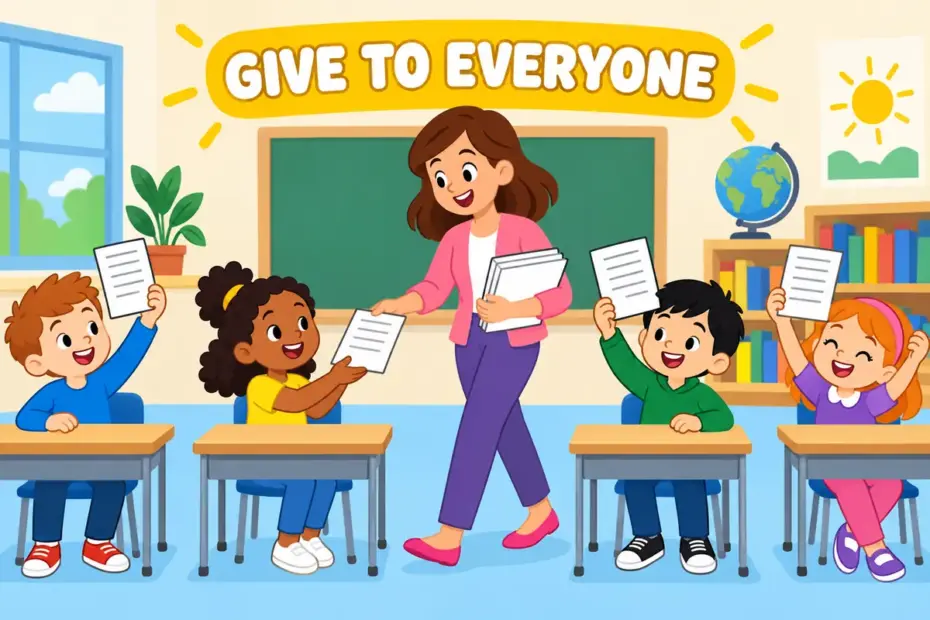
Hand out means to give things to each person in a group, and it usually describes sharing printed papers, food or supplies. To use hand out in a sentence, name the item and the group: “The teacher handed out the worksheets.” The verb is a phrasal verb, so the particle can move around the object.
Hand out at a glance
- Hand out is a transitive phrasal verb meaning to distribute, and it is separable: hand out the forms or hand the forms out.
- The object is the thing distributed, while the group that receives it follows to.
- It belongs to neutral everyday English, at home, in class and in the workplace.
- The noun form is different: a handout is one word and means a printed sheet or a gift.
- The commonest error is confusing hand out with hand over, which gives one thing to one recipient.
What does hand out mean?
Hand out is a phrasal verb meaning to distribute something to the people in a group. The Cambridge entry for hand out gives the distribute sense and also a second one, to give something free, as in volunteers handing out meals. Both senses share the idea of one giver reaching many receivers.
| Sense | Plain meaning | Example sentence |
|---|---|---|
| Distribute | Give one item to each person | The teacher handed out the worksheets. |
| Give for free | Offer something at no cost | Volunteers handed out hot soup. |
| Issue officially | Give out a formal item | Staff handed out visitor badges at the gate. |
Hand out is close to dispense, but it is warmer and more general. It does not mean to hand something to a single person, and it does not mean to give away ownership for good, so a sentence about handing out your only key to a friend uses the wrong phrase.
How do you use hand out in a sentence?
Hand out is transitive, so it always needs an object, and that object is the item being shared. Five patterns cover its ordinary uses, from a classroom to a ticket desk.
| Pattern | Example | What it signals |
|---|---|---|
| hand out + item | The teacher handed out the worksheets. | The commonest pattern; the item is the object. |
| hand out + item + to + group | They handed out leaflets to the crowd. | Names who receives the items. |
| hand + item + out + to + group | She handed the forms out to each parent. | A longer object moves after the particle. |
| hand out + item + at + place | Staff handed out badges at the gate. | Locates the distribution. |
| hand out + something free | Volunteers handed out water to runners. | The free sense, with no payment involved. |
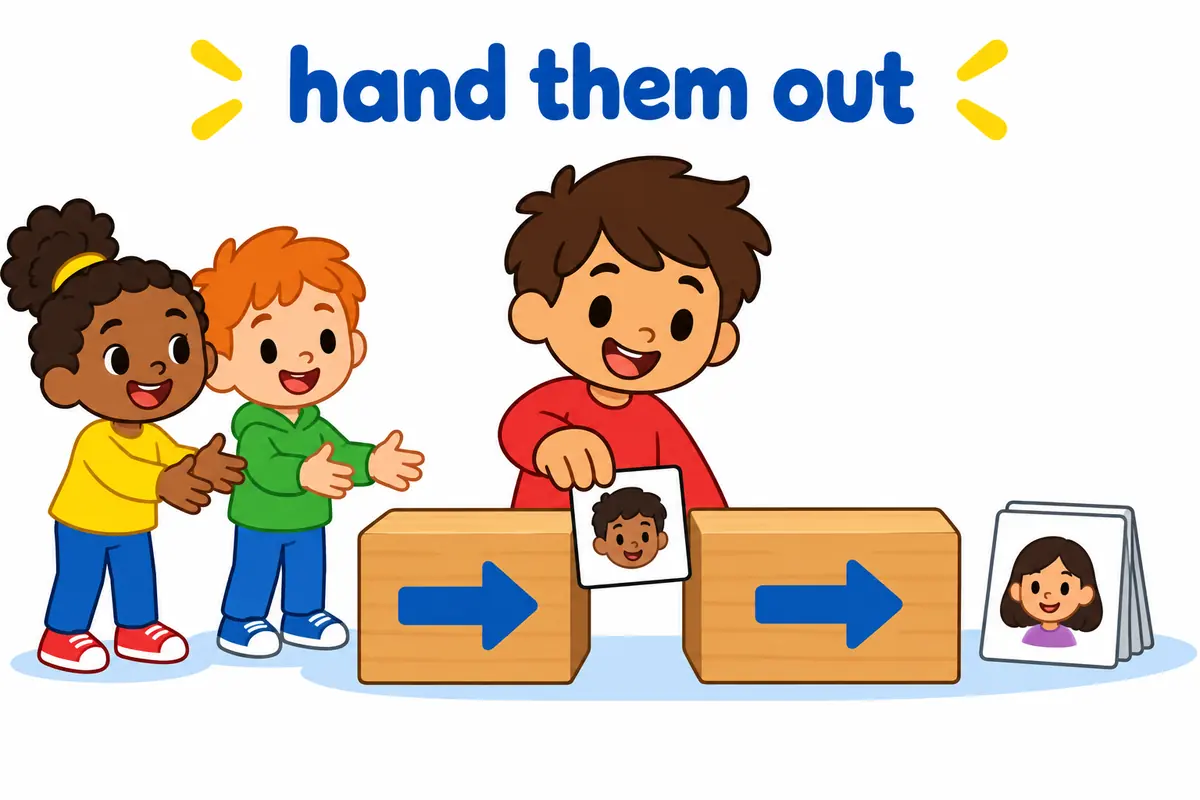
The particle out can move past a noun object but must stay before a pronoun: hand out the forms and hand the forms out are both fine, while a pronoun gives hand them out, never hand out them. Where the meaning is a formal transfer of one thing to one person, hand over is the phrase to use.
Hand out in a sentence: examples across contexts
Hand out keeps the same meaning wherever it appears, but the item and the group change with the setting. The ten sentences below show that range with one line of explanation each.
| Context | Example sentence | Why this works |
|---|---|---|
| Classroom | The teacher handed out the spelling lists. | One item to many pupils is the core sense. |
| Workplace meeting | Maya handed out the agenda before the meeting began. | A single document reaches the whole team. |
| Charity event | Volunteers handed out blankets to the families. | The free sense, with a named group. |
| Conference desk | Staff handed out name badges at the entrance. | Issue sense in an organised setting. |
| Sports event | Helpers handed out water to the runners. | Repeated giving along a route. |
| School trip | The guide handed out maps to every student. | Names both item and recipients. |
| Office kitchen | Someone handed out cake to celebrate the sale. | Informal sharing among colleagues. |
| Food bank | They hand out parcels every Friday morning. | Habitual action in the present tense. |
| Exam hall | Invigilators handed the papers out at nine sharp. | Long object after the particle. |
| Community notice | Neighbours handed out flyers about the road closure. | A local task with a clear item. |
Every sentence above gives one item to several people, which is what separates hand out from the single, deliberate transfer of hand over.
Is hand out separable?
Yes. Hand out is a separable phrasal verb, so the particle out can move to the far side of a noun object. Both hand out the forms and hand the forms out are correct, with no change in meaning.
| Object | Correct order | Incorrect order |
|---|---|---|
| A short noun | hand out the forms / hand the forms out | hand out them |
| A pronoun | hand them out | hand out them |
| A long noun phrase | hand out the whole set of forms | hand the whole set of forms out |
| A named group | hand out the forms to the class | hand out to the class the forms |
The guide line is the same as for other separable verbs: a pronoun sits between hand and out, while a long or heavy noun phrase stays after out. A closely related verb, back out, shares the particle but means to withdraw from a plan.
Hand out vs hand over and give out
Hand out overlaps with hand over and give, but only one of them fits a group. The difference is the number of receivers and whether ownership changes hands.
| Attribute | hand out | hand over | give |
|---|---|---|---|
| Core meaning | Distribute to many | Transfer one thing to one person | Pass something to anyone |
| Typical object | Sheets, food, badges | A key, a passport, control | Anything |
| Number of receivers | A group | Usually one | One or many |
| Tone | Neutral and practical | Often formal or serious | Neutral and broad |
| Ownership | Usually shared, not transferred permanently | Handed to the new holder | Can transfer for good |
Choose hand out for a group, give for a single general transfer, and the collect sense when you want the reverse: people collect what was handed out. Its opposite is to withhold, which means to refuse to give at all, and hand over is the phrase when one person formally passes control of something to another.
Hand out in formal writing
Hand out is neutral enough for most writing, but a formal report usually prefers a plainer or more technical verb. The table below maps the phrasal verb onto words that suit a policy or a news report.
| Phrasal phrase | Formal alternative | Example |
|---|---|---|
| hand out forms | distribute forms | The office distributed the forms to all staff. |
| hand out badges | issue badges | Security issued badges at the gate. |
| hand out meals | provide meals | The charity provided meals to residents. |
| hand out flyers | circulate flyers | The campaign circulated flyers across the town. |
Distribute and issue sound more official than hand out, which is exactly why a policy document avoids the phrasal verb.
Word forms and grammar of hand out
Hand out inflects like a regular verb, and the particle stays with the verb in every tense. The noun handout is written as one word and has a different job.
| Form | Part of speech | Example |
|---|---|---|
| hand out | verb, base form | Please hand out the programmes. |
| hands out | verb, third person singular | He hands out the keys at the desk. |
| handed out | verb, past and past participle | They handed out the prizes at noon. |
| handing out | verb, present participle | She is handing out leaflets on the corner. |
| handout | noun, one word | The handout was a single printed page. |
Common mistakes with hand out
- Incorrect:
She handed out to the students the worksheets.Correct: She handed out the worksheets to the students. Rule: Keep the item after the verb and put the group in a to phrase at the end. - Incorrect:
He handed out it.Correct: He handed it out. Rule: A pronoun always sits between hand and out. - Incorrect:
The office distributed out the forms.Correct: The office distributed the forms. Rule: Distribute is a single verb and never gains the particle out. - Incorrect:
They handed out with leaflets.Correct: They handed out leaflets. Rule: Hand out takes a direct object, not a with phrase. - Incorrect:
We handed over the leaflets to the crowd.Correct: We handed out the leaflets to the crowd. Rule: Hand over transfers one thing to one person; hand out distributes to a group.
Practice using hand out
Work through the six items, then read the reason beside each answer rather than only checking the key.
- Fill the gap: Volunteers handed ______ blankets to the families.
- Choose the better word: The guard (handed out / handed over) the visitor pass to me.
- Correct the error: The teacher handed out them at the door.
- Build a sentence: use hand out + item + to about a charity giving out soup.
- Spot the register: which belongs in a formal report – the office distributed the forms, or the office handed out the forms?
- Rewrite formally: Staff handed out badges at the gate. Use issue.
Answers
- out – hand out is the fixed phrasal verb, followed by the item.
- handed over – one pass goes to one person, which is the hand over sense.
- The teacher handed them out at the door – a pronoun goes between hand and out.
- Model answer: Volunteers handed out hot soup to the visitors.
- The office distributed the forms – a formal report prefers the single verb.
- Staff issued badges at the gate – issue is the formal alternative.
The bottom line
Use hand out in a sentence when one giver distributes an item to the members of a group, and keep the group in a to phrase. Two details decide most sentences: the object is the item rather than the receiver, and the verb is separable, so a pronoun must sit between hand and out. When a single thing passes to one person, hand over is the accurate phrase.
Frequently asked questions about hand out
Is hand out one word or two?
As a verb it is two words: hand out, as in hand out the forms. As a noun it is one word, handout, and it means a printed sheet given to an audience or a gift of money. The spelling changes with the grammar, so a sentence needs the right form for the job.
Can you say hand it out?
Yes. Hand out is a separable phrasal verb, so a pronoun goes between the verb and the particle: hand it out, not hand out it. A short noun can sit on either side, giving hand out the forms or hand the forms out, with no change in meaning.
What is the difference between hand out and hand over?
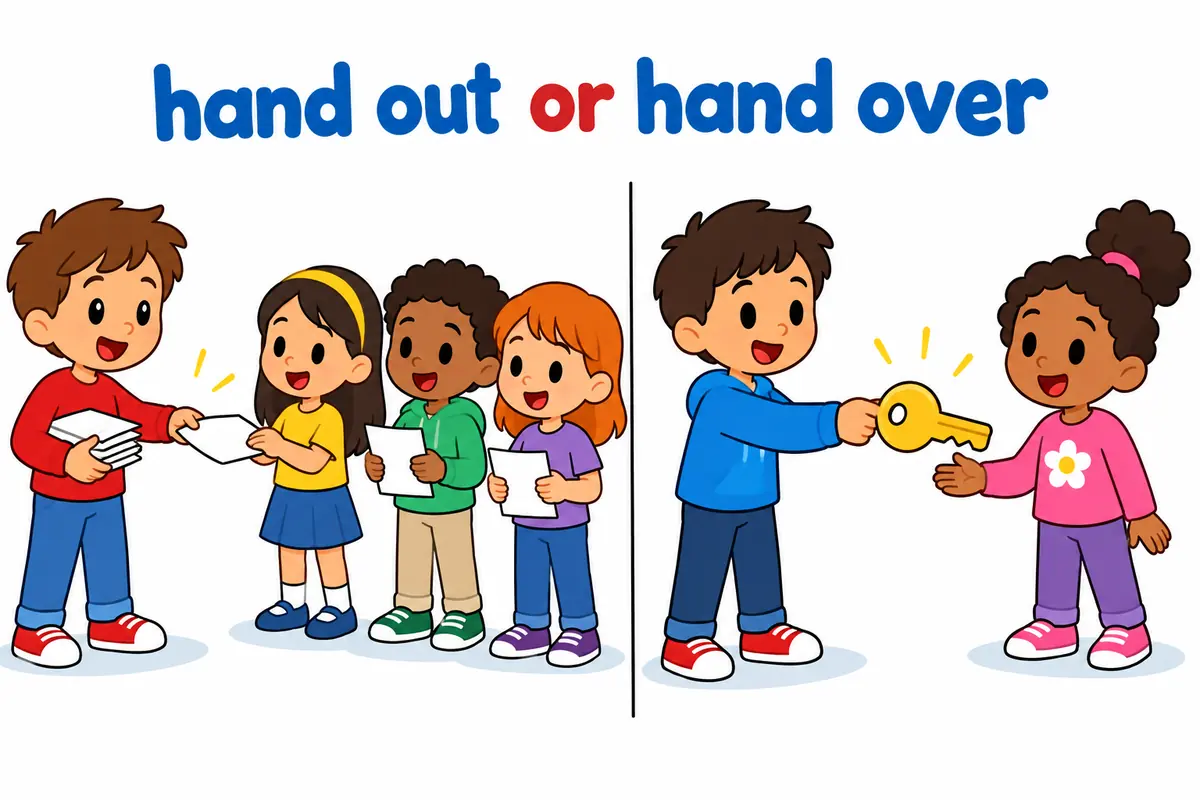
Hand out distributes one item to each person in a group, as when a teacher hands out worksheets. Hand over transfers a single thing or control to one recipient, as when you hand over your passport or a manager hands over the keys. The number of receivers decides which phrase fits.
Is hand out formal or informal?
Hand out is neutral and works in speech, classrooms and ordinary workplace writing. It sounds slightly casual in a policy or a news report, where distribute or issue is preferred. The meaning does not change, only the level of formality, so both are correct in the right setting.