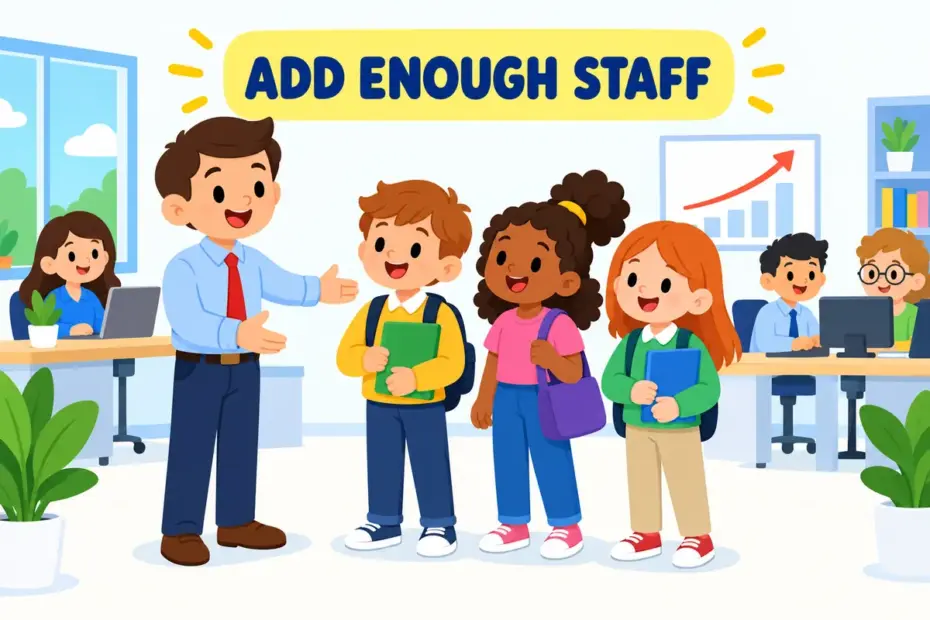
Staff up means to hire more employees so that a business, clinic or team has enough people to do its work. To use staff up in a sentence, keep the phrase together: “The clinic staffed up before winter.” It is usually intransitive, and when an object appears it sits between the verb and the particle.
Staff up at a glance
- Staff up is a phrasal verb made from the noun-turned-verb staff and the particle up.
- It means to reach an adequate number of employees, not simply to take on one person.
- The usual subjects are a company, a hospital, a school, a shop or a project team.
- Staff up belongs to business, management and news writing rather than to casual chat.
- The commonest error is treating it as a synonym for hire, which names a single appointment.
What does staff up mean?
Staff up is a phrasal verb meaning to increase the number of employees until a workplace is adequately covered, usually before a busy period or a new project. The Cambridge entry for staff up records the sense of providing people for a place. Where a business is opening one specific post, hire a driver is the exact verb, because staff up describes reaching a level rather than filling one slot.
| Sense | Plain meaning | Example sentence |
|---|---|---|
| Reach adequate staff | Hire until there are enough people | The café staffed up before the summer season. |
| Fill a workplace | Provide workers for a place or unit | Managers staffed up the new call centre in a month. |
| Prepare for demand | Add people ahead of a rush | The airline staffed up for the holiday travel peak. |
| Build a team | Recruit a group for a project | The studio staffed up the animation team first. |
One limitation is worth stating plainly. Staff up is not about the quality of a team and says nothing about training, so a department can be fully staffed up and still underperform. It also cannot describe replacing one leaver, which is simply a new hire, not a plan to grow.
How do you use staff up in a sentence?
The phrase is usually intransitive: the company staffed up says everything. When an object appears the phrase is separable, and standard usage prefers the object between verb and particle, as in staffed the ward up rather than staffed up the ward.
| Pattern | Example | What it signals |
|---|---|---|
| subject + staff up | The shop staffed up for the holidays. | The usual intransitive use. |
| staff up + for + event | They staffed up for the grand opening. | Names the reason for the growth. |
| staff + object + up | They staffed the new ward up quickly. | Separable use with the object inside. |
| staff up + with + people | The agency staffed up with freelance editors. | Names the kind of workers added. |
| be staffed up | We are fully staffed up for December. | Passive, reporting a completed level. |
For a single position, appoint a director is precise; staff up only makes sense when several roles are being filled to reach cover.
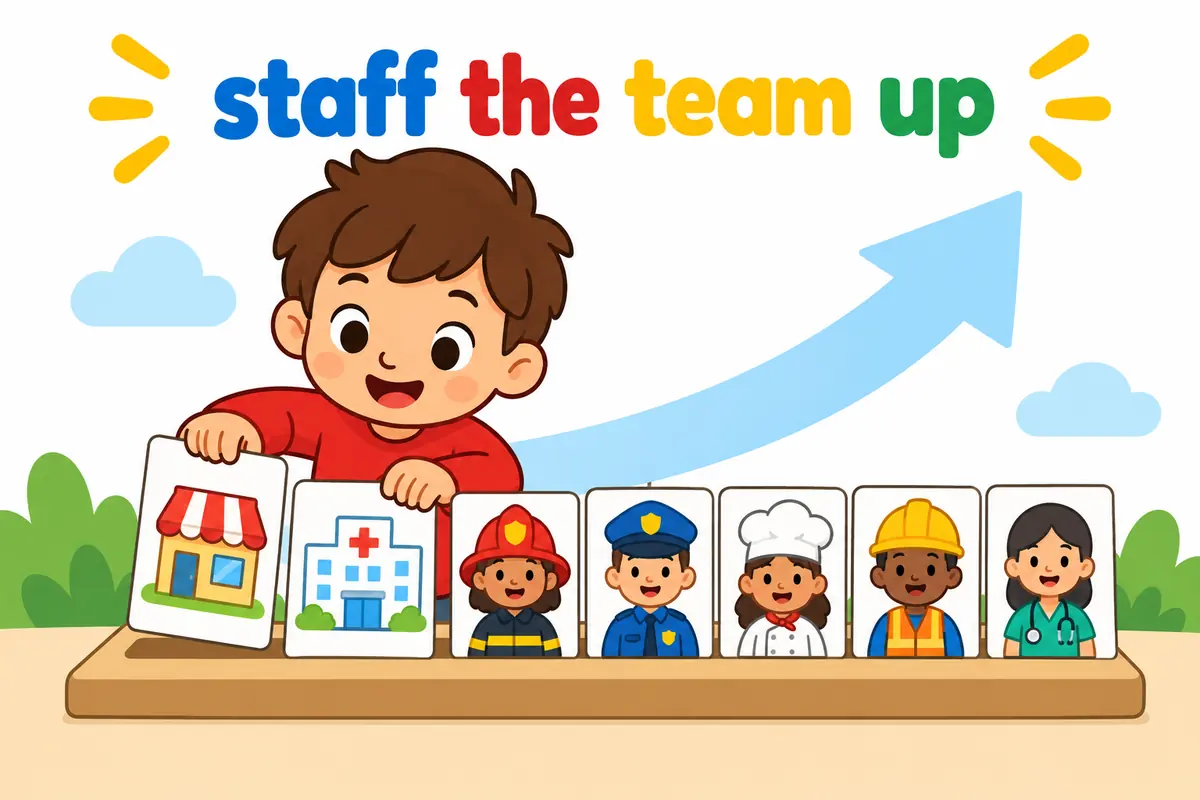
Staff up in a sentence: examples across contexts
The ten sentences below move the phrase from a corner shop to a hospital trust, and each one shows what triggered the hiring.
| Context | Example sentence | Why this works |
|---|---|---|
| Small business | The bakery staffed up before the Christmas rush. | Ties the hiring to a predictable peak. |
| Healthcare | The trust staffed its emergency department up for winter. | Uses the separable form with the object inside. |
| Workplace email | We need to staff up by two before the audit. | Names a number and a deadline. |
| News report | The airline staffed up as travel demand returned. | Links hiring to an external change. |
| Startup diary | The founders staffed up slowly to protect the culture. | Shows deliberate pacing rather than a rush. |
| School notice | The school staffed up with two extra teaching assistants. | The with-phrase names the roles added. |
| Sport report | The club staffed its medical team up after the injuries. | Explains the reason for the growth. |
| Restaurant review | The kitchen had clearly staffed up since our last visit. | Uses the passive to report a finished change. |
| Project plan | We will staff up once the funding is confirmed. | Conditions the hiring on a milestone. |
| Conference call | They staffed up fast and trained everyone later. | Adds a consequence in the same breath. |
Notice that only three of the ten sentences name a specific number or role. The rest treat staffing as a level to be reached, which is exactly what the phrase is for.
Staff up vs hire
The two are close but not interchangeable. Hire points to one person and one post, while staff up points to the total number of people and the cover they provide.
| Attribute | staff up | hire |
|---|---|---|
| Core meaning | Reach an adequate number of workers | Employ one person for a post |
| Scale | Several roles or a whole team | A single appointment |
| Typical subject | A company, department or clinic | A manager or business |
| Usual object | Often none, or a workplace | A named person or role |
| Register | Business and news writing | Neutral, everyday to formal |
Verdict: use hire when a single post is filled, and staff up when a workplace builds up to full cover. The matching verb in the other direction is lay off the crew, which removes people in a downturn.
Staff up vs scale up
A second confusion is with scale up, which appears in the same business headlines. Staff up is only about people; scale up is about the whole operation, including tools and processes.
| Attribute | staff up | scale up |
|---|---|---|
| Core meaning | Add employees | Grow the whole operation |
| What changes | Numbers of people | People, systems and capacity |
| Can happen alone | Yes, people are the focus | Usually includes hiring |
| Typical trigger | A busy season or new contract | A proven product or new market |
| Register | Business and management | Business, startup and tech writing |
Verdict: if only the payroll grows, say staff up; if the entire capacity grows, say scale up. A firm can staff up without scaling up, but a proper scale-up almost always includes staffing, and planners often expand the team before the systems catch up.
Word forms and grammar of staff up
Staff is regularly used as a verb, and its phrasal form is separable but usually appears without an object. The table also shows the passive, which is common in reports.
| Form | Part of speech | Example |
|---|---|---|
| staff up | base phrase | Small firms staff up before a launch. |
| staffs up | third person singular | The depot staffs up every autumn. |
| staffed up | past and past participle | They staffed up in June. |
| staffing up | present participle | We are staffing up for the season. |
| staffed | adjective | The office is well staffed now. |
The base verb employ two engineers names the act of taking people on, while staff up adds the target of full cover.
Common mistakes with staff up
- Incorrect:
We staffed up a new accountant.Correct: We hired a new accountant. Rule: Staff up means reaching a level, not taking on one person. - Incorrect:
The manager staffed up the ward.Correct: The manager staffed the ward up. Rule: When it takes an object, the separable phrase prefers the object between verb and particle. - Incorrect:
The team staffed up itself with two interns.Correct: The team staffed up with two interns. Rule: Staff up is intransitive in this sense; the with-phrase names the workers. - Incorrect:
They staffed up the project for finished.Correct: They staffed up to finish the project. Rule: A purpose takes to plus a verb, not for plus a past participle. - Incorrect:
The clinic was staff up by June.Correct: The clinic was staffed up by June. Rule: The passive needs the past participle staffed, not the base form.
Practice using staff up
Work through the seven items, then read the answers for the reason as well as the word.
- Fill the gap: The hotel ______ for the conference season.
- Choose the better word: After the interview, they decided to (staff up / hire) one receptionist.
- Correct the error: The shop staffed up a new manager.
- Build a sentence: use be staffed up about a busy hospital in December.
- Spot the register: which belongs in a company report — We staffed up the support desk, or We got loads more people on the desk?
- Rewrite with the object inside: They staffed up the new ward.
- Choose the better word: As orders doubled, the factory had to (staff up / scale up) its whole operation.
Answers
- staffed up — the hotel adds workers to cover a busy season.
- hire — one specific post is being filled, so hire is exact.
- The shop hired a new manager — a single appointment is a hire, not a staff-up.
- Model answer: The hospital was fully staffed up before the winter surge.
- We staffed up the support desk — a report keeps the phrase and avoids the loose loads more.
- They staffed the new ward up — the object sits between verb and particle.
- scale up — the whole operation grows, not only the payroll.
The bottom line
Use staff up in a sentence when a workplace hires enough people to reach full cover, usually before a busy period or a new project. Two details decide the tricky ones: the phrase is normally intransitive, and when an object appears it sits between staff and up. For a single appointment, recruit a designer is the precise choice, while staff up signals growth across several roles.
Frequently asked questions about staff up
Is staff up one word or two?
Staff up is two words, because up is a particle that belongs with the verb. It never becomes a single word in writing. When an object appears, the object may sit between the two parts, as in staff the team up.
Is staff up formal or informal?
Staff up sits in business, management and news writing, where planning headcount is routine. It is neutral rather than slang, so a company report and a newspaper both use it. In casual speech people are more likely to say take on more people.
Can you say staff up about one person?
Not usually. Staff up means adding people until a workplace has enough cover, so it implies several roles or a whole team. For one post, hire or appoint is the natural verb. Saying staffed up a new accountant sounds wrong because the phrase reports a level, not a single appointment.
What is a staff-up plan?
A staff-up plan is a written schedule for adding employees before a busy period or a new contract. It states how many people are needed, in which roles and by when. Managers use it to line up hiring with training and budget, so the workplace is ready on time.