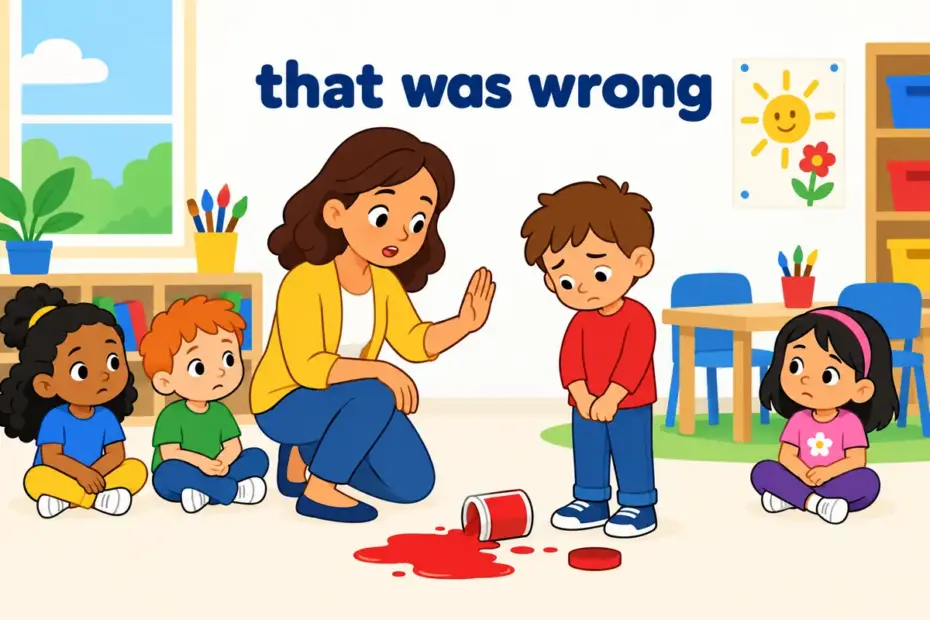
Tell off is a phrasal verb meaning to scold someone for doing something wrong. To use tell off in a sentence, put the person between tell and off: “the coach told the players off”. The verb always takes a person as its object, and a pronoun must sit in that middle position.
Tell off at a glance
- Tell off is a separable, transitive phrasal verb; its forms are tells off, told off and telling off.
- It means to scold or reprimand someone for a fault.
- The object is always a person, and it usually sits between tell and off.
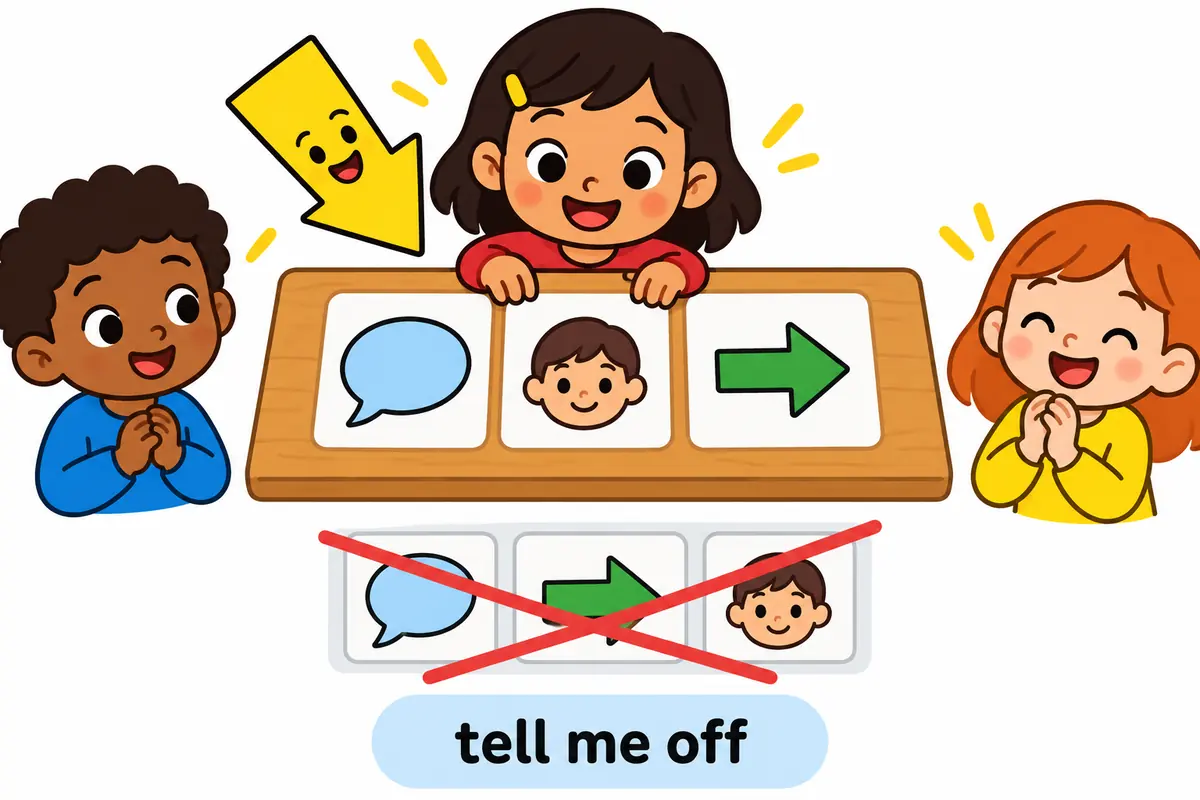
- A pronoun must split the verb and particle: tell me off, never tell off me.
- The noun is hyphenated, as in a telling-off.
- The register is informal but not slang, common in family and school talk.
What does tell off mean?
Tell off is a phrasal verb meaning to scold or reprimand someone for doing something wrong. The Cambridge entry for tell off records the reprimand sense, which is the one in daily use. A teacher reprimands rather than scolds when she wants a formal tone, but the phrasal verb carries the same idea with less ceremony.
| Sense | Plain meaning | Example sentence |
|---|---|---|
| Scold someone | Reprimand a person for a fault | The teacher told him off for being late. |
| Assign a duty | Allot a task or post, as in the armed forces | The sergeant told the recruits off for guard duty. |
One limitation is worth stating plainly. Tell off is not the same as tell on, and it does not mean to argue back. It describes one person correcting another, and the second sense about assigning duties is rare and dated, so learners can set it aside.
How do you use tell off in a sentence?
The verb is separable and transitive, so it always takes a person as its object, and the object usually stands between tell and off. A pronoun must take that middle position, because off is a particle that cannot accept a pronoun after it. The passive is common in reporting.
| Pattern | Example | What it signals |
|---|---|---|
| tell + person + off | The coach told the players off. | Separable; the object in the middle is the usual order. |
| tell + off + person | She told off the whole class. | Object after the particle also occurs, less often. |
| tell + pronoun + off | Mum told me off. | A pronoun must take the middle position. |
| be told off | He was told off for the mistake. | Passive, common in reporting and school writing. |
| tell off for + noun or gerund | They were told off for shouting. | For names the fault that caused the reprimand. |
Because the object is a person, a sentence with no object cannot use tell off, so the verb needs a name, a noun or a pronoun before it makes sense.
Tell off in a sentence: examples across contexts
Tell off belongs to homes, schools and workplaces, and the ten sentences below show how naturally the person lands in the middle of the verb. Each row names who did the scolding and who received it.
| Context | Example sentence | Why this works |
|---|---|---|
| Classroom | The teacher told the boys off for talking during the test. | Names the fault after for and the people in the middle. |
| Home | My grandmother told me off for leaving the gate open. | Pronoun in the middle, which every speaker uses. |
| Sports | The referee told the captain off for arguing. | Shows authority and a specific misdeed. |
| Workplace | The manager told the team off for missing the deadline. | Formal setting with a factual reason. |
| News report | The minister was told off by her own party for the remark. | Passive, which keeps the focus on the minister. |
| Conversation | Dad will tell you off if you come home late. | Future warning in everyday register. |
| Driving lesson | The instructor reprimanded and told the learner off for speeding. | Pairs the formal synonym with the phrasal verb. |
| Volunteering | She was told off for being late even though the bus broke down. | A passive clause with an unfair reason, which readers recognise. |
| Fiction | The headmaster told off the whole hall before assembly. | A public scolding, which raises the stakes. |
| Diary | I told myself off for forgetting the appointment. | A reflexive object between tell and off. |
Only the last row uses a reflexive, which shows how flexible the middle position is. The word order stays the same whether the object is a name, a noun phrase or a pronoun. Because that object is a person, the passive is common in news writing, where the person doing the scolding is unknown or unimportant.
Tell off vs tell on
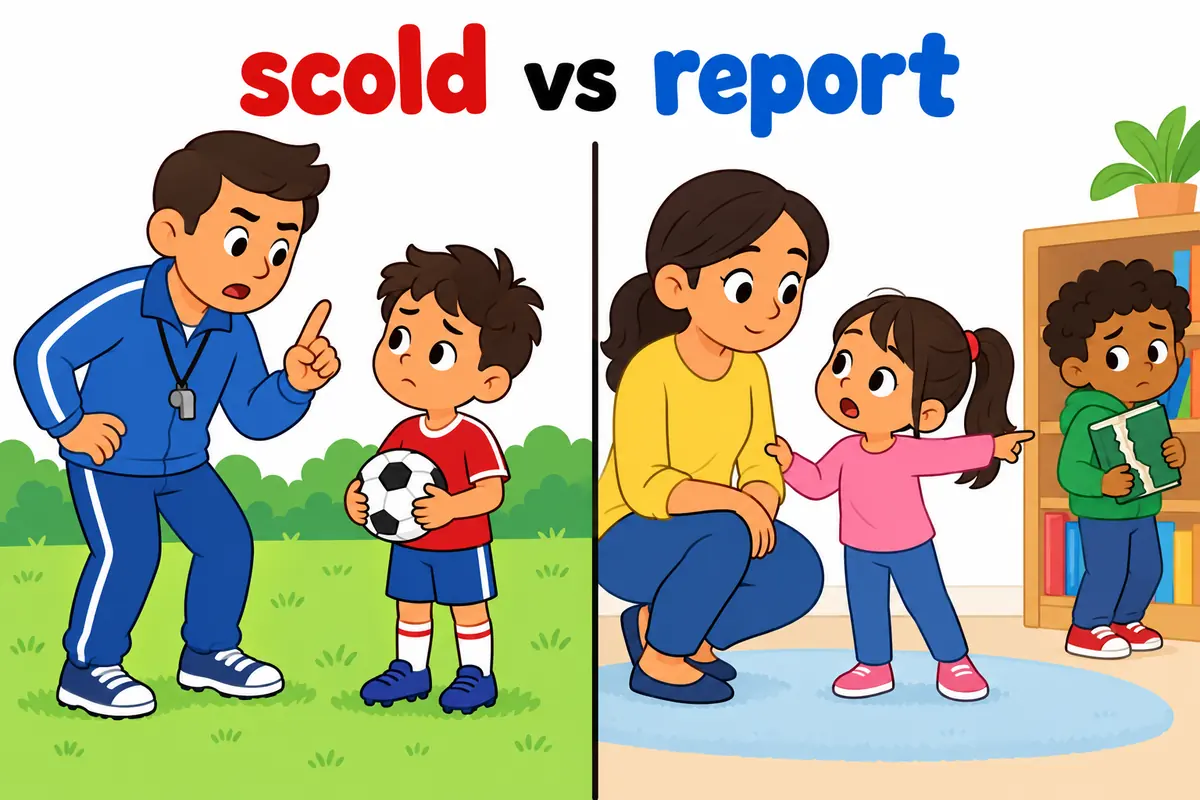
Tell off and tell on share the verb tell but point in opposite directions. Tell off corrects the person who did wrong; tell on reports that person to someone in charge.
| Attribute | tell off | tell on |
|---|---|---|
| Meaning | Scold a person for a fault | Report a person to an authority |
| Who acts | The person with authority | Anyone who saw the misdeed |
| Direction | Corrects the wrongdoer directly | Reports the wrongdoer to another |
| Object | The person being scolded | The person being reported |
| Register | Informal, common in families and schools | Informal, common among children |
| Example | The coach told him off for lateness. | His sister told on him for lateness. |
Verdict: use tell off when authority corrects the offender face to face, and tell on when the wrongdoer is reported to somebody else, because the two verbs describe completely different actions. A mild correction is closer to a chide, while a long public attack is closer to a berating.
Word forms and grammar of tell off
Tell off inflects through tell, and the noun takes a hyphen. The table also lists a related verb of scolding and a phrasal verb built on the same particle.
| Form | Part of speech | Example |
|---|---|---|
| tell off | phrasal verb, base | Do not tell him off in front of the class. |
| tells off | phrasal verb, third person singular | She tells the dog off for jumping up. |
| told off | phrasal verb, past and participle | The captain told the team off at half time. |
| telling off | phrasal verb, present participle | He is telling off the new apprentice again. |
| telling-off | noun | She gave the driver a firm telling-off. |
| rebuke | verb, formal | The report rebuked the department for delays. |
The particle off also builds brush off, which means to dismiss someone, so the same word can mark a reprimand in one verb and a cold refusal in another. The base verb tell keeps its own meanings of saying and informing, so the phrasal verb is only one branch of a busy word.
Common mistakes with tell off
- Incorrect:
She told off me for the noise.Correct: She told me off for the noise. Rule: A pronoun object must sit between tell and the particle off. - Incorrect:
The teacher told the student on for cheating.Correct: The teacher told the student off for cheating. Rule: Off means scold; on means report to an authority. - Incorrect:
He told off to his mother about the fight.Correct: He told on his brother after the fight. Rule: Reporting someone takes tell on, not tell off. - Incorrect:
I was told off by my boss to be late.Correct: I was told off by my boss for being late. Rule: For plus a gerund names the fault; to plus an infinitive does not. - Incorrect:
My telling off was unfair.Correct: My telling-off was unfair. Rule: The noun is hyphenated, while the verb is written as two separate words.
Practice using tell off
Work through the seven items, then read the reasoning rather than only the answer.
- Fill the gap: The referee ______ the goalkeeper off for wasting time.
- Choose the better word: When her brother broke the vase, she (told him off / told on him) to their mother.
- Correct the error: The teacher told off them for arriving late.
- Build a sentence: use tell off about a manager who corrects an intern politely.
- Rewrite in the passive: The head teacher told the boys off for running in the corridor.
- Spot the register: which belongs in a school newsletter, pupils were told off for damaging the fence, or a few pupils got a right telling-off, honestly?
- Change the noun: The coach gave the striker a warning. Rewrite it with telling-off.
Answers
- told — the past tense matches the sentence and the object sits between told and off.
- told on him — she reported her brother to their mother, which is tell on.
- The teacher told them off for arriving late — the pronoun must come before off.
- Model answer: The manager told the intern off quietly for missing the client’s call.
- The boys were told off by the head teacher for running in the corridor — the passive keeps be plus told off together.
- Pupils were told off for damaging the fence — a newsletter keeps a measured, formal tone.
- The coach gave the striker a telling-off — the hyphenated noun replaces the warning.
The bottom line
Use tell off in a sentence when somebody with authority scolds a person for a fault, and keep that person between tell and off. Two details decide most sentences: the object is always a person, and a pronoun must split the verb and particle. Where the meaning is reporting someone to an authority, tell on is the right verb instead.
Frequently asked questions about tell off
Is tell off one word or two?
The verb is written as two words, tell off, and the noun is hyphenated as telling-off. You would write the coach told her off after the match for the verb, and she gave the player a telling-off for the noun. Keeping that distinction avoids the most common spelling slip.
Does tell off always need an object?
Yes. Tell off is transitive, so it needs a person as its object, as in the teacher told the class off. A sentence such as the teacher told off does not work, because a reader still asks who was scolded. Add a name, a noun or a pronoun to complete the verb.
Is tell off formal?
Tell off is informal but not slang, and it sits comfortably in family, school and sports talk. A formal report would use reprimand, rebuke or censure instead. The passive he was told off appears in news writing, where it keeps a neutral surface even though the verb stays conversational.
What is the noun form of tell off?
The noun is telling-off, written with a hyphen, as in the driver got a telling-off from the inspector. It names the scolding itself rather than the act of delivering it. The hyphen is required, because telling off without one reads as the continuous form of the verb.