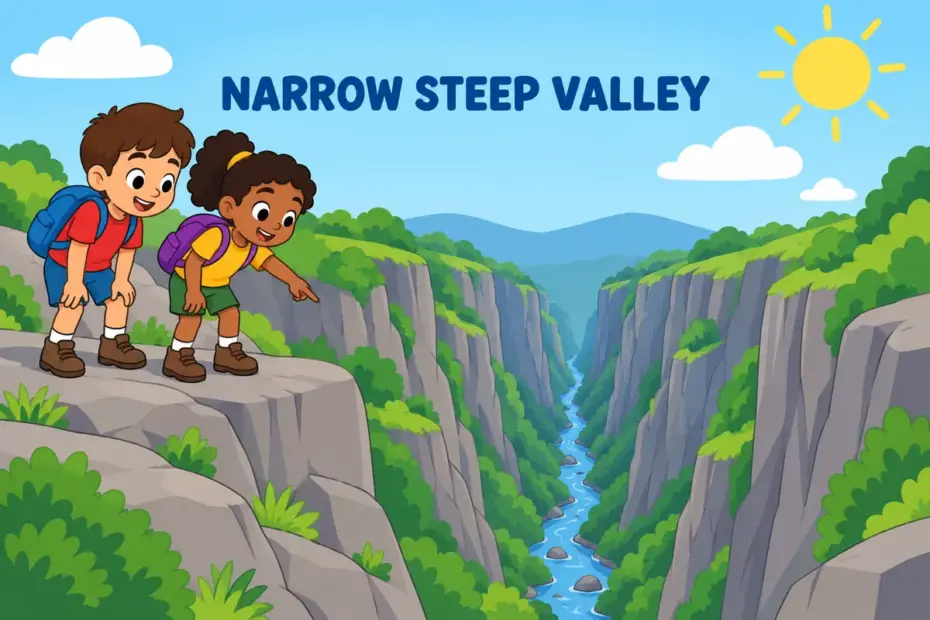
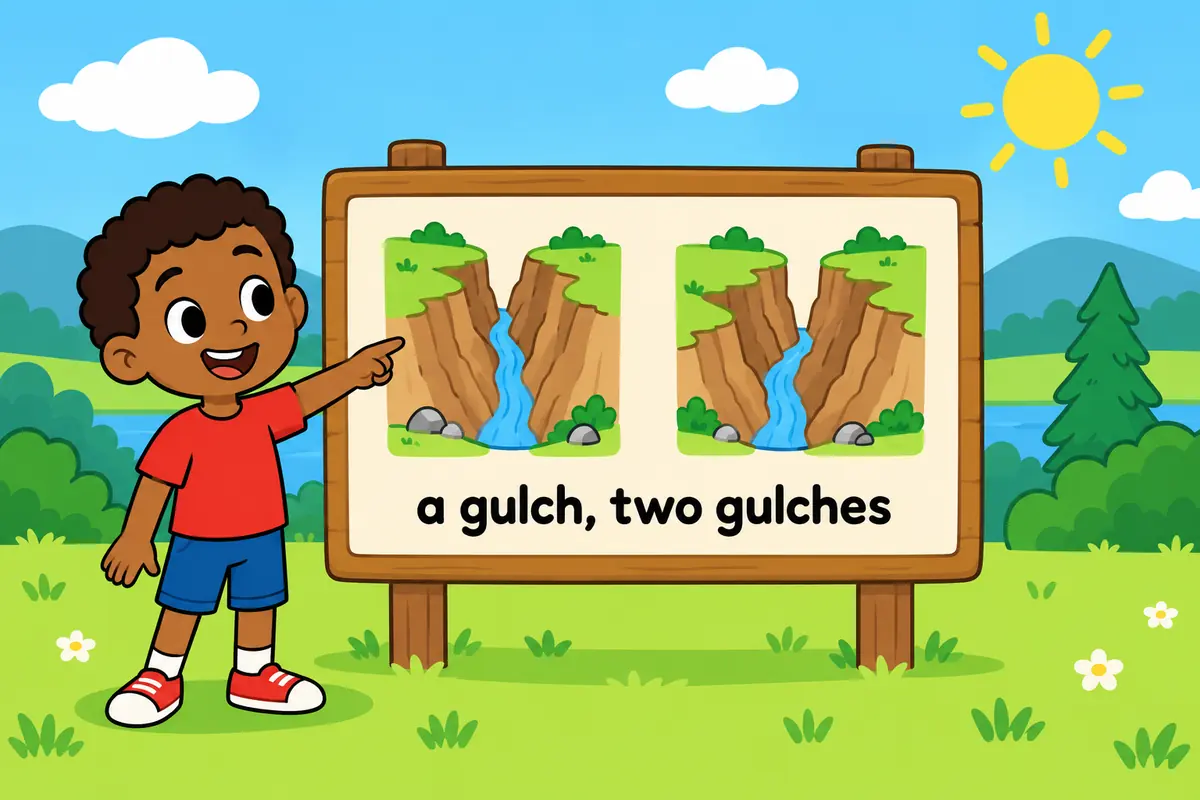
A gulch is a narrow, steep-sided valley cut by a stream, smaller than a canyon and rougher than a ditch. To use gulch in a sentence, treat it as a countable noun: “The trail dropped into a dry gulch.” The word belongs to landscape description, so it usually appears with a place phrase or a verb of walking.
Gulch at a glance
- Gulch is a countable noun; the plural is gulches.
- It means a narrow, steep-sided valley, often with a stream at the bottom.
- It is smaller than a canyon and more enclosed than a valley.
- The word is common in descriptions of the American West in fiction and travel writing.
- The commonest error is the plural gulchs, which drops the -es.
What does gulch mean?
A gulch is a narrow, steep-sided valley or ravine, usually carved by running water and often dry for much of the year. The Cambridge entry for gulch records this single core sense, and the key features are the narrow floor and the steep walls. A wider, grander feature of the same kind is a canyon in the desert, while a broader open depression is a valley below the ridge.
The same word covers two states of the same feature. A wet gulch carries a stream that can swell in minutes after rain, while a dry gulch is a stony channel that may stay empty for months. Writers signal which one they mean with a single adjective, so the noun rarely needs extra description.
One limitation is worth stating plainly. Gulch is not a general word for any hole or ditch, and it is not a verb. A shallow roadside channel is a ditch, and a wide basin is a valley; the gulch is specifically narrow, steep and stream-cut.
How do you use gulch in a sentence?
Give the gulch a verb of movement or a position phrase, because the word describes a place you enter, cross or look down into. The five patterns below cover most natural sentences, and the preposition in is the one that appears most often.
| Pattern | Example | What it signals |
|---|---|---|
| a / the + gulch | A dry gulch ran behind the cabin. | Introduces one countable landform. |
| into / down + a gulch | The cattle wandered down into a shaded gulch. | Movement into the narrow floor. |
| the bottom of the gulch | A thin stream trickled along the bottom of the gulch. | Fixes the exact position inside it. |
| gulches (plural) | Spring rain filled the gulches within an hour. | Several features at once; note the -es plural. |
| gulch as a place name | They camped near Deadwood Gulch for the night. | Names a specific, mapped location. |
Two collocations are worth learning as whole phrases. At the mouth of the gulch means where the narrow walls open onto flatter ground, and at the head of the gulch means the highest point where the channel begins. Both sound native, while the gulch water sounds translated; English prefers the water in the gulch or the stream along the gulch floor.
Gulch in a sentence: examples across contexts
The noun keeps one meaning but changes company. The nine sentences below move from a hiking guide to a western novel, and each one makes the narrow, steep shape clear.
| Context | Example sentence | Why this works |
|---|---|---|
| Hiking guide | The path climbs steeply out of the gulch after the second bend. | Movement and a landmark show the enclosed shape. |
| Travel writing | Pines crowd the walls of the gulch, shutting out the afternoon sun. | Describes the steep sides rather than the floor alone. |
| Western novel | A rider picked his way along the rocky floor of the gulch. | Uses the genre where the word is most at home. |
| Geography lesson | Water cut the gulch through soft rock over many seasons. | Names the cause and the narrow result. |
| News report | Rescuers reached the stranded hikers in a remote gulch by midday. | Treats the gulch as a precise location. |
| Nature journal | Two deer slipped into the shadowed gulch and vanished. | The quick exit suits the narrow, hidden ground. |
| Mining history | Prospectors worked the gravel at the head of the gulch. | Fixes a specific point within the feature. |
| Fiction, weather | Rain turned the quiet gulch into a rushing brown torrent. | Shows how fast a dry channel can fill. |
| Conversation | We picnicked at the mouth of the gulch, where the shade was deep. | An everyday use with a clear landmark. |
| Ranching | Snowmelt ran off the gulches and swelled the creek below. | Shows the plural and the seasonal water. |
| Film description | The camera follows a rider up a sunlit gulch at dawn. | Places the feature inside a wide western shot. |
| Geology field notes | The gulch exposes a clean band of pale sandstone. | Treats the steep cut as a natural cross-section. |
Gulch vs ravine, gorge and canyon
Gulch sits in a family of landform words, and the difference is mostly size and steepness. The words overlap enough that a single wrong choice can make a landscape sound too grand or too small. A ravine on the hillside is a close cousin; a gorge is deeper and often has a river; a canyon is the largest of the group.
| Attribute | gulch | ravine | canyon |
|---|---|---|---|
| Typical size | Small and narrow | Small to medium | Very large |
| Sides | Steep, often rocky | Steep, often wooded | Sheer and high |
| Usual water | A stream, often seasonal | A stream or brook | A river |
| Common region | American West in writing | General English | Dry plateaus |
| Register | Descriptive and literary | Neutral | Neutral |
A crevice in the rock is a narrow crack rather than a valley with a floor, so it is not a synonym at all. Verdict: choose gulch for a small, steep, stream-cut valley in western landscapes, ravine for a general steep-sided hollow, and canyon only when the feature is genuinely vast.
Word forms and grammar of gulch
Gulch is a regular noun that ends in the -ch sound, so the plural adds -es. It has no verb form, and writers who need one use scramble, wade or climb instead. The table also marks the plural spelling learners most often get wrong.
| Form | Part of speech | Example |
|---|---|---|
| gulch | noun, singular | The gulch was dry by midsummer. |
| gulches | noun, plural | Three gulches feed the reservoir. |
| gulch | noun, before another noun | The gulch trail is steep and loose. |
| gulch | noun, in a proper name | We stopped at Dry Gulch Junction. |
| gulchs | non-standard plural | The correct plural is gulches, never gulchs. |
Because the noun already contains the idea of a cut, adding deep or narrow in front of it is usually redundant, though a writer may keep one adjective for rhythm. The stronger habit is to let a verb such as wound, carved or drained carry the sense of depth and origin.
Common mistakes with gulch
- Incorrect:
The gulchs were full after the storm.Correct: The gulches were full after the storm. Rule: Nouns ending in the -ch sound take -es in the plural. - Incorrect:
A gulch is wider and shallower than a canyon.Correct: A gulch is narrower and shallower than a canyon. Rule: A gulch is narrow and steep, not wide. - Incorrect:
We gulched down the loose slope.Correct: We scrambled down the loose slope. Rule: Gulch is a noun and is never used as a verb. - Incorrect:
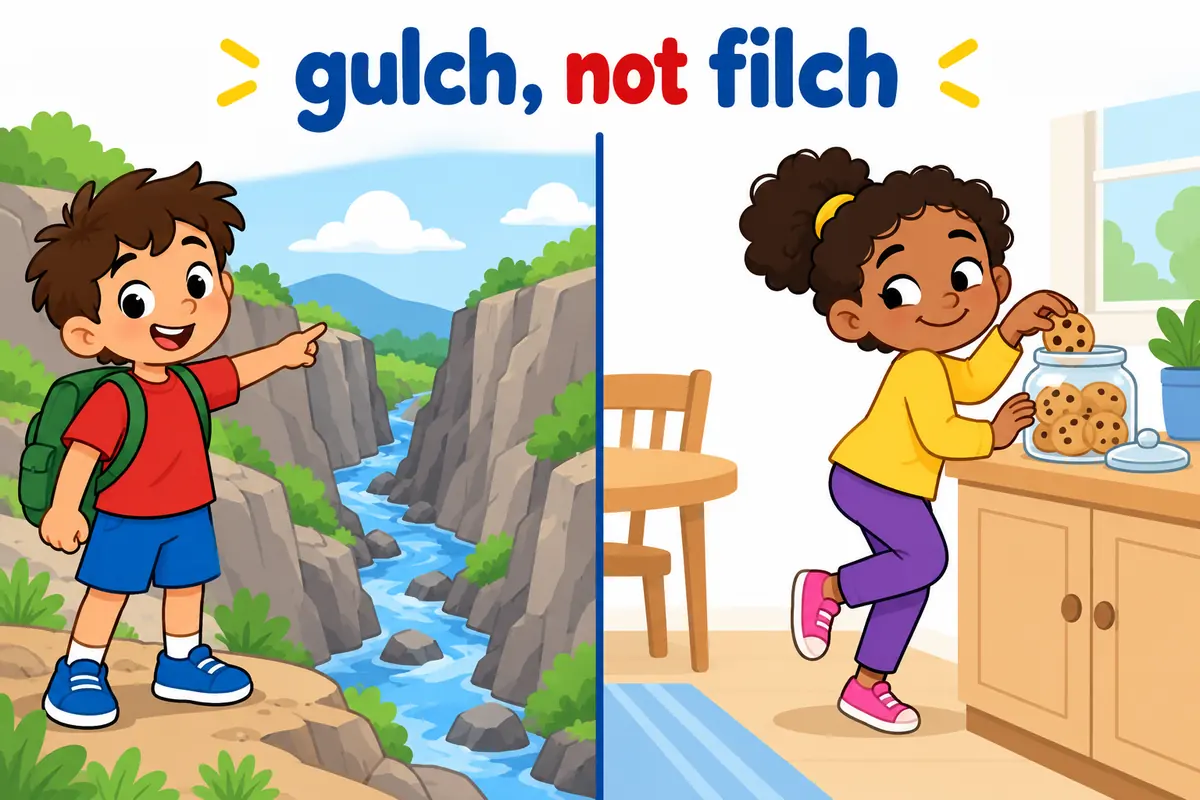
The prospector tried to gulch the gold.Correct: The prospector tried to filch the gold. Rule: Filch means to steal; gulch is a landform.
Practice using gulch
Work through the six items, then read the reasoning rather than only the answer.
- Fill the gap: The stream had worn a deep ______ through the soft red rock.
- Choose the better word: From the ridge we looked down into a narrow (gulch / valley) with sheer walls.
- Correct the error: Two gulchs crossed the old mining road.
- Build a sentence: use gulch about a dry channel on a ranch.
- Spot the register: which belongs in a geography essay — the gulch was cut by seasonal water, or the gulch was super cool?
- Rewrite in the plural: A gulch can flood without warning.
- Fill the gap: The old trail crossed three narrow ______ before it reached the mine.
- Choose the better word: Meltwater had carved a small, steep (gulch / crevice) beside the track.
Answers
- gulch — the steep, stream-cut shape is exactly what the noun names.
- gulch — sheer walls and a narrow floor point to the smaller feature.
- Two gulches crossed the old mining road — the plural adds -es.
- Model answer: A dry gulch ran along the fence line for most of the summer.
- The gulch was cut by seasonal water — an essay avoids slang such as super cool.
- Gulches can flood without warning — the plural takes the -es ending.
- gulches — three separate valleys need the plural, again with -es.
- gulch — a crevice is a crack, while this feature has a floor and walls.
The bottom line
Use gulch in a sentence when you describe a small, narrow, steep-sided valley cut by water, and give it a verb of movement or a position phrase. The two facts that decide most sentences are these: the noun is countable, so it needs a, the or the plural gulches, and it is smaller than a canyon, so a gorge with a river or canyon is the wrong word for a broad, deep feature. Let a verb of movement carry the shape, and the noun will do the rest of the work.
Frequently asked questions about gulch
Is gulch used only in American English?
Gulch is most familiar from American writing about the West, where it names a small, steep, stream-cut valley. British writers usually reach for ravine or gully instead. The word is understood everywhere, but its natural home is a western landscape or a story set there.
What is the plural of gulch?
The plural is gulches, because the noun ends in the -ch sound and adds -es. The spelling gulchs is a common mistake and is not standard. The singular and plural look the same as the base word in compound place names such as Dry Gulch.
How is a gulch different from a ditch?
A ditch is a narrow channel that people dig, often beside a road or field, while a gulch is a natural valley cut by running water with steep sides. A gulch is larger and wilder than a ditch, and it usually carries a seasonal stream rather than drainage from a roadside.
Can gulch be used as a verb?
No. Gulch is only a noun in standard English, so a sentence such as they gulched the slope is not correct. Writers who need an action use scrambled, waded or climbed. The nearby verb that sounds similar is trench a field, which means to dig a long cut.