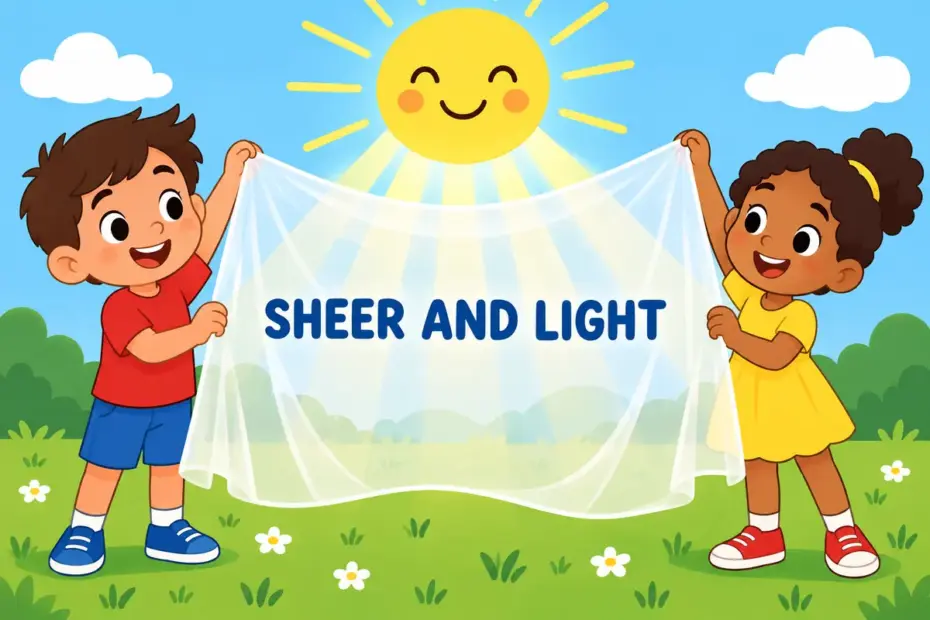
Diaphanous describes a material that is light, delicate and softly see-through, the quality of gauze, thin silk or a butterfly wing. To use diaphanous in a sentence, place it before the noun it describes: “a diaphanous curtain”. The word suggests beauty and fragility rather than simply allowing light through.
Diaphanous at a glance
- Diaphanous is an adjective meaning light, delicate and translucent.
- It is almost always attributive, standing directly before its noun.
- The usual nouns are gown, curtain, veil, mist, wing and silk.
- The register is literary and descriptive, at home in fashion and nature writing.
- The commonest error is using it for hard, clear materials such as glass.
What does diaphanous mean?
Diaphanous is an adjective meaning light, delicate and translucent, especially of a fine fabric, a mist or a wing. The Cambridge entry for diaphanous gives the sheer, transparent sense, and the word adds a judgement to it: the thing is not merely see-through but beautiful and fragile. A related adjective, translucent, describes light passing through without the same praise, and sheer keeps the fabric sense without the poetry.
| Sense | Plain meaning | Example sentence |
|---|---|---|
| Sheer fabric | Very thin cloth that lets light through softly | She wore a diaphanous scarf over her shoulders. |
| Delicately transparent nature | Mist, wings or water that look almost unreal | A diaphanous mist hung over the lake at dawn. |
| Light and insubstantial, figurative | Something faint or barely there | The score leaves a diaphanous trace of the old melody. |
One limitation deserves stating plainly. Diaphanous is not a neutral technical term, so it is the wrong choice for clean glass, clear plastic or a bright window, where transparent is exact. It also cannot do the work of flimsy, which criticises weakness: a flimsy excuse is badly made, while a diaphanous one would sound like a compliment to its delicacy.
Etymology is worth a cautious note rather than a confident claim. The word has travelled through Latin and Greek with the sense of showing through, and modern writers use it for something glimpsed rather than plainly seen. What matters for a sentence is the result: the material reveals a soft impression of whatever lies behind it, never a sharp outline.
How do you use diaphanous in a sentence?
Diaphanous behaves like a long descriptive adjective: it sits before the noun, grades with more, and only rarely follows a linking verb, where it reads as deliberately literary. The nouns it prefers are few and specific, which is why a wrong noun is the surest sign that a writer has borrowed the word.
| Pattern | Example | What it signals |
|---|---|---|
| diaphanous + gown or dress | She chose a diaphanous gown for the ceremony. | Fashion writing; the fabric is fine and glowing. |
| diaphanous + curtain or veil | Light fell through a diaphanous curtain. | Interiors and weddings; soft filtered light. |
| diaphanous + mist or cloud | A diaphanous cloud crossed the moon. | Nature writing; thin and half-transparent. |
| diaphanous + wings | The moth lifted its diaphanous wings. | Biology described with a literary eye. |
| more or most diaphanous | Her later veils were even more diaphanous. | Grading with more, never diaphanouser. |
| linking verb + diaphanous | At sunset the veil looked diaphanous. | Rare predicative use, strongly literary. |
Two near neighbours are useful for comparison. Gauzy fabric is loosely woven and slightly coarse, while gossamer thread is impossibly fine, and diaphanous sits between them, delicate but still visible as cloth.

Diaphanous in a sentence: examples across contexts
Diaphanous travels easily from a fashion page to a nature diary, but it always brings the same soft admiration. The eleven sentences below keep the word beside a noun it genuinely suits.
| Context | Example sentence | Why this works |
|---|---|---|
| Fashion writing | The model crossed the runway in a diaphanous robe of pale silk. | Names a real fabric, which the word assumes. |
| Poetry | A diaphanous dusk settled over the orchard. | Applies the adjective to atmosphere, a literary move. |
| Nature diary | Dragonflies hovered on diaphanous wings above the reeds. | Wings are a natural, almost fixed collocation. |
| Interior design | They hung a diaphanous panel between the rooms to keep the light. | Names a practical object that filters daylight. |
| Photography | He shot the dancer behind a diaphanous sheet. | The material becomes a lighting tool, not just decoration. |
| Wedding blog | She chose a diaphanous veil that fell to her waist. | Veils are the most familiar example of the word. |
| Science writing | The insect’s diaphanous casing crumbled at a touch. | Notes the fragility as well as the transparency. |
| Conversation | I would call that scarf diaphanous rather than merely thin. | Uses the word in speech but flags it as a careful choice. |
| Art criticism | The painter builds a diaphanous surface from many thin glazes. | Transfers the idea from cloth to paint. |
| Product description | A diaphanous cotton throw that lightens a heavy armchair. | Justifies the word with a specific material and effect. |
| Historical costume | Portraits show courtiers in diaphanous linen against dark walls. | Anchors the word in a real historical setting. |
| Film review | The final shot drifts through a diaphanous haze of dust and light. | Extends the word to a filmed atmosphere. |
Every row names a thing that light can pass through softly, which is the boundary the word will not cross. A brick wall, however beautiful, will never be diaphanous.
Diaphanous vs translucent
Diaphanous and translucent both describe light passing through a material, but only one of them is a compliment. Translucent is a neutral description that a scientist, a glassmaker or a builder can use, while diaphanous adds delicacy, fineness and beauty.
| Attribute | diaphanous | translucent |
|---|---|---|
| Core meaning | Light, fine and softly see-through | Allowing light through, without clarity |
| Material | Thin fabric, mist, wings | Glass, plastic, stone, paper |
| Register | Literary and descriptive | Neutral and technical |
| Judgement | Beautiful and fragile | None at all |
| Typical sentence | A diaphanous veil floated past her face. | The lampshade is made of translucent glass. |
Other close words grade the idea further. A filmy layer is thin and slightly hazy, and transparent means fully clear, with nothing hidden. Verdict: choose translucent for a factual statement about light, transparent for perfect clarity, and diaphanous when the material itself is delicate and lovely. A useful test is to ask whether the sentence would survive in a laboratory notebook; if it would, translucent belongs there, while diaphanous is doing work that no neutral term can do.
Word forms and grammar of diaphanous
Diaphanous is an adjective, and its family is small. The noun diaphaneity is rare but real, and the two spellings below it should never be copied into a sentence.
| Form | Part of speech | Example |
|---|---|---|
| diaphanous | adjective | A diaphanous veil covered the window. |
| diaphanously | adverb, rare | The curtain hung diaphanously to the floor. |
| diaphaneity | noun | The diaphaneity of the silk surprised the buyer. |
| diaphanousness | noun, rare | Critics praised the diaphanousness of the final scene. |
| diaphonous | non-standard adjective | Marked as wrong; use diaphanous. |
| diaphaneous | non-standard adjective | Marked as wrong; use diaphanous. |
Common mistakes with diaphanous
- Incorrect:
The shop sells diaphanous glassware.Correct: The shop sells delicate glassware. Rule: Diaphanous suits fine fabric, mist and wings, not hard glass. - Incorrect:
He gave a diaphanous excuse.Correct: He gave a flimsy excuse. Rule: For weakness use flimsy; diaphanous means light and see-through. - Incorrect:
A diaphonous veil hung over the doorway.Correct: A diaphanous veil hung over the doorway. Rule: The spelling keeps ph and drops the extra o, so it is diaphanous. - Incorrect:
The window was diaphanous, so we saw the garden clearly.Correct: The window was transparent, so we saw the garden clearly. Rule: Clear glass is transparent; diaphanous implies a soft, fine material. - Incorrect:
The curtain was diaphanouser than the panel.Correct: The curtain was more diaphanous than the panel. Rule: Long adjectives grade with more, not with an -er ending.
Practice using diaphanous
Work through the seven items, then read the reasons rather than only the answers.
- Fill the gap: A ______ mist covered the field before sunrise.
- Choose the better word: The lamp shade is made of (diaphanous / translucent) glass.
- Correct the error: She wore a diaphonous veil at the wedding.
- Build a sentence: use diaphanous + wings about a dragonfly by a pond.
- Spot the register: which fits a nature diary — a diaphanous veil of rain drifted across the valley, or the rain was see-through enough?
- Rewrite with more: The second curtain is diaphanous. Compare it with the first using more.
- Fix the false friend: His argument was diaphanous and fell apart.
Answers
- diaphanous — the mist is thin and softly translucent, which is the nature sense.
- translucent — glass is a technical material that takes the neutral adjective.
- She wore a diaphanous veil at the wedding — the correct spelling is diaphanous.
- Model answer: A dragonfly skimmed the pond on diaphanous wings.
- A diaphanous veil of rain drifted across the valley — a nature diary welcomes the literary adjective.
- Model answer: The second curtain is more diaphanous than the first.
- Corrected: His argument was flimsy and fell apart — diaphanous cannot mean weak.
The bottom line
Use diaphanous in a sentence for something light, fine and softly see-through, and keep it beside a noun such as gown, veil, mist or wings. The two nuances that decide most sentences are these: the word praises delicacy, so it cannot describe hard, clear materials, and it is literary rather than technical, so translucent and transparent remain the neutral alternatives. Because the word is literary, one appearance in a paragraph is usually enough, and repetition quickly makes it precious. For a plainer sentence, delicate is the safest substitute.

Frequently asked questions about diaphanous
Is diaphanous the same as transparent?
No. Transparent means fully clear, so you can see straight through with no distortion. Diaphanous means light, fine and softly see-through, and it usually describes fabric, mist or wings rather than glass. A diaphanous curtain filters the light; a transparent window lets it pass untouched.
What kinds of things can be diaphanous?
Diaphanous suits a small set of nouns: gowns, veils, curtains, scarves, mist, clouds and insect wings. It can also describe a faint trace of something in art or music. It does not suit hard surfaces, heavy cloth or anything that blocks light completely.
Is diaphanous a formal word?
Diaphanous is literary and descriptive rather than formal in the legal sense. It appears often in fashion, wedding and nature writing, and it can sound precious in ordinary conversation. In a technical context, translucent or sheer is usually the better choice because it carries no judgement.
What is the noun form of diaphanous?
The noun is diaphaneity, meaning the quality of being light and translucent. A rarer noun, diaphanousness, also appears in criticism. Both are uncommon, so most sentences use the adjective and let a noun such as veil or mist carry the meaning instead.