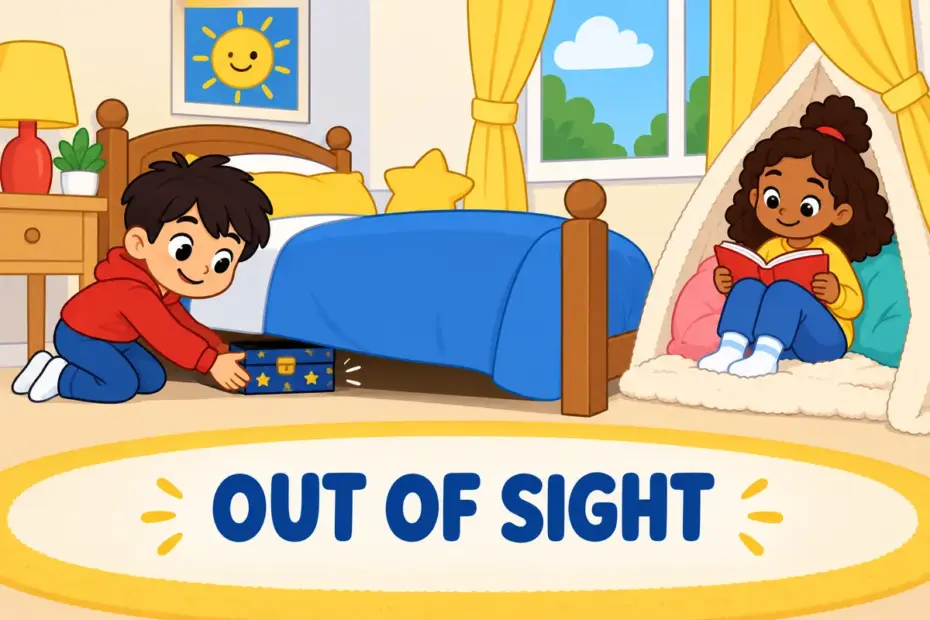
Hide away means to keep someone or something out of sight, or to go somewhere quiet to be alone. Use hide away with an object you are storing, as in she hid the letters away, or without one, as in the family hid away for the weekend. It is separable when it takes an object.
Hide away at a glance
- Hide away is a phrasal verb with both an intransitive and a transitive use.
- The intransitive sense means to go somewhere private, as in they hid away in the attic.
- The transitive sense means to store something out of sight, as in he hid the money away.
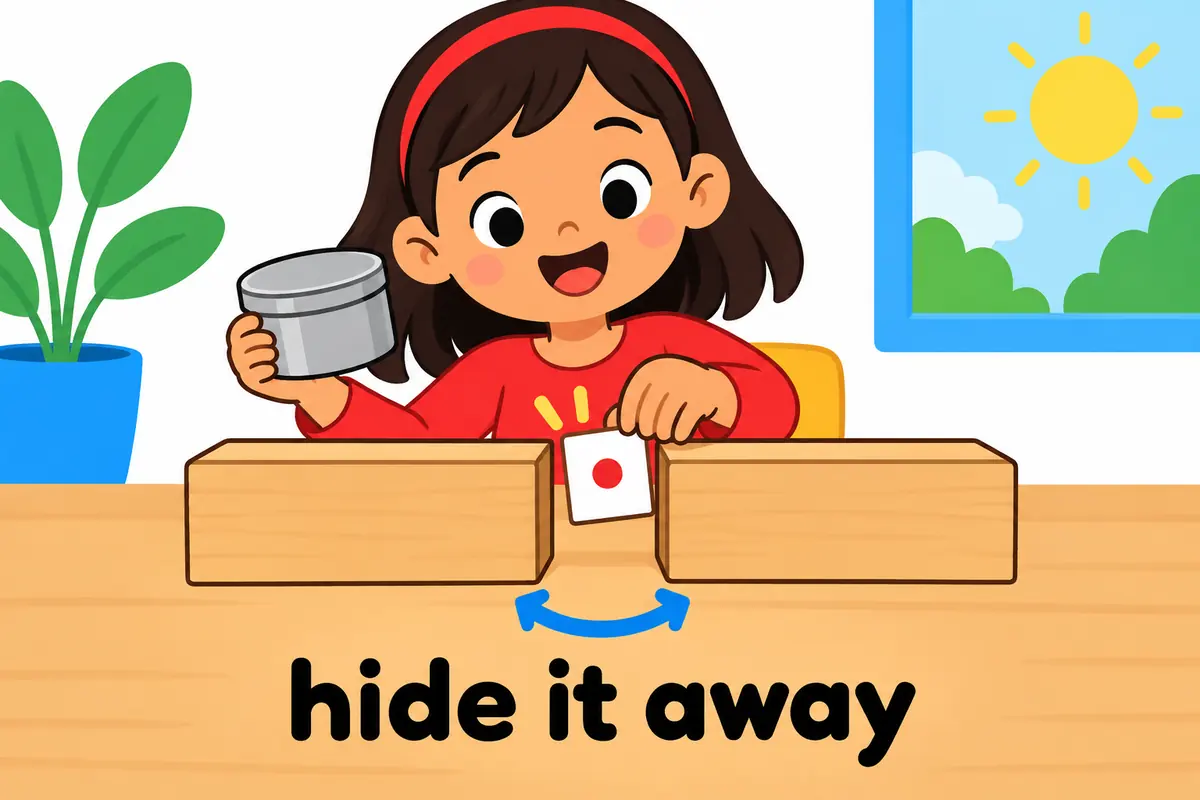
- It is separable when transitive, so a pronoun goes between hide and away: hide it away.
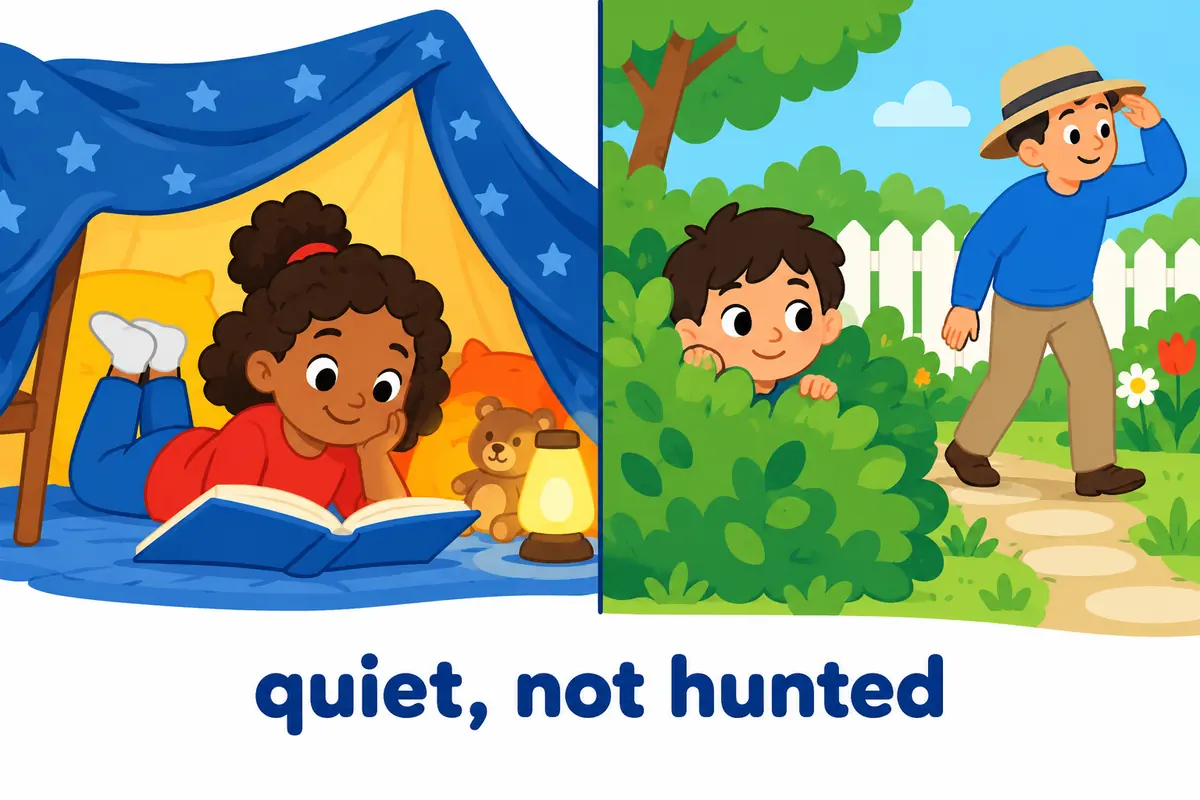
- The commonest error is confusing hide away with hide out, which means hiding from people who are searching.
What does hide away mean?
Hide away is a phrasal verb meaning to put something out of sight and keep it there, or to go to a private place and stay. The Cambridge entry for hide away records the sense of going somewhere secret or keeping something concealed. The intransitive sense describes a person who withdraws from company, often for rest rather than danger. The transitive sense describes storing an object somewhere safe or secret, which is where conceal is the closer formal verb. A third, quieter sense keeps a feeling or a person out of public view, as when a family hides a relative away from attention.
| Sense | Plain meaning | Example sentence |
|---|---|---|
| Go somewhere private | Withdraw to a quiet place, usually for rest | They hid away in a cottage for a week. |
| Store out of sight | Put an object in a safe or secret place | She hid the photographs away in a drawer. |
| Keep from public view | Shield a person or feeling from attention | The family hid him away from the reporters. |
One limitation is worth stating. Hide away suggests a settled or repeated act, not a single quick movement. Ducking behind a door is hiding, but it is not hiding away. The phrase also carries no built-in sense of fear: a person can hide away to rest, to work undisturbed or to prepare a surprise, and only context tells you which.
How do you use hide away in a sentence?
Decide first whether the sentence has an object. Without one, the subject simply withdraws; with one, hide away behaves like other separable phrasal verbs. Five patterns cover the way it is really used.
| Pattern | Example | What it signals |
|---|---|---|
| hide away, no object | The children hid away in the treehouse. | The subject goes into seclusion; nothing is named as hidden. |
| hide away + object | She hid the letters away in a tin. | Transitive and separable; the object follows the particle. |
| hide + object + away | He hid the key away behind a brick. | Split form with a noun object, common when the object is short. |
| hide + pronoun + away | She hid it away from the visitors. | A pronoun must sit between hide and away. |
| be hidden away | The papers were hidden away in the cellar. | Passive, which keeps the object rather than the hider in focus. |
The practical rule is the same one that governs other separable phrasal verbs: keep hide away together with a noun object, but put a pronoun in the middle. If you simply mean to put something in a safe place, store is the plainer verb.
Hide away in a sentence: examples across contexts
Hide away keeps one core meaning while shifting between rest, storage and secrecy. The nine sentences below move from a garden shed to a news report, and each one shows whether an object is present.
| Context | Example sentence | Why this works |
|---|---|---|
| Home talk | The puppy hid away under the stairs whenever it thundered. | The intransitive sense fits a frightened animal seeking cover. |
| Workplace email | We hid the spare key away in the office safe. | Transitive use with a concrete storage place. |
| News report | The family hid away in a village for a month. | States the duration of a deliberate withdrawal. |
| Literary prose | She hid her grief away behind a steady smile. | The figurative sense keeps a feeling out of view. |
| History essay | Villagers hid the manuscripts away from the soldiers. | Names what is protected and from whom. |
| Diary entry | I hid away all afternoon with a good book. | The first person shows the restful sense clearly. |
| Gardening note | The tools were hidden away in the shed for winter. | Passive keeps attention on the stored objects. |
| Conversation | Do not hide the biscuits away from your brother. | Playful use with a human audience named at the end. |
| Academic prose | The archive hid the letters away for a century. | Uses the storage sense for an institution over time. |
Only two rows are intransitive, which shows how often the verb carries an object. Even in the restful sense, the phrase usually names what is being kept out of sight.
Hide away vs hide out
Hide away and hide out look close and behave differently. The table sets out the criteria that separate them.
| Attribute | hide away | hide out |
|---|---|---|
| Core meaning | Withdraw for privacy, or store something out of sight | Stay hidden to avoid being found |
| Who or what is hidden | A person at rest, or an object being stored | Usually a person avoiding capture |
| Implies a pursuer | No | Often yes |
| Takes an object | Yes, in the storage sense | No |
| Typical duration | Settled or repeated | Until the search ends |
| Register | Neutral to literary | Neutral and journalistic |
Verdict: choose hide away for rest, privacy or storage, and choose hide out when someone is keeping clear of people who are actively looking for them.
Word forms and grammar of hide away
Hide away inflects on hide, and the past participle hidden regularises in the passive. The table also lists the noun built from the phrase and the form learners build by mistake.
| Form | Part of speech | Example |
|---|---|---|
| hide away | phrasal verb, base form | We should hide the gifts away tonight. |
| hides away | third-person singular | He hides away in his study each morning. |
| hid away | simple past | They hid away until the storm passed. |
| hidden away | past participle | The coins were hidden away under the floor. |
| hiding away | -ing form | She spent the winter hiding away indoors. |
| hideaway | noun | The cabin became their weekend hideaway. |
Keep the two-word verb and the one-word noun apart. You hide away in a place, and the place itself is a hideaway. Writers who want the place rather than the action often choose retreat for the same idea.
Common mistakes with hide away
- Incorrect:
She hid away it in the cupboard.Correct: She hid it away in the cupboard. Rule: Hide away is separable, so a pronoun goes between the two parts. - Incorrect:
He hid away from the police in a shed.Correct: He hid out in a shed. Rule: Use hide out when someone is avoiding people who are searching. - Incorrect:
The thief hid the money out in a barn.Correct: The thief hid the money away in a barn. Rule: Hide out does not take an object; use hide away for storing something. - Incorrect:
Hide away the door and nobody will see us.Correct: Hide behind the door and nobody will see us. Rule: Hide away means settled seclusion or storage, not a quick single movement. - Incorrect:
She hid away in the meeting all morning.Correct: She stayed in the meeting all morning. Rule: Hide away implies privacy or being out of sight, which an open meeting is not.
Practice using hide away
Work through the six items, then read the reason beside each answer rather than only the key.
- Fill the gap: The squirrels ______ nuts away for the winter.
- Choose the better word: The suspect (hid away / hid out) in a friend’s flat until the search ended.
- Correct the error: He hid away it behind the bookshelf.
- Build a sentence: use hidden away about a box of old photographs in an attic.
- Spot the register: which belongs in a news report — the witness hid out for three days, or the witness hid away for three days?
- Rewrite with the noun: The cabin was the place where they hid away. Use hideaway instead.
Answers
- hid away — a noun object follows the full phrase, and the action is in the past.
- hid out — the suspect was avoiding a search, which is the hide out sense.
- He hid it away behind the bookshelf — the pronoun goes in the middle of the separable verb.
- Model answer: A box of old photographs lay hidden away in the attic for years.
- The witness hid out for three days — a searched-for person suits hide out rather than hide away.
- The cabin was their hideaway — the noun names the private place itself.
The bottom line
Use hide away in a sentence to describe going somewhere private or storing something out of sight, and decide first whether an object is present. Two nuances decide most sentences: the verb is separable, so a pronoun goes between hide and away, and hide away differs from hide out, which is reserved for avoiding a search. For plain storage, bury or store is often the simpler choice.
Frequently asked questions about hide away
Is hide away a separable phrasal verb?
Yes, in its transitive sense. When hide away takes an object, a short noun or a pronoun may sit between the verb and the particle, as in hide the tin away or hide it away. A pronoun must take that middle position. The intransitive sense, meaning to withdraw, has no object and so is never split.
What is the difference between hide away and hide out?
Hide away means to seek privacy or to store something out of sight, with no pursuer involved. Hide out means to stay hidden to avoid being found, usually from a search. A reader doubting the pair can ask whether anyone is looking for the person; if so, hide out is the verb.
Can hide away take an object?
Yes. In the storage sense hide away is transitive, as in she hid the letters away. The object is the thing being stored, and it may follow the particle or sit between hide and away. Without an object, the same words describe a person withdrawing to a private place.
What is the noun form of hide away?
The noun is hideaway, written as one word, and it means a private place rather than the act of hiding. A cabin can be a weekend hideaway. Keep the two forms apart in writing: hide away is the verb, and hideaway is the place.