Yerk vs jerk comes down to one rule: use jerk in modern standard English and reserve yerk for dialect or deliberately old-fashioned prose. Both verbs describe a sudden sharp pull or movement, but jerk is the everyday word every reader knows, while yerk survives mainly in regional speech and historical writing.
Yerk vs jerk at a glance
- Yerk and jerk are both verbs meaning to give something a sudden sharp pull or movement.
- Jerk is the standard modern choice; it also works as a noun for a sudden jolt.
- Yerk is rare in current standard writing and appears mainly in dialect, poetry and historical prose.
- Jerk works both transitively and intransitively, while yerk is almost always transitive.
- The commonest mistake is using yerk for everyday effect, where readers take it for a misspelling of jerk.
Yerk vs jerk: the master comparison
| Criterion | Yerk | Jerk |
|---|---|---|
| Frequency | Rare; regional and literary | Common in every register |
| Register | Dialect, archaic, historical fiction | Neutral and standard |
| Parts of speech | Verb | Verb and noun |
| Typical object | A rein, a rope, a limb | Almost anything: a handle, a car, a head |
| Sense spread | A pull and a quick kick | A pull, a jolt, a sudden stop, a foolish person |
| Reader reaction | Sounds old or regional | Sounds ordinary and clear |
| Best use | Evoking a period voice | Everyday description and instruction |
The two rows that settle most sentences are frequency and register. If a reader might think the word is a typo, the word has already failed, and for a modern audience that is the usual fate of yerk. Register is the second filter: even a reader who knows yerk will pause, because a sudden pull in a neutral sentence belongs to jerk. Notice too that only jerk has become a noun, which is why a single sharp movement is a jerk and never a yerk.
What does yerk mean?
Yerk is a verb meaning to pull, move or throw something with a sudden sharp motion, close in sense to jerk but much rarer. The Cambridge entry for yerk records the pulling sense and its regional flavour, and the word has also named a quick kick or thrust. Yerk is not incorrect; it is simply narrow, and it carries a voice that a neutral sentence does not want.
| Sense | Plain meaning | Example sentence |
|---|---|---|
| Pull sharply | Move something with a quick tug | She yerked the rope free of the post. |
| Kick or thrust | Strike out with a sudden movement | The pony yerked its hind legs at the gate. |
What does jerk mean?
Jerk is a verb and a noun meaning a sudden sharp pull, push or jolt, and it is the form modern readers expect. The Cambridge entry for jerk covers the movement sense together with the informal noun for a foolish person. That second sense is a real trap: a sentence about motion should never let the everyday verb jerk drift into name-calling.
| Sense | Plain meaning | Example sentence |
|---|---|---|
| Pull or jolt | Move with a sudden sharp motion | He jerked the handle and the drawer opened. |
| Sudden stop | Move abruptly and unevenly | The train jerked to a halt. |
| Foolish person | Informal insult | Only a jerk would park across the ramp. |
One honest limit applies to both words: neither suits a gentle or continuous movement. For a slow, steady pull, use drag or ease instead, because yerk and jerk both insist on suddenness. A second limit is grammatical. Both verbs take a direct object or stand alone, but neither takes a person as an indirect object, so a sentence such as he jerked me the keys is wrong no matter which form you choose. The verbs describe motion applied to a thing, not a favour passed to a person.
Using yerk and jerk in a sentence
Both verbs follow the same skeleton, so the choice is about register rather than grammar. Yerk sits in the older, transitive pattern with a physical object, while jerk extends to intransitive and noun uses.
| Pattern | Example | What it signals |
|---|---|---|
| yerk + object | She yerked the rein. | Old-fashioned transitive pull |
| yerk + object + hard | He yerked the door hard. | Dialect movement with force |
| jerk + object | He jerked the door open. | Modern transitive pull |
| jerk + adverb | The bus jerked forward. | Modern intransitive jolt |
| give + object + a jerk | Give the rope a jerk. | Noun form for one sharp pull |
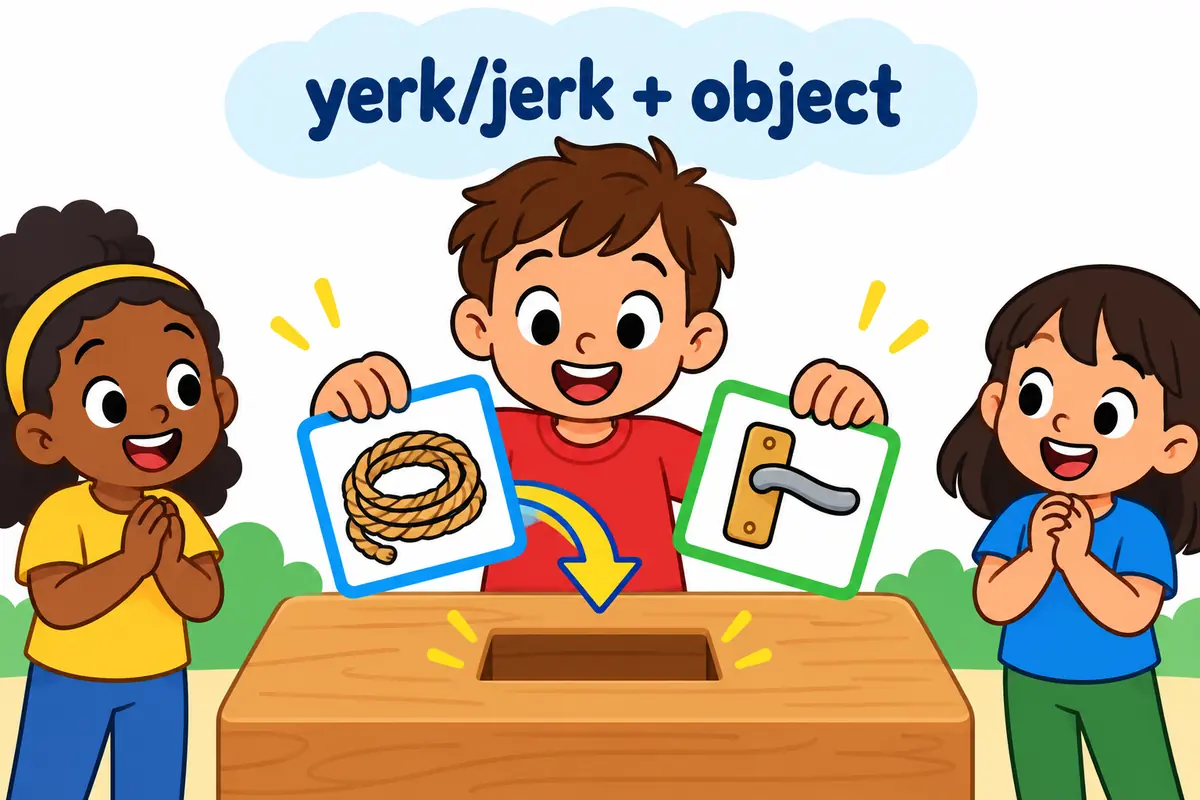
Yerk and jerk in a sentence: examples across contexts
| Context | Example sentence | Why this works |
|---|---|---|
| Historical fiction | He yerked the latch and the door swung wide. | The rare verb matches the period setting. |
| Dialect dialogue | Yerk that bale over here, lad. | Regional speech colours the character’s voice. |
| News report | The cable car jerked twice before stopping. | The neutral verb keeps the report factual. |
| Workplace email | Please jerk the lever only if the alarm sounds. | A plain instruction uses the common word. |
| Instruction manual | Jerk the cord firmly to start the engine. | Short, unambiguous transitive use. |
| Conversation | The car jerked when I hit the brake. | Everyday description of a sudden jolt. |
| Academic writing | The pendulum jerked at the point of release. | A precise motion verb fills the technical sentence. |
| Sports commentary | The winger jerked past two defenders. | The sudden movement mirrors the action. |
| Playground | The swing jerked when Sam jumped off. | Vivid but simple enough for a young reader. |
| Classroom task | Write a sentence in which a rope jerks. | It practises the intransitive pattern on purpose. |
Notice how quickly the balance tilts. Nine of those ten rows use jerk, and only the two deliberately antique contexts welcome yerk, which is exactly the ratio a sensible writer keeps. A useful test is to read the sentence aloud in a neutral voice: if yerk sounds like a stumble, the sentence wants jerk; if the whole register is already old, yerk will blend in.
Which should you use?
- Everyday writing, news, email or instruction: use jerk, because readers grasp it instantly.
- Historical fiction, dialect dialogue or poetry: use yerk to signal an older or regional voice.
- Technical description of motion: use jerk, or a sharper verb such as jolt or lurch sideways.
- Any sentence where the pull is sideways and clumsy: lurch fits better than either word.
- If you are unsure, choose jerk; a stray yerk reads as a spelling error, while jerk always reads as ordinary English.
The habit that keeps both words sharp is to name the physical object being moved. A rope, a rein, a lever or a head belongs beside the verb; an abstraction such as attention or hope does not, and belongs with yank a rope-style physical energy instead.
Word forms and grammar of yerk and jerk
| Form | Part of speech | Example |
|---|---|---|
| yerk | base verb | They yerk the oars on the last stroke. |
| yerked | past tense | He yerked the tiller round. |
| yerking | present participle | She was yerking the rope loose. |
| jerk | base verb or noun | Give the line a jerk. |
| jerked | past tense | The horse jerked its head. |
| jerking | present participle | The carriage kept jerking. |
| jerky | adjective | A jerky ride unsettled the passengers. |
| yerkt | non-standard past tense | Do not write it; the past of yerk is yerked. |
Common mistakes with yerk and jerk
- Incorrect:
The cart yerked forward.Correct: The cart jerked forward. Modern writing uses jerk, and yerk only sounds right in an older voice. - Incorrect:
She jerked at the news.Correct: She recoiled at the news. Jerk names physical motion, not an emotional reaction. - Incorrect:
He yerked me the keys.Correct: He tossed me the keys. Neither verb hands an object to a person. - Incorrect:
The rope was yerk short.Correct: The rope was jerked short. The past participle needs the -ed ending. - Incorrect:
He gave the handle a yerk.Correct: He gave the handle a jerk. The noun form survives only for jerk.
Learners also mix up jerk with twitch, a smaller, repeated movement, and with wrench, a violent twist that implies pain. Keep jerk for the single sharp pull and those two neighbours stay distinct.
Practice using yerk and jerk
- Fill in the blank: The engine coughed and the boat ____ forward.
- Fill in the blank: In old ballads the sailor ____ the rope with both hands.
- Choose the better word: The mule (jerked / twitched) the cart to a stop.
- Choose the better word: For a medieval scene, (jerk / yerk) the rope to sound authentic.
- Correct the error: The bus yerked to a halt at the corner.
- Build a sentence: describe a drawer opening suddenly, using jerk as a verb.
- Spot the register: which sentence suits a news report, ‘He yerked the rein’ or ‘He pulled the rein’?
- Build a sentence: describe a horse striking out with its back legs, using yerk in a period voice.
Answers
- jerked: the everyday verb fits an engine stalling.
- yerked: the historical setting justifies the archaic form.
- jerked: a mule makes one sharp pull, not a small twitch.
- yerk: only the period voice calls for the rare form.
- The bus jerked to a halt: yerk is wrong outside dialect.
- He jerked the drawer open and the letters spilled out.
- He pulled the rein: a news report uses the plain verb.
- The pony yerked its hind legs, and the groom stepped back: the dialect verb matches the stable setting.
The bottom line
Yerk vs jerk is settled by audience, not by grammar. Choose jerk for anything a modern reader will meet today, and reach for yerk only when the older or regional sound is the point. Both verbs demand a sudden motion, so if the pull is slow and steady, pick a different word entirely.
Frequently asked questions about yerk vs jerk
Is yerk a real word?
Yerk is a genuine verb recorded in major dictionaries with the sense of a sudden sharp pull, and it has also described a quick kick. It is rare in modern standard English, so most readers meet it only in dialect writing, poetry or historical fiction rather than in everyday prose.
Can yerk and jerk be used interchangeably?
They overlap in meaning but not in effect. Yerk and jerk can both name a sudden sharp pull, yet jerk is neutral and familiar while yerk sounds regional and old. Swapping them rarely breaks grammar, but it almost always changes the tone of the sentence.
What part of speech is jerk?
Jerk works as both a verb and a noun. As a verb it means to move with a sudden sharp motion, as in she jerked the door open. As a noun it names that motion, as in the rope gave a jerk, or informally a foolish person.
Is it ever correct to use yerk in modern writing?
Yes, when the old or regional voice is deliberate. Historical fiction, dialect dialogue and poetry use yerk to set a period or place. In news, email or instruction it looks like an error, so modern standard prose almost always prefers jerk instead.