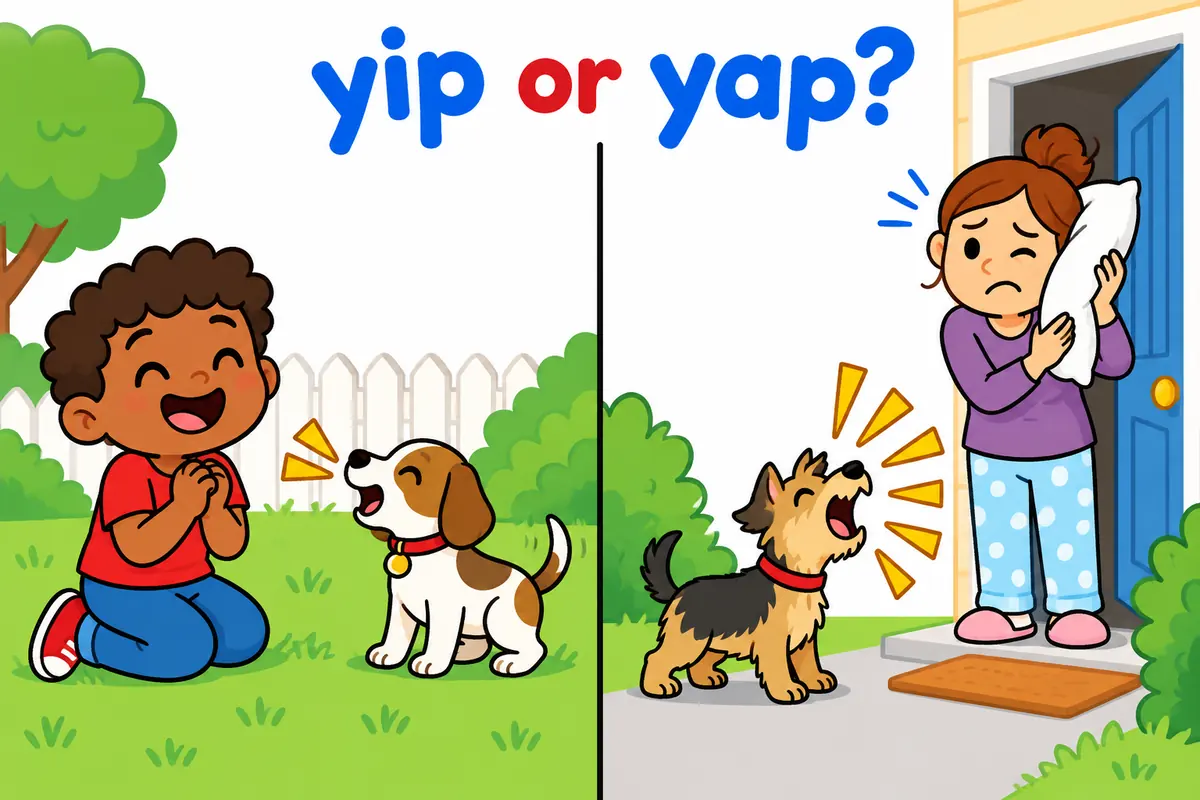
The yip vs yap choice comes down to pitch, length and repetition. Yip names a single short, high-pitched bark or squeak, often from a puppy, a fox or a person who is startled. Yap names rapid, repeated high-pitched barking, and informally the nonstop chatter of someone who will not stop talking.
Yip vs yap at a glance
- Both yip and yap work as verbs and as nouns for high-pitched barking sounds.
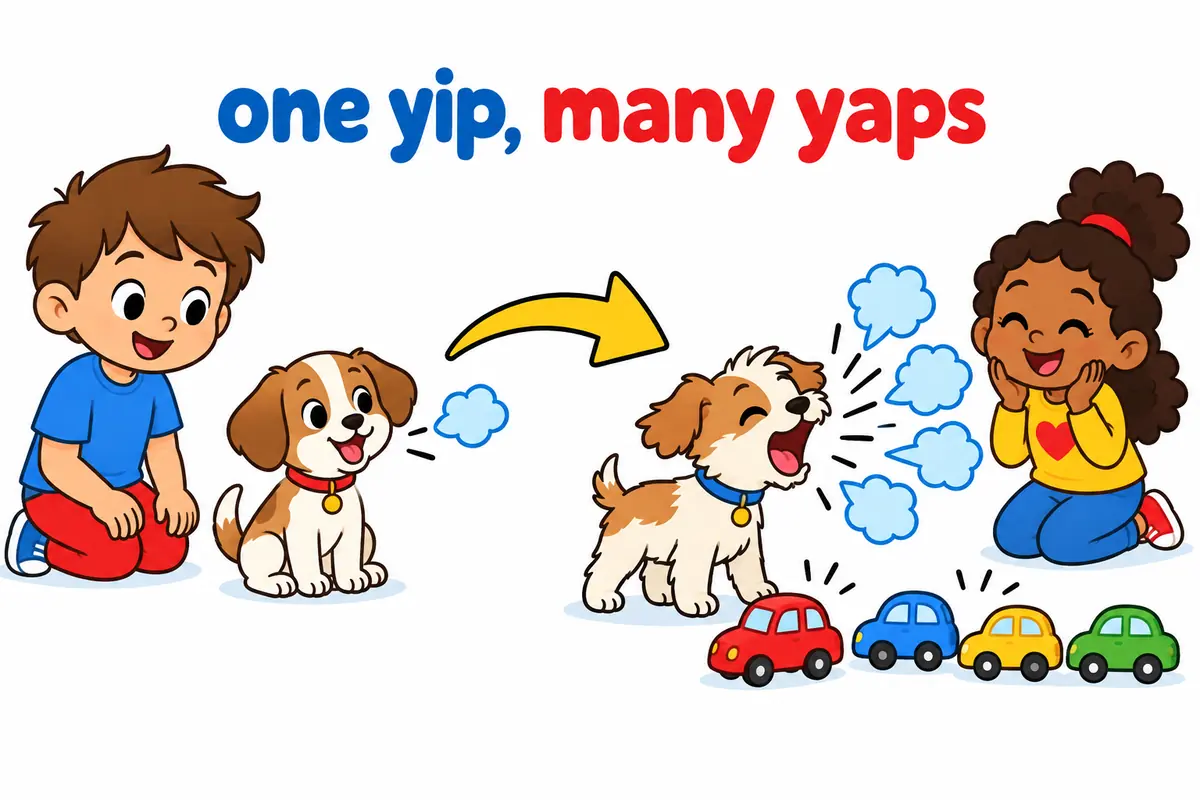
- Yip is one short, sharp sound; yap is a run of shrill sounds in quick succession.
- Yip usually points to a small dog, a fox or a cry of surprise or pain.
- Yap usually points to a small dog that will not stop, or informally to a talkative person.
- Yip is neutral or affectionate; yap often carries mild irritation.
- The commonest error is using yap for a single sound or yip for endless chatter.
Yip vs yap: the master comparison
Seven criteria separate the two words, and repetition is the one that decides most sentences. A single sound is a yip; a stream of sounds is a yap.
| Criterion | Yip | Yap |
|---|---|---|
| Core meaning | A single short, high-pitched bark or cry | Rapid, repeated high-pitched barking |
| Number of sounds | One | Many in quick succession |
| Typical source | A puppy, a fox, or a person in pain or surprise | A small dog that barks at everything |
| Duration | A moment | Continuous until something interrupts it |
| Connotation | Neutral, often affectionate | Often mildly annoyed or critical |
| Informal human sense | A startled cry | Nonstop chatter |
| Typical domain | Pets, wildlife, exclamations | Noise complaints, informal talk |
The number row settles most doubts. If the sound happens once and stops, it is a yip; if it keeps restarting, it is a yap. The connotation row decides the rest: a writer who wants to sound fond of the animal chooses yip, and a writer who is complaining about noise chooses yap.
What do yip and yap mean?
Yip is a noun and a verb for a single short, sharp, high-pitched bark or cry. Yap is a noun and a verb for shrill barking repeated without pause and, informally, for chatter of the same exhausting kind. The Cambridge entry for yip records the short bark, and the entry for yap records both the repeated bark and the human chatter sense, so the split between one sound and many is the first thing to hold onto. A fox that gives one call yips once in the dark, while a dog that never settles yaps on.
| Sense | Plain meaning | Example sentence |
|---|---|---|
| Yip (noun) | One short, sharp, high-pitched bark | A single yip came from the cardboard box. |
| Yip (verb) | To give one short, sharp bark or cry | The puppy yipped when the door opened. |
| Yap (noun) | A shrill repeated bark, or informal chatter | The yap of the terrier woke the street. |
| Yap (verb) | To bark shrilly and repeatedly, or to chatter | The little dog yapped at every passer-by. |
One limitation is worth stating plainly. Neither word suits a deep, threatening sound: a large guard dog does not yap, it barks, growls or bays. Both words also stay informal, so a veterinary report or a formal complaint usually prefers bark, or the phrase excessive barking, rather than yap.
How do you use yip and yap in a sentence?
Yip and yap share the same grammar, so the choice is almost entirely one of repetition and tone. Both take a subject that is an animal or a person, and both appear with the preposition at when the sound is aimed at someone.
| Pattern | Example | What it signals |
|---|---|---|
| yip + at + someone | The puppy yipped at the postman. | One sharp sound aimed at a target. |
| yip + with + emotion | The children yipped with delight. | A single cry of feeling. |
| a yip (countable noun) | A yip came from behind the shed. | One sound treated as an event. |
| yap + at + someone | The terrier yapped at every passing car. | Repeated barking aimed at a target. |
| yap + about + topic | He yapped about football for an hour. | The informal chatter sense about people. |
| keep + yapping | The dog kept yapping all night. | Continuation and annoyance. |
Yip and yap in a sentence: examples across contexts
Yip and yap keep the same contrast from the playground to the news report. The nine sentences below move through registers and show which word each one needs. A related everyday sound is the yelp of a dog whose tail is stepped on, sharper and more sudden than a yip.
| Context | Example sentence | Why this works |
|---|---|---|
| Pets at home | Our puppy gives one excited yip at the door and then goes quiet. | The single sound and the quick stop fit yip. |
| Neighbour complaint | The dog next door yaps from dawn until dusk. | Endless repetition is the point, so yap fits. |
| Children’s story | The fox gave a startled yip and slipped into the hedge. | A fox’s short cry is a yip, not a yap. |
| News report | Residents say the yapping has made the courtyard unbearable. | The repeated bark becomes a noise problem. |
| Vet notes | The patient yipped once when the leg was examined. | A single reaction during a procedure. |
| Conversation | She yapped about her holiday until the bus arrived. | The chatter sense belongs to yap. |
| Wildlife writing | A pair of foxes yipped across the field at dusk. | Short calls traded between animals. |
| Humour column | My neighbour’s new puppy yaps at its own reflection. | Comic repetition is exaggerated by yap. |
| Classroom | The reading dog gave a soft yip at the end of the page. | One gentle sound within a calm scene. |
The register stays light in every row, because both words are informal. A learner who wants a neutral report writes the dog barked repeatedly, and saves yap for speech or mild complaint.
Yip, yap and their neighbours
Four words sit close to yip and yap, and each measures a different kind of sound. A single sharp bark of a farm dog is the neutral base, while a long high whine of a dog left outside is continuous rather than repeated.
| Word | Kind of sound | Example |
|---|---|---|
| bark | Neutral, can be short or repeated | The retriever barked a warning. |
| yelp | A sudden high cry of pain or alarm | She yelped when the door caught her hand. |
| whine | A long, drawn-out high complaint | The puppy whined beside the closed gate. |
| howl | A loud, long sound, often at night | A dog howled somewhere across the valley. |
| growl | A low, threatening rumble | The old dog growled from under the step. |
| snap | A quick bite or a sharp closing sound | The terrier snapped at the flying leaf. |
Yip sits between bark and yelp: sharper than a bark, less urgent than a yelp. Yap sits between bark and whine: repetitive like a bark, high like a whine.
Word forms and grammar of yip and yap
Both words inflect as regular verbs and count as regular nouns, and the participle forms double the final consonant. The adjective yappy is common, and it keeps the complaining tone of yap.
| Form | Part of speech | Example |
|---|---|---|
| yip | verb, base and noun | The pup will yip at strangers. |
| yipped | verb, past and past participle | It yipped once and hid. |
| yipping | verb, present participle | The yipping woke the baby. |
| yaps | verb, third person singular | The spaniel yaps at the window. |
| yapped | verb, past and past participle | They yapped all through the film. |
| yappy | adjective | A yappy little dog guards the gate. |
The doubled consonant before -ed and -ing is the point learners miss: yapped and yapping, not yaped and yaping. The noun yip is countable, so a yip is one sound and several yips are several short sounds.
Common mistakes with yip and yap
- Incorrect:
The puppy yapped once and fell asleep.Correct: The puppy yipped once and fell asleep. Rule: Yap means repeated barking, so it cannot describe a single sound. - Incorrect:
He would not stop yipping about his new car.Correct: He would not stop yapping about his new car. Rule: Endless human chatter takes yap, not yip. - Incorrect:
The dog yiped at the gate.Correct: The dog yipped at the gate. Rule: The past form doubles the p before -ed. - Incorrect:
The fox yapped one short call.Correct: The fox yipped one short call. Rule: One short call is a yip; yap needs repetition. - Incorrect:
The guard dog yapped a deep warning.Correct: The guard dog growled a deep warning. Rule: Yip and yap are high-pitched and light, so they cannot describe a deep sound.
Which should you use?
Four reader situations cover almost every case, and each has one firm answer.
- You are describing one sudden sound: use yip. A single short cry is never a yap.
- You are complaining about noise that will not stop: use yap. Repetition is the reason the word exists.
- You are writing about a small dog you find charming: use yip for the occasional sound and yappy only if the tone is playful.
- You are describing a person who talks without pause: use yap, which carries the informal, faintly critical sense.
If the sound is deep, long or threatening, neither word fits, and bark, growl, howl or bay is the better choice.
Practice using yip and yap
Work through the six items, then check the reasoning rather than only the key.
- Fill the gap: The little dog ______ at every bicycle that passed the gate.
- Choose the better word: The fox gave a single (yip / yap) and vanished into the reeds.
- Correct the error: The puppy yapped once and wagged its tail.
- Build a sentence: use keep yapping about a dog that barks all night.
- Spot the register: which belongs in a friendly note — our puppy gives one happy yip at the door, or the animal emits repetitive high-frequency vocalisations?
- Rewrite for a formal report: The dog yapped all morning. Avoid the informal word.
Answers
- yapped — the barking repeats at every bicycle, so yap fits.
- yip — one sound is a yip, because yap needs repetition.
- The puppy yipped once and wagged its tail — a single sound takes yip.
- Model answer: The dog next door kept yapping until midnight.
- Our puppy gives one happy yip at the door — a friendly note keeps the warm, informal word.
- The dog barked all morning — a formal report prefers the neutral verb bark.
The bottom line
Use yip for a single short, high-pitched bark or cry, and yap for the same sound repeated until it becomes a nuisance or a figure of speech for nonstop chatter. The number of sounds is the deciding test, and the tone decides the rest: yip stays neutral or fond, while yap carries mild irritation. When the sound is deep or threatening, both words are wrong, and bark, growl or howl is the honest choice.
Frequently asked questions about yip and yap
Is a yip the same as a yelp?
They overlap but are not identical. A yip is a short, high, often cheerful bark, while a yelp is a sharper cry usually caused by sudden pain or alarm. A puppy may yip at a doorbell for excitement, but it yelps when a tail is stepped on.
Can yap describe a person?
Yes, informally. When someone yaps, they talk continuously and often about nothing important, and the word carries the same mild criticism as a dog that barks without pause. It belongs in conversation and light journalism, not in formal writing about people.
Why is it yapped and not yaped?
Yap follows the short-vowel doubling rule: a one-syllable verb ending in a single vowel and a single consonant doubles that consonant before -ed and -ing. The same rule gives yipped and yipping, so both yap and yip take a doubled p.
Do foxes yip or yap?
Both words can describe a fox, but the meaning splits as usual. A fox yips when it gives one or a few short calls traded across a field, and yaps when the calls come rapidly and repeatedly. Writers describing the sound at a distance usually choose yip.