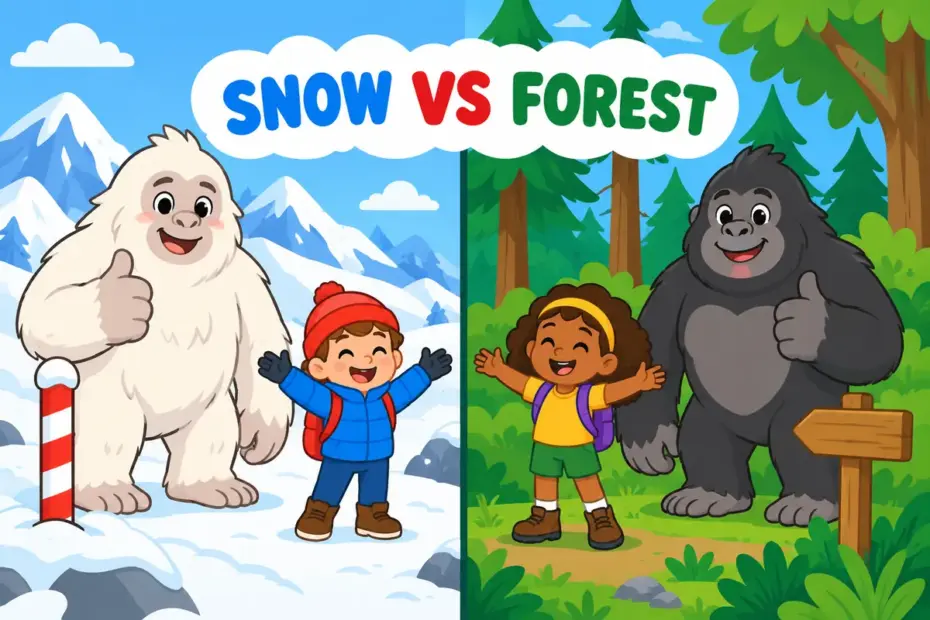
Yeti vs bigfoot comes down to geography: use yeti for the Himalayan snow legend and bigfoot for the North American forest creature. The two are separate traditions, not rival names for one animal, and each belongs to a different continent. Pick the word that matches the story’s setting and audience.
Yeti vs bigfoot at a glance
- Yeti names a creature of Himalayan folklore; bigfoot names one from North America.
- Their popular nicknames are the Abominable Snowman and Sasquatch respectively.
- Both are cryptids, meaning animals whose existence is claimed but never confirmed.
- Yeti stories favour snow and high rock; bigfoot stories favour deep forest.
- Both words are count nouns, so they take plurals: yetis, and usually bigfoots.
- The commonest error is treating the two names as synonyms for a single animal.
Yeti vs bigfoot: the master comparison
The table below sets the two traditions side by side across the points that decide which word a reader expects. Every row names a real difference, so the comparison can be quoted on its own.
| Attribute | yeti | bigfoot |
|---|---|---|
| Region in the stories | The Himalayas and the Tibetan plateau | The forests of North America, especially the Pacific Northwest |
| Popular nickname | The Abominable Snowman | Sasquatch |
| Story habitat | High snow and bare rock above the tree line | Deep temperate forest and remote river valleys |
| Name origin | From Himalayan languages, and still debated by etymologists | From the oversized footprints reported at sighting sites |
| Usual description | A tall, shaggy, ape-like figure in pale fur | A tall, heavily built, ape-like figure in dark fur |
| Claimed evidence | Prints in snow and distant high-altitude photographs | Footprint casts and grainy forest footage |
| Cultural home | Nepali, Tibetan and Bhutanese mountain lore | The camping, logging and hiking lore of the Pacific Northwest |
| Use the word when | Writing about snow, mountains or the Himalayas | Writing about forests, North America or Sasquatch |
Read the last row as the decision rule. The rest of the table explains why the rule holds, because each word carries the landscape and the storytellers it grew from.
Which should you use?
Choose the name that belongs to the setting you are describing, then keep that choice consistent through the piece. The five situations below cover almost every real decision.
| Your situation | Use | Why |
|---|---|---|
| A legend set in snow and high mountains | yeti | The image only makes sense in a Himalayan landscape. |
| A sighting reported in a North American forest | bigfoot | The tradition and the evidence reports are North American. |
| You want the classic nickname | the Abominable Snowman | It is the popular tag long attached to the yeti. |
| You want the Indigenous-linked name | Sasquatch | It is the usual alternative name for bigfoot in the Pacific Northwest. |
| You mean an unnamed beast in general | cryptid or creature | Neither proper name fits when no region or tradition is meant. |
One firm rule: never use the two names in the same breath as if they were the same animal. If a plot needs a single creature across both continents, name the region each time rather than blurring them.
What do yeti and bigfoot mean?
Yeti is a noun naming a large, hairy, ape-like creature of Himalayan folklore, and bigfoot is a noun naming a similar creature of North American legend. The Cambridge entry for yeti and the Cambridge entry for bigfoot both treat the words as names for unconfirmed animals rather than for real species. Neither word is a scientific name, and no museum holds a type specimen.
| Word | Type of noun | Tradition | Typical partners |
|---|---|---|---|
| yeti | count noun, usually lowercase | Himalayan mountain lore | yeti tracks, a yeti sighting, the yeti legend |
| bigfoot | count noun, often capitalised as a name | North American forest lore | a bigfoot report, bigfoot hunters, the Bigfoot story |
One honest limitation applies to both words. They name creatures whose existence is unproven, so they belong to stories, debates and popular culture rather than to biology. Travel columns still call the mystery beast by the local name, and headlines reach for monster, but the reports describe a shy ape-like figure rather than a horror. A writer who needs to sound neutral should say a claimed creature or an unconfirmed animal, not present the name as settled fact.
How do you use yeti and bigfoot in a sentence?
Both words are count nouns, so each takes a plural and each can follow a or the. The patterns below cover the plain noun uses, the plural choices and the unexpected verb bigfoot, and they show where the two words part company.
| Pattern | Example | What it signals |
|---|---|---|
| a + yeti / a + bigfoot | A yeti was said to roam the pass. | Introduces one creature, real or imagined, for the first time. |
| the + yeti / the + bigfoot | The bigfoot of local stories is shy. | Refers to the legend as a known topic between reader and writer. |
| plural yetis | Reports described several yetis on the ridge. | The plural is regular and needs no apostrophe. |
| plural bigfoots | Two bigfoots were reported near the lake. | The common plural; bigfeet and even unchanged bigfoot also appear. |
| attributive use | yeti tracks, a bigfoot hunter | The noun acts like an adjective in front of another noun. |
| verb bigfoot | The chair bigfooted the whole meeting. | Informal; means to dominate or override others. It has no yeti twin. |
The verb bigfoot is the trap for careful writers. It has nothing to do with the creature, and it only exists for bigfoot, so there is no parallel sentence with yeti.
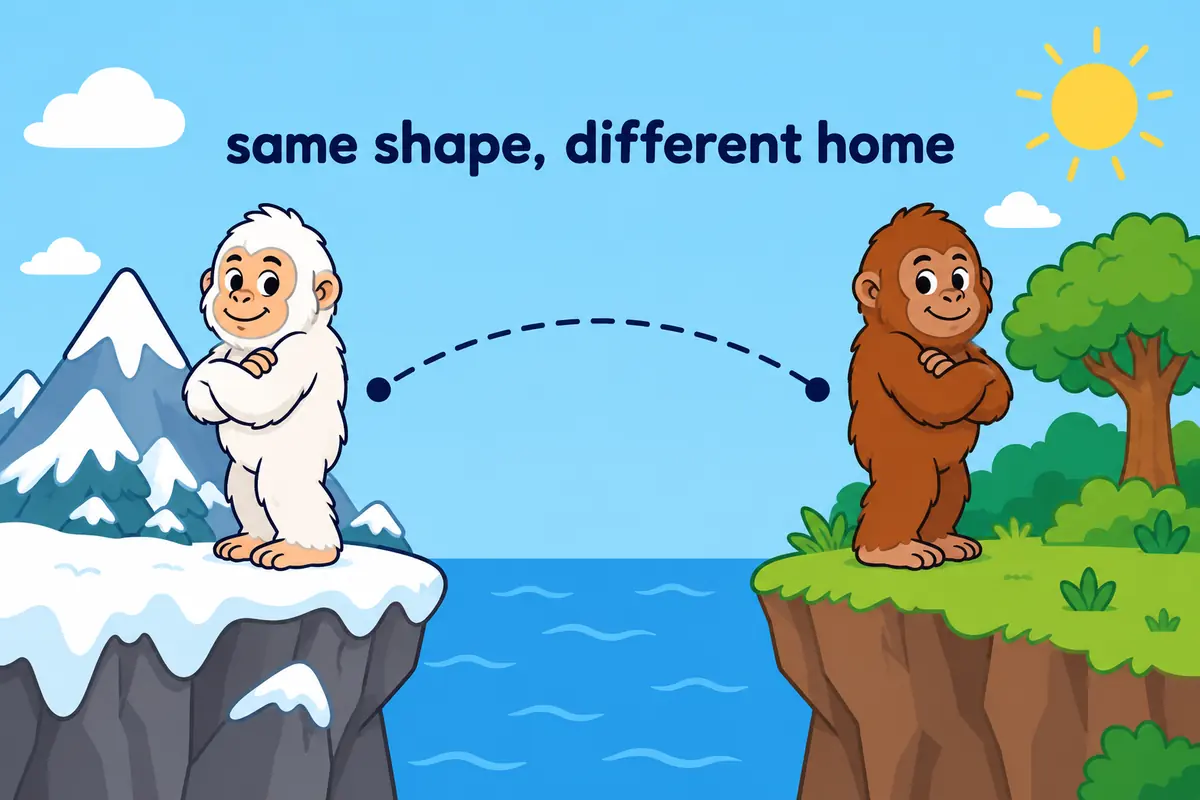
Yeti and bigfoot in a sentence: examples across contexts
The two names move from campfire stories to travel features without changing their spelling. Each of the nine sentences below shows which region and which register is at work, so a reader can copy the pattern rather than guess.
| Context | Example sentence | Why this works |
|---|---|---|
| Children’s story | The shy yeti peeped from behind a snowdrift. | The snowy setting justifies the Himalayan word. |
| Travel writing | Porters still trade yeti tales on the high pass. | Local voices make the legend feel rooted. |
| News report | A hiker claimed a bigfoot crossed the trail before dawn. | A forest sighting matches the North American name. |
| Documentary script | Every bigfoot cast tells a different story. | The evidence object keeps the tone measured. |
| Museum caption | The yeti remains a creature of report, never of record. | Formal prose can state the uncertainty plainly. |
| Academic prose | Cryptid traditions such as the yeti and bigfoot resist simple proof. | Names both while keeping the claim general. |
| Everyday conversation | My uncle swears he saw a bigfoot in the woods. | The spoken register and forest setting fit together. |
| Opinion column | The yeti survives because the mountains stay out of reach. | Links the legend to its landscape rather than its truth. |
| Brand or tourism copy | Come for the trails and leave with a bigfoot story. | Uses the local name to sell the place, not the animal. |
Not one sentence swaps the names, because each region carries its own word so firmly that a swap would read as a mistake.
Word forms and grammar of yeti and bigfoot
The two words look unlike each other in the plural, and that difference trips up more writers than any other feature. The table below lists the forms that appear in print and marks the ones a general reader will find odd.
| Form | Part of speech | Example |
|---|---|---|
| yeti | count noun, singular | A yeti is said to leave deep prints. |
| yetis | count noun, plural | Stories name whole families of yetis. |
| bigfoot | count noun, singular | A bigfoot was reported by two campers. |
| bigfoots | count noun, plural | Two bigfoots were seen near the logging road. |
| bigfeet | plural, playful or rare | Bigfeet appeared in a comic strip. |
| Bigfoot | proper name | Bigfoot is a fixture of Pacific Northwest lore. |
| bigfoot | verb, informal | The manager bigfooted the discussion. |
Most editors accept bigfoots for the creature and reserve bigfeet for jokes, because the irregular plural borrows the pattern of foot and sounds comic when applied to a monster.
Common mistakes with yeti and bigfoot
- Incorrect:
Campers in Oregon reported a yeti near the lake.Correct: Campers in Oregon reported a bigfoot near the lake. Rule: Yeti belongs to the Himalayas; North American forests take bigfoot. - Incorrect:
Sherpas told stories of the bigfoot on Everest.Correct: Sherpas told stories of the yeti on Everest. Rule: Match the word to the mountain tradition, not to the creature’s shape. - Incorrect:
Two bigfoot were spotted.Correct: Two bigfoots were spotted. Rule: The count noun needs a plural; bigfoots is the standard choice. - Incorrect:
The team bigfooted the snow to find a yeti.Correct: The team trudged through the snow to find a yeti. Rule: The verb bigfoot means to dominate, not to walk heavily. - Incorrect:
Yeti and Bigfoot are two names for one creature.Correct: The yeti and bigfoot are two separate legends from two continents. Rule: The traditions never merge; keep the names apart.
Practice using yeti and bigfoot
Work through the six items, then read the reason with each answer rather than only the key.
- Fill the gap: Climbers on the high pass blamed fresh prints on a ______.
- Choose the better word: A hiker in Washington state filmed what she called a (yeti / bigfoot).
- Correct the error: Two bigfoot were seen crossing the logging road.
- Build a sentence: use the Abominable Snowman as a nickname for the yeti.
- Spot the register: which belongs in a museum caption – the yeti remains unconfirmed, or the yeti is totally a mystery?
- Rewrite for a North American audience: A yeti was reported in the forest. Change only the creature name.
Answers
- yeti – snow and a high pass are the Himalayan setting where the word fits.
- bigfoot – the location is North America, so the forest name is expected.
- Two bigfoots were seen crossing the logging road – the count noun takes a plural.
- Model answer: The Abominable Snowman is the nickname long attached to the yeti.
- The yeti remains unconfirmed – a caption keeps a measured tone and avoids totally.
- A bigfoot was reported in the forest – the forest setting calls for the North American name.
The bottom line
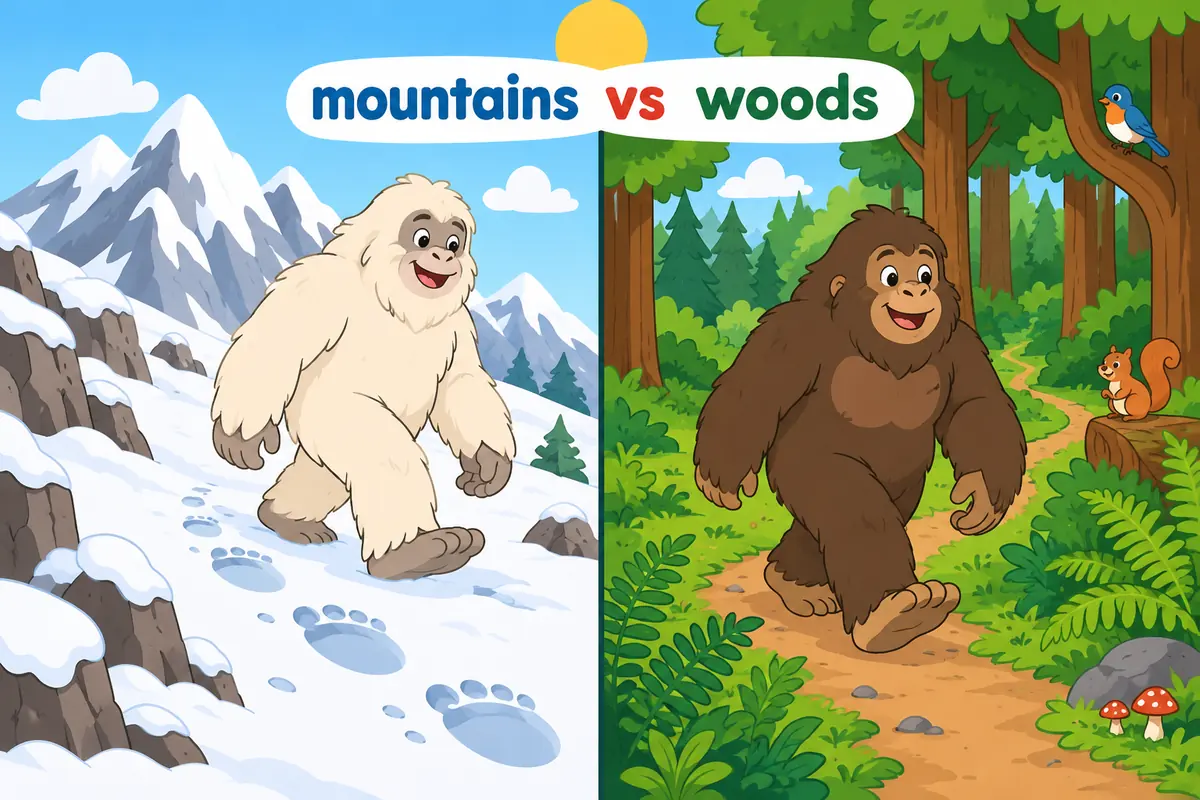
Use yeti for the Himalayan snow legend and bigfoot for the North American forest creature, and let the setting decide which word belongs. Two details settle the rest: the two names belong to separate traditions rather than one animal, and each is a count noun, so the plurals are yetis and bigfoots. Where no region is meant, choose a general word such as cryptid instead.
Frequently asked questions about yeti and bigfoot
Is Sasquatch the same as bigfoot?
Yes, in ordinary use Sasquatch and bigfoot name the same North American creature. Sasquatch is the older name, traced to a Salish-language word from the Pacific Northwest, while bigfoot comes from the large footprints in the reports. Choosing between them is a matter of tone, not meaning.
What does cryptid mean?
A cryptid is an animal whose existence is claimed in reports but never confirmed by science. The yeti and bigfoot are both standard examples. The word is neutral and describes the status of the claim rather than passing judgement, so it suits careful, factual writing about unexplained creatures.
Is the yeti real?
There is no confirmed evidence that the yeti exists, and no specimen has been accepted by biologists. The name comes from Himalayan traditions and later expedition reports, which is why it is described as a cryptid. Writers should present the yeti as a legend or a claim, never as a known species.
Are yeti and bigfoot ever capitalised?
Both are usually lowercase when used as common nouns, as in a yeti or a bigfoot. Bigfoot is often capitalised when it works as a proper name for the legend, and many publications treat it as a name throughout. Yeti is capitalised less often, so lowercase is the safe default.