Pump out means to force a liquid or gas out with a pump, and, in a common figurative sense, to produce something in large quantities and at speed. To use pump out in a sentence, name what flows or what is made: “They pumped the flooded cellar out overnight.”
Pump out at a glance
- Pump out is a phrasal verb; its forms are pumps out, pumped out and pumping out.
- The literal sense is to remove liquid or gas by pumping it away.
- The figurative sense is to produce goods, content or sound in large amounts.
- It is transitive, so it always needs something to pump out.
- It is separable, and a pronoun must take the middle slot: pump it out.
- The commonest error is confusing pump out with pump up, which means to inflate.
What does pump out mean?
Pump out is a transitive phrasal verb meaning to draw a liquid or gas out with a pump, or to turn something out in volume, as a factory or a speaker does. The Cambridge entry for pump out records the removal sense, and the figurative use extends it to anything produced steadily and fast. The related verb drain the tank describes the same flow but often by gravity rather than by a machine.
| Sense | Plain meaning | Example sentence |
|---|---|---|
| Remove liquid | Draw water or fuel out with a pump | Fire crews pumped out the flooded basement. |
| Produce in bulk | Turn out goods or content quickly | The studio pumps out a new episode each week. |
| Emit sound | Send out music or noise loudly | The speakers pumped out dance music all night. |
One limitation is worth stating plainly. Pump out implies a steady, mechanical flow with a source, so it is the wrong verb for a single leak or a slow drip: a tap drips and a cracked pipe trickles, but neither pumps out. The figurative use also carries a faint criticism, because producing in bulk can suggest quantity at the expense of care.
Where the liquid only needs to leave and no machine is involved, empty the bucket is the plain, neutral choice.
How do you use pump out in a sentence?
Pump out is transitive and separable, so the object may follow the whole phrase or sit between pump and out. With a pronoun, the object must go in the middle. The table shows the patterns and where the particle may move.
| Pattern | Example | What it signals |
|---|---|---|
| pump out + object | The crew pumped out the floodwater. | The object follows the full verb. |
| pump + object + out | The crew pumped the floodwater out. | The separable form, equally correct. |
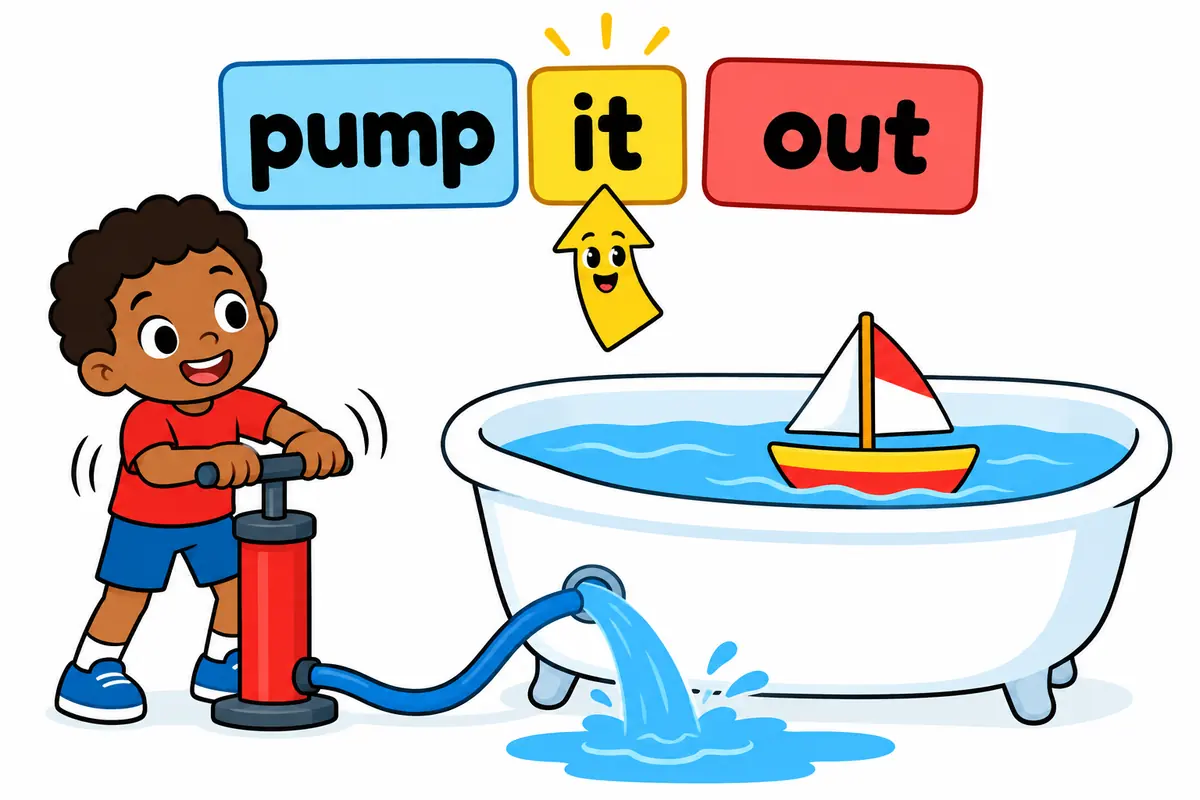
| pump + pronoun + out | Pump it out before it spreads. | A pronoun must sit between the parts. |
| pump out + produce sense | The plant pumps out a thousand units a day. | Bulk output from a source. |
| be pumped out | The air was pumped out of the chamber. | Passive voice keeps the removed substance in focus. |
| pump out + sound sense | The radio pumped out a steady beat. | A machine sends out sound or signal. |
The literal and production senses share the shape pump out plus object, so only context tells them apart. To emit a low hum names the same sending-out without the mechanical image, which suits scientific writing better than the vivid phrasal verb.
Pump out in a sentence: examples across contexts
Pump out keeps its sense of flow while the setting changes from a flooded cellar to a music venue. The twelve sentences below each name what is removed or produced, and the last three use near neighbours of the same verb.
| Context | Example sentence | Why this works |
|---|---|---|
| Emergency report | Crews pumped out the flooded underpass before dawn. | The literal sense names the substance removed. |
| Home repair | We pumped the water out and dried the floorboards. | The separable form keeps the object before out. |
| Engineering | The vacuum pump pumps out the air before the test. | A technical subject matches the literal sense. |
| Factory news | The plant pumps out fifty cars an hour. | The production sense states a fast rate. |
| Publishing | The studio pumps out a fresh episode every week. | Regular output from a single source. |
| Music review | The speakers pumped out a soaring chorus. | The sound sense describes loud, steady music. |
| Finance writing | The bank pumps out loans through its branch network. | A discouraging tone hints at quantity over care. |
| Sports report | The arena speakers pumped out the team anthem. | The sound sense sets a lively scene. |
| Conversation | The old heater pumps out plenty of warm air. | Everyday speech keeps the mechanical image. |
| Environmental note | The works pumped out fumes for an hour. | A source emits something unwanted. |
| Same base verb | They had to extract the trapped gas from the mine. | Extract is precise where pump out is physical and vivid. |
| Near neighbour | Officials chose to evacuate the flooded homes at once. | Evacuate moves people, while pump out moves liquid. |
| Shared particle | The gust made the candle blow out in an instant. | Same particle out, but blow out means to extinguish. |
The final rows are the useful warning: out appears in countless phrasal verbs, and each pair carries its own meaning. Pump out is about a driven flow, while blow out is about a sudden end.
Pump out vs spew out
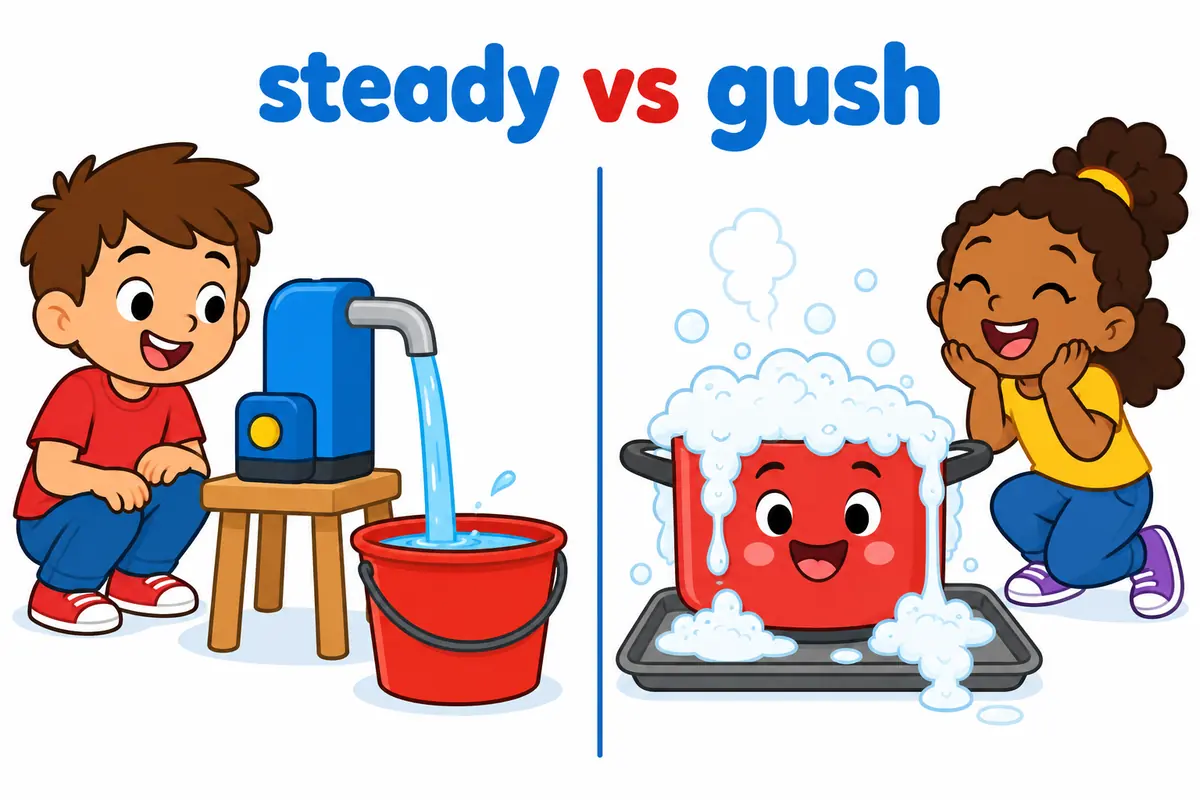
Pump out and spew out ash both describe sending something out in volume, yet the manner could hardly be more different. Pump out is controlled and steady, while spew out is forceful and uncontained.
| Attribute | pump out | spew out |
|---|---|---|
| Core manner | Steady and driven | Sudden and uncontrolled |
| Mechanism | A pump or a production line | Pressure, heat or violence |
| Typical object | Water, fuel, air, goods, songs | Lava, ash, smoke, abuse |
| Connotation | Regular, sometimes routine | Excessive and messy |
| Register | Neutral to technical | Vivid, often negative |
Verdict: choose pump out for a controlled flow or a brisk rate of production, and spew out when the release is violent, messy or unwanted.
Word forms and grammar of pump out
Pump out inflects on the verb pump, and the particle out stays fixed. The table also lists the near form pump up, which changes the meaning entirely.
| Form | Part of speech | Example |
|---|---|---|
| pump out | phrasal verb, base | We must pump out the tank tonight. |
| pumps out | third person singular | The station pumps out thousands of litres. |
| pumped out | past and past participle | They pumped out the cellar at dawn. |
| pumping out | present participle | The crew is pumping out the floodwater. |
| pump it out | correct pronoun order | Pump it out before the tide turns. |
| pump up | near form, different sense | Pump up the tyres before the trip. |
Keep produce the units in mind as the plainer alternative to the figurative sense, because pump out adds an image of machinery that formal writing may not want.
Common mistakes with pump out
- Incorrect:
Pump out it before the tide turns.Correct: Pump it out before the tide turns. Rule: A pronoun object must sit between pump and out. - Incorrect:
The cellar pumped out the water.Correct: We pumped the water out of the cellar. Rule: The thing holding the liquid is not the subject; the pump or the people are. - Incorrect:
They pumped out the air in the room slowly.Correct: They pumped the air out of the room slowly. Rule: The object goes before out, and the container takes of. - Incorrect:
The tap pumped out slowly all night.Correct: The tap dripped slowly all night. Rule: Pump out implies a driven, steady flow, not a drip. - Incorrect:
She pumped out the bike tyre at the garage.Correct: She pumped up the bike tyre at the garage. Rule: Pump up inflates, while pump out removes.
Practice using pump out
Work through the eight items, then read the reason beside each answer rather than only the key.
- Fill the gap: Fire crews ______ the water from the flooded basement.
- Choose the better word: The volcano (pumped out / spewed out) ash across the valley.
- Correct the error: Pump out it before the tank overflows.
- Build a sentence: use pump out about a factory making shoes in large numbers.
- Spot the register: which suits a news report — the plant pumps out fifty cars an hour, or the plant makes a whole lot of cars?
- Rewrite with the pronoun: Pump out the floodwater tonight. Use it instead of the floodwater.
- Choose the better word: Please (pump up / pump out) the tyres before we leave.
- Correct the error: The pipe pumped out a slow trickle all day.
Answers
- pumped out — the literal sense removes the water as object.
- spewed out — a violent, messy release suits spew, not the controlled pump.
- Pump it out before the tank overflows — the pronoun goes between pump and out.
- Model answer: The factory pumps out thousands of shoes every day.
- The plant pumps out fifty cars an hour — a report prefers the exact verb and rate.
- Pump it out tonight — the pronoun must sit between the two parts.
- pump up — inflating a tyre needs up, not out.
- The pipe trickled all day — a slow drip is not a pumped flow.
Pump out in formal and everyday writing
Pump out is welcome in everyday speech, trades and headlines, where its mechanical picture is an advantage. A plumber who says the pump will pump the water out in an hour is both precise and easy to picture, and a headline that a studio pumps out hits reads briskly without needing extra words. In these settings the phrase earns its place by naming the method as well as the result.
The production sense turns risky in formal writing, because it often implies that speed has replaced care. A report that says a factory pumped out faulty parts sounds more critical than one that says it produced or manufactured them, and a reviewer who describes a band pumping out albums may mean that each one was rushed. When the tone must stay neutral, produce, manufacture or release are the safer verbs.
The bottom line
Use pump out in a sentence when a machine drives liquid or air away, or when something is produced in volume and at speed. Two nuances decide most sentences: the verb is separable, so a pronoun goes between pump and out, and the figurative sense can sound faintly critical, because quantity may come before quality. Where the flow is slow or the release is messy, drip or spew out fits better, and where the tone must stay neutral, produce is the plainer verb.
Frequently asked questions about pump out
Is pump out one word or two?
It is two words, because pump is the verb and out is its particle. The pair never takes a hyphen and never becomes a single word, even in the past tense, where it appears as pumped out. Only pump changes form, while out stays fixed in every sentence.
What does pump out mean in music?
In music writing, pump out means to send out sound loudly and steadily, usually from speakers or a sound system. A sentence like the speakers pumped out a heavy beat treats the equipment as the source. The phrase is informal and lively, so a technical report would say emitted or played instead.
Is pump out separable?
Yes. Pump out is separable, so the object may follow the whole verb or sit between pump and out: crews pumped out the water, or crews pumped the water out. Both are correct. The one fixed rule is that a pronoun object must go in the middle, giving pump it out rather than pump out it.
What is the difference between pump out and pump up?
Pump out removes something, pushing liquid or air away from a container or sending goods and sound out. Pump up adds air to something to inflate it, as in pump up the tyres. The particles out and up reverse the direction, so the two phrases are never interchangeable.