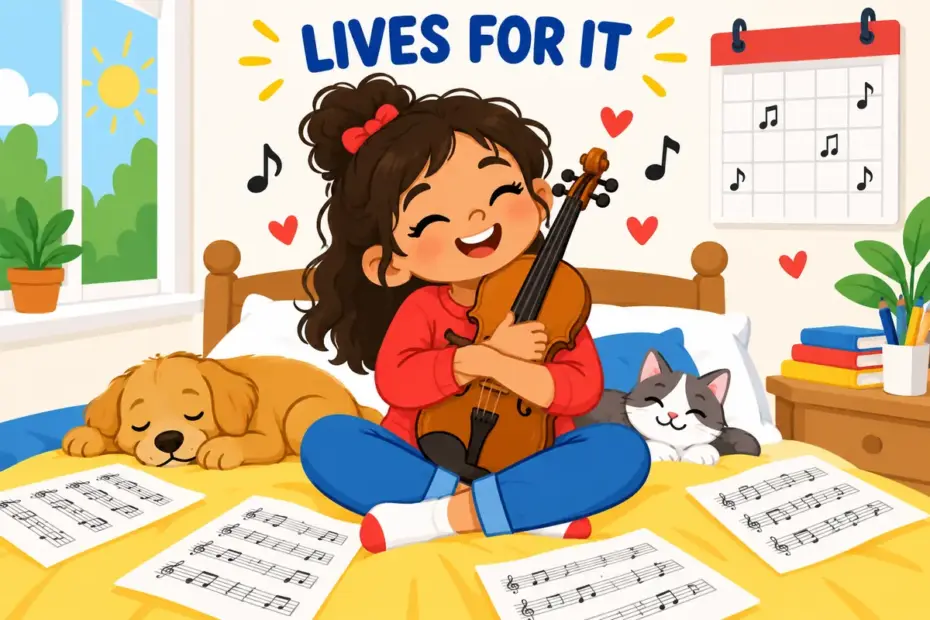
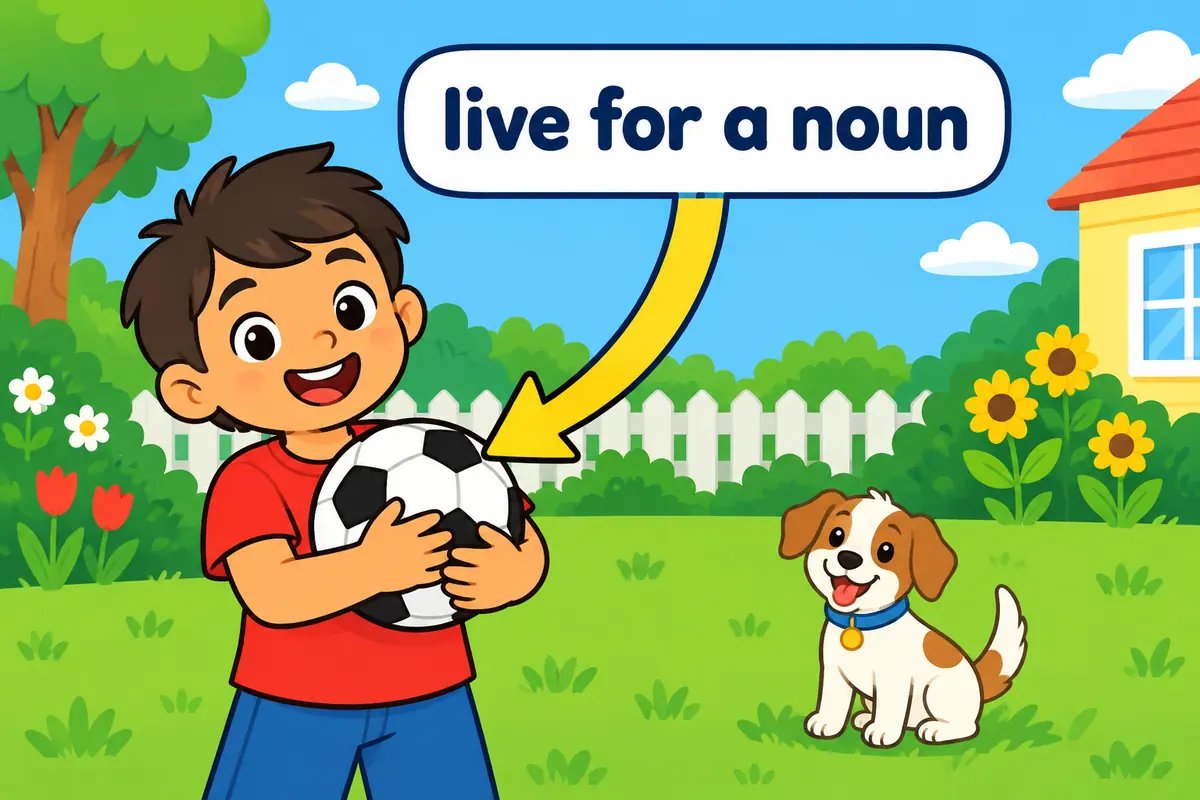
Live for means to value something so much that it shapes how you spend your life. To use live for in a sentence, name what the person treasures: “She lives for the weekend.” The phrase takes a direct object, so what someone lives for must always be stated.
Live for at a glance
- Live for is a phrasal verb that takes a direct object, as in live for music.
- Its forms are live for, lives for, lived for and living for.
- The object follows for and is never placed before it.
- The subject is a person; the object is a thing, an activity, a person or a time.
- Live for signals the centre of a life, not a mild preference.
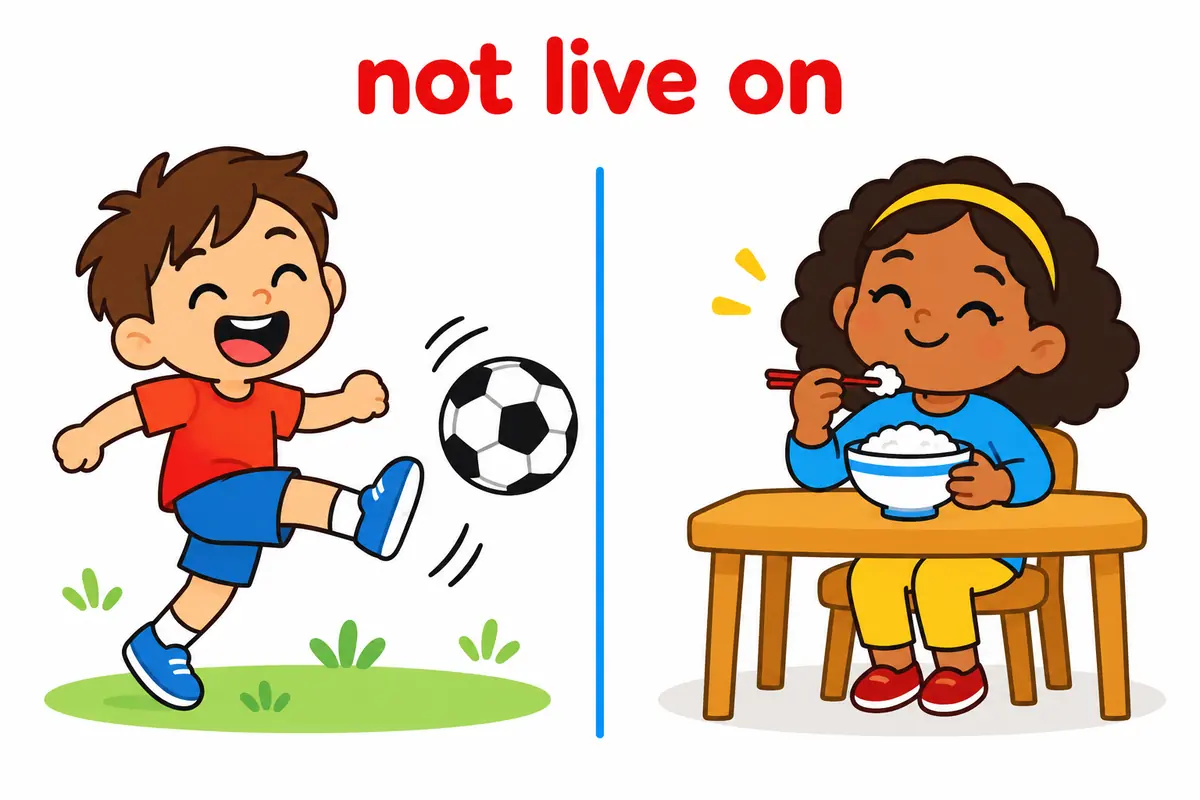
- Its commonest confusable is live on, which means survive on food or money.
What does live for mean?
Live for is a transitive phrasal verb meaning to treat something as the greatest source of enjoyment or purpose in your life. The Cambridge entry for live for records that sense of intense enjoyment. Where the feeling is gentler, adore fits better, and for objects and keepsakes the quieter word is treasure a gift.
| Sense | Plain meaning | Example sentence |
|---|---|---|
| Main purpose | Something that gives life its point | After the accident he lives for his garden. |
| Greatest pleasure | Something awaited with delight | The children live for the summer holidays. |
| Eager anticipation | A recurring event looked forward to | The whole town lives for the harvest festival. |
| Person at the centre | Somebody a life is organised around | She lives for her grandchildren. |
One limitation is worth stating plainly. Live for does not mean simply to like or to do often: it means the thing sits at the centre of a person’s attention, so a mild preference calls for enjoy instead. Where the object is merely pleasant, like or enjoy keeps the sentence accurate.
How do you use live for in a sentence?
Live for behaves like a transitive verb, so the thing valued always follows for. The phrase is inseparable, which rules out live it for, and the subject is almost always a person. Five patterns cover most sentences, and the object decides the shade of meaning.
| Pattern | Example | What it signals |
|---|---|---|
| subject + live for + noun | She lives for her grandchildren. | Names the person at the centre of that life. |
| live for + activity | He lives for surfing. | An activity as the object is the commonest form. |
| live for + recurring time | We live for Fridays. | A recurring period signals eager anticipation. |
| live for + the moment | The band lives for the moment on stage. | A fixed collocation stresses present pleasure. |
| live for + a cause | The volunteers live for the work they do. | Shows purpose rather than a pastime. |
| live for + a season | The shepherds live for the lambing season. | A recurring working period can be the object. |
Live for in a sentence: examples across contexts
Live for changes subject and register while keeping one meaning: something matters more than the rest of life. The twelve sentences below move from a family kitchen to a sports interview. In food writing, relish every bite is the natural phrase where live for would sound too large.
| Context | Example sentence | Why this works |
|---|---|---|
| Family | She lives for the evenings when all four children are home. | The time phrase names the centre of her routine. |
| Hobbies | He lives for the two hours he spends at the piano each night. | An activity as the object is the basic pattern. |
| Workplace | Our small team lives for the launch weeks. | The phrase reports shared enthusiasm. |
| Sports interview | I live for the last five minutes of a close match. | The first person suits quoted speech. |
| Travel writing | The islanders live for the week the boats return. | A seasonal event gives the object a rhythm. |
| Teaching | Good teachers live for the moment a hard idea clicks. | The object is an event rather than a thing. |
| Music review | The drummer lives for the final chorus. | A recurring musical moment is the object. |
| News feature | The whole village lives for the summer fair. | A collective subject shows shared anticipation. |
| Conversation | I live for a quiet Sunday with no plans. | Everyday speech keeps the object simple. |
| Coaching | She lives for the sessions that hurt a little. | The object can be demanding, not only pleasant. |
| Community | They live for the day the hall reopens. | A future event shows patient hope. |
| Academic prose | Participants reported that they live for their weekly club meeting. | A reported clause keeps the register formal. |
| Sport | The striker lives for the roar of the crowd. | The object is a sensation rather than an event. |
| Gardening | My father lives for the week the tomatoes ripen. | A seasonal task can be the centre of a life. |
Live for vs live on
Live for and live on look almost identical but answer different questions: one names what gives life meaning, the other what keeps a person alive. Cherish a memory is the gentler verb for valued things, while live for describes the centre of a working life.
| Attribute | live for | live on |
|---|---|---|
| Core meaning | Treat as life’s purpose | Survive using as food or money |
| Typical object | An activity, person or cause | Food, a small income, memories |
| Question answered | What gives life meaning? | What keeps body and soul together? |
| Feeling present | Strong positive emotion | Necessity, often hardship |
| Example | She lives for her garden. | They live on rice and beans. |
| Register | Warm and personal | Neutral to grim |
Verdict: choose live for when the object is a source of joy or purpose, and live on when the object is what a person survives with. If the point is a small income or a plain diet, only live on will do.
Word forms and grammar of live for
Live for keeps for fixed, and the object never moves. The same base verb appears in several other phrasal verbs with different particles.
| Form | Part of speech | Example |
|---|---|---|
| live for | phrasal verb, base | The team lives for match days. |
| lives for | present, third person | She lives for her music. |
| lived for | past and past participle | He lived for the summers he spent sailing. |
| living for | present participle | Living for the weekend can blur the working days. |
| live for + a noun | required pattern | Say she lives for music, not she lives music for. |
| live for for + to + verb | non-standard | Say she lives for dancing, not she lives for to dance. |
The base verb live also forms live down, which means to make people forget a mistake, and the particle for appears in call for a change, which means demand rather than value.
Common mistakes with live for
- Incorrect:
She lives her garden for.Correct: She lives for her garden. Rule: The particle for precedes the object and never moves after it. - Incorrect:
I live for the weekend to come.Correct: I live for the weekend. Rule: The object is a plain noun phrase, not a clause with to come. - Incorrect:
He lives for his computer to fix.Correct: He lives for fixing computers. Rule: Use a noun or a gerund after for, not an infinitive clause. - Incorrect:
The building lives for its tenants.Correct: The tenants live for the community garden. Rule: The subject must be a person or animal, because only they can value something. - Incorrect:
They live for their salary.Correct: They live off their salary. Rule: A salary keeps a person alive, so live off or live on fits; live for would mean the salary is their joy. - Incorrect:
We live for go to the coast.Correct: We live for trips to the coast. Rule: After for, use a noun or gerund rather than a bare verb.
Practice using live for
Work through the eight items, then read the answers for the reasoning rather than only the key.
- Fill the gap: After retiring, my grandfather ______ for his morning swim.
- Choose the better word: With no money for food, the refugees (lived for / lived on) bread and water.
- Correct the error: The puppy lives its ball for.
- Build a sentence: use live for about a weekly activity a teenager loves.
- Spot the register: which is warmer — I live for the moments my son laughs, or I enjoy my son’s laughter?
- Rewrite with a gerund: She lives for dance music that she can move to.
- Fill the gap: The whole village ______ for the day the ferry returns.
- Choose the better word: He (lives for / lives on) his garden, tending it every free hour.
Answers
- lives — the object follows for, and the morning swim is what gives his days their point.
- lived on — bread and water keep people alive, so live on fits; live for would mean joy.
- The puppy lives for its ball — the object is placed after for, never before it.
- Model answer: My cousin lives for Saturday football with his friends.
- I live for the moments my son laughs — live for reports warmth directly, while enjoy is flatter.
- She lives for dancing — a gerund works as the object after for.
- lives — the ferry’s return is the event the village awaits all year.
- lives for — he organises his days around the garden, which is joy rather than survival.
The bottom line
Use live for in a sentence when one thing sits at the centre of a person’s life and supplies its purpose or joy, and place that thing directly after for. Two details decide most sentences: the object is a noun or gerund rather than a clause, and the phrase is inseparable. For survival with food or money, choose live on instead.
Frequently asked questions about live for
Is live for one phrasal verb or two words?
Live for is a phrasal verb written as two words. The base is live and for is a fixed particle, so nothing can sit between them. The object always follows, as in she lives for music, and the phrase is never hyphenated.
What is the difference between live for and live on?
Live for names what gives life meaning, while live on names what keeps a person alive. She lives for her garden reports joy; she lives on fruit reports diet. Both use the same base verb, so the particle alone carries the whole difference.
Can live for be used about a person?
Yes. The object can be a person, an activity, a cause or a period of time, so a parent may live for the children and a fan may live for match days. The only limit is that the object must be a noun phrase, not a full clause.
Is live for formal or informal?
Live for is informal and warm, common in conversation, interviews and feature writing. A formal report would say the residents valued the garden rather than lived for it. Its intensity makes it a poor fit for neutral or academic prose.