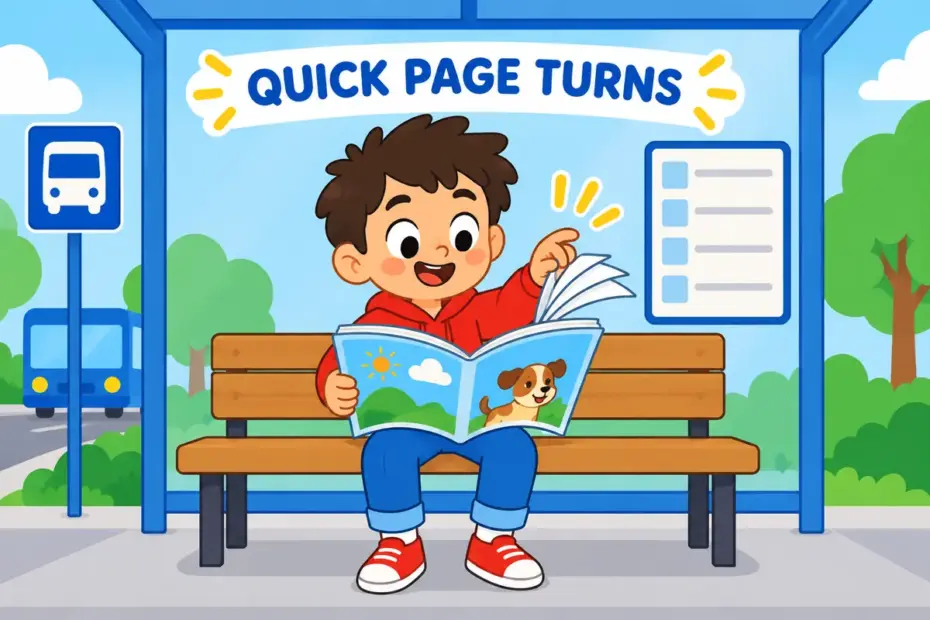
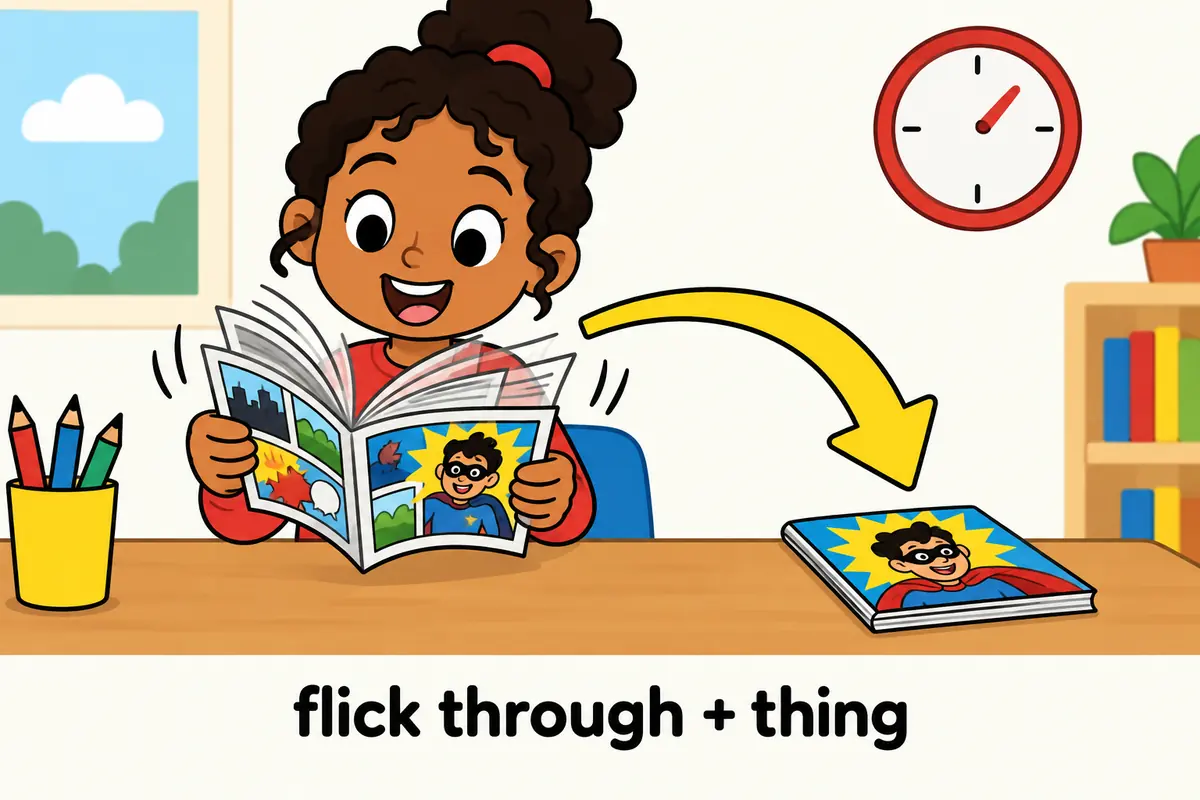
Flick through means to look quickly through a book, magazine or set of pages, turning them fast, or to change television channels one after another. To use flick through in a sentence, name what is being scanned: “She flicked through the magazine at the station.” The verb is transitive and its particle never moves.
Flick through at a glance
- Flick through is a transitive phrasal verb, so it always needs an object.
- The two main senses are browsing pages and changing television channels.
- The particle through stays with the verb and never separates from it.
- Typical objects are magazine, pages, photos, channels and pile of letters.
- The commonest learner error is saying flick the magazine through instead of flick through the magazine.
What does flick through mean?
Flick through is a phrasal verb meaning to look over something quickly by turning its parts one after another, with little reading and much movement. The Cambridge entry for flick through covers the sense of looking at a magazine or book quickly, and the same motion extends easily to channels on a screen. The verb is transitive, so a reader always flicks through something, and the particle through never leaves the verb.
| Sense | Plain meaning | Example sentence |
|---|---|---|
| Browse a publication | Turn pages fast with little reading | He flicked through the magazine in the waiting room. |
| Change channels | Move from one channel to the next | She flicked through the channels and found a match. |
| Scan a pile of paper | Look quickly through documents | I flicked through the letters before the meeting. |
| Glance at photos | Move quickly from picture to picture | We flicked through the holiday photos on his phone. |
One limitation is worth stating plainly. Flick through never means to read carefully, and it never means to search in earnest. If the goal is understanding, run through the argument is the closer verb, because it implies at least one full pass. Flick through keeps the eye moving, and that movement is the whole point.
How do you use flick through in a sentence?
Put the thing being scanned straight after the verb, because flick through is transitive: flick through the magazine, flick through the channels. The particle through is fixed, so it never splits from flick in an active sentence, and the object never squeezes between the two words. Five patterns cover almost every natural line.
| Pattern | Example | What it signals |
|---|---|---|
| flick through + publication | He flicked through the newspaper at breakfast. | The object names what is being scanned. |
| flick through + channels | They flicked through the channels all evening. | The screen sense keeps the same quick motion. |
| flick through + pages | She flicked through the pages without reading. | The extra phrase stresses the lack of reading. |
| flick through + it | I flicked through it on the train. | A pronoun still follows the whole verb. |
| be flicked through | The catalogue was flicked through and discarded. | The passive keeps the object in front. |
Flick through in a sentence: examples across contexts
Flick through keeps the same quick rhythm in every register, but the object tells you where you are. The twelve sentences below move from a school library to a news desk, and each one makes clear how little reading is happening.
| Context | Example sentence | Why this works |
|---|---|---|
| Classroom | Pupils flicked through the picture books before the bell. | A concrete object and a deadline keep it simple. |
| Library | He flicked through three atlases looking for the island. | The number shows the speed of the search. |
| Living room | She flicked through the channels during the adverts. | The screen sense suits a casual setting. |
| Workplace email | I flicked through the draft and sent two notes. | The quick pass is honest about its shallowness. |
| News report | The editor flicked through the copy before the deadline. | A senior reader implies a fast, routine check. |
| Conversation | I only flicked through it, so do not quote me. | The disclaimer explains the lack of depth. |
| Travel writing | Travellers flicked through the guide on the ferry. | The setting explains why the reading is rushed. |
| Academic prose | Reviewers often flick through the appendices first. | The habit is described, not criticised. |
| Bookshop scene | She flicked through the opening pages and bought it. | The fast scan leads to a firm decision. |
| Retail writing | Customers flick through the catalogue for offers. | A commercial context keeps the aim practical. |
| Story scene | He flicked through the letters, then read one twice. | The contrast slows the sentence at a key moment. |
| Digital media | Readers flick through the feed faster than they read. | The verb extends to scrolling screens. |
Two features repeat. The subject is always a person doing the scanning, and the object is always a pile of things with discrete parts, whether pages, letters or channels. Nothing is read, examined or judged in depth.
The magazine example is the one to keep in mind because it is the plainest. A single vivid object, a clear action and no claim about understanding make the sentence honest and easy to picture.
Flick through vs skim through
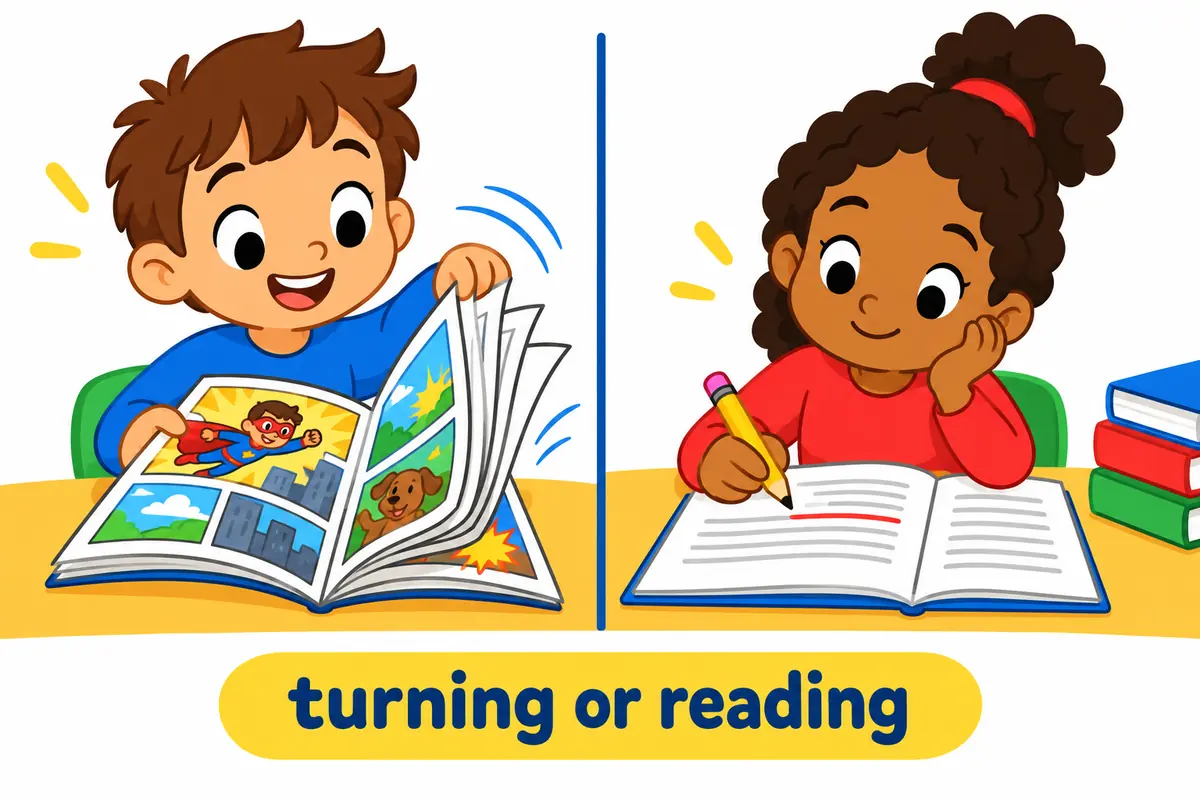
Flick through and skim through both describe a fast pass, but they disagree about attention. Flicking is about the hand as much as the eye, while skimming is a genuine reading skill aimed at the main points.
| Attribute | flick through | skim through |
|---|---|---|
| Speed and action | Very fast, page by page | Fast but more deliberate |
| What the reader does | Turns and glances | Reads quickly for the gist |
| Typical object | Magazine, photos, channels | Report, article, chapter |
| Purpose | Browse or pass the time | Grasp the main ideas |
| Implies understanding | Almost none | Some, by design |
Verdict: choose flick through when the reader is browsing and the goal is simply to see what is there, and skim through when the reader wants the main points quickly. When a person works through every page with care instead, sift through the evidence is the phrase that fits, because sifting implies judging as well as looking.
Word forms and grammar of flick through
Flick through inflects like a regular verb and keeps its particle in every tense. The table also separates it from the plain verb flick, which takes an object such as a switch, and lists the near-synonyms that writers often reach for instead.
| Form | Part of speech | Example |
|---|---|---|
| flick through | phrasal verb, base form | Do not flick through the exam paper early. |
| flicks through | phrasal verb, third person singular | She flicks through the news each morning. |
| flicked through | phrasal verb, past tense | He flicked through the album twice. |
| flicking through | phrasal verb, present participle | They were flicking through the channels. |
| flick | verb, transitive, separate meaning | Flick the switch to turn it on. |
| leaf through | phrasal verb, near-synonym | He leafed through the programme. |
The difference from plain flick is worth remembering: a hand flicks a switch in one movement, but a reader flick through a whole object over several seconds. The related preposition throughout covers the spread of something across an entire period, which is a different job again. When a reader checks every item in order, go through the list reports the slower, fuller pass, and a promise kept to the end is one you follow through on, which is unrelated to turning pages fast.
Common mistakes with flick through
- Incorrect:
She flicked the magazine through.Correct: She flicked through the magazine. Rule: the particle never separates from the verb in an active sentence. - Incorrect:
He flicked through.Correct: He flicked through the report. Rule: flick through is transitive, so the object cannot be left out. - Incorrect:
We flicked through the whole film last night.Correct: We watched the whole film last night. Rule: flick through fits pages and channels, not a single long programme. - Incorrect:
They flicked through the problem.Correct: They glossed over the problem. Rule: flick through is physical browsing, not avoiding a topic. - Incorrect:
He flicked through to page forty.Correct: He flicked to page forty. Rule: through implies many pages; use to for one destination. - Incorrect:
The wind flicked through the pages of the book.Correct: The wind turned the pages of the book. Rule: flick through needs a person doing the scanning.
Practice using flick through
Work through the eight items, then check the reasoning rather than only the answer.
- Fill the gap: She ______ through the magazine while she waited.
- Choose the better word: The manager asked us to (flick through / skim through) the report properly before the vote.
- Correct the error: He flicked the catalogue through in a minute.
- Build a sentence: use flick through the channels about a rainy evening.
- Spot the register: which suits a bookshop review — readers flick through the first pages, or readers flick the first pages through?
- Rewrite in the passive: Somebody had flicked through the file. Start with The file.
- Fill the gap with a pronoun: The leaflet was on the table, so I flicked ______ it.
- Correct the error: She flicked through to the last page for the answer.
Answers
- flicked — the past tense matches the finished browse, and the object follows the whole verb.
- skim through — proper reading for the main points is skimming, not flicking.
- He flicked through the catalogue in a minute — the particle stays after flick.
- Model answer: We flicked through the channels on the rainy evening.
- Readers flick through the first pages — the object belongs after the whole verb.
- The file had been flicked through — the passive keeps the object in front and strands through at the end.
- through — a pronoun still follows the complete verb, so write flicked through it.
- She flicked to the last page — through suggests many pages, so use to for one jump.
The bottom line
Use flick through in a sentence when somebody scans pages or channels quickly and reads almost nothing, and keep the object after the whole verb. The two points that settle most sentences are transitivity and the fixed particle: something is always flicked through, and through never moves. When the reader actually wants the main points, skim through is the more honest verb.
Frequently asked questions about flick through
Is flick through separable?
No. Flick through is an inseparable phrasal verb, so the particle always stays with the verb in an active sentence. You write she flicked through the magazine, never she flicked the magazine through. A pronoun does not change this, because it also follows the whole verb, as in she flicked through it.
Does flick through need an object?
Yes. Flick through is transitive, so it always takes an object such as a magazine, a pile of letters or a set of channels. A sentence that stops at he flicked through is incomplete and leaves the reader waiting for the thing being scanned. Name the object and the sentence stands on its own.
Can flick through mean changing TV channels?
Yes, and the sense is very common. Because the motion is the same quick jump from one item to the next, flick through the channels is a natural extension of flick through a magazine. Both keep the idea of fast movement with little attention, and neither suggests that anything was watched or read properly.
What is the difference between flick through and skim through?
Flick through is physical browsing with almost no reading, driven by the hand turning pages. Skim through is a deliberate reading skill aimed at grasping the main points quickly. Flicking answers the question of what is there, while skimming answers the question of what it says, so the two are close but not interchangeable.