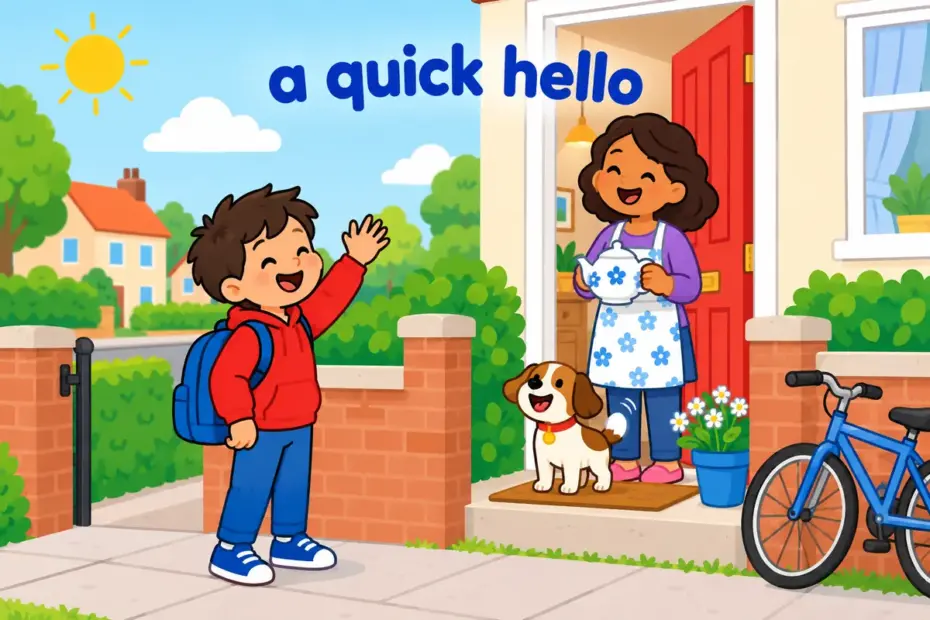
Pop in means to visit someone briefly and informally, usually without arranging it in advance. To use pop in in a sentence, name the person or place and keep the tone casual: “I will pop in after work.” The phrase is chiefly British and takes on or to when you add who or where.
Pop in at a glance
- Pop in is an intransitive phrasal verb in its main sense, so it takes no object.
- It means to make a short, informal visit, often with no warning.
- The phrase is common in British English and rare in American usage.
- A second, separable sense means to put something in quickly: pop it in the post.
- The commonest error is using it for a formal appointment or a long stay.
What does pop in mean?
Pop in is a phrasal verb meaning to go into a place or visit someone for a short time, usually without planning. The Cambridge entry for pop in records the short-visit sense, and the same particle carries two other jobs: entering briefly, and putting an object somewhere with a quick movement.
The visit sense is the one readers meet most. A neighbour pops in for a cup of tea, a carer pops in twice a day, and a shopper pops in to the corner shop. The put sense is transitive and separable, so the object can sit after in or between pop and in, and that difference in grammar is the main thing to learn.
| Sense | Plain meaning | Example sentence |
|---|---|---|
| Short visit | See someone briefly and informally | The neighbour popped in for a chat. |
| Enter briefly | Go into a place for a moment | She popped in to the bakery on her way home. |
| Put in quickly | Place an object inside something | Pop your coat in the wash. |
| Appear briefly | Come into view for a moment | A rabbit popped in through the hedge. |
One limitation is worth stating plainly. Pop in is informal and strongly associated with British speech, so it sounds wrong in a formal notice; a business letter would say call in or visit. It also means a short stay, so a two-week holiday is never a pop in. Where a planned, brief stop is meant, stop by is the more neutral phrase.
How do you use pop in in a sentence?
The visit sense is intransitive, so the particle never separates and no object follows it. The put sense is transitive and separable, so a noun object may follow in or split pop and in, and a pronoun must split them. The particle can also strand in the passive of the put sense.
| Pattern | Example | What it signals |
|---|---|---|
| pop in (intransitive) | I popped in for a coffee. | No object is possible; the phrase stands alone. |
| pop in on + person | She popped in on her aunt. | On marks the person who receives the visit. |
| pop in to + place | He popped in to the shop. | To marks the place that is entered. |
| pop + object + in | Pop your keys in the bowl. | The separable put sense, with the object in the middle. |
| pop + pronoun + in | Pop it in the fridge. | A pronoun must split the phrase; pop in it is wrong. |
| pop in + object | Pop in a coin to start the machine. | The put sense with a short object after the particle. |
Two other phrasal verbs with the same particle, call in and butt in, differ in whether they take an object, so separability should be tested phrase by phrase rather than assumed.
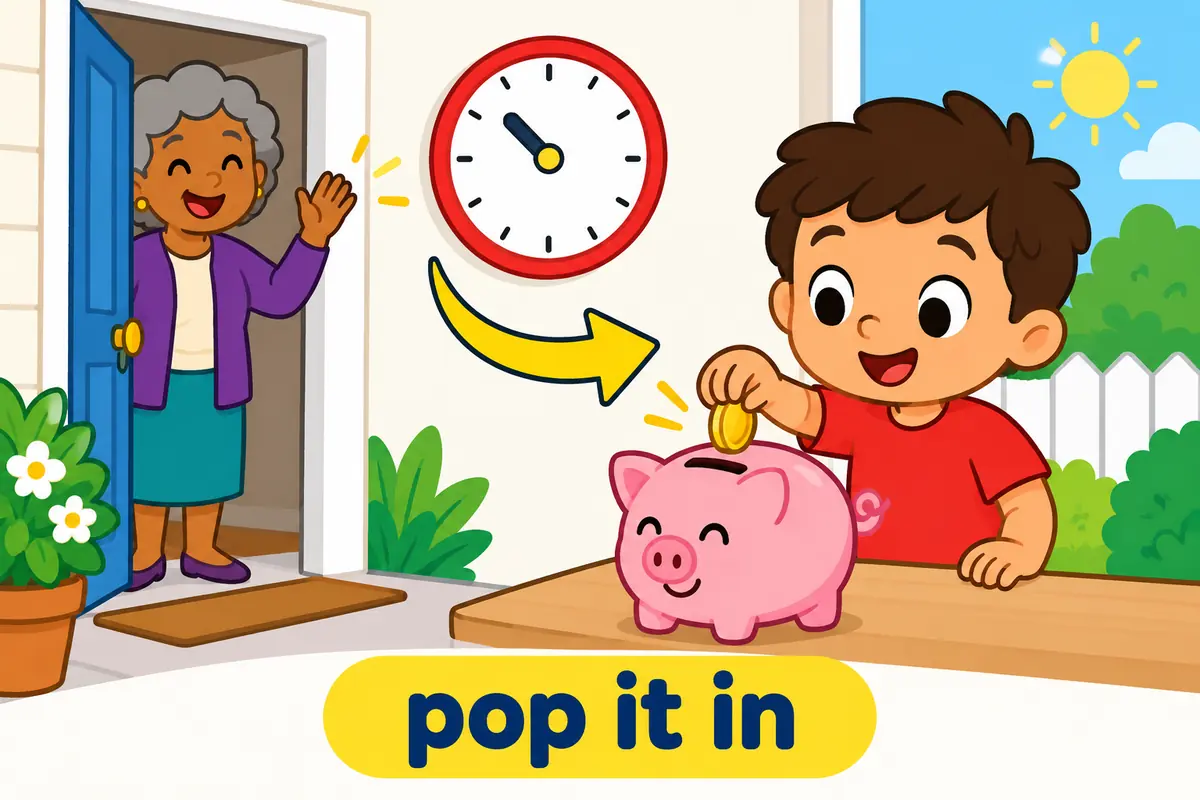
Pop in in a sentence: examples across contexts
The phrase keeps its shape while the setting changes, and each sentence below names the part of the sense doing the work.
| Context | Example sentence | Why this works |
|---|---|---|
| Conversation | I will pop in on Gran after the match. | The core visit sense with the on pattern. |
| Workplace email | I will pop in to the office before the meeting. | The to pattern, marking a brief stop at a place. |
| Neighbourhood | The postman pops in for a cup of tea each Friday. | A repeated short visit, naturally British. |
| Care work | A carer pops in twice a day to check the heating. | Shows a short scheduled call made in an informal way. |
| Parenting | Pop your shoes in the cupboard before dinner. | The separable put sense with a clear object. |
| Retail writing | Shoppers pop in for a loaf and leave with a basket. | The enter-briefly sense with a light, friendly tone. |
| News report | The minister popped in to a local cafe before the speech. | An informal phrase used to humanise a formal figure. |
| Nature writing | A wren popped in through the open window. | The appear-briefly sense, drawing on the same particle. |
| Instruction | Pop in a coin and press the green button. | The put sense with a short object after the particle. |
| Conversation | Pop it in the post on your way past. | A pronoun forces the split, a useful test of the put sense. |
Pop in vs drop in, call in and stop by
Pop in overlaps with three nearby phrases and is interchangeable with none of them. drop in also means an unplanned visit but is more common in American English, call in suggests a formal or purposeful stop, and visit is the neutral word for any length of stay.
| Attribute | pop in | drop in | call in | visit |
|---|---|---|---|---|
| Core job | Make a short informal visit | Visit without planning | Stop for a purpose | Spend time at a place |
| Implies brevity | Strongly, it must be short | Usually short | Short but purposeful | No, the stay can be long |
| Region | Chiefly British | Common in American English | Both, often formal | Both, neutral |
| Typical partner | on a person; to a shop | on a friend | to collect, on a patient | a museum, a relative |
| Tone | Warm and casual | Light and casual | Businesslike | Neutral |
Verdict: choose pop in for a warm, short, unplanned call in British English, drop in for the same idea in American usage, call in when the stop has a purpose, and visit when the length of the stay is open.
Word forms and grammar of pop in
The verb inflects regularly, and the phrase has no separate noun. The table also lists the compound spelling that appears in a few attributive phrases.
| Form | Part of speech | Example |
|---|---|---|
| pop in | phrasal verb, base form | Do pop in if you are passing. |
| pops in | verb, third person singular | She pops in most mornings. |
| popped in | verb past; adjective | He popped in at noon; a popped-in visit. |
| popping in | present participle | We are popping in later. |
| pop-in | attributive adjective, rare | a pop-in centre for new parents |
| pop out | related phrasal verb | I will just pop out for a minute. |
The base verb has a large family, and a related phrase, pop off, carries a very different meaning from the same verb. The general verb arrive covers the moment of reaching a place without the informality of pop in.
Common mistakes with pop in
- Incorrect:
We popped in for the whole weekend.Correct: We stayed for the whole weekend. Rule: pop in means a short visit, so it cannot describe a long stay. - Incorrect:
She popped in him on the way home.Correct: She popped in on him on the way home. Rule: a person is visited with on, so the pronoun follows the whole phrase. - Incorrect:
Pop in it the box.Correct: Pop it in the box. Rule: in the put sense a pronoun object must split pop and in. - Incorrect:
I will pop in you tomorrow.Correct: I will pop in on you tomorrow. Rule: on introduces the person who receives the visit, not a bare pronoun after in. - Incorrect:
He popped in a meeting yesterday.Correct: He popped in to a meeting yesterday. Rule: a place takes to before the noun in the visit sense.
Practice using pop in
Work through the seven items, then check the reasoning rather than only the answer.
- Fill the gap: I will ______ ______ on my grandmother after lunch.
- Choose the better phrase: A nurse (pops in / visits for a fortnight) to change the dressing.
- Correct the error: Pop in it the drawer before you go.
- Build a sentence: use pop in on about a friend who is unwell.
- Spot the register: which fits a formal notice — relatives may pop in daily, or relatives may call in daily?
- Rewrite with a pronoun: Pop the parcel in the post. Use it instead of the parcel.
- Explain the grammar: why does pop in take no object in the visit sense but needs one in the put sense?
Answers
- pop, in — the two-word phrasal verb forms one verb phrase before on.
- pops in — a short routine call suits the phrase, while a fortnight is far too long.
- Pop it in the drawer — a pronoun object must split pop and in.
- Model answer: I will pop in on Sam with some soup and a book.
- Relatives may call in daily — a formal notice prefers the neutral phrase.
- Pop it in the post — the pronoun sits between the verb and the particle.
- The visit sense is intransitive and means going somewhere, while the put sense is transitive and must say what is placed inside.
The bottom line
Use pop in in a sentence for a short, friendly visit, and keep it informal and chiefly British. The two decisions that settle most sentences are the sense and the grammar: the visit sense is intransitive and takes on for a person or to for a place, while the put sense is separable, so a pronoun must split pop and in. For a planned or formal stop, call in or visit reads better.
Frequently asked questions about pop in
Is pop in used in American English?
Pop in is understood in the United States but belongs mainly to British English, where it is common in speech. American speakers are more likely to say drop in or stop by. The difference is one of habit rather than meaning, since all three describe a short visit made without much planning.
Can you pop in on someone at work?
Yes, and the phrase is common in offices, but it suits a brief, friendly call rather than a scheduled appointment. Pop in on a colleague for a quick question works well; pop in on a client for a formal review does not. Match the phrase to the informality of the visit.
What does pop in for a coffee mean?
It means to make a short, casual visit with no fixed length, usually to see someone and have a quick drink together. The coffee is incidental; the point is the brief social call. It never suggests a long afternoon, which is what separates the phrase from a planned visit.
Does pop in take an object?
In the visit sense, no, so nothing follows in and the phrase stands alone. In the put sense it does take an object, and the object may follow in or split the phrase: pop your keys in or pop your keys in the bowl. A pronoun must always split the two words.