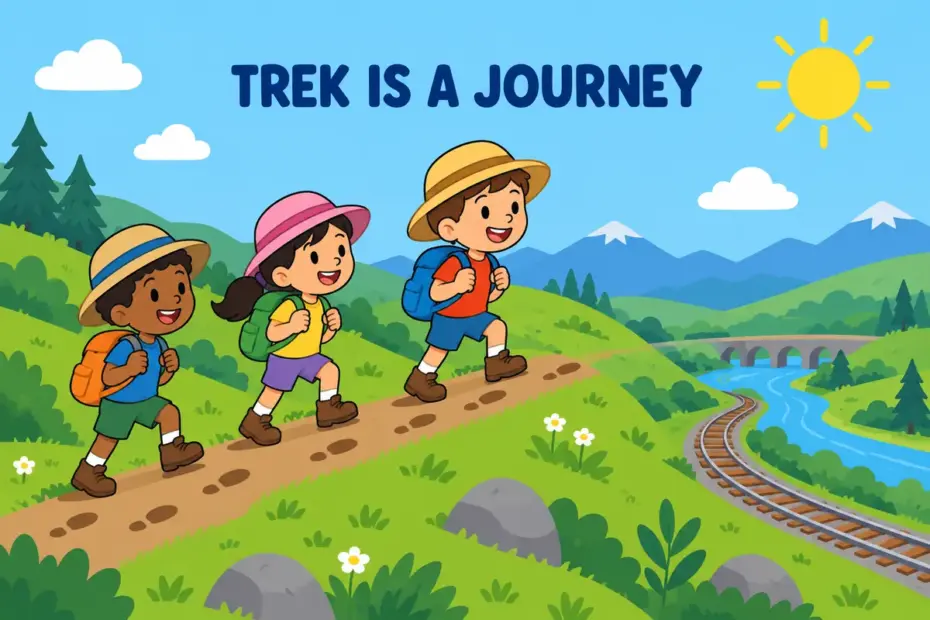
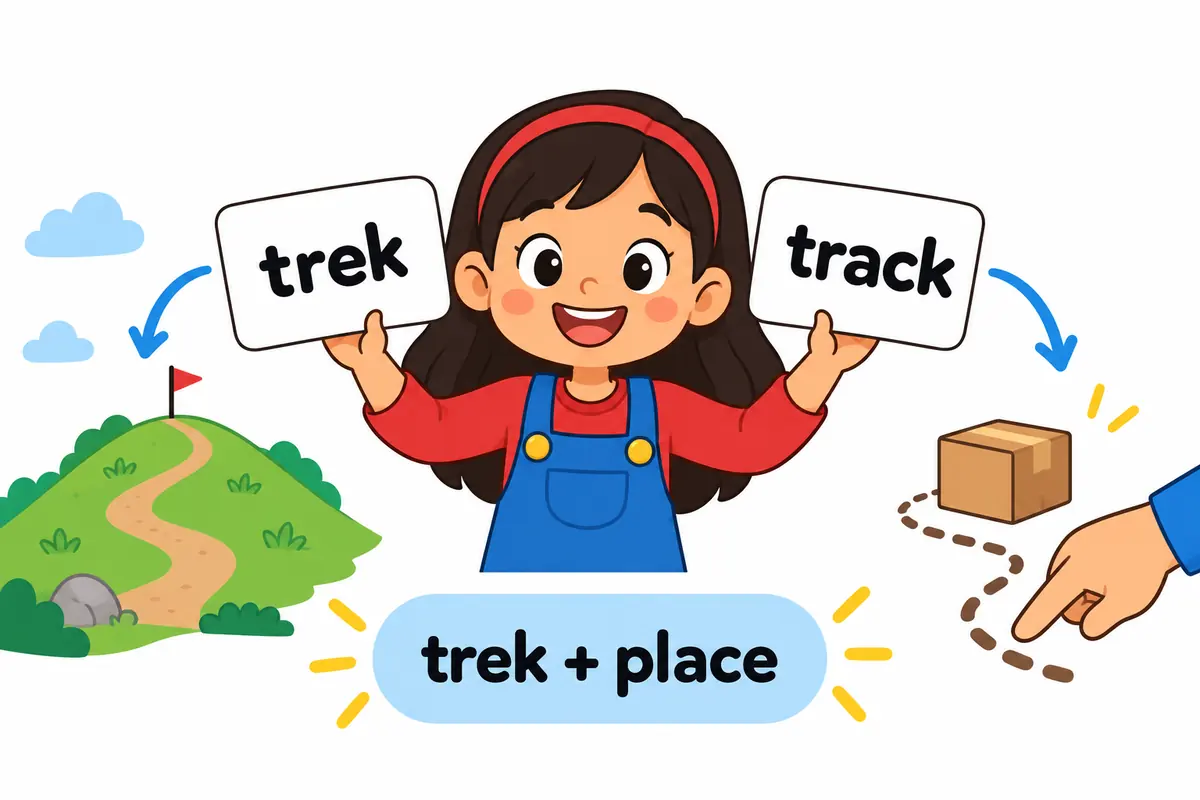
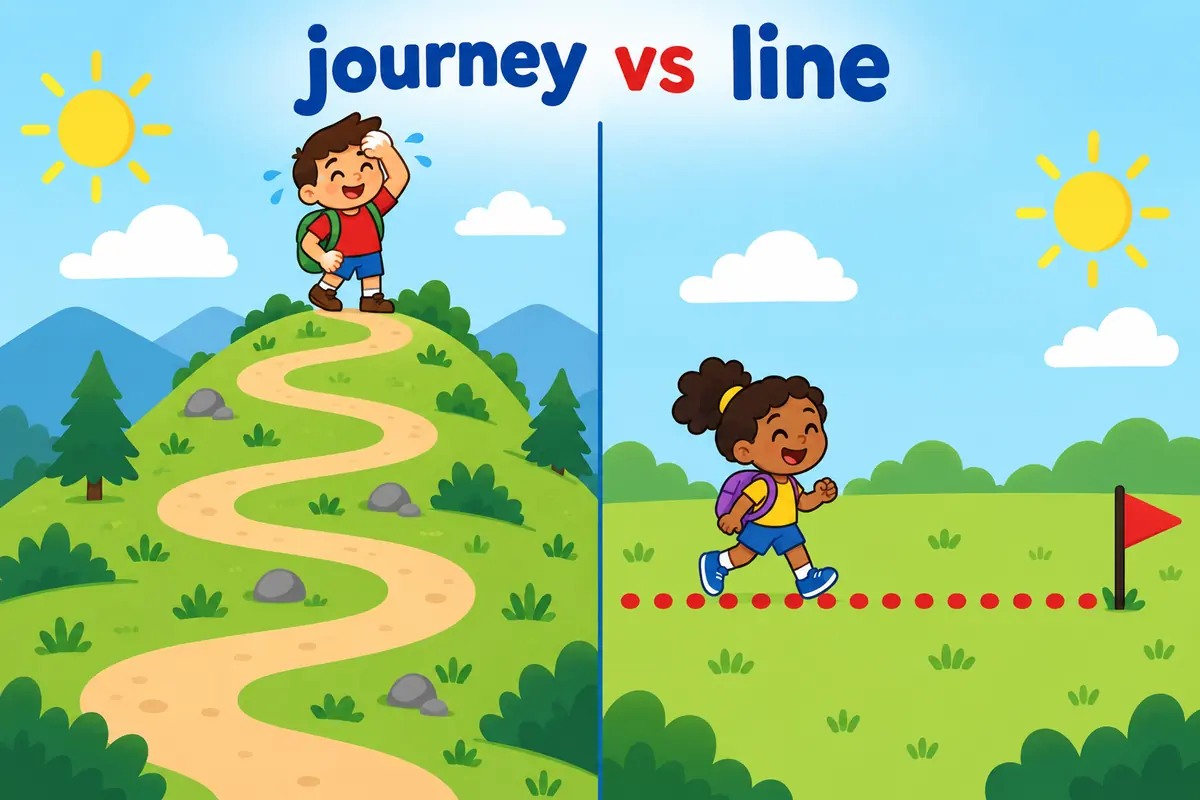
Trek vs track is easy to settle once you name the job each word does: trek is a long, hard journey on foot, while track is the path, rail line or mark left behind. “We trekked six hours to the ridge” walks; “the track curved uphill” does not.
Trek vs track at a glance
- Trek is a noun and a verb, and track is also both, so word class alone does not separate them.
- Trek carries distance, effort and often rough ground; track stays neutral about effort.
- The commonest learner error is using track for a journey and trek for a path.
- Trek is rarer and more emphatic, while track is far more frequent and more literal.
- Trek takes no direct object, but track usually does when it means to follow.
Trek vs track: the master comparison
| Criterion | Trek | Track |
|---|---|---|
| Core meaning | A long, hard journey on foot | A path, rail line or mark left by movement |
| Word class | Noun and verb | Noun and verb |
| Typical subject | People or animals moving over distance | Paths, railways, runners, software |
| Effort implied | High and sustained | None; the word stays neutral |
| Register | Travel writing, narrative, slightly literary | Everyday, sporting and technical writing |
| Quick test | Would you call the journey exhausting? | Is the thing a line or a trace? |
Which should you use?
Most sentences need only one of the two words, and the situation decides it.
| Situation | Choose | Example |
|---|---|---|
| Describing a tiring walk in the hills | trek | They trekked from the valley to the pass before dusk. |
| Naming the path itself | track | The track narrowed to a single rut near the gate. |
| Following a parcel or a trend | track | Customers can track the order without an account. |
| Writing about a rail route | track | Engineers relaid the track after the flood. |
| Reporting a migration or pilgrimage | trek | Families trek south each year with the herds. |
What does trek mean and what does track mean?
Trek is a noun and a verb meaning a long, difficult journey on foot. The Cambridge entry for trek places the noun at a journey made on foot and the verb at making that journey. Because effort is the point, trek rarely describes a short walk; you would not trek to the corner shop. The dedicated trek page shows the word carrying that emphasis through travel writing.
Track is a noun and a verb meaning the path, rail line or mark left by movement, and by extension the act of following something. The Cambridge entry for track gathers these senses around a line or a trace. Where trek names the journey, track in a sentence names either the line you walk along or the evidence you leave behind.
| Word | Sense | Example |
|---|---|---|
| trek (noun) | A long, hard journey on foot | The three-day trek crossed two ridge lines. |
| trek (verb) | To make such a journey | They trekked home through freezing rain. |
| track (noun) | A narrow path or course | A muddy track led to the farm. |
| track (noun) | A mark or trail left behind | Fresh tracks crossed the snow. |
| track (noun) | A rail line | The train waited on the outer track. |
| track (verb) | To follow the progress of something | The app tracks your weekly runs. |
One limitation is worth stating plainly. Trek does not mean any trip: a flight, a drive or a short stroll is not a trek, because the word insists on foot power and difficulty. Track, in turn, says nothing about who moves or why, so it can sound cold where a warmer word belongs.
How do you use trek and track in a sentence?
Both words change class, so the pattern depends on the job in the sentence. Five patterns cover most real uses, and the object test is the fastest guide.
| Pattern | Example | What it signals |
|---|---|---|
| trek + to/through/across + place | We trekked through the pine forest. | Movement toward a goal; no object needed. |
| go on a trek | They went on a trek in the highlands. | Names the journey as an event or package. |
| track + object | She tracked the parcel all week. | A direct object is required; someone follows something. |
| track + down | Police tracked down the previous owner. | Finding a person or thing after a search. |
| on track / off track | The project is on track for June. | Progress judged against a plan. |
Trek and track in a sentence: examples across contexts
Register is where the two words separate most clearly. The nine sentences below keep the same contrast while moving from a classroom to a news desk.
| Context | Example sentence | Why this works |
|---|---|---|
| Classroom | The class trekked to the museum when the bus failed to arrive. | An everyday let-down supplies the difficulty trek needs. |
| Workplace email | We will track the shipment daily until it clears customs. | Tracking progress is the standard business sense of track. |
| News report | Rescuers trekked for nine hours to reach the stranded walkers. | Distance and effort justify the stronger word. |
| Travel writing | A faint track wound around the lake before vanishing in reeds. | Track names the route the writer can see. |
| Sports report | The sprinter stayed on track for a personal best. | The idiom judges progress against a target. |
| Technical writing | Sensors track the temperature every thirty seconds. | Instrumental subject plus object, the neutral register. |
| Conversation | We got lost because the track gave out at the stream. | Everyday speech keeps track concrete and physical. |
| History essay | Herdsmen trekked the same pass for centuries. | Habitual trekking across time suits formal narration. |
| Weather bulletin | Forecasters are tracking a second storm from the west. | Following a moving system is a settled use of track. |
Notice that every tracking sentence has an object and no trekking sentence does. That single difference prevents most errors.
Word forms and grammar of trek and track
Both verbs inflect regularly, but trek doubles its final consonant and track does not. The table lists the forms learners most often misspell.
| Form | Part of speech | Example |
|---|---|---|
| trek | verb, base form | Volunteers trek the coastal path each spring. |
| trekked | verb, past and past participle | We trekked twelve kilometres before lunch. |
| trekking | verb, present participle | Trekking in July means carrying more water. |
| treks | verb, third person singular | She treks to the village twice a week. |
| track | verb, base form | Analysts track the price every morning. |
| tracked | verb, past and past participle | Radar tracked the aircraft across the coast. |
| tracking | verb, present participle | Tracking wildlife requires patience. |
| tracker | noun | A fitness tracker counted her steps. |
Keep the spellings apart: a trail may be tracked, but trekking never becomes an -ing form without its second k.
Common mistakes with trek and track
- Incorrect:
We tracked three days to the summit.Correct: We trekked three days to the summit. Rule: Track needs a thing being followed; a hard journey on foot takes trek. - Incorrect:
The path trekked up the hill.Correct: The path climbed up the hill. Rule: A path cannot trek, because trekking requires an effort-making traveller. - Incorrect:
She trekked the missing dog.Correct: She tracked the missing dog. Rule: Tracking takes an object; trekking does not, so the object test separates them. - Incorrect:
They went on a track through the valley.Correct: They went on a trek through the valley. Rule: Go on a trek names the journey, while a track is the surface you walk on. - Incorrect:
The hikers followed the trek for miles.Correct: The hikers followed the track for miles. Rule: You follow a track; you undertake a trek.
Practice using trek and track
Work through the six items, then check the reasoning rather than only the key.
- Fill the gap: After the storm, we ______ four hours to reach the village.
- Choose the better word: Rangers (track / trek) the herd by radio collar.
- Correct the error: The runners trekked their split times on a wall chart.
- Build a sentence: use go on a trek about a school trip to the hills.
- Spot the register: which belongs in a railway report — engineers inspected the track, or engineers inspected the trek?
- Combine both: write one sentence using trek and track together.
Answers
- trekked — the sentence describes hard travel on foot, which is exactly the job of trek.
- track — the rangers follow the herd, so a direct object follows the verb.
- The runners tracked their split times on a wall chart — following data needs track, not trek.
- Model answer: Our class went on a trek across the moor and camped by a stream.
- Engineers inspected the track — a railway has tracks, never treks.
- Model answer: We tracked the old route on the map, then trekked it the next morning.
The bottom line
Choose trek for a long, hard journey on foot and track for the path, rail line or mark that movement leaves. Trek never takes an object, while track almost always does when it means to follow, and that single test resolves trek vs track in nearly every sentence. Where you simply mean a short walk, a hike is the plainer word.
Frequently asked questions about trek vs track
Is a trek the same as a hike?
A hike is a walk for pleasure, usually a few hours on a marked route. A trek is longer and harder, often over several days and sometimes with a purpose beyond enjoyment. The difference is degree rather than kind, so a gentle afternoon out is a hike, while a week on a mountain trail is a trek.
Can track mean a song?
Yes. In music, a track is one recorded piece on an album or playlist, and the sense grew from the idea of a groove or line. Context makes it clear: a running track is a surface, a train track is a rail line, and a favourite track is simply a song. None of these senses involves walking.
Why do people say keep track?
Keep track means to stay aware of something as it changes, and it borrows the image of following a trail so you do not lose it. The phrase is fixed, so you keep track of a budget or of time. You would not say keep trek, because trek carries no sense of monitoring.
Is trek always about walking?
Trek usually means travelling on foot, and it rarely fits a car or a plane. The word can stretch to any slow, effortful journey, so writers sometimes say a trek across the desert or a trek through paperwork. Even then, the sense of difficulty and duration remains, which is what keeps the word distinct.