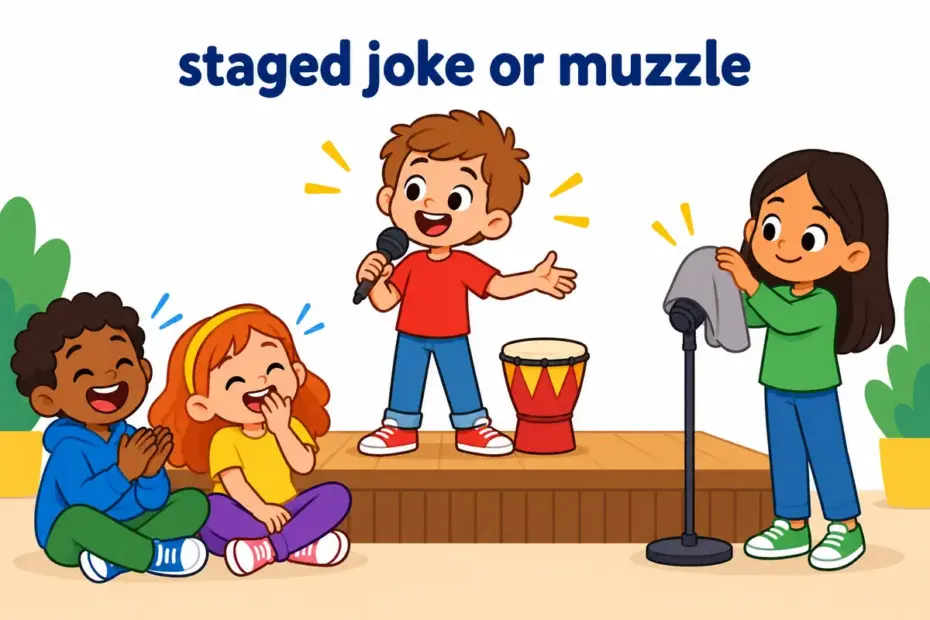
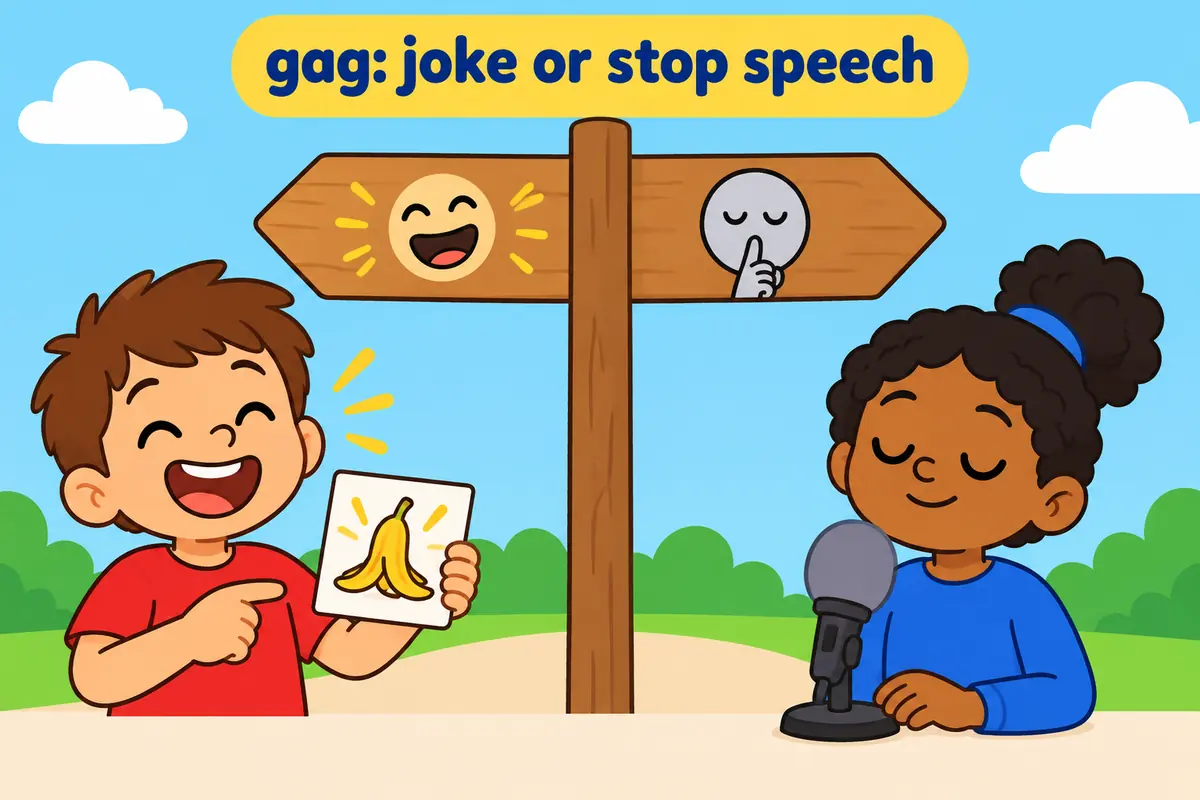
Gag means either a staged joke that a performer uses, or a device or rule that stops someone from speaking. To use gag in a sentence, decide which sense you need: an audience laughs at a gag, while a court imposes a gag on the press. The word is short, concrete and slightly informal in the comedy sense.
Gag at a glance
- Gag is both a noun and a verb, with the forms gags, gagged and gagging.
- As a noun it means a performed joke or a device that silences someone.
- As a verb it means to silence a person or to retch and choke.
- The dominant collocations are gag order, running gag and visual gag.
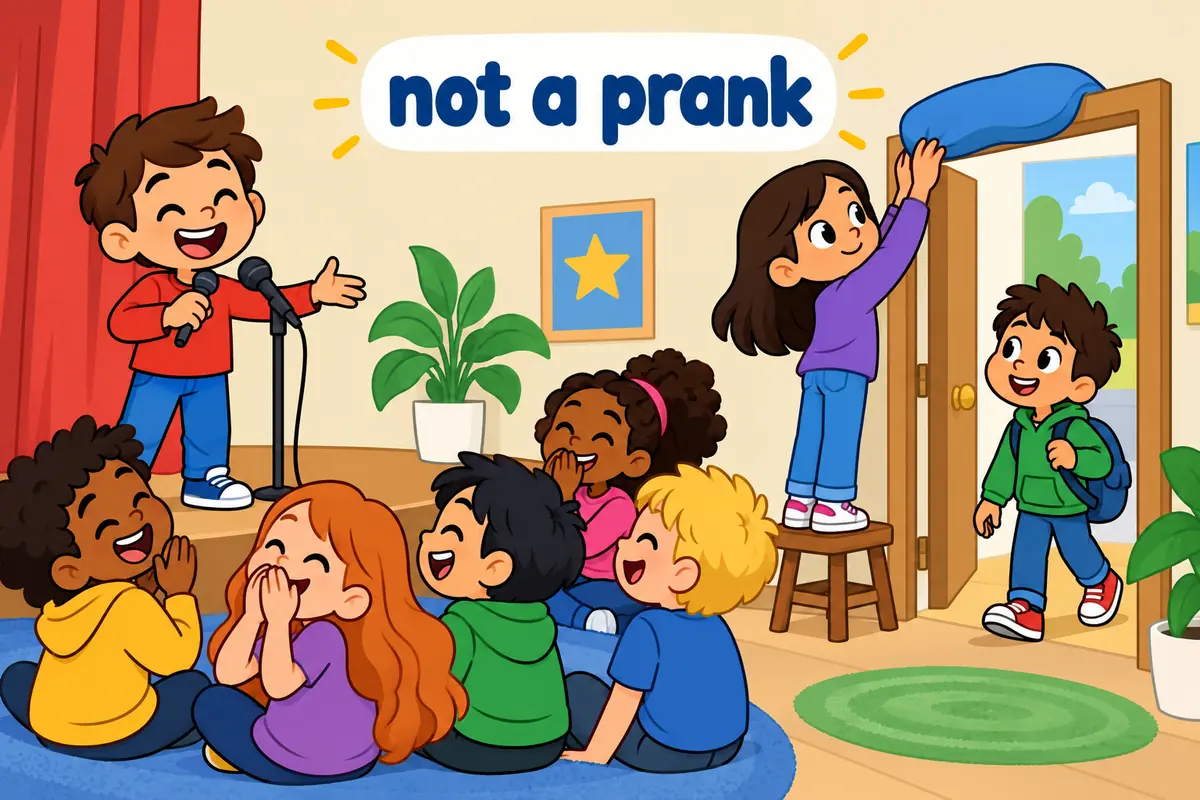
- The commonest error is treating a gag as a prank, which is a trick played on a victim.
- Gag also names a novelty item, as in a gag gift, and a comic routine in a show.
What does gag mean?
Gag is a noun and a verb whose two families of meaning are a joke and a silence. The Cambridge entry for gag lists the joke sense and the silencing sense side by side. In comedy the noun names a written or rehearsed joke, which is why performers talk about a gag rather than a spontaneous remark. In law and medicine the same shape of word names something that blocks speech, as when one side tries to muzzle the other, or the throat.
| Sense | Part of speech | Plain meaning | Example sentence |
|---|---|---|---|
| Performed joke | noun | A staged joke used by a comedian | The host opened with a safe gag about the weather. |
| Repeated joke | noun | A joke that returns through a show | The running gag about the broken lift never grew old. |
| Silencing device | noun | A cover or order that stops speech | The judge issued a gag order before the trial. |
| To silence | verb | To stop a person from speaking | New clauses gagged the staff from talking to reporters. |
| To retch | verb | To heave as if about to vomit | He gagged on the bitter medicine. |
One honest limit: gag is precise for a staged joke but weak for a clever off-the-cuff line, where quip is sharper. Because the silencing sense can sound harsh, a sentence about ordinary shyness needs a plainer word. Gag is never neutral about a person who is gagged; the verb implies force or authority. The physical sense of the verb is close to retch, the heaving reflex.
How do you use gag in a sentence?
The two senses take different frames: the joke sense takes about, while the silence and choke senses take a direct object or on.
| Pattern | Example | What it signals |
|---|---|---|
| a gag about + topic | She told a gag about the office printer. | a performed joke with a subject |
| running gag | The running gag returns in every episode. | a joke repeated across a series |
| gag order | The court imposed a gag order on both sides. | a formal ban on public speech |
| gag + object (silence) | The contract gags employees. | to stop someone from speaking |
| gag on + substance | The child gagged on a fish bone. | the throat reacting to something caught |
| be gagging for + noun | The team were gagging for a win. | informal eagerness, mainly British |
| gag reflex | The doctor tested the gag reflex first. | the automatic throat response in medicine |
Gag in a sentence: examples across contexts
| Context | Example sentence | Why this works |
|---|---|---|
| Comedy club | The comic tried a new gag on a quiet crowd. | the joke sense, with a performer as subject |
| Television review | The running gag about the broken lift carries the show. | a repeated joke is a running gag |
| Legal writing | The judge signed a gag order to protect the jury. | the formal silencing sense |
| News report | Critics said the rule gagged peaceful protesters. | the verb of silencing, used critically |
| Medicine | The patient gagged when the swab touched the throat. | the reflex sense of retching |
| Classroom | The pupil told a gag about the school bell. | an everyday, harmless joke |
| Social media | A visual gag landed before a single word was spoken. | a visual gag teaches through images rather than words |
| Workplace | Managers were accused of gagging staff over the merger. | the silencing verb in business news |
| Hospital | He gagged on the bitter syrup. | the fixed frame gag on plus substance |
| Podcast | The host recycled an old gag from the first season. | a joke reused, close to a running gag |
| Courtroom drama | The lawyer feared a gag would end the interviews. | the noun as a concrete restraint |
| Family story | Grandad told the same gag at every birthday. | the affectionate, repetitive joke sense |
Gag vs joke, jest and prank
Gag sits in a small family of humour words, and the differences are about who is laughing and how the humour is delivered.
| Word | What it names | Typical frame | Register |
|---|---|---|---|
| gag | a staged or repeated joke | a running gag, a visual gag | informal, performance and media |
| joke | anything said to amuse | tell a joke | neutral and everyday |
| jest | a joke, often literary | in jest, a mere jest | formal or old-fashioned |
| quip | a clever, short remark | a witty quip | neutral, slightly literary |
| prank | a trick played on someone | pull a prank | informal, often mischievous |
Choose gag when the humour is performed and can be repeated, joke for the ordinary word, and prank only when a real person is the target of a trick. In the silence family the differences are strength: a gag order is legal, to mute is gentler, and to muzzle someone suggests force. The jest of older prose now sounds playful rather than serious.
Word forms and grammar of gag
| Form | Part of speech | Example |
|---|---|---|
| gag | base noun or verb | Do not gag the speaker. |
| gags | third-person singular or plural noun | She gags at the smell. The gags kept coming. |
| gagged | past tense and past participle | They gagged the witness with an order. |
| gagging | present participle | He was gagging on the fumes. |
| gag order | compound noun | A gag order limited what lawyers could say. |
| running gag | compound noun | The running gag tied the episodes together. |
| gag gift | compound noun | She wrapped a novelty gag gift for the party. |
Common mistakes with gag
- Incorrect:
The friends set up a gag on their teacher.Correct: The friends set up a prank on their teacher. Rule: a trick played on a victim is a prank; a gag is a performed joke. - Incorrect:
He gagged from the bitter taste.Correct: He gagged on the bitter taste. Rule: the throat reacts on a substance, not from it. - Incorrect:
The court gave the witness a gag.Correct: The court placed the witness under a gag order. Rule: the restraining sense is normally the compound gag order. - Incorrect:
She is gagging to see the film.Correct: She is eager to see the film. Rule: be gagging for is informal and mainly British; formal writing avoids it. - Incorrect:
His gag made the crowd think for hours.Correct: His quip made the crowd think for hours. Rule: a clever remark is a quip; a gag is a performed joke. - Incorrect:
The gagged exercise protects the jury.Correct: The gag order protects the jury. Rule: use the compound noun, not the past participle, for the rule itself. - Incorrect:
He made a gag with the broken lift.Correct: He made a gag about the broken lift. Rule: the subject of a joke takes about, not with. - Incorrect:
The toddler gagged of the medicine.Correct: The toddler gagged on the medicine. Rule: the physical verb selects on for the substance.
Practice using gag
- Fill the blank: The comedian closed with a ______ about the broken microphone.
- Choose the better word: The friends played a (gag / prank) on the new pupil.
- Correct the error: He gagged from the smell of the paint.
- Build a sentence: describe a court stopping lawyers from speaking, using gag order.
- Spot the register: which fits a TV review, The running gag never gets old, or The repetitive joke bit is still funny, seriously?
- Choose the sense: in the sentence the syrup made the toddler gag, is gag a joke or a reflex?
- Rewrite with the verb: The judge stopped the reporters from publishing. Use gag.
- Fill the blank: The doctor checked the patient’s ______ reflex.
Answers
- gag: a performed joke is the natural fit here.
- prank: the humour is aimed at a real victim, so prank is correct.
- He gagged on the smell of the paint: the throat reacts on a substance.
- Model answer: The judge issued a gag order that barred the lawyers from speaking to the press.
- The running gag never gets old: a review uses the fixed collocation running gag.
- a reflex: the toddler is retching, not telling a joke.
- The judge gagged the reporters: the verb carries the silencing sense.
- gag reflex: the medical collocation is fixed and keeps the word before reflex.
The bottom line
Gag in a sentence works in two directions: as a staged or repeated joke, and as a device or verb of silence. The sense is clear from the frame, since a gag about a topic is a joke while a gag order is a restraint that produces silence, and the verb gag often means to retch. Keep prank for tricks played on people, and reach for quip when the humour is a quick, clever remark.
Frequently asked questions about gag
What does gag mean in comedy?
In comedy a gag is a written or rehearsed joke, the kind a performer can repeat night after night. A running gag is the same joke brought back through a show, and a visual gag works through images rather than words. Because a gag is constructed, it differs from a spontaneous quip, which is invented on the spot.
Is a gag the same as a prank?
No. A gag is a joke performed for an audience, while a prank is a trick played on an unsuspecting person. The audience laughs with a gag and at the victim of a prank, which is why a prank can cause hurt. Keep the two apart whenever real people are involved.
What is a gag order?
A gag order is a formal instruction, usually from a court, that forbids certain people from speaking publicly about a case. Lawyers, witnesses or journalists may be covered by it. The compound noun gag order is the standard term, and the verb form appears as the judge gagged the parties.
Can gag be a verb meaning to choke?
Yes. The verb gag means to retch or heave, usually because something is caught in the throat or a smell is overpowering. It takes on, as in she gagged on the fumes. This physical sense is separate from the silencing sense, where gag takes a direct object such as the witnesses.