Zealous vs jealous is the difference between eager devotion and uneasy envy: choose zealous for someone who works hard for a cause, and choose jealous for someone who resents what another person has. The two words look alike and sound alike, but one praises energy and the other names a discomfort.
Zealous and jealous at a glance
- Zealous means full of energetic devotion to a cause, and it is an adjective.
- Jealous means envious of another person, or anxiously protective of what one has.
- Zealous takes about or in to name the cause; jealous almost always takes of.
- The adverb of zealous is zealously, and its noun is zeal.
- The adverb of jealous is jealously, and its noun is jealousy.
- The commonest error is using jealous when the sentence means keen, which needs zealous.
What do zealous and jealous mean?
Zealous is an adjective meaning energetically devoted to a cause or goal, and jealous is an adjective meaning envious of another person or anxious about losing an advantage. The Cambridge entry for zealous centres on eager commitment, while the Cambridge entry for jealous centres on envy and suspicion. The dedicated pages on zealous and on jealous show how each behaves in real sentences.
| Word | Sense | Example sentence |
|---|---|---|
| zealous | energetically devoted to a cause | A zealous campaigner knocked on every door. |
| zealous | overkeen, to the point of criticism | The zealous guard checked every bag twice. |
| jealous | envious of another person | He was jealous of his brother’s promotion. |
| jealous | anxiously protective of a relationship | A jealous partner read every message twice. |
One honest limit: neither word is a soft stand-in for keen. Zealous is too strong for a mild preference, and jealous always carries an edge of unease, so a sentence about simply enjoying a hobby needs enthusiastic instead. Zealous can also slide into criticism when the devotion becomes overbearing, a risk that jealous shares in a different way.
Zealous vs jealous: the decisive differences
The master table compares the two words on the criteria that decide a sentence, and the direction of feeling is the row that settles most cases.
| Criterion | zealous | jealous |
|---|---|---|
| Core meaning | energetically devoted to a cause | envious or anxiously protective |
| Direction of feeling | toward a goal or cause | toward another person’s advantage |
| Typical subject | a campaigner, a reformer, an effort | a partner, a rival, a sibling, a reaction |
| Usual connotation | admiring, sometimes overkeen | negative and uneasy |
| Opposite quality | indifferent or apathetic | trusting and content |
| Common frame | zealous about recycling | jealous of a colleague |
| Adverb and noun | zealously and zeal | jealously and jealousy |
| Trap | never means envious | never means keen |
The quick test is to ask who or what the feeling points at. A feeling aimed at a task, a club or a cause is zealous; a feeling aimed at a person who has something is jealous. Close synonyms shade along the same line: envious focuses narrowly on wanting another’s good fortune, which is the core of jealous.
How do you use zealous and jealous in a sentence?
Both words are adjectives that work before a noun and after the verb be, but their prepositions differ, and the preposition is the safest guide.
| Pattern | Example | What it signals |
|---|---|---|
| zealous + noun | A zealous volunteer tidied the whole hall. | active devotion attached to a person |
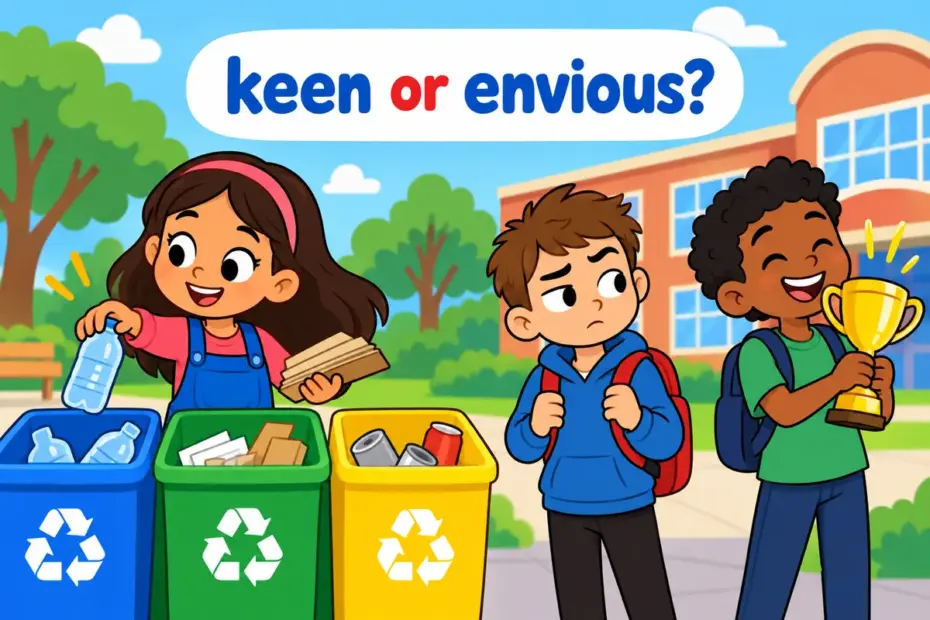
| be zealous about + noun | She is zealous about recycling. | an everyday cause that draws the energy |
| be zealous in + gerund | He is zealous in defending the club. | the activity the devotion is poured into |
| jealous of + person | He was jealous of his brother’s success. | envy aimed at another person |
| jealous + noun | A jealous partner read every message. | protective suspicion inside a relationship |
| be jealous that + clause | She was jealous that he won the prize. | envy of a finished event |
| jealously + verb | He jealously guarded the recipe. | the adverb carrying guarded vigilance |
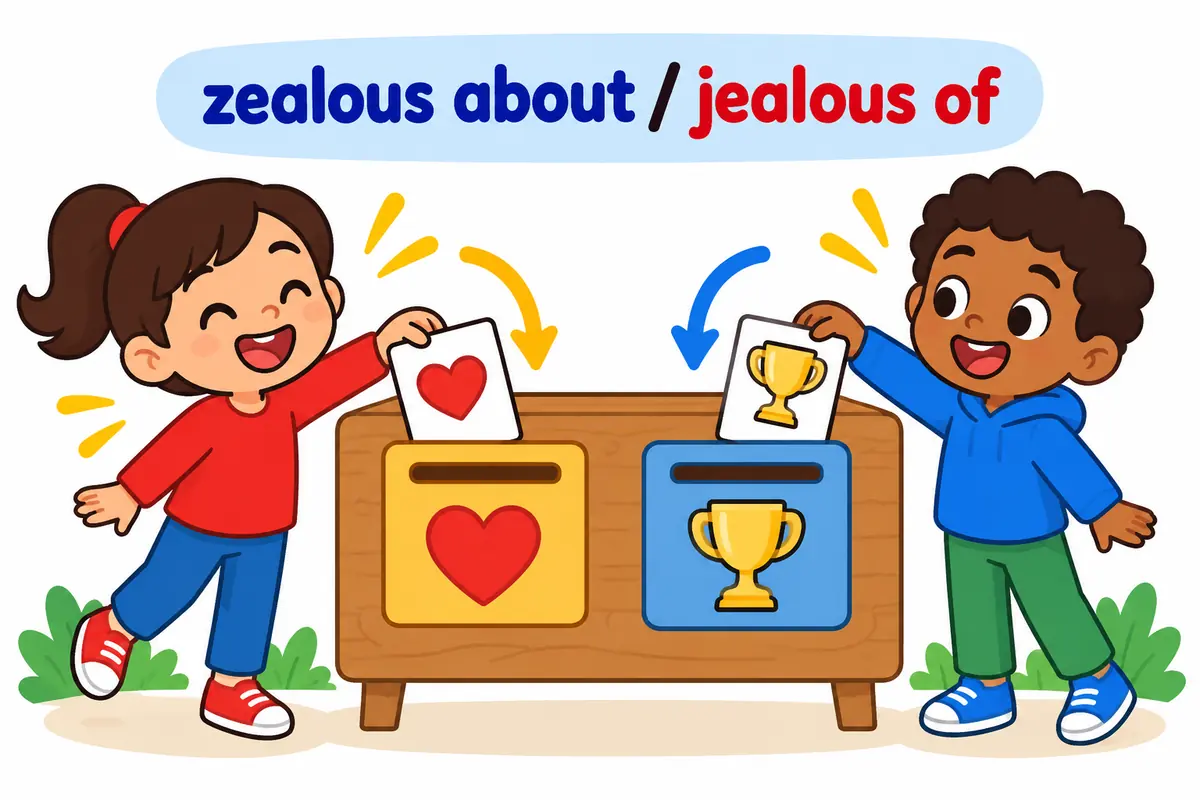
Zealous and jealous in a sentence: examples across contexts
| Context | Example sentence | Why this works |
|---|---|---|
| Classroom | Our zealous book monitor shelved the returns before the bell. | the effort, not a feeling about a person, earns the praise |
| Workplace email | Thanks to a zealous reviewer, the report caught three errors. | names the energy that produced a result |
| News report | Zealous inspectors closed the site after one visit. | the faint hint of excess suits a critical report |
| Advocacy writing | Campaigners remained zealous in pursuit of the ban. | the in-pattern names the cause they act for |
| Personal writing | He was jealous of a classmate’s new bicycle. | envy aimed at a specific person and thing |
| Relationship advice | A jealous partner can mistake a late shift for betrayal. | protective suspicion inside a close bond |
| Sports writing | Rivals grew jealous of the club’s sudden success. | collective envy of another team’s fortune |
| Academic writing | The author makes a zealous case for open data. | a deeply energetic conviction argued in prose |
| Conversation | She is zealous about the choir but never mentions the members. | the cause, not a person, receives the energy |
| Opinion piece | The party’s most zealous members demanded a vote. | group energy, mildly critical in tone |
| Family writing | The older child was jealous of the new baby’s attention. | envy of a rival for affection |
| Diary | I felt a jealous pang when my friend moved away first. | an inward, uneasy feeling about a person |
Which should you use?
Map the sentence to a situation, then follow the recommendation without hesitation.
| Your situation | Use | Why |
|---|---|---|
| Describing someone who works hard for a cause | zealous | the sentence will go on to describe effort |
| Describing envy of a friend’s success | jealous | the feeling points at another person |
| Praising energy in a volunteer | zealous | admiring devotion to a shared goal |
| Writing about suspicion in a relationship | jealous | protective unease is the whole subject |
| Writing about a mild everyday hobby | neither; use enthusiastic | both words are too strong for small pleasures |
Word forms and grammar of zealous and jealous
Zealous gives the noun zeal and the adverb zealously, while jealous gives the noun jealousy and the adverb jealously. The two nouns behave differently: zeal is usually positive heat, and jealousy is almost always a burden.
| Form | Part of speech | Example |
|---|---|---|
| zealous | adjective | A zealous advocate wrote to every member. |
| zealously | adverb | She zealously guarded the minutes. |
| zeal | noun | His zeal for the project never faded. |
| jealous | adjective | A jealous rival spread a rumour. |
| jealously | adverb | He jealously watched the counter. |
| jealousy | noun | The jealousy faded once they talked. |
| unenvious | adjective, rare | She stayed unenvious of the winner. |
Common mistakes with zealous and jealous
- Incorrect:
He is jealous about the charity and works all weekend.Correct: He is zealous about the charity and works all weekend. Rule: jealous means envious; zealous means devoted to a cause. - Incorrect:
He is zealous of his brother’s success.Correct: He is jealous of his brother’s success. Rule: envy takes jealous, never the sound-alike zealous. - Incorrect:
She felt zealous that he won the prize.Correct: She felt jealous that he won the prize. Rule: a that-clause about another person’s win describes envy. - Incorrect:
The team was jealous in knocking on doors.Correct: The team was zealous in knocking on doors. Rule: a clause about effort fits zealous; keep jealous for resentment. - Incorrect:
I am zealous about pizza.Correct: I am enthusiastic about pizza. Rule: zealous is reserved for causes, not trivial preferences. - Incorrect:
A zealous partner read every message.Correct: A jealous partner read every message. Rule: suspicion in a relationship is jealousy, not keen devotion. - Incorrect:
He was jealous about winning the race.Correct: He was zealous about winning the race. Rule: when the object is a goal rather than a person, choose zealous. - Incorrect:
They are jealous of the project and work late.Correct: They are zealous about the project and work late. Rule: effort for a project is devotion, not envy.
Practice using zealous and jealous
- Fill the gap: The ______ volunteers cleared the whole beach by noon.
- Choose the better word: He was (zealous / jealous) of his cousin’s new bike.
- Correct the error: She is jealous about her garden and tends it daily.
- Build a sentence: use jealous about a classmate and an award, naming the envious feeling.
- Spot the register: which fits a news report, The zealous inspector rejected the plan, or The inspector was well zealous and said no?
- Rewrite with the noun: The neighbours resented the winner. Use jealousy.
- Choose the preposition: should you write zealous for a cause or zealous about it? Explain in one line.
- Rewrite with the adverb: The guard protects the recipe closely. Use jealously.
Answers
- zealous: the sentence describes energy for a task, which is where zealous belongs.
- jealous: envy of a person’s possession calls for jealous.
- She is zealous about her garden and tends it daily: the cause, not envy, is the subject.
- Model answer: The boy was jealous of his classmate’s award, though he said nothing.
- The zealous inspector rejected the plan: a news report avoids the vague intensifier well.
- The neighbours felt jealousy towards the winner: the noun names the uneasy feeling.
- Both work, but zealous for is older and slightly more formal, while zealous about is safer in everyday prose.
- The guard jealously protects the recipe: the adverb carries guarded vigilance.
The bottom line
Choose zealous for energetic devotion to a cause and jealous for envy or protective unease about a person, then check that the preposition matches the choice. The two nuances that decide most sentences are the direction of the feeling and the strength of the word. Where the feeling is warm but modest, enthusiastic is the safer, plainer choice; where the devotion is quiet and religious, devout is closer still.
Frequently asked questions about zealous vs jealous
Is zealous always a compliment?
Usually, but not always. A zealous volunteer earns praise for relentless effort, yet the same word can criticise an official whose energy overruns good judgement. The context and the noun after zealous decide the tone. Jealous has no such positive side, because envy and suspicion read as faults in nearly every sentence.
What is the difference between jealous and envious?
Envious means wanting something another person has, such as a prize or a talent. Jealous is broader: it can mean the same envy, and it can also mean fear of losing someone’s affection, as in a jealous partner. Choose envious for a clean wish to have, and jealous when a relationship or a possession feels under threat.
Can jealous ever mean protective rather than envious?
Yes. Jealous can describe guarding what one already has, as in a nation jealous of its independence or a writer jealous of her privacy. That sense still carries vigilance rather than desire, so it stays distinct from zealous. The protective use is formal and slightly old-fashioned, and it rarely appears in casual speech.
How do you pronounce zealous and jealous?
Zealous is pronounced ZEL-uhs, with a short first syllable, and its noun zeal rhymes with feel. Jealous is pronounced JEL-uhs, with the same rhythm but a j sound at the start. The words are near-homophones except for that first sound, which is exactly why writers confuse them.