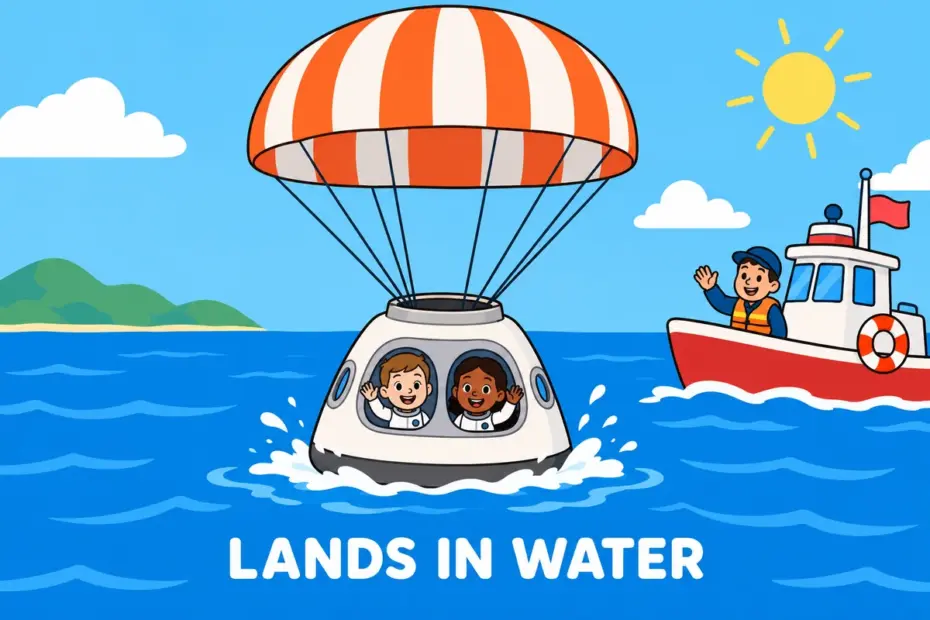
Splash down means to land in water, most often when a spacecraft or capsule returns to Earth in the ocean. To use splash down in a sentence, make the craft the subject and keep the particle fixed: “The capsule splashed down in the Pacific.” The verb is intransitive and never takes a direct object.
Splash down at a glance
- Splash down is an intransitive phrasal verb; the craft that lands in water is the subject.
- The particle down stays fixed and does not move around an object.
- The one-word noun is splashdown, written without a space.
- It applies to spacecraft, whales, divers and anything landing heavily in water.
- The commonest error is writing it as one word when it is a verb.
What does splash down mean?
Splash down is a phrasal verb meaning to land in water, especially when a spacecraft returns to Earth at sea. The Cambridge entry for splash down records the spacecraft landing and the related noun. The word is built from splash and the particle down, and the launch that precedes it is covered by launch. Because the sea cushions the impact, the word carries a gentler tone than crash, which is why mission updates prefer it when the crew is safe.
| Sense | Plain meaning | Example sentence |
|---|---|---|
| Spacecraft landing | A capsule returns to Earth in the sea | The module splashed down at dawn. |
| Water landing | Any person or thing lands heavily in water | The seal splashed down off the rocks. |
| Noun form | The event of such a landing | The splashdown was shown live. |
How do you use splash down in a sentence?
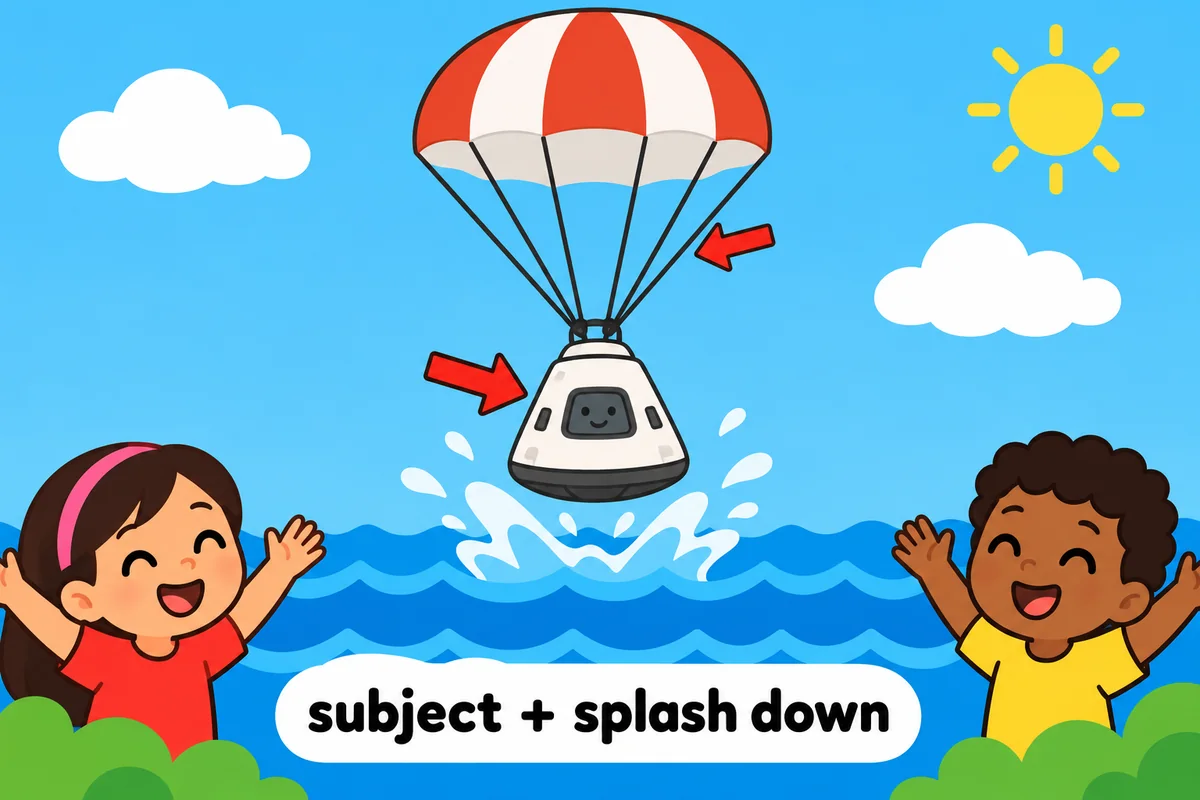
The verb is intransitive, so the thing that lands is the subject and no object follows. The particle down stays fixed, which means there is no splash the capsule down form. A general water landing can also be described with submerge when the object sinks below the surface, though that verb does not imply a landing. The tense comes from the auxiliary, so will splash down marks a plan and has splashed down marks a finished event.
| Pattern | Example | What it signals |
|---|---|---|
| subject + splash down | The capsule splashed down safely. | the water landing itself |
| splash down + in/off + place | They splashed down off the coast. | where the landing happens |
| splashdown (noun) | The splashdown drew a huge crowd. | the event as a thing |
| will / has + splash down | The crew will splash down tomorrow. | a planned or completed landing |
| splash down + and + verb | It splashed down and drifted. | a landing followed by another action |
Splash down in a sentence: examples across contexts
| Context | Example sentence | Why this works |
|---|---|---|
| News report | The capsule splashed down in the Pacific after a nine-hour flight. | The space sense leads the story. |
| Science writing | Parachutes slow the module before it splashes down. | A formal article explains the sequence. |
| Mission update | The crew is expected to splash down just before sunset. | A planned landing uses the future. |
| Nature documentary | A humpback splashed down and sent spray across the bay. | The animal sense fits descriptive prose. |
| Sports report | The diver splashed down almost without a ripple. | A clean entry borrows the water-landing image. |
| Children’s story | The little boat splashed down beside the jetty and bobbed. | A concrete subject suits young readers. |
| Technical manual | The probe will splash down and release a marker buoy. | A procedure names the landing step. |
| Travel feature | Seaplanes splash down in the harbour each morning. | A routine water landing suits travel writing. |
| History book | The first crewed splashdown ended the mission. | The noun form names an event. |
| Conversation | The rocket came back and splashed down on camera. | The verb works in casual talk. |
| Engineering log | Telemetry held steady until the capsule splashed down. | A technical record marks the final event. |
| Classroom | The teacher showed how a module splashes down and floats. | An explanation joins the verb to a visible image. |
| Podcast chat | The hosts joked that the probe would splash down before lunch. | The informal sense shows the verb travels beyond mission control. |
| Safety briefing | Recovery teams rehearsed how the capsule would splash down. | A briefing uses the verb inside a conditional plan. |
Two patterns run through every context. The landing is treated as a single, completed event, which is why the past tense dominates news and history. The sea is part of the meaning, so a sentence that adds a runway or a field contradicts the verb. When the story continues after the landing, a second verb follows the particle, as in it splashed down and drifted. A time phrase then slots in freely, which is why reports so often pair the verb with at dawn or before sunset.
Splash down vs touch down
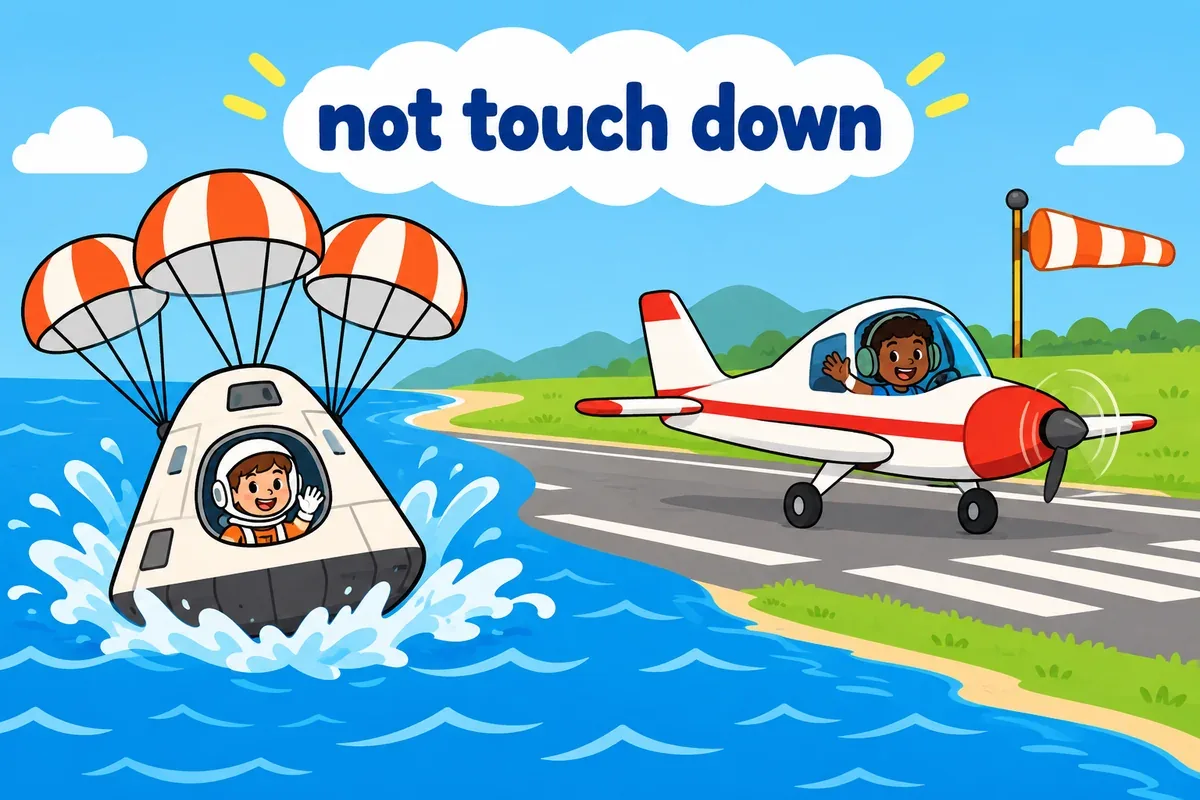
The two verbs differ by surface. Splash down means a landing in water, while touch down means a landing on solid ground, typically a runway. The nouns follow the same split: a splashdown happens at sea, and a touchdown happens on land or, in sport, beyond the goal line. Recovery also differs, because a water landing usually needs boats or helicopters.
| Attribute | Splash down | Touch down |
|---|---|---|
| Landing surface | Water, usually the sea | Land, usually a runway |
| Typical subject | Capsules, seaplanes, whales | Aircraft, birds, helicopters |
| Particle | Down, always fixed | Down, often fixed |
| Noun form | Splashdown, one word | Touchdown, one word |
| What it implies | A heavy, wet contact | A controlled contact with a surface |
| Recovery | Boats or helicopters often retrieve the crew | The aircraft taxis to a gate |
Choose splash down for water and touch down for land, and let the surface, not the fame of the mission, decide.
Word forms and grammar of splash down
The verb inflects as splashes down, splashed down and splashing down. The noun splashdown is one word, and the adjective splashy belongs to a different meaning, describing something showy. The related noun splashing names the sound or action of water, not the landing, and verbs with the same down particle, such as back down, keep the particle fixed in the same way. The hyphenated compound splash-down is uncommon and appears mainly in names for designated sea zones, so the plain verb and the one-word noun cover almost every sentence.
| Form | Part of speech | Example |
|---|---|---|
| splash down | phrasal verb, base | The capsule will splash down soon. |
| splashes down | phrasal verb, third person singular | It splashes down near Hawaii. |
| splashed down | phrasal verb, past | The module splashed down at dawn. |
| splashing down | phrasal verb, present participle | The crew is splashing down now. |
| splashdown | noun | The splashdown was a success. |
| splash-down | attributive adjective | A splash-down zone was marked on the chart. |
| splashy | adjective, different sense | The splashy finale filled the tabloids. |
| splash downed | non-standard past | Do not write this; use splashed down. |
Common mistakes with splash down
Writing the verb as one word. Incorrect: The capsule splashdown at dawn. Correct: The capsule splashed down at dawn. Rule: the verb is two words, and splashdown is only the noun.
Making the verb transitive. Incorrect: The team splashed down the capsule. Correct: The capsule splashed down. Rule: splash down is intransitive and takes no object.
Using it for a land landing. Incorrect: The plane splashed down on the runway. Correct: The plane touched down on the runway. Rule: splash down means landing in water.
Wrong past form. Incorrect: The module splash downed safely. Correct: The module splashed down safely. Rule: add -ed to splash and keep down unchanged.
Using the noun for the act. Incorrect: The crew will splashdown tomorrow. Correct: The crew will splash down tomorrow. Rule: use the verb in a sentence with a subject and tense.
Choosing crash for a safe landing. Incorrect: The capsule crashed into the sea. Correct: The capsule splashed down in the sea. Rule: crash implies damage, while splash down simply marks a water landing.
Practice using splash down
- The capsule will ____ in the Atlantic at noon.
- Choose better: The plane ____ on the runway. (splashed down / touched down)
- Correct the error: The crew will splashdown before sunset.
- Write a sentence about a seaplane arriving, using splash down.
- Which word is the noun: splash down or splashdown?
- Complete the sentence: The seal ____ off the rocks and vanished.
- Correct the error: The rocket splashed down on the landing pad.
- Write a sentence with splash down and the time of day.
Answers
- splash down — the base form follows the modal will.
- touched down — a runway is land, so the water verb does not fit.
- The crew will splash down before sunset — the verb is two words.
- The seaplane splashed down in the harbour — the craft is the subject and no object follows.
- splashdown — the one-word form is the noun.
- splashed down — the past tense marks a completed landing.
- The rocket touched down on the landing pad — splash down needs water, not concrete.
- The capsule splashed down at sunrise — the subject lands and the time is added freely.
The bottom line
Splash down in a sentence describes a landing in water, and the craft that lands is always the subject. Keep the particle fixed, keep the verb in two words, and reserve the one-word splashdown for the noun. Because the sea softens the impact, the verb suits a safe return and should not be swapped for crash. If the surface is land rather than water, touch down is the correct choice.
Frequently asked questions about splash down
Is splash down one word or two?
The verb is two words, as in the capsule splashed down. The noun is one word, as in the splashdown was broadcast live. Keeping the two forms apart is the single most useful habit for writing the term correctly. A simple memory aid is that the action needs a space and the event does not.
Does splash down need an object?
No. Splash down is intransitive, so the thing that lands is the subject and no object follows. A sentence such as the team splashed down the capsule is not standard, because the verb cannot take a direct object. If an object is needed, rewrite the sentence so the capsule becomes the subject.
Can splash down describe animals?
Yes. Whales, seals and divers can splash down when they return to the water and send up spray. The verb suits any heavy entry into water, though it appears most often in reports about spacecraft returning to Earth. Seaplanes, too, splash down when they land on a harbour or a lake.
What is the past tense of splash down?
The past tense is splashed down, as in the module splashed down at dawn. The third person singular is splashes down and the present participle is splashing down. Non-standard forms such as splash downed never appear in edited writing, so use splashed down for every completed landing.