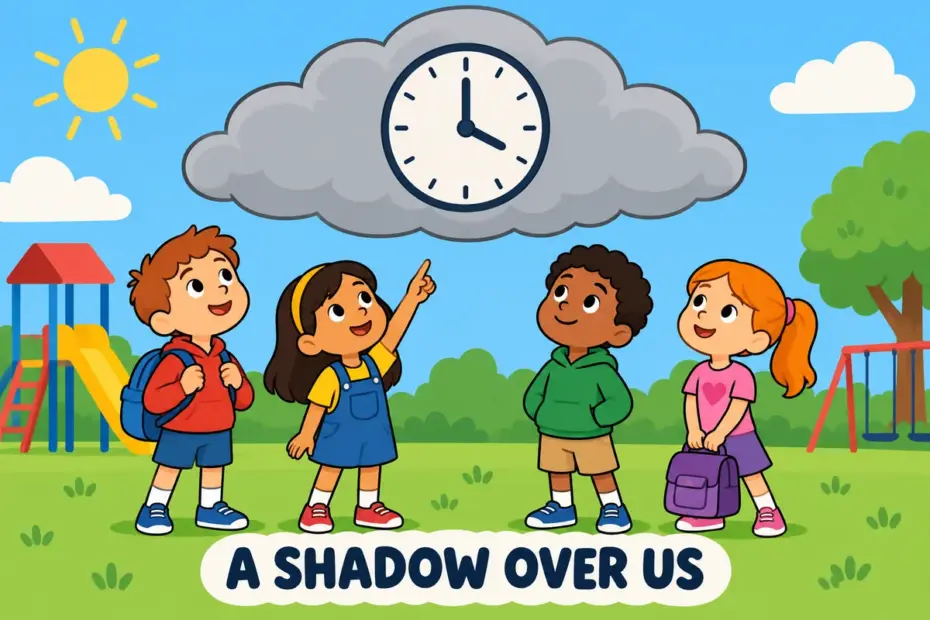
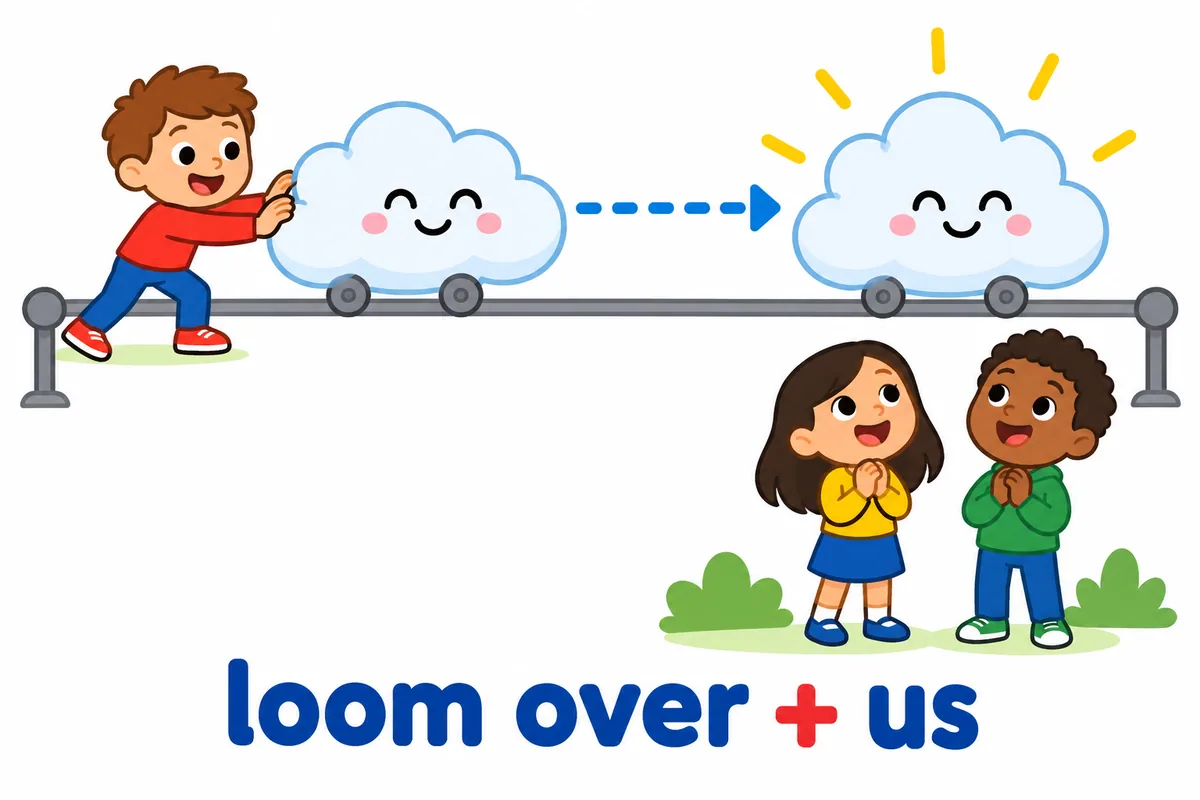
Loom over means to stand above someone as a threat or to seem about to happen in a worrying way. To use loom over in a sentence, put the danger or obligation first and the person after over: “A tight deadline loomed over the whole team.” The phrase is inseparable, so the two words always stay together.
Loom over at a glance
- Loom over is an inseparable phrasal verb, so the object always follows over.
- Its forms are loom, looms, loomed and looming.
- The usual subjects are deadlines, doubts, dangers, debts and defeats.
- The literal sense describes something physically large standing above something smaller.
- The commonest error is splitting the phrase, as in loom it over.
What does loom over mean?
Loom over is a phrasal verb meaning to appear as a large, threatening presence, whether a physical mass or an approaching problem. The Cambridge entry for loom over records both the physical sense of towering above and the figurative sense of a worrying possibility. Context decides which one a reader pictures: a mountain or a building belongs to the literal sense, while a deadline, a doubt or a defeat belongs to the figurative one.
| Sense | Plain meaning | Example sentence |
|---|---|---|
| Threaten to happen | Seem close and unwelcome | A second test loomed over the week. |
| Stand physically above | Tower over something smaller | The cliff looms over the harbour. |
| Cast doubt on something | Make an outcome feel uncertain | A question mark loomed over the plan. |
Loom over is the wrong choice for a mild worry. A small task that can wait does not loom; it merely sits on a list. The phrase carries size and threat, so it suits a danger that is close or unavoidable, and it never promises that the bad thing will actually happen. A genuine hazard can threaten a project, while a menace is the threatening thing itself.
Loom over belongs to formal and journalistic writing as much as to conversation, which is why it turns up in headlines about debt, weather and elections. A reader meets it most often in the past tense, describing pressure that has already passed, or in the continuous form, describing a threat that is still on its way.
How do you use loom over in a sentence?
Loom over never splits and never takes a second object, so the danger stays before the verb and the affected person or place follows over. Adding large turns the phrase into an idiom about importance. A literal scene usually needs a landmark as its subject, while a figurative scene needs a noun such as deadline, doubt or debt.
| Pattern | Example | What it signals |
|---|---|---|
| threat + loom over + person | The exam loomed over the class. | The danger sits above a group’s plans. |
| doubt + loom over + thing | A cloud of doubt loomed over the deal. | An outcome feels uncertain. |
| be looming over | Big changes are looming over the firm. | The continuous form stresses nearness. |
| loom over + place, literal | The tower looms over the square. | Describes size in a physical scene. |
| loom large over | The election loomed large over the talks. | Marks something as dominant in importance. |
Loom over in a sentence: examples across contexts
Loom over holds its outward shape everywhere, but the sentences around it shift from a child’s worry to a market report. Each example below names what is approaching and who feels the pressure.
| Context | Example sentence | Why this works |
|---|---|---|
| Classroom | The spelling test loomed over the class all morning. | A school event supplies the threat. |
| Workplace email | A funding decision looms over the project. | The subject is an official process. |
| Conversation | The dentist appointment loomed over my whole weekend. | The first person makes it personal. |
| News report | A trade dispute looms over the talks in Brussels. | A city name grounds the report. |
| Financial writing | Rising interest rates loom over small businesses. | A market force acts as the danger. |
| Academic writing | The possibility of bias loomed over the whole study. | Names an abstract doubt. |
| Sports report | Relegation loomed over the club for months. | A single noun sums up the threat. |
| Travel writing | Snow-capped peaks loom over the quiet valley. | Uses the literal sense of height. |
| Diary | A difficult phone call loomed over me all day. | Small scale, real emotion. |
| Legal summary | An appeal loomed over the ruling for a year. | A formal, dated process. |
| Project planning | Let the review date hang over the team only briefly. | Uses hang as a close cousin of loom. |
| Storytelling | A storm loomed over the village as the lanterns were lit. | Builds atmosphere before the action. |
The last four rows place the phrase in extended writing, where it usually sets a mood before a turn in the plot or the argument. In a headline the same phrase compresses a whole story of pressure. The phrase rarely appears in the middle of a plain instruction, because it works best when a sentence wants to convey mood as well as fact.
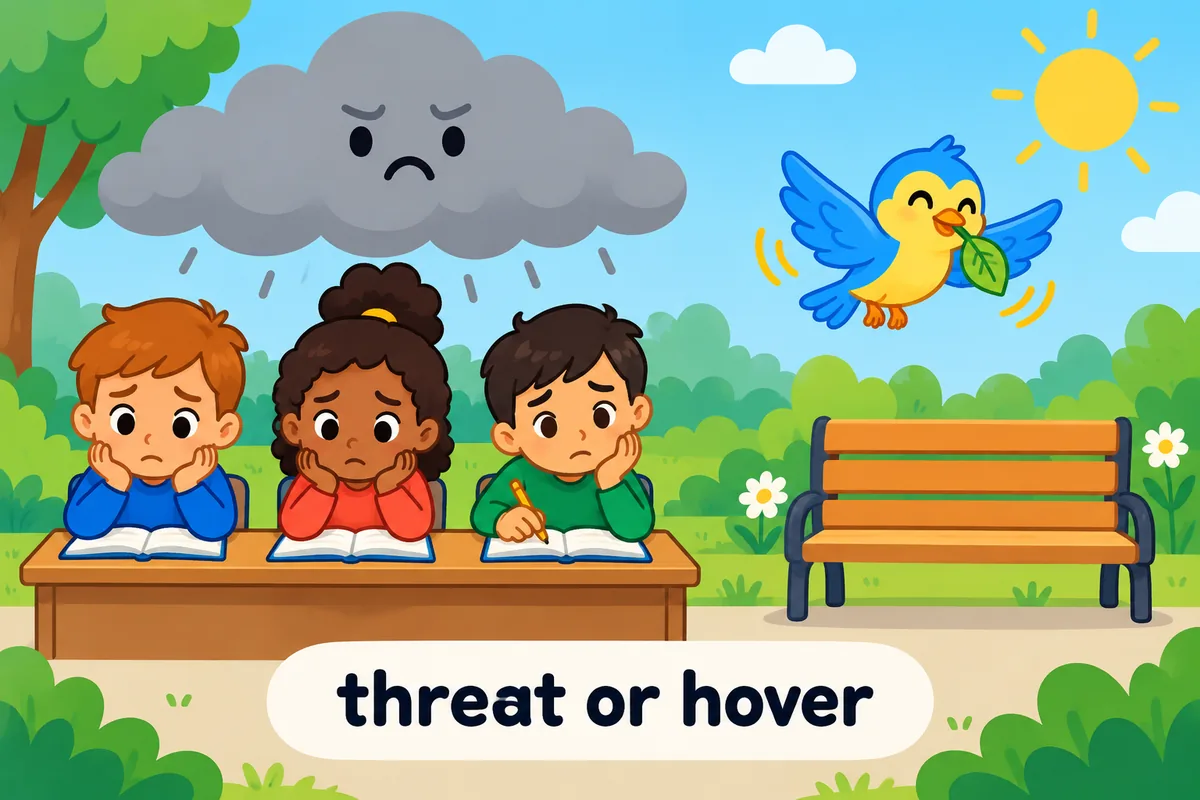
Loom over vs hover, overshadow and dwarf
Loom over shares a sense of closeness with three other verbs, and the differences decide which one a sentence needs.
| Attribute | loom over | hover | overshadow | dwarf |
|---|---|---|---|---|
| Core meaning | Threaten from above or ahead | Stay close, often waiting | Make something look smaller or less important | Make something look tiny by comparison |
| Threat implied | Strong | Mild or neutral | Moderate, about importance | None, about size or scale |
| Typical subject | A deadline, danger or debt | A person, bird or value | A rival, success or memory | A building, mountain or record |
| Literal use | Towers above a place | Floats in the air | Rarely literal | Common and visual |
| What it implies | Pressure that will soon arrive | Uncertainty that lingers | The thing still stands but looks smaller | Pure difference in scale |
Choose loom over for a threat with a deadline, hover for a presence that stays nearby without menace, overshadow when success or reputation is at stake, and dwarf when the only point is size. The four verbs can describe the same view, yet only loom over adds the sense that something unwelcome is on its way.
Word forms and grammar of loom over
Loom over follows the regular verb loom, and the same word has an unrelated noun sense.
| Form | Part of speech | Example |
|---|---|---|
| loom over | phrasal verb, base form | Debts can loom over a household. |
| looms over | phrasal verb, third person singular | A deadline looms over the desk. |
| loomed over | phrasal verb, past and past participle | A doubt loomed over the vote. |
| looming over | phrasal verb, present participle | With winter looming over the farm, they stocked up. |
| looming | adjective | A looming shortage worried the buyers. |
| loom | noun, unrelated | The loom stood silent in the empty mill. |
The noun loom names a weaving machine and has nothing to do with threat, so the two uses never overlap in a sentence once the particle over is present. The same particle also appears in chew over, which means to think something through rather than to threaten. In the continuous form, looming over is the most common way to describe a threat that has not yet arrived.
Common mistakes with loom over
- Incorrect:
The deadline loomed it over us.Correct: The deadline loomed over us. Rule: the phase is inseparable, so over stays before the object. - Incorrect:
She loomed over about the test.Correct: The test loomed over her. Rule: the person is the object of over, not of about. - Incorrect:
The small errand loomed over me.Correct: The small errand was on my mind. Rule: loom over needs a threat with size or nearness. - Incorrect:
It loomed over that we might lose.Correct: The risk of losing loomed over us. Rule: the subject is a noun phrase, not a that-clause. - Incorrect:
The mountain hovered over the valley.Correct: The mountain loomed over the valley. Rule: loom over signals size and threat; hover does not.
Practice using loom over
Work through the seven items, then read the reason beside each answer.
- Fill the gap: A difficult match ______ the team all week.
- Choose the better word: A dark cloud (loomed / hovered) over the picnic.
- Correct the error: The audit loomed it over the manager.
- Build a sentence: use loom over about an exam that worries a student.
- Spot the register: which belongs in a market report — the debt looms over the firm, or the debt is hanging over the firm big time?
- Rewrite in the past: The deadline is looming over the office. Use loomed.
- Choose the sense: is the sentence the cliff looms over the bay literal or figurative?
Answers
- loomed — a hard match is a threatening event that stays close.
- loomed — the cloud carries a threat of rain, not a neutral presence.
- The audit loomed over the manager — the phrase never splits.
- Model answer: The final exam loomed over Priya for a fortnight.
- The debt looms over the firm — a report keeps the formal phrase and drops big time.
- The deadline loomed over the office — the past tense keeps the same word order.
- Literal — a cliff physically standing above the bay uses the height sense.
The bottom line
Use loom over in a sentence when a danger, duty or doubt feels close and large, and keep the two words together because the phrase never splits. The two points that decide most sentences are that the threatening thing is the subject while the worried person follows over, and that the verb can describe a physical height as easily as a mounting worry. In a headline, the same phrase can replace a whole clause about pressure.
Frequently asked questions about loom over
Is loom over a phrasal verb?
Yes. Loom over is an inseparable phrasal verb, so the object always follows the particle over. You write the deadline loomed over us, never the deadline loomed us over. Because the two words stay together, learners only need to place the affected person at the end of the phrase.
What is the difference between loom and loom over?
Loom alone means to appear or approach in a vague and threatening way, and it often stands without an object, as in trouble looms. Adding over names exactly who feels the pressure, so the threat has a target. The preposition is what turns a general warning into a personal one.
Does loom over only describe bad things?
It usually does, because the phrase carries a sense of threat or pressure. A happy event such as a wedding is better described as approaching or drawing near. The rare neutral use appears in physical description, where a mountain or tower simply stands above the land without any danger at all.
Can loom over mean something will definitely happen?
No. Loom over means a bad event feels close and likely, not certain. A storm that looms over a village may pass, and a debt that looms over a firm may be settled. The word records the pressure a possibility creates, not the outcome itself, so sentences that treat it as certain are wrong.