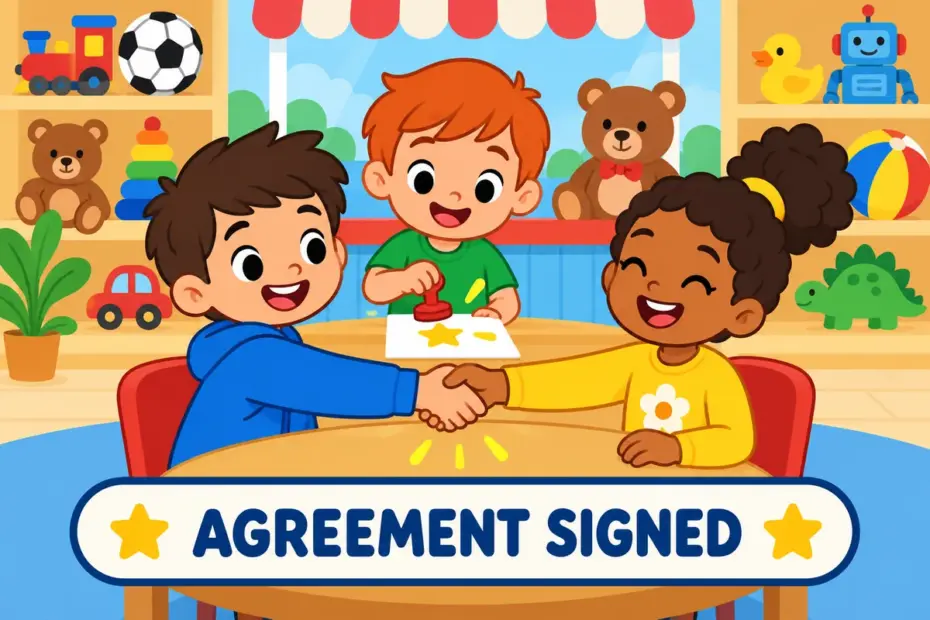
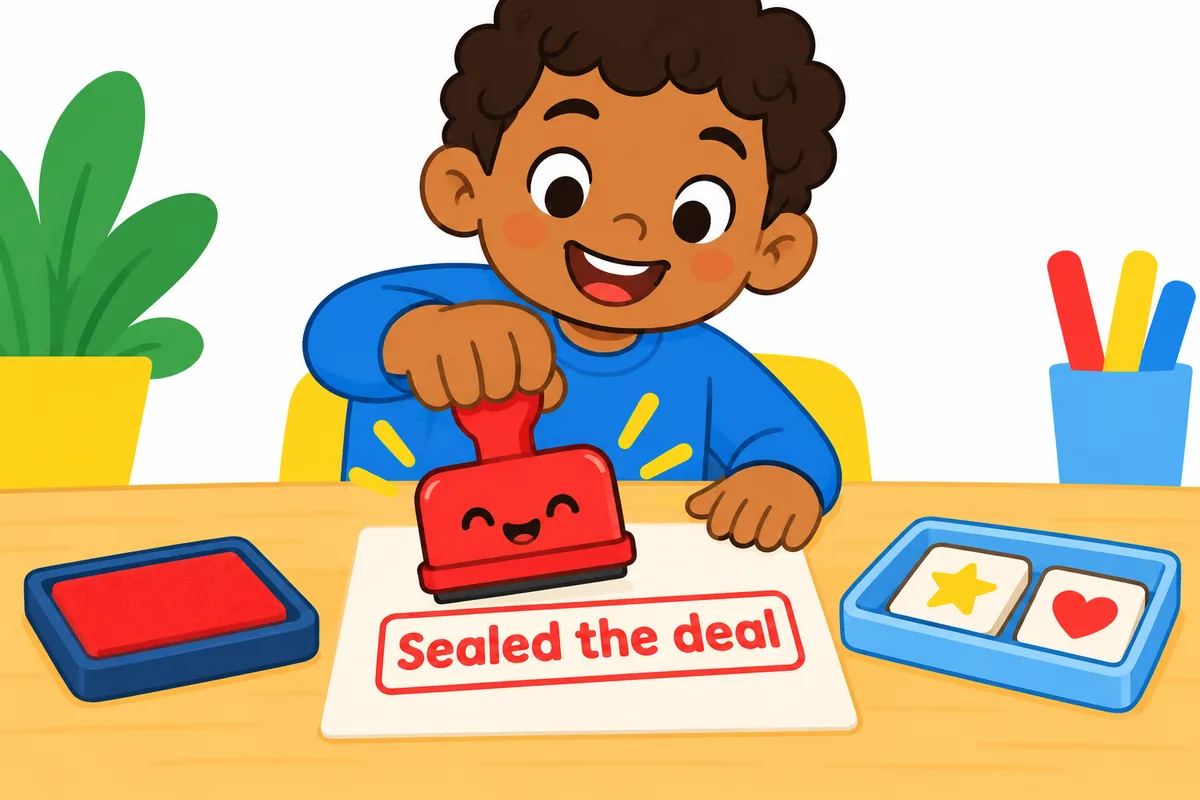
To seal the deal means to finalize an agreement or make a successful result certain, and the phrase usually marks the moment of commitment. To use seal the deal in a sentence, put the person or the offer as the subject and let the deal follow: “The extra discount sealed the deal.”
Seal the deal at a glance
- Seal the deal is a fixed phrase meaning to finalize an agreement or make success certain.
- Only the verb changes form: seals the deal, sealed the deal, sealing the deal.
- The usual subjects are an offer, a handshake, a goal or a final detail.
- The phrase belongs to business, sport and informal negotiation.
- The commonest error is dropping the article and writing seal a deal.
What does seal the deal mean?
Seal the deal is an idiom meaning to complete an agreement or to make a good outcome certain. The Cambridge entry for seal the deal records the finalize sense, and the image behind it is a stamped or signed document that cannot easily be undone. The phrase works in two registers: a literal bargain between two sides, and a figurative moment when one event decides everything.
| Sense | Plain meaning | Example sentence |
|---|---|---|
| Finalize an agreement | Complete a bargain both sides accept | The handshake sealed the deal. |
| Make success certain | Supply the event that decides the result | Her late goal sealed the deal. |
| Confirm a choice | Settle a decision that was open | The test drive sealed the deal for us. |
Seal the deal is also a business cliché, and a reader notices it after the third use in one report. It is also the wrong phrase for an ordinary promise, because it names a finished outcome rather than an intention. A deal that falls apart has been undone as quickly as it was sealed. The phrase survives because a sealed document is a concrete image that a reader pictures at once.
How do you use seal the deal in a sentence?
The phrase is fixed, so the article the never disappears and the noun deal rarely becomes plural. What changes is the subject that does the sealing and the preposition that names the terms. In the make-certain sense the subject is often an event rather than a person, as when a goal or a test seals the deal.
| Pattern | Example | What it signals |
|---|---|---|
| subject + seal the deal | The discount sealed the deal. | A single detail decides the outcome. |
| seal the deal + with + noun | They sealed the deal with a handshake. | Names the act that completes it. |
| seal the deal + on + noun | She sealed the deal on the flat. | Names the thing being agreed. |
| seal the deal for + person | The offer sealed the deal for the buyers. | Names who benefits. |
| be the thing that seals the deal | A good reference can seal the deal. | Presents a final, deciding factor. |
Seal the deal in a sentence: examples across contexts
Seal the deal moves easily between a playground swap and a boardroom summary, and the sentences below show how the surrounding words carry the register. Each example names the detail that finally decides the outcome.
| Context | Example sentence | Why this works |
|---|---|---|
| Classroom | A promise to share the crayons sealed the deal. | A small, concrete detail decides a trade. |
| Workplace email | Free delivery sealed the deal for the client. | The for phrase names the winner. |
| Conversation | The quiet street really sealed the deal for us. | Everyday speech keeps the idiom intact. |
| News report | The final clause sealed the deal between the two unions. | A formal subject suits the report. |
| Sales writing | A money-back guarantee can seal the deal with a nervous buyer. | Addresses a specific customer. |
| Sports report | A last-minute try sealed the deal for the home side. | Sport uses the make-certain sense. |
| Property | The survey report sealed the deal on the cottage. | The on phrase names the property. |
| Negotiation notes | Both sides secured the terms and sealed the deal on Friday. | A dated summary of a completed bargain. |
| Finance writing | Better terms sealed the deal for the merger. | Names the benefit that decided it. |
| Diary | One friendly phone call sealed the deal. | The first person stays natural in private writing. |
| Review | A generous warranty confirmed the quality and sealed the deal. | Pairs two near-synonyms without repeating. |
| Storytelling | The old map sealed the deal and the voyage was planned. | A single object drives the plot. |
Only the business rows need a formal tone; the same phrase sounds relaxed in conversation because the image of a stamped document is old and familiar. That familiarity is exactly why the idiom appears in both a schoolyard and a merger summary. Notice that the phrase almost always arrives near the end of the sentence, because it reports the deciding moment.
Seal the deal vs clinch, finalize and settle
Seal the deal overlaps with three verbs that also describe a finished agreement, and each one carries a slightly different weight.
| Attribute | seal the deal | clinch | finalize | settle |
|---|---|---|---|---|
| Core meaning | Complete or decide an outcome | Secure a win or an agreement | Put into final form | Resolve a dispute or a debt |
| Register | Informal to business | Journalistic and sport | Formal and official | Neutral to legal |
| Typical object | A deal or a victory | A match, contract or nomination | A contract or a plan | A bill, claim or argument |
| Emphasis | The deciding moment | The winning move | The paperwork | The end of a conflict |
| What it implies | Success is now certain | A contest has been won | Nothing more will change | Both sides accept the result |
Choose seal the deal for the moment that decides a result, clinch for a win secured under pressure, finalize for the formal last steps, and settle when a disagreement is resolved. The four words can describe one bargain, but only seal the deal carries the stamp of a finished outcome.
Word forms and grammar of seal the deal
The expression is fixed at three words, so learners need to know what may change and what may not.
| Form | Part of speech | Example |
|---|---|---|
| seal the deal | fixed phrase, base form | A warm handshake can seal the deal. |
| seals the deal | fixed phrase, third person singular | A single detail seals the deal. |
| sealed the deal | fixed phrase, past and past participle | The final goal sealed the deal. |
| sealing the deal | fixed phrase, present participle | She was sealing the deal when the call came. |
| seal the deal on + noun | extended phrase | They sealed the deal on the lease. |
| seal the deal with + noun | extended phrase | They sealed the deal with a toast. |
Only the verb seal inflects, and the noun deal can be replaced by a more specific word such as contract, agreement or victory. The article the stays fixed: seal the deal is idiomatic, while seal a deal sounds like a translation and is best avoided. A plural subject still takes the singular phrase, so both sides sealed the deal keeps deal unchanged.
Common mistakes with seal the deal
- Incorrect:
They sealed a deal after lunch.Correct: They sealed the deal after lunch. Rule: the idiom keeps the definite article the. - Incorrect:
The win sealed the deal to the team.Correct: The win sealed the deal for the team. Rule: use for, not to, to name who benefits. - Incorrect:
We sealed the deal with sign it.Correct: We sealed the deal with a signature. Rule: with is followed by a noun phrase. - Incorrect:
He sealed the deals quickly.Correct: He sealed the deal quickly. Rule: the phrase is singular and fixed. - Incorrect:
Please seal the deal the contract.Correct: Please seal the deal on the contract. Rule: a second object needs the preposition on.
Practice using seal the deal
Answer the seven items, then read the reason beside each key.
- Fill the gap: A friendly price ______ the deal for the young couple.
- Choose the better word: The last goal (sealed the deal / did the deal) for the champions.
- Correct the error: They sealed a deal on the house.
- Build a sentence: use seal the deal with about a handshake that ends a bargain.
- Spot the register: which belongs in a sales report — better terms sealed the deal, or better terms totally sealed the deal?
- Rewrite in the present: The discount sealed the deal. Use seals.
- Explain the phrase: what image does the word seal bring to mind?
Answers
- sealed — the past tense matches a completed bargain.
- sealed the deal — the fixed idiom uses the, and did the deal is not standard.
- They sealed the deal on the house — the idiom keeps the article the.
- Model answer: The two shops sealed the deal with a handshake.
- Better terms sealed the deal — a report avoids the filler word totally.
- The discount seals the deal — only the verb changes form.
- A stamped or signed document that cannot easily be opened again.
The bottom line
Use seal the deal in a sentence when one detail or act completes an agreement or makes a result certain, and keep the fixed article the in place. The two points that decide most sentences are that only the verb seal changes form, and that the phrase names a finished outcome rather than an intention. In a formal report, finalize or settle is often the plainer choice. When the outcome is still open, an offer is still on the table rather than sealed.
Frequently asked questions about seal the deal
Is seal the deal a cliché?
It can become one when a writer reaches for it again and again. In business writing, one use to mark the deciding moment is clear and natural, while several uses in the same report begin to sound hollow. A synonym such as finalize or clinch refreshes the sentence when the idiom has already appeared.
Can you say seal a deal?
It is understandable but not idiomatic. The fixed phrase keeps the definite article, so native speakers say seal the deal. Writing seal a deal sounds like a direct translation and draws attention to itself. If you need a plain verb, choose close a deal or strike a deal instead.
What is the opposite of seal the deal?
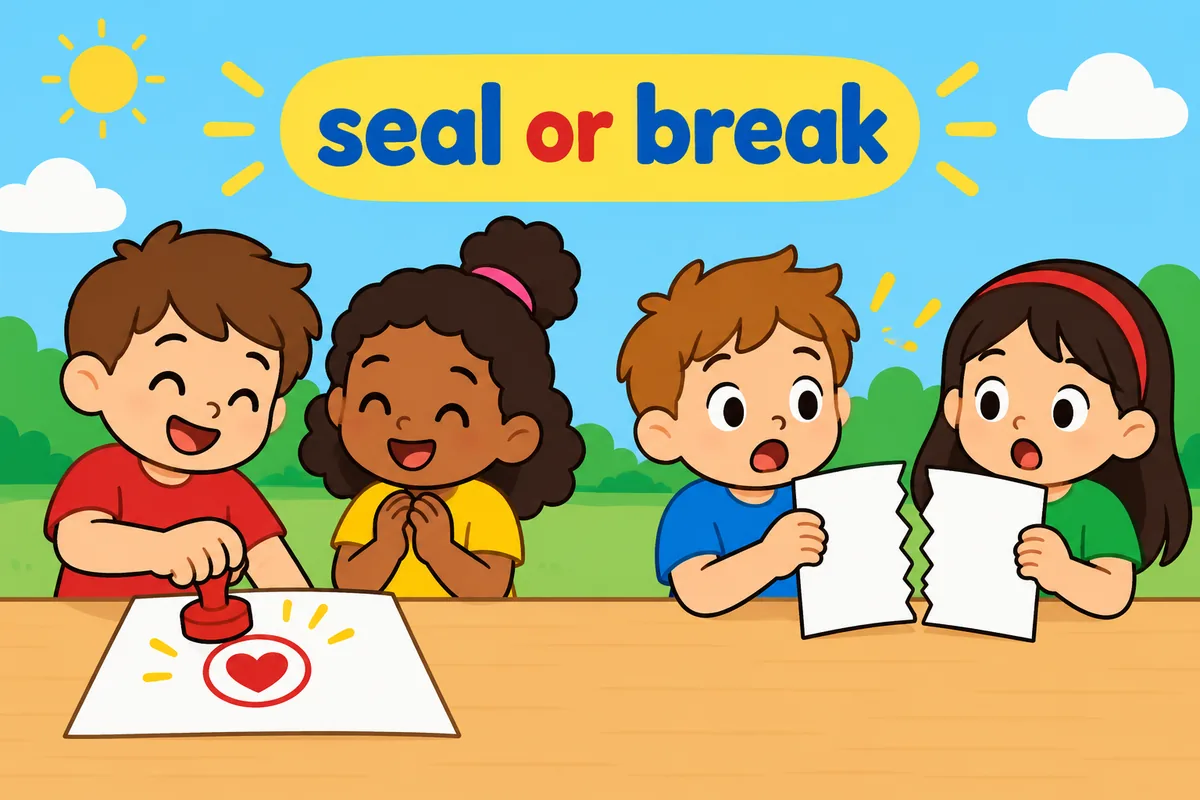
The natural opposite is break the deal or walk away from the deal. Breaking it means one side withdraws before the agreement holds, and walking away means the talks simply end. Undo is used once the deal is done, as when a signed contract is cancelled later by a court.
Does seal the deal only refer to business?
No. Sport reporters use it when a late score decides a match, and people use it in everyday decisions such as choosing a house or a car. Any event that turns an open question into a settled result can seal the deal, so the phrase travels well beyond the boardroom.